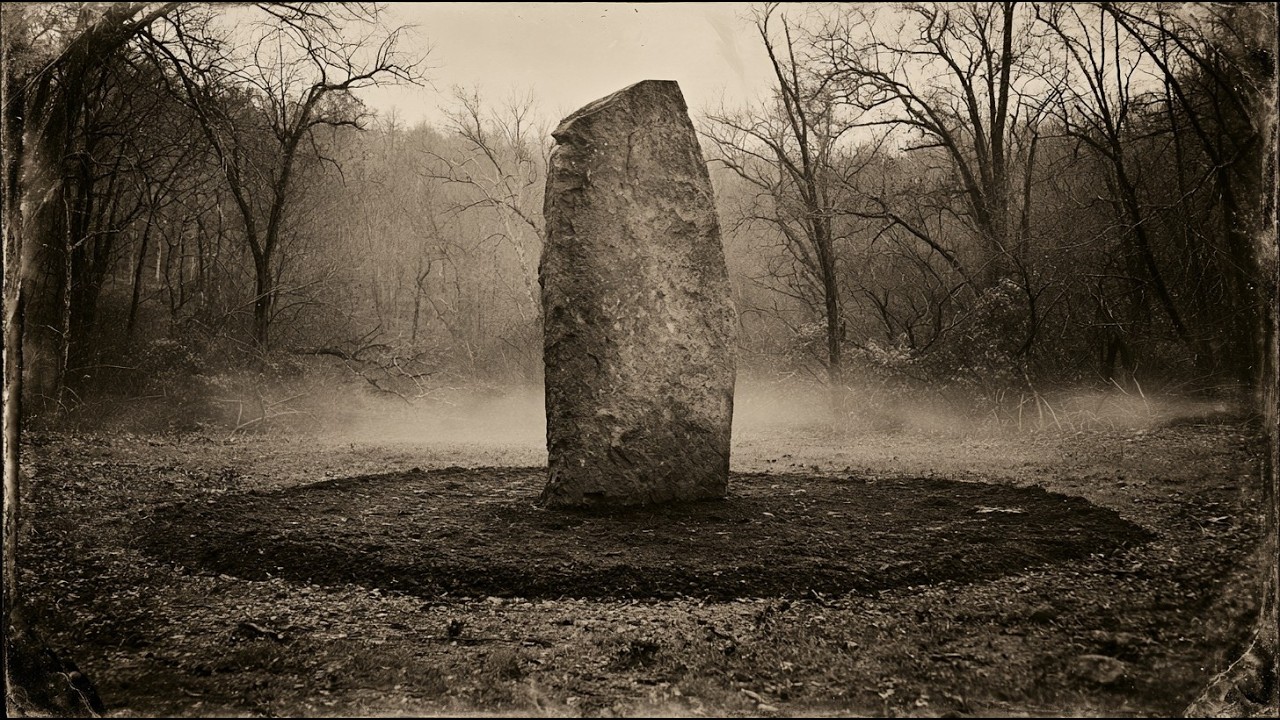
Oren Veasey stood inside a ring of warm black dirt at the top of a hollow no map had ever bothered to name, and he could not have told you which direction he faced. The good brass compass in his hand spun like a living thing, its needle drifting slowly and evenly round and round without ever settling, as if north existed everywhere at once. He had surveyed half of that county and most of the one beside it, and across forty years of running lines he had never once come up short of making the figures close like a door. Now the door refused to close, the ground beneath his boots felt as warm as breath leaving a man’s mouth, and the stone before him bore a message that had not been there nine hours earlier.
His name was Oren Veasey, and in the fall of 1888 he was forty-three years old—an age that in that country made a man careful enough to know better and young enough to believe care would be sufficient. He was a county surveyor. Where most men saw a ridge, a creek, and a stand of black oak, Oren saw bearings and distances, corners and closures. He could stand at the base of a mountain and tell you, down to the link, exactly how far it stretched and which way it slanted.
He had a favorite saying, the sort a man constructs an entire life upon without ever realizing he has done it. “A line always closes,” he would tell the young men who carried his chain. “Run it true and bring it back to where you started, and the figures will shut like a door. Land doesn’t lie.
Land can’t. It’s only ever the man with the compass who lies.”
He was tall, thin as a fence rail, with shoulders stooped from forty years of bending over a tripod. His face had weathered to the color of saddle leather and stayed that way.
He wore a close-trimmed gray mustache and had a habit of chewing the inside of his cheek whenever a set of figures refused to agree. His hands were not a farmer’s calloused paws but something odder: the fingers long, the tips stained dark from years of marking lines in indelible pencil, steady as a clockmaker’s. A man who worked with the small bones of his hands and the great bones of the earth, and trusted both without reservation. That trust is what they took from him.
The job reached him in the usual manner—which is to say, a man with money wanted to know precisely what he owned. A timber outfit out of Fort Smith had acquired the rights to a large wedge of ridge and hollow in the deep folds of the Ozarks, country so broken and so remote that no proper line had ever been run across it. They needed the boundary surveyed before the saws moved in. Standard work.
Tedious, lonely, well-paid. Oren accepted it without hesitation, loaded two mules with his instruments and supplies, and rode three days west and then south past the last wagon road until the maps in his saddlebag simply quit and showed nothing but the printer’s mark for unknown—a blank. The closest thing to a town out there was a place called Coldwater, though the word was generous. It amounted to a store, a smithy gone cold, a scattering of cabins up the hollows, and a Methodist meeting house that served as everything else a community requires.
Oren spent the first night at the store, which a man named Cordell Pruitt ran. Over a supper of fatback and cornbread, he spread his map on the counter and asked the way into the ground he had come to measure. He pointed to the wedge of unknown country and named the creek that was supposed to mark its eastern run: a thread of water the timberman’s deed called Sennett’s Branch. Pruitt studied the map for a long while.
He was a heavy, slow-spoken man, not prone to nerves. He placed one thick finger on the blank and traced the branch’s line up into the folds where the printer had surrendered. Then he lifted the finger before it reached the spot the deed called the head of the hollow. “You can run your line up the branch easy enough, and run it down the far ridge easy enough,” he said.
“But there’s a hollow at the head of it that the old families never let a survey through, going back before my granddad. And if I was you, I’d run my corner short of it and call the difference a swamp. Nobody’ll check.”
Oren asked him why.
And Pruitt, in the manner of men in that country who have learned that the safest answer is the one that sounds like a joke, said, “Because the ground up there won’t hold a number. You can’t measure it. Men have tried.” Then he laughed, but it was the laugh a man uses to close a subject, not the laugh a man uses when something is funny.
And he would not say another word about it, only refilled Oren’s coffee and steered the talk to the price of cotton. Oren heard “ground that won’t hold a number” the way a doctor hears “a symptom I can’t explain” or a hunter hears “a track I’ve never seen.” Not as a warning. As an insult to the trade.
Land doesn’t lie. That was his entire creed. And here was a man telling him there was a patch of it that wouldn’t tell the truth. He did not sleep much that night.
He lay on Pruitt’s storeroom cot and listened to the wind coming down off the ridges. And somewhere in that wind, faint, he thought he heard a sound like a spade biting into dirt, slow and patient. One stroke, then a long wait, then another. He told himself it was a loose shutter.
He was right to tell himself that. He was wrong to believe it. In the morning he hired a guide, because the country was too broken to risk alone. The guide was a trapper somewhere past fifty named Absalom Skaggs, lean and ruined-looking, with a beard like a thorn bush and one eye gone milky from a long-ago accident he never explained.
He knew that whole tangle of hollows the way Oren knew a sheet of figures—every spring, deadfall, and game trail. He agreed to guide the survey for a dollar and a half a day, which was robbery, and Oren paid it gladly, because Skaggs was the only man in Coldwater who would go up the branch at all. The others, when Oren asked, had found sudden reasons to be elsewhere. They went in on the morning of a gray day in late October, leading the mules up the bed of Sennett’s Branch, where the water ran shallow over black stone.
For the first two days, nothing happened you could give a name to, and that is precisely how the worst things begin. The work went smoothly, almost too smoothly. Oren set his first corner at the mouth of the branch, drove his stake, took his bearing from the brass compass, and started running the line north along the eastern edge of the timber wedge, with Skaggs ahead clearing brush and the rear chainman—one of Pruitt’s nephews—hauling the steel sixty-six feet at a pull. Each day the figures closed up neat as a shut door.
Oren would sit by the fire and close out the day’s traverse in his field book, and the numbers would match to the link. He felt that quiet satisfaction a man gets when the world behaves itself, and Skaggs would watch him with that milky eye and say nothing. It was on the third day that they reached the head of the hollow, and the ground stopped behaving. They came up over a low saddle expecting more of the same broken timber, and instead they emerged into a clearing.
Now, a clearing deep in the woods is not strange in itself. Lightning makes them, old burns, and sometimes a spring that drowns the roots. But this one was wrong in a way that took Oren a moment to name. When he named it, the back of his neck went cold.
Nothing grew in it. Not that the trees were gone—that you would expect. Nothing grew. No grass, no brier, no seedling, no moss on the few gray stones, not one living green thing in a circle maybe forty yards across, in country so wet and fertile that a man’s footprint sprouted weeds by August.
The dirt inside that circle was bare and dark and freshly turned, raked into low ridges as though a plow had passed through that morning, though there was no farm within ten miles and no plow could have climbed that grade. And it was October. All around it was dying back for winter, the woods gone rust and bone. Yet that dirt was black and soft and warm-looking the way a garden bed looks in May.
And in the middle of it stood the stone. Skaggs halted at the edge of the clearing and would not set foot inside. He planted the butt of his rifle on the ground and leaned on it. “That’s the place,” he said, in the flat voice of a man who has decided to say as little as the situation permits.
Oren asked him what place. “The place that won’t hold a number,” Skaggs said. Then he sat down on a log at the clearing’s edge, took out a twist of tobacco, and made it plain he meant to do his waiting from there. Oren walked out into the circle alone.
He told people afterward that the first thing he noticed was the temperature. The woods that morning had been raw, the kind of cold that gets into the chain so the steel bites your fingers. But the air over that bare dirt was warm. Not warm like sunlight—there was no sun, only a flat gray sky—but warm like the air above a banked fire, or the air a man breathes out.
It rose around his boots as he walked, and the dirt gave under him just slightly, the way new-turned ground gives. And he had the distinct and unwelcome sense that he was walking on something disturbed very recently, and from below. The stone, when he reached it, was a single slab of gray limestone set upright in the dirt about chest high. It had stood there a long time.
Lichen crusted its back, and the weather had rounded its top edge—the work of a hundred winters at least. But the dirt around its base was that same fresh black, as if the ground kept turning itself over around a thing that never moved. And here was the first wrong thing, the thing Oren noticed before anything else, because it was his trade to notice it. The stone faced the wrong way.
Every grave Oren had ever surveyed, every churchyard he’d ever run a line through, the stones faced east. The dead are laid to face the sunrise. That custom is older than the church, a thing so deep in people that they do it without being told. This stone faced north.
Dead north. He took out his compass to be sure, and that was when the trade truly failed him. The needle would not settle. It swung slow and steady, like a compass laid on iron, round and round, never resting, as though the whole clearing were the lodestone and north were everywhere at once.
He had never seen the like. He stood there in the warm air with his good brass compass turning in his hand, and for the first time in his professional life, Oren Veasey could not tell you which way he was facing. He put the compass away. He told himself: iron ore, a deposit under the ground.
It happens. It skews a needle. It’s geology and nothing more. He was right that such things happen.
He clung to being right about that for as long as he could. Then he went around to the face of the stone to read it, because surveyors read everything carved into stone: corners, witness trees, old grants. It’s the alphabet of the trade. And he found it carried no name.
No dates of a born and a died, no scripture, no maker’s mark. Only a single line cut deep and square by a careful hand, deeper than weather could erase. The line read: “He is below. Leave the stone.
”
That was all. He is below. Leave the stone. Oren stood reading those five words longer than he meant to.
There was something in the plainness of them. A grave begs you to remember the one inside it, gives you a name to say, a span of years to be sad over. This stone didn’t want you to remember anybody. It wanted you to do exactly one thing, which was nothing, and go away.
It was less like a marker than like a sign nailed to a door. And under his boots, the warm dirt shifted, the smallest settling, a sound like a long breath let out slow. And Oren Veasey, forty-three years old and afraid of nothing he could write a number on, felt the hair stand up the whole length of his arms. He did the thing his trade told him to do.
He decided to measure it. He called his rear chainman in from the edge of the clearing. The boy came white-faced and would only come because he was more afraid of Oren’s temper than of the clearing. And they began to measure the circle of bare ground.
Oren planted a stake at the foot of the stone and ran a line due east—or as near east as he could fix it by sighting on a distant ridge, the compass being worthless there—then chained off sixty-six feet and drove a stake. From there he carried the line on around the circle, stake after stake, exactly as you would measure any ordinary patch of ground, and closed it back at his starting point. More than forty chains of work, painstaking and slow, every link verified. Yet when he returned to the stone, his closing line fell a full eleven feet short of the stake he had set first.
Eleven feet is a staggering error. A boy on his first day with a chain does not miss by eleven feet over forty chains. Oren Veasey had not missed by eleven feet in twenty years. He thought to himself: I have blundered.
I am tired. The ground threw me off. So he ran it again. The second time, the line closed cleanly, dead on the stake, the numbers fitting together like a door shutting.
And he laughed aloud in relief, and the laugh caught in his throat, because that perfect closure made the circle a different size from the one he had measured the first time. Smaller. By his own honest chain, the same ring of ground measured sixty-eight feet across at one hour and fifty-five feet across at the next. Both readings were correct.
And that cannot be. Land does not change size. Land does not lie. That was the door his whole life had leaned against.
And standing in that warm clearing, he felt it swing open onto nothing. He measured it eleven times before dark. This comes from his field book, the one he kept and never filed. Eleven traverses of the same circle, and no two agreeing, the figures drifting like a drunk man.
And in the margin beside the eleventh, in his neat draftsman’s hand, the only thing he set down that day that was not a number. He wrote: “It is not the chain. It is not me. The ground is moving, and it is moving on purpose.
“
That night they made camp down the branch, well clear of the clearing, and Skaggs built the fire larger than it needed to be. Oren sat with his field book and chewed the inside of his cheek and tried to make the figures behave. They would not. At last he put the book down and asked Skaggs outright: “You’ve lived here your whole life.
What is that place?”
Skaggs studied him for a long moment across the fire, that milky eye catching the light. Then he told him to go and ask Mahala Traice, because she was the oldest living soul in that country, and her people had set the stone. Whatever little anyone knew, she kept.
And he would say no more, except, as he rolled himself into his blanket, one thing. “You measured it eleven times today,” he said. “Don’t measure it a twelfth.”
Oren, who did not yet believe, asked why not.
And Skaggs, already turned away, his voice half smothered in the blanket, said: “Because every time you measure it, you tell it where its edges are. And a thing that’s been still a hundred years, you don’t want to go reminding it where it ends.”
Oren lay awake. The wind came down the hollow, and beneath the wind, the way you’ll hear a clock you’ve stopped noticing, he heard it again: the sound from his first night at the store, far off up the branch in the direction of the clearing.
A spade going into dirt. One slow stroke, a long wait, another. Patient. Tireless.
The unmistakable sound of something digging in a clearing where there was no one but a stone, and no living thing but the warm, dark earth that turned itself over and over around it. In the morning he went to find Mahala Traice. She lived alone in a cabin at the top of a hollow of her own, at a great age, so old that the people of Coldwater had stopped counting her years and simply said she was older than the meeting house, which had stood since before the war. She was small and bent, dressed all in black wool gone green with time.
Her hands, when Oren took one in greeting, were so light and dry they felt like a bundle of dry grass. But her eyes were clear and quick, and she knew why he had come before he opened his mouth. “You’ve been up to the head of Sennett’s,” she said. He said yes.
She looked at him with something that was not fear and not pity, but was made out of both. “Sit down then, surveyor,” she said, “and I’ll tell you the once. And after I’ve told you, you’ll do me the favor of getting on your mule and going home. But I’ll have told you, and that’s all an old woman can do.
“
This is what she told him. Her people had come into that country among the first, before there was a county, before there were lines on any map at all, when a man’s claim was as far as he could see and defend. And among the first families, there had been an understanding, handed down so long that nobody living knew its beginning, about the head of Sennett’s Hollow. The understanding was very simple.
That ground was not theirs. It had not been theirs when they came. Something was already in it, in the warm dirt under the north-facing stone. Something that had been put down and kept down by people who were there before her people, people whose name was gone.
And the keeping of it was a thing you inherited along with the land, like a debt. You did not clear that hollow. You did not run a fence through it, nor a road, nor a property line. You did not dig in it for any reason.
You did not even cross it if you could help it. And above all, above every other part of the understanding, you left the stone exactly where it stood and exactly as it faced. Because the stone was not a marker. The stone was a lid.
And under it, she said, “is the door, and the dirt is only the dirt that the door is set into.”
The warmth you felt, and the digging you heard, and the way the ground won’t be measured: they are all the same thing. The thing below has never, for one single day, stopped trying to come up. The stone and the keeping are the only reasons it never has.
Oren, being who he was, asked the natural question. He asked what it was. And Mahala Traice said the truest and most frightening thing in the whole account: “Child, my people gave up asking that before your country had a flag. The name of it is in nobody’s mouth anymore, and that’s a mercy.
We don’t know what it is. We only know what it does, which is dig. And what it wants, which is up. And what holds it, which is the stone and the leaving alone.
“
Then she told him about the surveyor who came before. Because Oren wasn’t the first. There had been another, long ago, in the years right after the war, when the new county was being mapped and bounded, and a young government man with a chain and a compass had been sent up the branch to run the boundary just as Oren had been. His name was Erasmus Quill.
The families had warned him, just as Pruitt had warned Oren, and Quill, being a man of his trade and his time, had laughed at them and gone up the hollow and into the clearing and done exactly what Oren had done. He had measured it. He had stood at the foot of the stone with his chain and his pride, and tried to make that ground give up an honest number, and the ground had wandered under him just as it wandered under Oren. Stubborn the way the trade makes men stubborn, Quill had measured it not eleven times but beyond counting, days on end camped right in the warm dirt, driven half mad trying to make the circle close—until the families found him there raving and dragged him out by main force.
And Erasmus Quill never ran another true line in his life. He kept surveying. He went back east and worked his trade another thirty years. But every survey he closed came up wrong by a few feet.
Always short. Always the world a little smaller than his chain said it should be. And he died an old man in a state asylum, still measuring the walls of his room with a string and weeping because the room would not close. The room was three inches short.
The world was three inches short and getting shorter, and nobody would believe him. And he was, Mahala Traice said quietly, the only man besides her own grandfather who ever understood what that stone was holding, because once you’ve made it show you its edges, you carry a piece of those edges out with you, and they don’t ever fit back into the rest of the world. Then she gave Oren the warning she’d promised, the same as Skaggs’s. Don’t go back.
Don’t go back at night. And don’t ever, under any circumstance, lift that stone or clear that dirt or open that ground, no matter what you hear, no matter what voice asks you to. Because the thing below has had a hundred years to learn the sound of a man who’s curious, and it knows exactly how to call one. Oren Veasey rode away from Mahala Traice’s cabin fully intending to do as she said.
He got about four miles down the hollow, and stopped his mule, and sat there in the failing afternoon light. And turned around, because he couldn’t carry it. It wasn’t courage, and it wasn’t greed. The circle had shown him its edges, eleven different edges, none of them true, and a man whose whole life was the closing of lines could not lie down at night with a line that would not close.
It was already in him. The three inches were already in him. He had to go back and make it shut just once, just one true measurement, and then he’d leave forever. That’s what he told himself.
That’s what Quill had told himself. That’s what the thing below was counting on. Because that, you see, is the call. It doesn’t call you with a voice.
It calls you with an unclosed line. He sent the chainman home. He couldn’t bring a boy into it. He kept Skaggs; or rather, Skaggs kept himself, because when Oren turned the mule around, Skaggs simply turned with him without a word.
When Oren asked why he’d come, the old trapper said: “Somebody’s got to be at the edge to drag you out, and I’m too old to outrun much, so I expect we’ll see.”
They came back up to the clearing as the light was going, and it had changed. The circle of bare turned dirt was larger. Oren knew it the way you know a room you’ve been in has been rearranged before you can say what’s moved.
The ring of dead ground had spread. The nearest trees that had stood green-stumped at its edge that morning now stood half swallowed in the black turned earth, their roots bare and dark. And the stone in the center stood the same as ever, facing its wrong north. But the dirt at its base was no longer merely soft.
It was moving. Not much. The way the surface of a pot moves just before it boils. A slow swelling and settling.
A breathing. And from it rose that warmth, now strong enough to feel across the whole clearing. And that smell—the smell that would follow Oren the rest of his life—the smell of deep fresh-turned grave dirt, cold and sweet and mineral. The smell of the inside of the ground.
Skaggs took up his post at the clearing’s edge with his rifle across his knees, though what he thought a rifle would do, neither he nor Oren could say. And Oren walked out one last time into the warm breathing dark, with his lamp and his chain and his pride, to make the line close. He never got the chance to chain it. Because the moment he set his lamp down at the foot of the stone, he saw that the carving had changed.
That morning, the stone had read only: “He is below. Leave the stone.” Now, beneath those five words, in the same deep square hand, fresh cut, the raw stone bright in the cuts where no lichen had grown and no weather had touched, there was a second line that had not been there nine hours before. The second line was a date.
The date was that very night. The day, the month, the year: 1888. Cut into stone that no living hand had touched, the figures clean and new and waiting. His date.
Cut the way you cut a born and a died, except a grave gives you the day a man went down. And the stone wasn’t telling Oren when anyone had gone down. It was telling him when someone would. And the dirt at the base of the stone heaved.
A long, slow swell, and out of the warm black earth at the very foot of the stone, a shape pushed up against the underside of the surface, the way the dirt moves over a mole, but slow and broad and wrong. The shape of something turning over far down and rising. The smell came up thick enough to choke him. And from below, clear now, clear as a man working beside him, came the sound of the spade: stroke, and wait, and stroke.
Patient. Almost done. And Oren understood, in the way you understand things in nightmares all at once and whole, that the digging he’d heard for three nights had not been someone burying a thing. It had been the thing digging its own slow way up.
A century spent at that labor. And the stone above it, with its ring of keeping, had been the only things holding it back. And he, Oren Veasey, by measuring the circle eleven times, by telling it eleven times precisely where its boundaries lay, had undone in two days what a hundred years of holding had kept shut. He had shown it the way out.
And now, with the dirt rising and his own date freshly cut into the stone, a voice rose up out of the shifting ground. And that was the worst of it. Because the voice was his own. It was Oren Veasey’s own voice, calm and sensible and patient, the voice he used when speaking to the young chainman.
And it said, from beneath the dirt: “Just one more measurement. Just close the line. Help me find my edges and I’ll be still. You’re so close.
Lift the stone.”
And Oren Veasey reached for the stone. His hands were on it. His long stained clockmaker’s hands rested on the cold gray slab, and it was warm where he touched it, warming beneath his palms like something alive.
The voice that was his own voice was thanking him, and the dirt was parting at the base, a black seam widening, and the smell, and the warmth. In another half a breath, Oren Veasey would have lifted the lid off the door at the head of Sennett’s Hollow and learned the thing that Mahala Traice’s people gave up the name of before this country had a flag. What saved him was Erasmus Quill. Not the man—Quill had been thirty years dead in his asylum—but the memory of Quill.
The picture Mahala Traice had planted in his head of an old man measuring the walls of a locked room with a string and weeping because the world was three inches short and getting shorter. Because as Oren’s hands tightened on the warm stone to lift it, he heard, beneath the false patient voice that was his own, a smaller sound: the spade, stroke and wait and stroke. And he thought, with the last cold clear running part of his surveyor’s mind, the part that had closed ten thousand honest lines: it has been digging for a hundred years and it is not yet up. The stone is what’s left.
I am the last three feet. And if I lift it, I am not closing a line. I am the line it closes. And he took his hands off the stone.
It was the hardest thing he ever did. Pulling his hands off that warm slab was like pulling them out of his own grip, because the voice was his and it wanted them there, and for a moment his hands did not feel like his hands at all but like the things on the ends of someone else’s arms. The dirt at his feet surged up around his boots, warm as blood. The seam at the base of the stone gaped.
The smell was the whole world. He turned and he ran. He left the lamp burning at the foot of the stone, left his chain, left his good brass compass, left forty years of his trade lying in the warm dirt. He ran across the breathing clearing toward the one cold sane point in all that dark: the orange spark of Absalom Skaggs’s pipe at the edge of the trees.
And behind him, the whole clearing seemed to lean after him, the warmth and the smell and his own voice calling him, reasonable and patient: come back, come back. You didn’t close the line. You’ll never close another. He burst out of the bare dirt into the cold living woods, and the cold hit him like water.
Skaggs had him by the arm and was hauling him down the hollow at a dead run, an old man and a half-mad one crashing through black timber in the dark. They did not stop, either of them, until the branch was between them and the head of the hollow, and the first gray of morning was in the east—the true east, where Oren could finally see which way the sun came up. He looked back once from down the branch in that first light. And the clearing, he said, was already smaller.
The bare dirt had drawn back in. The trees stood green-stumped at its edge again, as if they’d never been swallowed. The warmth was gone, and the smell was gone, and the stone stood quiet in the center, facing its wrong north. A man walking up to it that morning would have read: “He is below.
Leave the stone.” And below it, fresh-cut, a date. And he’d have thought it nothing but an old strange marker in an old strange clearing. And he’d have been a fool, and he’d have been right to leave.
The ground had closed itself over the night like water closing over a dropped stone. It had a hundred years. One more night was nothing to it. It could wait.
Oren Veasey left that country and never went back. He never filed the survey. The timber concern out of Fort Smith sent letters, then threats of lawsuit, then gave it up. The saws never went into the head of Sennett’s Hollow.
As far as anyone has ever been able to learn, they never have to this day. He gave his reason to no one, not for years. He simply could not, would not run the line through that ground. And a surveyor who refuses a line gives up his living, which Oren did.
He went east and took other work, smaller work, town work: fences and lots, the corners of ordinary men’s ordinary land. But the three inches went with him. That was the part Mahala Traice had warned him of, and it was true, every word. From that autumn to the end of his life, Oren Veasey could not close a line.
He’d run a traverse honest and careful the way he’d done ten thousand times, and bring it back to where he started, and it would come up short. Always short. Always by a few feet, then a few inches. The figures never quite shutting like a door.
The world always just slightly smaller than his good steel chain swore it should be. As if some part of the measure had been kept back down in the warm dirt under the north-facing stone. He checked his chain a hundred times. He bought new ones.
It made no difference. He had carried a piece of the clearing’s edges out of that hollow, and they did not fit into the rest of the world. And they never would. He grew old.
In the end he abandoned the profession altogether, for a surveyor who cannot close a line is no surveyor at all. His final years he passed quietly, in a town far removed from any mountain. The only soul he ever confided the full account to was a young man who had lodged in the same house and sat with him on certain nights, and it was through that young fellow, along a long and winding road, that the story finally reached the man who relayed it to me. Toward the close, the young man asked him whether he believed the thing beneath the stone ever rose.
And Oren, by then very old and not far from his own appointed day, turned it over for a long while and said no. No, the stone is still there, and the family still keeps it, what remains of them. And it is still digging, and it will dig another hundred years and another after that. Because it has nothing but time.
And the stone is patient as well. Looking back, he said the one thing that ever truly terrified him was not the dirt, nor the smell, nor the voice. It was the date. That his date had been carved into that stone fresh the very night he went back.
For that meant, he said, that the night could have ended in any manner at all. There was a world, he said, no wider than his own two hands away, in which Oren Veasey lifted that stone, and in that world they carved his name nowhere, and his body was never found. And the clearing the next morning stood just a hair wider than the morning before, with one more measure of the world drawn down into the warm dark to feed the long slow climb of the thing below. And the only reason he sat there, an old man telling it, was that at the final second he had remembered a dead man measuring a room with a string, and chosen, only just, to leave a line forever open rather than be the one who closed it.
He died not long afterward. They found him in his bed one cold morning, peacefully enough, an old man’s death. Nothing strange about it save one thing the landlady mentioned and could not explain: the window had stood open all night in killing weather, and the room was full of the smell of freshly turned earth—cold and sweet and mineral, the smell of the inside of the ground—in a town a hundred miles from any hollow, in the dead of a winter when nothing had been dug for months. It was three in the morning by the hall clock when she had come down and found the cold pouring through the house.
She had gone up and shut his window. He had been lying there with his eyes open and his old stained hands folded on the quilt. And on the floor beside the bed, where it had no business being, lay a single steel surveyor’s chain, sixty-six feet of it, that nobody in that house had ever seen before. Laid out straight and true across the floorboards, stretched to its full honest length, it was three inches short.
So that is the strangest grave ever found in the Ozark woods, though it was never a grave at all. And the strangest thing about it was never the stone, nor the dirt, nor even the voice, but the plain fact that the most dangerous question a man can ask is not what lies down there. It is how far does it go. Because some ground was never meant to be measured, and some lines were never meant to close.
And the door at the head of that hollow stays shut for one reason alone: that for a hundred years, through warning and through fear, and through one man’s hands coming off a warm stone at the last possible second, people have been wise enough or frightened enough to leave it be.
