On the morning of July 24, 1943, in the Pacific north of Truk, Lieutenant Commander Lawrence Daspit brought the submarine USS Tinoso to periscope depth. Ahead of him lay the target every submarine commander waits an entire war to find. The Tonan Maru No. 3, a Japanese whaling ship converted into an oil tanker, displaced more than nineteen thousand tons.
It ranked among the largest merchant vessels in the Japanese Empire, and it was completely unescorted. Daspit fired from long range and hit it. The ship stopped dead in the water. What followed bordered on the unreal.
A massive, valuable enemy vessel sat motionless in broad daylight, unprotected, with a fully loaded submarine at point-blank range. Daspit took his time. He maneuvered into textbook position: perfect range, perfect angle, the target broadside at ninety degrees. Everything the submarine school at New London had taught him to strive for.
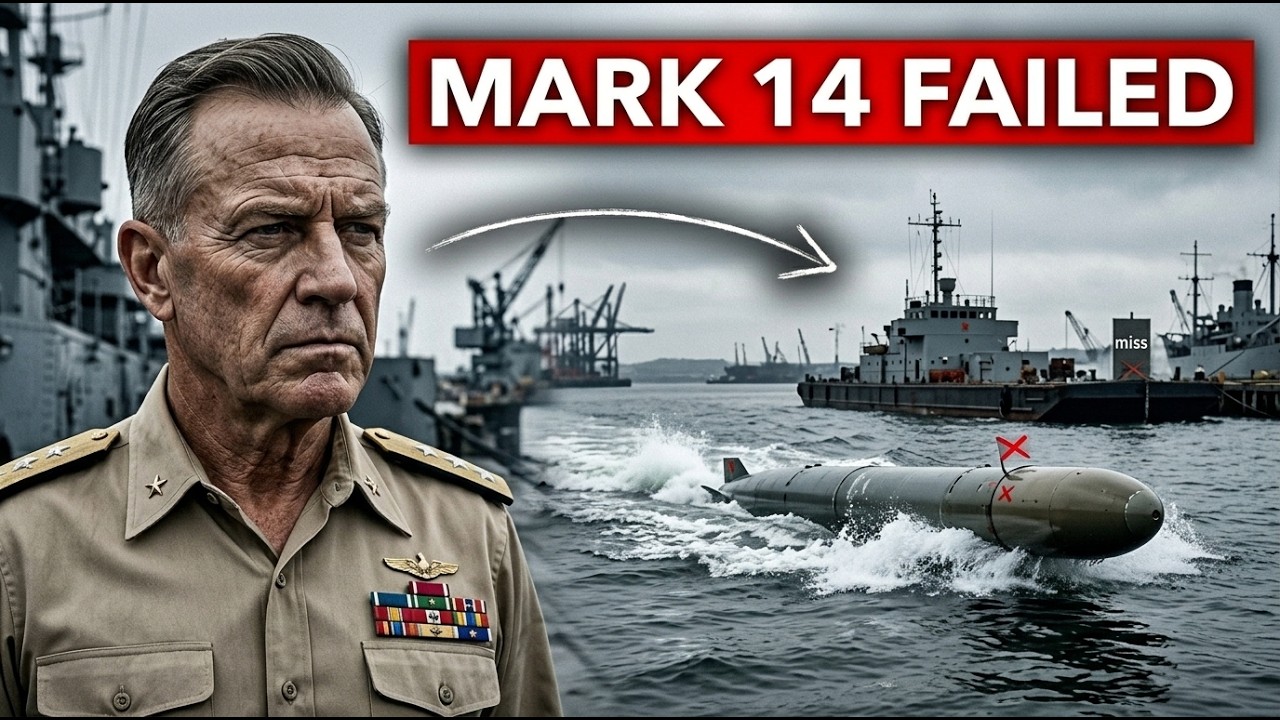
He fired. The torpedo ran straight and true, struck the hull, and nothing happened. He fired again. Straight, accurate, hit, nothing.
Again. Daspit stood at the periscope and launched torpedo after torpedo at a stationary ship from close range, watching each one slam into the steel, watching the spray, watching the vessel sit there untouched. Fifteen torpedoes went into the water that day. The crew in the conning tower listened to each impact.
According to accounts, the Japanese crew leaned over the rail, looking down at the marks. In the end, Daspit had one torpedo left. He made a decision that required a particular kind of courage in wartime. He did not fire it.
He broke off the attack, turned the Tinoso around, and carried that final torpedo back to Pearl Harbor so someone could take it apart and find out what was wrong with it. He returned from a war patrol having found the perfect target, failed to sink it, and brought home the evidence. By the summer of 1943, American submarine commanders had been telling the Navy for a year and a half that the standard submarine torpedo did not work. The Navy had essentially been telling them that the problem was them.
The Mark 14 torpedo had three separate defects. Not one, but three. The reason the disaster dragged on for over two years was that the defects were arranged in sequence, each one hiding the next. The first defect: the torpedo ran too deep.
Set to run at ten feet, it actually traveled at twenty or twenty-one feet, which for a torpedo aimed at a merchant ship meant it passed beneath the target and came out the other side. Nobody on either ship knew why. The second defect: the magnetic exploder. The Mark 14 carried a device called the Mark 6, designed to detonate the warhead beneath a ship’s hull by sensing its magnetic field.
A hit underneath breaks a ship’s back, far more destructive than a side strike. When it malfunctioned, it exploded early, sometimes fifty or a hundred feet short of the target. It looked like a hit and was worse than useless, because the commander reported a hit while the ship sailed on. The third defect was almost absurd.
The backup contact exploder failed when the torpedo struck the target directly. The impact at a perfect ninety-degree angle at forty-six knots decelerated the mechanism so violently that the firing pin assembly jammed before the pin reached the detonator. A glancing blow at an oblique angle usually worked. Read that again.
The better the hit, the more likely the torpedo failed. Now see how the sequence hid itself. While the torpedo ran too deep, no one could evaluate the exploders because the torpedo touched nothing. Fix the depth, and the magnetic exploder started producing early explosions that looked like hits.
Disable the magnetic exploder, and only then did the third defect become visible. By then it was mid-1943, and men had been dying for eighteen months. Each repair revealed the next problem. That explains the technical sequence.
It does not explain the institution, and the institution is the real story. The Mark 14 was designed and built at the Naval Torpedo Station in Newport, Rhode Island, under the Bureau of Ordnance. The bureau never once fired the weapon with a live warhead at a real target. Not once.
The reason was not stupidity. The Mark 14 cost roughly ten thousand dollars, the price of a good house in that era. A live-fire test destroyed it. During the Depression, the peacetime Navy budget for expending torpedoes in trials was nearly nonexistent.
Testing was done with exercise heads, lighter than warheads and buoyant, so the torpedo could be recovered and reused. The lighter head changed the torpedo’s balance, and the depth-sensor port was located where the torpedo’s movement through the water distorted the pressure reading. They tested the weapon in a configuration that did not match the weapon they issued, did it for years, and certified it as satisfactory. When war came and reports started arriving from the Pacific, the Bureau of Ordnance had a ready explanation.
The torpedoes were fine. The problem was the submarine commanders. Poor aim, poor approach technique, exaggerated claims, lack of aggression. Captains were relieved of command.
Then a commander named Charles Lockwood did what separates this story from a hundred other institutional failures. In mid-1942, as commander of submarines in Australia, he stopped arguing and ran his own test. He stretched a large fishing net across Frenchman’s Bay near Albany in Western Australia. He fired torpedoes through it with the depth set to a known number and went to examine the holes.
The holes were about eleven feet below where they should have been. He reported it. The bureau questioned his methodology. The test had not been run under proper conditions.
The net could have sagged. The numbers were not scientific. Lockwood ran the test again, more carefully, and got the same result. By August 1942, the bureau admitted the problem and issued a depth correction.
Eight months into the war, the Navy had fought with a weapon that had been passing under its targets since day one, and it was corrected only because a field commander in Australia bought a fishing net. With the depth problem fixed, the second defect emerged, and this one had a man responsible for it. The Mark 6 magnetic exploder was one of the most secret American weapons projects of the interwar period. It was developed in near-total secrecy at Newport, which meant few people understood it, and virtually no one tested it under realistic conditions.
The physics problem is plain in retrospect. The device was triggered by the target’s magnetic field, and the Earth’s magnetic field varies enormously with latitude. The Mark 6 was calibrated in Rhode Island waters. American submarines were using it near the equator.
The result was torpedoes exploding short of their targets, sometimes so far short as to have no effect, and always far enough to warn every escort in the area that a submarine was present. To be fair, the Americans were not alone. The German submarine force suffered a nearly identical crisis in 1939 and 1940. Depth-keeping errors and magnetic fuze failures, torpedoes fired at massive British warships that simply did not explode.
Karl Dönitz described his crews as sent into battle with wooden dummy rifles. The Germans convened investigative commissions and got to the truth faster than the Americans. What made the American case worse was not the error itself, but who embraced it. Admiral Ralph Christie was one of the officers involved in developing the Mark 6.
By 1943, he commanded a submarine force in the Pacific. The man responsible for the device was also the man commanding the men who used it, and the man receiving their complaints about it. He believed in it sincerely, with the conviction of someone defending something he helped build, and he kept mandating its use in his command after other commanders had lost patience. On June 24, 1943, Admiral Chester Nimitz settled it.
He issued an order disabling the magnetic exploders on all submarines in the Pacific Fleet. Not the Bureau of Ordnance, not Newport. The theater commander overrode the technical authority on its own weapon eighteen months into the war. With the magnetic exploder disabled, the nature of the complaints changed.
Commanders now reported perfect hits producing nothing but the sound of a clang. That was exactly what happened to Daspit on the Tinoso in July 1943. Lockwood, by then commanding the submarine force in the Pacific, did not send the problem to Newport and wait. He tested it himself again.
First the crude version. He took live torpedo heads, hoisted them by crane in Pearl Harbor, and dropped them nose-first from about ninety feet onto a steel plate. A large percentage failed to explode. Then the version that tells you what those men were willing to do.
They fired live torpedoes against the cliffs of Kahoolawe, one of the Hawaiian Islands, to simulate a real impact at real speed. When one struck and failed to explode, divers recovered it. One diver swam down toward an armed torpedo that had already malfunctioned once and brought it back to be taken apart. The examination revealed the deceleration problem.
On a direct impact at maximum speed, the firing pin assembly twisted under the shock before the pin could travel far enough to strike the primer. The perfect shot destroyed the mechanism that was supposed to fire it. The solution was produced locally at Pearl Harbor by the men who faced the problem: a lighter firing pin that could complete its travel before the assembly deformed. The metal for the first pieces, according to the standard historical account of the campaign, came from propellers of Japanese aircraft shot down over Pearl Harbor on December 7, 1941.
The wreckage of the attack that began the war was cut up to repair the weapon that had been failing ever since. By September 1943, the Mark 14 worked. Twenty-one months after the war began. The judgment here is not about a torpedo.
The Bureau of Ordnance designed the weapon. The Bureau of Ordnance built the weapon. The Bureau of Ordnance tested the weapon and certified it for service. When reports came back from the fleet that it did not work, complaints were referred to the Bureau of Ordnance.
Four functions, one organization, no room for doubt among them. That is not a torpedo problem. That is a management problem. It is the entire reason this lasted twenty months instead of twenty days.
An institution asked to investigate whether its flagship product was defective will, on average, produce the answer that its product is not defective, and it will produce that answer sincerely. No one at Newport was lying. They were doing what organizations do, weighing evidence against their own competence and ruling in their own favor. The alternative explanation was that the submarine commanders were at fault.
That explanation was cheaper. It was institutionally comfortable, and it had the overwhelming advantage of requiring nothing to change. Officers were relieved of command for insufficient aggression while firing weapons that could not explode. The cost should be stated honestly, both what it was and what it was not.
The American submarine force lost about fifty-two submarines and roughly thirty-five hundred men, the highest casualty rate of any branch of the American armed forces in the war. About one in five men. Most of those losses came from mines, depth charges, and accidents, not torpedo malfunctions. It would be dishonest to blame all of it on this failure.
What the failures cost was ships that never sank. Two years of Japanese oil tankers, troop transports, and cargo ships that should have been at the bottom of the sea in 1942 but kept moving in 1943, carrying oil, men, and rice to garrisons across the Pacific because the weapon aimed at them ran eleven feet too deep, exploded early, or hit them dead center and did nothing. Once the defect was fixed, that same submarine force, about one and a half percent of Navy personnel, went on to sink more than half of all Japanese merchant tonnage destroyed in the war, strangling the Japanese economy more effectively than any other instrument. That is what twenty months cost.
That is the scale of the loss. The system did correct itself. But look closely at how. Not by the responsible bureau.
Not through a formal review process. Not on schedule. It was corrected because a field commander in Australia bought a fishing net on his own initiative, because a fleet commander overrode the technical authority on its own weapon, and because a lieutenant commander with one torpedo left decided the evidence mattered more than taking a shot. The institution failed.
But the individuals inside it were allowed to overrule the institution, and were not destroyed for doing so. That permission is the essence of the whole story. Lockwood spent that capital again and again. In a system that would not have allowed it, the Mark 14 would still be failing until someone at Newport found time to look into it.
So the judgment is not that the American system was flawless. It clearly was not. It is that the American system had a mechanism for people in forward positions to be right out loud. It took twenty months and many lost opportunities before that mechanism finally worked.
Daspit brought his last torpedo home instead of firing it. Every officer in that navy knew what that looked like on a patrol report. No sinking, a perfect target, and he had let it go. Fifteen torpedoes fired.
Nothing to show except one weapon still in its tube, and a claim his superiors had ignored for eighteen months. He did it anyway, and he was right, and finally someone listened. The most dangerous thing in any organization is not the error itself.
It is the fact that the people who made the error are also the people you have to convince.
