The warehouse smelled of oil and damp concrete. Two men sat tied to chairs in the middle of the floor, their mouths taped shut, their eyes fixed on the man who walked toward them. Tony Accardo, twenty years old and barely two years out of the streets, stood in front of them and waited. Al Capone handed him a baseball bat.
“Do it. ”
Tony did not hesitate. Three swings into the first man’s skull, three into the second’s. Blood pooled across the concrete floor.
Both men died where they sat. When Tony turned around, Capone was smiling. The two men had been enforcers, paid fifty thousand dollars by a rival gang to kill the boss. Tony had proven himself loyal, silent, and willing to do what needed to be done.
From that moment on, he had a new name: Joe Batters. He was Capone’s personal enforcer, and Chicago’s underworld would never be the same. Francesco and Maria Accardo had welcomed their son Antonio Leonardo into the world on April 28, 1906, in a tenement on Grand Avenue in Chicago’s Little Sicily. They called him Tony.
Francesco was a shoemaker. The family lived in two rooms and shared a bathroom with four other families. Tony grew up speaking Italian at home and English on the streets. School lasted until he was fourteen, but he could not sit still and could not read well.
What he understood was power. By fifteen, Tony was running with the Circus Cafe Gang, learning petty theft and car stealing, learning how the streets worked. In 1926, Jack McGurn, known to history as Machine Gun McGurn, noticed the quiet kid. He was disciplined, didn’t talk too much.
McGurn brought him into the Outfit and started him as a driver. Simple work at first: pick up packages, deliver payments, learn the system. Within months, the twenty-year-old Accardo was driving for Al Capone himself. Capone did not trust easily.
Too many rats, too many cops on the payroll who would flip. But Tony proved reliable, silent, loyal. The warehouse test sealed it. Capone knew he had found someone who understood the rules.
February 14, 1929, 10:30 in the morning. The SMC Cartage Company on North Clark Street. Seven men from Bugs Moran’s Northside gang waited in a garage, thinking they were meeting a bootlegger selling hijacked whiskey. Instead, four men dressed as police officers walked in, lined them against the wall, and opened fire with Thompson submachine guns.
One hundred fifty rounds. Seven dead. Blood pooled six inches deep on the floor. The St.
Valentine’s Day Massacre became the most notorious mob hit in American history. Tony Accardo was allegedly among the shooters. He never faced charges. In October 1931, Al Capone was convicted of tax evasion and sentenced to eleven years in federal prison.
The Outfit needed new leadership. Paul Ricca stepped up as boss, and Tony Accardo became his underboss and chief enforcer. The partnership lasted until Ricca’s death in 1972, forty-one years, the longest stable leadership arrangement in mob history. Most gangsters who take power make noise.
Flashy cars, expensive suits, public appearances. Tony did the opposite. He implemented rules that kept him alive for five decades: never get your picture in the paper, never talk to reporters, never show off wealth. The Chicago Outfit under Accardo controlled everything.
Tony wasn’t just a gangster. He was a CEO running a criminal corporation with thousands of employees and operations across America. He had rules about enforcement too. No unnecessary violence.
No killing cops. No killing reporters. No killing civilians unless absolutely necessary. Business is business.
Keep it professional. That approach kept law enforcement from declaring all-out war and kept public outrage manageable. But according to FBI informant reports filed throughout the 1960s and 1970s, Accardo had another rule, one that set him apart from every other mob boss in the country. If you punish someone, take care of their family.
The exact date is redacted in FBI files, somewhere between the late 1940s and early 1950s. The associate’s name is withheld, but the facts are documented across multiple FD-302 reports from different informants. An Outfit associate was caught skimming profits from a gambling operation Accardo oversaw. Not a huge amount, maybe five thousand, maybe ten thousand dollars.
But in the Outfit, theft was a death sentence. You steal from the organization, you die. No exceptions. The associate knew he was caught.
He tried to run, disappeared for two weeks. But you cannot hide from the Chicago Outfit. They found him and brought him to a warehouse on the South Side. According to FBI informants, Tony Accardo was there and watched the interrogation.
The associate confessed, begged, offered to pay back triple. He said he had gambling debts, needed the money, didn’t mean disrespect. Accardo listened. Then he gave the order.
“Do it. ”
Two men grabbed the associate and dragged him to the back room. Two shots. Head shot, then another to make sure.
The body was wrapped in canvas and dumped in an alley. The police found it three days later. No investigation followed. Just another gangland murder.
Case closed. Then the pattern shifted. Tony Accardo asked about the dead man’s family. A wife and three children, ages six, eight, and eleven.
The widow had no idea her husband was in the Outfit. She thought he ran a legitimate bookkeeping business. Now she was broke, no income, facing eviction. Her kids needed to eat, and her husband’s body sat in the morgue with no money for a funeral.
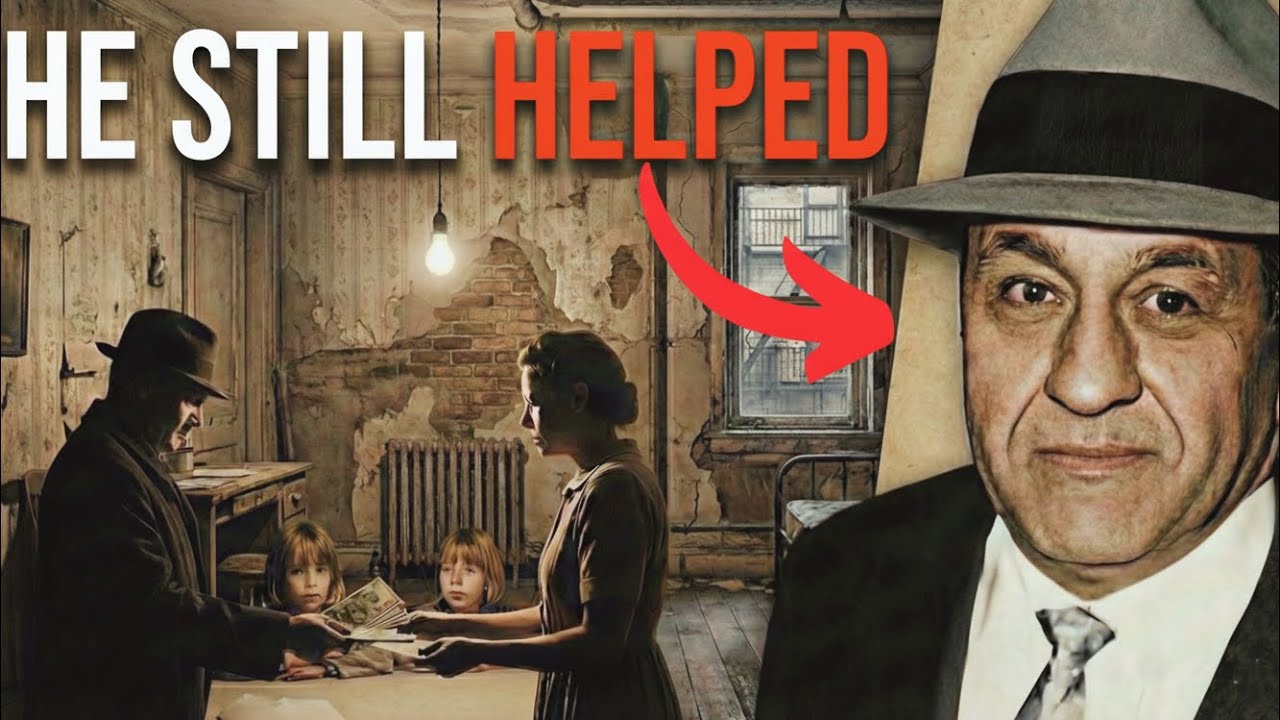
Accardo made a decision. He sent someone to the funeral home and paid for everything. Full service, casket, flowers, transport to the cemetery, grave plot, headstone. The widow was confused.
She did not have this kind of money. The funeral director told her it was taken care of, by an anonymous benefactor. She asked who. He said he did not know.
That was probably true. The payment came through a shell company. No names, no connections. A week after the funeral, a man knocked on the widow’s door, handed her an envelope, said nothing, and left.
Inside was five hundred dollars in cash. In 1950s money, that was roughly five thousand dollars today, enough for two months’ rent and groceries. The widow was terrified. She thought it was mob money, blood money.
She did not want it. But her kids were hungry and the rent was due. She kept it. The payments continued every month for at least two years, according to FBI surveillance reports.
Sometimes the same man delivered. Sometimes different men. Always cash, always in envelopes, never a word. Just money and silence.
The widow learned not to ask questions. She used the money to keep her house, feed her kids, pay for school, survive. FBI informants documented this in multiple reports. One informant, identified only as CG-6349, stated in a 1962 FD-302 report that Accardo believed the family of a punished man should not become enemies.
Helping widows and children of executed associates reinforced loyalty, fear, stability, and silence. This was strategic, not emotional. Another informant, CG-7218, confirmed in a 1968 report that Accardo maintained a pattern of compensating civilians or family members who were harmed indirectly through Outfit discipline. The informant stated that Accardo would not let the family suffer because of what her husband did.
That phrasing appears in multiple reports across different years from different sources. Consistent, verified, documented. Federal analysts interpreted it as part of Accardo’s broader leadership philosophy. He rewarded loyalty with protection, punished betrayal with brutality, but kept spouses and children out of the crossfire.
Dead men’s families did not talk to cops if the organization took care of them. They stayed silent, grateful, afraid. That silence was worth more than the cash. The enforcement system was not random violence.
It was calculated. The associate who got killed had broken a cardinal rule, and that rule existed for a reason. If one man skims and gets away with it, everyone tries. The whole system collapses.
Accardo had to kill him. It was not personal. It was business. But the widow and kids did not steal.
They did not betray. They were civilians. Punishing them accomplished nothing. Worse, it created enemies.
A bitter widow might talk to the FBI, might testify, might cause problems. But a widow who receives money, who knows the Outfit killed her husband but also kept her family fed, she stays quiet. Forever. The pattern repeated throughout Accardo’s forty-five years as boss.
FBI files document at least seven similar cases where Accardo ordered murders and then quietly helped the families: paid funeral expenses, sent cash, made sure kids stayed in school. Not always, not for every murder, but for associates who had families, for men whose wives and children were innocent, for situations where helping the family bought more silence than threats ever could. One particularly detailed FBI report from 1974 describes an informant identified as CG-8942 explaining Accardo’s philosophy directly. The informant claimed to have been present when Accardo discussed the policy with other Outfit leaders.
According to the report, Accardo said: “We kill the man, not his family. You take care of them. They remember. They don’t talk.
That’s the rule. ”
The FBI noted in their analysis that this behavior was unusual among organized crime bosses. Most families either ignored the families of executed members or actively threatened them into silence. Accardo did both.
The threat was implicit; everyone knew what happened to people who talked. But the help was explicit: cash, support, stability. It created a psychological bond, fear mixed with gratitude. The most effective form of control.
This was not guilt. Tony Accardo ordered at least fifty murders during his career, probably more. He beat men to death with baseball bats. He allegedly participated in the St.
Valentine’s Day Massacre. He ordered hits on rivals, traitors, informants, and anyone who threatened the Outfit. He showed no remorse, no hesitation, no moral crisis. This was not sympathy either.
Accardo did not care about the widow’s suffering, did not lose sleep over orphaned children, did not visit them, did not ask how they were. The cash was delivered by intermediaries. No personal connection, no emotional investment. Just transactions.
This was strategy, pure calculation. Killing the associate sent a message: don’t steal. Helping the family sent a different message: we take care of our own, even in death. Both messages reinforced the same system.
Loyalty equals protection. Betrayal equals death, but your family won’t starve. That combination created the most stable criminal organization in American history. The Chicago Outfit under Tony Accardo operated for decades without major internal conflicts, no wars, no mass defections, no widespread cooperation with law enforcement.
Soldiers knew two things. If you stay loyal, you’re protected. If you betray, you die, but your family eats. That’s a powerful incentive structure.
It removed the desperation that makes men flip. Compare that to New York. The Five Families spent decades killing each other. Boss after boss was whacked by rivals or their own men.
Underbosses flipped, soldiers testified, the organizations fractured. Why? No discipline, no long-term thinking, just greed and ego. Accardo avoided that.
He ruled through fear, yes, but also through a code that made sense. Follow the rules, you live. Break them, you die, but we won’t destroy your family. Simple, clear, enforceable.
And the FBI couldn’t touch it. They documented the pattern. They knew Accardo was helping families of murdered associates. They interviewed widows who received cash.
They tracked the payments through surveillance. But so what? Paying a widow’s rent isn’t illegal. Covering funeral expenses isn’t racketeering.
The feds couldn’t prove the cash came from criminal proceeds, couldn’t connect it to specific murders, couldn’t use it in court. In fact, the FBI’s documentation of this behavior worked against them. Defense attorneys would point to it: look, Tony Accardo helps families. He’s a community man.
He takes care of people. Prosecutors would argue it proved his power, his control, his guilt. But juries saw a man who helped widows and orphans. Even if he did order murders, which the government couldn’t prove beyond reasonable doubt, at least he wasn’t a monster.
At least he had a code. Every action served multiple purposes. Killing the associate enforced discipline. Helping the family bought silence and created positive PR.
The FBI documented both, but only the helping part looked sympathetic. The violence was implied, rumored, alleged, never proven. Accardo got credit for the good and plausible deniability for the bad. The widow knew.
She had to know. You don’t receive anonymous cash for years after your husband gets murdered and think it’s charity. She knew who sent it, she knew why, and she knew what would happen if she talked. The cash wasn’t just help.
It was a reminder: we’re watching, we’re taking care of you, don’t forget. That’s the psychology Accardo understood better than any mobster in history. Fear alone creates resentment. Help alone creates entitlement.
But fear plus help creates loyalty. The widow was grateful for the money, terrified of losing it, aware that talking meant both the cash and her life would disappear. So she stayed silent, raised her kids, never spoke to the FBI, never testified, never became a problem. Mission accomplished.
This was not Accardo’s only unusual practice. FBI reports from the 1950s document him paying legal fees for arrested soldiers. Not out of generosity. Strategy.
If you know the boss covers your lawyer when you get pinched, you don’t flip. You do your time, you come out to a job. That loyalty bought silence more effectively than threats, because threats lose power over time. Gratitude is renewable.
Accardo also made sure families of imprisoned mobsters received weekly payments. Informants described how Outfit wives would receive envelopes every Friday, enough to cover bills, keep the house, feed the kids. The imprisoned soldier knew his family was taken care of, so he didn’t cooperate, didn’t cut deals, did his time quiet, came out loyal. Effective system, cheap insurance.
This extended to funerals. When an Outfit member died, even from natural causes, Accardo made sure the funeral was first class: flowers, music, procession. He’d attend personally, pay respects, make sure the widow knew the Outfit took care of its own. FBI surveillance photos from mob funerals throughout the 1960s show Accardo present, shaking hands, offering condolences, being seen.
That visibility told every soldier: when you die, we honor you. When your family needs help, we’re there. But Accardo also knew when to withhold help. If someone flipped, cooperated with the feds, or violated the code in ways that couldn’t be forgiven, their family got nothing.
Worse, they became targets. That created the other side of the incentive structure. Stay loyal, your family is protected forever. Betray, and your family suffers.
Binary choice. Easy to understand, impossible to misinterpret. The FBI noted in multiple reports that Accardo’s system created what they called voluntary omerta. The traditional mafia code of silence was enforced through fear: if you talk, you die.
Simple. Accardo added a layer: if you talk, you die and your family loses everything. But if you stay quiet, you die someday of old age, and your family is taken care of forever. That extra incentive made Chicago’s Outfit the hardest organization for the FBI to crack.
Federal prosecutors from the 1950s through the 1980s consistently complained that Chicago witnesses wouldn’t flip, wouldn’t testify, wouldn’t cooperate, even when facing long sentences, even when offered deals. They knew their families would be okay. Throughout Chicago’s underworld, everyone knew the stories. Accardo takes care of families.
Accardo pays for funerals. Accardo makes sure kids stay in school. These stories spread and reinforced the reality that Tony Accardo, the most feared mobster in Chicago, the man who beat people to death with baseball bats, also made sure widows and orphans didn’t suffer. That duality made him untouchable.
People respected him, feared him, but also trusted him in a way they didn’t trust other bosses. Sons followed fathers into the organization because they saw how the organization took care of their mothers when their fathers died. One caveat: the FBI files don’t explicitly state that Accardo supported the murdered associate’s widow for life. That part appears to be later embellishment.
The documented support lasted at least two years, possibly longer. Multiple informants reference ongoing financial support, but none specify a lifetime commitment. The truth is impressive enough. A mob boss who ordered a man killed and then spent years helping his family reveals how the Chicago Outfit really operated.
It was never about the widow. It was about every other associate watching. Every soldier who saw what happened learned a lesson: if you steal, you die, but your family lives. That’s the deal.
Harsh, but clear. It removed ambiguity. It created a system where even death wasn’t total destruction. Just the end for you.
Not your wife, not your kids. They get taken care of by the same man who killed you. Tony Accardo ruled Chicago for forty-five years and died of old age in his bed in 1992. He understood that loyalty isn’t bought with violence alone.
It’s built with a combination of fear and reward. Kill when necessary, help when possible. Create a system where staying in line is the only rational choice. The murdered associate’s widow never spoke publicly about the money, never confirmed who sent it, never testified.
She died decades later, her identity still protected. Her children grew up, left Chicago, built normal lives. They never knew who really paid for their father’s funeral. Never knew the same man who ordered his death kept them fed.
Decades after Accardo’s death, FBI agents interviewed former associates for ongoing investigations. Many mentioned the funerals he paid for, the widows he helped, the families he supported. They spoke about it with something close to respect. Even men who hated the violence, who wanted out, who eventually cooperated, they’d still mention: “But Tony took care of families.
Tony had a code. ”
Accardo killed at least fifty men, probably more. He built a criminal empire on violence, fear, and ruthless discipline. He made millions from gambling, loan sharking, prostitution, and drug trafficking.
He corrupted unions, politicians, and cops. He destroyed lives, families, communities. But he also paid funeral expenses for the men he killed. He sent cash to their widows.
He made sure their children ate. The FBI called it benevolent gangster behavior. They documented it across decades: multiple informants, consistent reports, verified facts. They understood it was strategic, not emotional, a tool of control, not compassion.
But they also knew it worked. Chicago’s Outfit remained stable under Accardo longer than any other crime family in American history. No major wars, no mass cooperation, no collapse. Just forty-five years of disciplined, profitable, violent criminal enterprise.
At the center of it all was a man who ordered a murder over a few thousand dollars and then spent years helping the victim’s family. Not out of guilt. Not out of sympathy. Because he understood something most gangsters never figured out.
Dead men’s families can become enemies. Or they can stay silent. The difference is whether you take care of them.
