In the pre-dawn dark of 1961, a line of concrete trucks stretched down the Seattle streets, headlights burning, one after another after another. Four hundred and sixty-seven of them, hauling close to six thousand tons of wet concrete toward a single hole in the ground. The pour could not stop—not for a shift change, not for a jam in the street—because if the flow broke for too long, the load already sitting in the hole would begin to harden, and the next truck’s load would never fully bond to it. That would leave a weak seam buried at the very base of a six-hundred-foot tower, a flaw nobody could ever reach again.
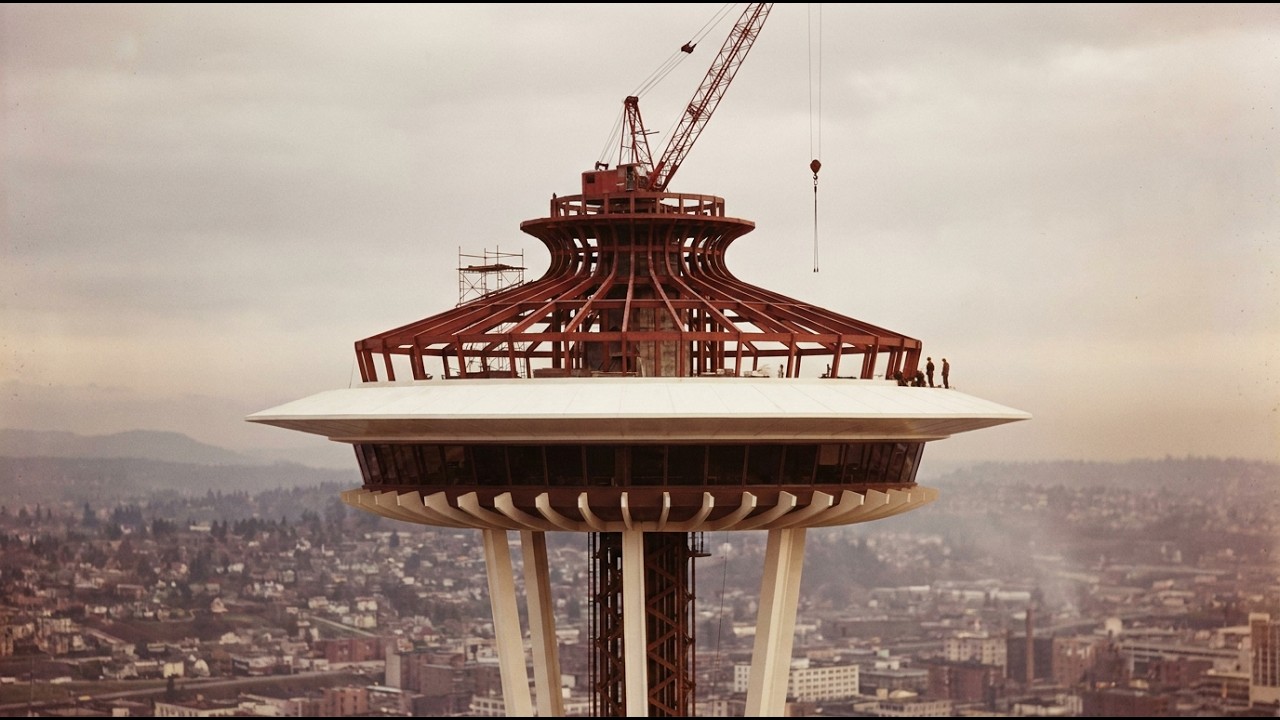
This was the foundation of the Space Needle, and this is the story of how it got built—the machines that lifted it, and the men who rode them into the sky. Five Seattle businessmen had bought a scrap of city land the size of a tennis court, a lot holding nothing but an old fire alarm station. They put in $75,000 of their own money with thirteen months to turn that square of dirt into the tallest structure west of the Mississippi. The county had refused to fund it.
The city had refused to grant the height they needed. So they started digging anyway, on a deadline nobody believed they could hit. The thing they were racing to build had never existed anywhere on Earth. Not a tower in the ordinary sense, but a five-hundred-ton steel flying saucer holding a restaurant and an observation deck, lifted six hundred and five feet into the sky and balanced on three curved legs that pinched inward at the middle like the waist of an hourglass.
There was no textbook for it. There was no crane on the continent tall enough to reach the top of it. And there was a world’s fair opening in barely a year, with the whole planet invited to come and look. Five men do not bet their own money on something this strange for no reason.
You have to understand the moment. The fair was called the Century 21 Exposition, and it was built to sell the entire world a vision of the future. This was the peak of the space race. The Soviets had put the first satellite into orbit.
The Americans were pouring everything they had into catching up, and the whole country had its eyes locked on rockets and astronauts and the distant year 2000. Seattle wanted to host the fair that captured all of it. And a fair like that needed one unforgettable image—a single structure that could sit on a postcard and quietly say, “The future is being built right here. ” A row of ordinary exhibition halls was never going to do that.
They needed something that looked like it had landed from another planet. It started, of all places, on a napkin. In 1959, a Seattle hotel executive named Edward Carlson was traveling through Germany and had dinner at the top of a broadcast tower in Stuttgart, a slender concrete spike with a restaurant perched near its peak. He could not stop thinking about it.
Back home, sitting in a coffee shop, he sketched what he was picturing onto a placemat: a tethered balloon on a tall pole, a restaurant hanging in the air over Seattle. It was rough and it was strange, and almost everyone who saw it wanted to change it. Some of the early drawings looked like a landed spaceship. Others looked like a giant cocktail shaker.
For months, the idea drifted around without a shape anyone could actually build—a nice sketch and nothing more. The shape came from two other men. The architect, John Graham, had just made his name designing one of the first modern shopping malls in the country, and he had already built a rotating restaurant on top of a mall in Hawaii, so he understood how to make a room turn slowly in the sky. He took over the design and pushed it toward the flying saucer we know today.
But the silhouette—that pinched, tapered, almost living outline—came from a university architecture professor named Victor Steinbrueck. He had kept a small abstract wooden sculpture in his office for about ten years, a carved female figure called The Feminine One that squeezed tight in the middle and created a strange kind of visual tension. That squeeze became the waist of the tower: a ten-year-old sculpture quietly scaled up into six hundred feet of steel. The two design teams got so tangled over who deserved the credit that one of them eventually filed a formal complaint against the other.
Even the shape of this thing came with a fight. And here is where the whole project almost died before it began. The men behind the fair went looking for public money to build the tower, and the county turned them down flat. So five private businessmen formed a company called the Pentagram Corporation and decided to fund the entire thing out of their own pockets.
These were not reckless men. Among them were a hotel executive, a shipping heir, a timber magnate, the architect himself, and the contractor who would actually build it—five people with real fortunes and real reputations to lose. The whole tower would end up costing about $4. 5 million, and they were personally on the hook for it, on a structure that had never been attempted, on a deadline set by a world’s fair that would not wait.
If the thing came in late or came in wrong, or worse, if it came down, it was their names and their money going down with it. But they had nowhere to put it. The fairgrounds were already carved up and spoken for, and the only open scrap left was that tiny square with the old alarm station on it, barely 120 feet on each side. They bought it for $75,000, with the clock already running down and a bank stepping in at the last moment to make the numbers work.
The city council approved the project. Then the planning commission rejected the height they were asking for. Rather than wait for permission, they broke ground anyway, pouring the foundation while the paperwork was still unsettled. Now the digging began, and the first enemy was the ground itself.
Seattle sits on glacial soil, layers of earth packed down hard by ice thousands of years ago. To hold a tower this tall, the crews could not just scratch the surface. They cut a pit thirty feet deep in the shape of a wide letter Y, one arm reaching out for each of the three legs. And into that hole, they were about to pour the heaviest single foundation the West Coast had ever seen.
Most of this tower is underground. The trucks kept coming roughly one every ninety seconds for twelve straight hours, until the crews had placed about 2,800 cubic yards of concrete laced with hundreds of tons of steel reinforcing bar, without a single break. It was the largest continuous concrete pour attempted anywhere in the West up to that time. Sunk down into that concrete were seventy-two steel anchor bolts, each one more than thirty feet long, waiting in the dark for legs that had not yet been built.
Every one of those bolts mattered, because a single trapped air pocket around a single bolt could leave a hidden weakness exactly where the whole tower met the earth. So the men worked the wet concrete for hours, vibrating it and driving out every void they could find. When it was finally done, the finished foundation weighed about as much as the entire tower it would one day carry. And that was the whole secret.
The center of gravity of the completed Space Needle sits only about five feet above the ground. Six hundred feet of steel standing in the sky, and the balance point of the whole thing is down around the height of your knees. Engineers describe it like a buoy floating in water, weighted so low that it simply refuses to tip over. Most people picture a tall tower as top-heavy and delicate, waiting to topple.
But by burying nearly half of the tower’s total weight down in that hole, the builders turned the whole thing into something closer to a giant nail hammered into the earth. The harder the wind pushes against the top of it, the harder that massive base holds it down. The concrete needed a full week to properly cure. The schedule did not have a week to give.
So, while it was still hardening in the ground, the steel was already on its way. That steel came from a company just south of the city called Pacific Car and Foundry—known today as Paccar, the maker of Peterbilt and Kenworth trucks, the same outfit that would later fabricate steel for the World Trade Center in New York. In 1961, its shop floor was welding together the bones of the Space Needle. And the steel it used was almost comically ordinary: standard structural beams ordered right out of a catalog, the same stock you could buy for any office building in the country.
Everything unusual about this tower came from what they were about to do to it. Each leg was built from enormous segments, some of them ninety feet long and weighing 90,000 pounds apiece. They were so large that the crews could only move them through the city before dawn, when the streets were empty enough to carry something the size of a train car. A ninety-foot column laid on a trailer is longer than most buildings on the street are wide, and steering it around corners in a working city is nearly impossible in daylight.
So the loads rolled out in the dead calm of early morning, when the roads were empty and the wind was low—because a beam that size hanging off a truck can catch a gust and turn into a sail. At the site, the very first thing to rise was not a leg at all. It was the core: a hollow steel shaft about eleven feet across, standing straight up through the middle of the Y like a spine. Everything else on the tower would climb around that core, and everything the tower needed to work—the elevators, the wiring, the crews—would eventually run up through the middle of it.
To lift the steel, the crews started with a mobile crane sitting on the ground. But a crane on the ground can only reach so high, and this one gave out at around sixty-eight feet, barely a tenth of the way to the top. After that point, they needed a completely different kind of machine. So they mounted a derrick crane inside the hollow core itself—a crane that would build the tower from within and then climb the very tower it was building.
The crane sat inside the core and lifted the next ring of steel up and over its own head, setting the pieces that would rise above it. Then, once that new section was locked in place, the crane climbed up inside it, hauling itself higher up the shaft it had just extended, and started the whole cycle again. Section by section, it built the ladder above itself and then climbed that ladder, lifting the tower up around its own body as it went. It was a machine slowly sealing itself into the structure, one floor at a time, trading away its own escape route for every foot of height it gained.
Then came the problem that should have stopped everything cold. The three legs did not run straight up to the top. They had to curve inward, leaning toward the center to form that famous pinched waist about 370 feet off the ground. And nobody at the shop actually knew how to bend steel beams that massive into a smooth matching curve three times over, so that three separate legs would meet perfectly in the middle.
The answer came, strangely enough, from a fire. Someone remembered that at a nearby air base, a building fire had warped the steel roof trusses, bending heavy structural metal into curves using nothing but heat. So the crews decided to try to do it on purpose—to burn the bend into the beam in a controlled way instead of by accident. They heated the steel in careful pie-shaped sections with torches, watching the color of the metal.
As each section cooled, it contracted and slowly pulled the beam into a curve. Heat too much in the wrong place, and the leg bends the wrong way or twists, and a ninety-foot piece of the tower is ruined. Heat too little, and the curve falls short, and three legs that are supposed to meet in the middle miss each other by inches at six hundred feet in the air—where inches are not something you can fix. There was no giant hydraulic press for this, no custom machine flown in from somewhere.
Just fire, patience, and men reading the glowing steel by eye, until three straight legs leaned inward and met exactly at the waist. That trick was never printed in any engineering manual. It was invented on the spot by men who could not afford to guess wrong. But the machines are only half of this story, because up on that steel, with no net below them and no harness holding them, were the men.
The iron workers on the Space Needle came out of the local union, and by every account, they were the best in the region, competing hard for the chance to work a job like this one. What they did not have was any of the safety equipment we would now consider absolutely basic. There were no straps, no cables clipping them to the beams, nothing at all between them and six hundred feet of open air. One of them, an iron worker named Jack Edwards, explained their thinking years later.
They genuinely believed that being able to move freely was itself their safety. A harness, he said, was just one more thing to stumble over up there. They were paid around $4 an hour to do it. And remember when they were doing it.
This was a Pacific Northwest autumn and winter, which meant rain, cold, and wind driving in off the water, coating the steel in a slick film hundreds of feet above the ground. If the steel was up there, the men went up there with it, in whatever weather the sky handed them, and they walked beams a few inches wide, with the city shrinking away beneath their boots. The reason we can even see their faces today is its own small miracle. The architecture firm hired a photographer named George Gulacsik, who spent the entire build climbing the tower with a camera and shooting roughly 2,400 photographs of the whole thing going up.
Then those images sat forgotten in a closet for about fifty years, until a library finally tracked them down and scanned them. His photographs are why we know what the raw steel looked like before the skin went on, and why the men who built it are not just names on a payroll but faces frozen on a beam, hundreds of feet up, calmly doing the impossible. Watch how they actually set one of those legs, and your stomach turns over. A 90,000-pound column would swing in slowly on the crane, enormous and unstoppable, while a worker waited to receive it, perched on a stub of metal barely eighteen inches long, jammed into a hole in the splice plate.
He would sit on that little stub of steel hundreds of feet up, reach out and catch the swinging leg with a wrench, guide it down onto the connection, and then hammer in the pins that held it while the crane finally let go. Down on the ground, a signalman named Jim Torrey called every single move by radio. And the crane operator, who often could not even see the top of the tower, moved 90,000 pounds of steel on nothing but the sound of that one voice in his ear. One wrong call, one misheard word, and the column swings past its mark with a man sitting directly in its path.
Higher up near the crown, it somehow got worse. The saucer at the top needed a ring of curved ribs, and those pieces reached out past the point where the crane could safely place them. So the workers carried them out by hand—steel ribs about nine feet long, hauled out onto narrow beams five hundred feet in the air and set into place by men who slid along the metal sitting on the very beams they were installing. A writer at the time called those narrow walkways “sparrow paths into open space.
” Behind all of that, a crew of thirty-nine welders was fusing the connections together, and every single weld was x-rayed at night, because one hidden crack in one joint could split open under an earthquake decades into the future. Through all of it, the calendar was the real enemy. The whole tower, from the first shovel of dirt to the finished structure, went up in only about 400 days—a pace so fast that people at the time simply called it the “400-day wonder. ” There was no room in that schedule for a redo, no slack to wait out bad weather, no time to stop and rethink a leg that came out wrong.
Every day the steel had to climb a little higher, and every day the men had to go back out onto it. Fall behind, and the fair opens without its centerpiece in front of the whole world. One small story captures the spirit of these men better than anything else. When the iron workers finished topping out the steel, their foremen insisted that the men who actually built it would eat the first real meal up there, before any businessman or dignitary ever set foot on top.
So a full holiday-style buffet was hoisted six hundred feet into the sky in the cold, and the crew sat down to eat at the very top of the thing they had raised. Before they could even finish, the wind picked up and the food started blowing straight off their plates. Around the same time, just before Christmas, a worker even climbed to the top in a Santa Claus suit to plant a Christmas tree up there, and the photograph of it ran in papers across the country. And now the part that makes this entire build almost impossible to believe.
With all of it—the 90,000-pound columns, the winter wind, the open air, the beams with no nets—not one single worker died building the Space Needle. Across the entire job, the worst injury anyone recorded was a broken leg. They worked without harnesses through a Seattle winter, hundreds of feet up, on a deadline that never once let them slow down. And every last man went home.
They should not have finished this tower on time, and they should not have finished it without burying someone. They did both. By December of 1961, the final piece went up, and the tower reached its full height of 605 feet. And now there was exactly one machine left to deal with: the crane still sitting inside the core.
It had climbed all the way up through the center of the tower, but it could not simply ride back down the way it came, because the staircase and the structure had been built in beneath it as it rose. It was trapped inside its own tower. But the crews had planned for this from the very beginning. They had deliberately left one section of the core wall unwelded—a hidden door—and they took the crane apart and lowered it back out, piece by piece, through that single opening.
The machine that built the tower had to be quietly smuggled back out of it. Now the tower still had to come alive. Inside the top sat the machinery that made it move: three elevators that could carry visitors up to the observation deck in about forty-one seconds, descending at ten miles an hour and slowing to half that speed on the windiest days. For a visitor in 1962, that ride was the closest thing to a rocket launch most people would ever feel—sealed into a glass car and lifted the height of a sixty-story building in under a minute.
At the top, an open observation deck let them stand more than five hundred feet up and look out over the whole city, the water, and the mountains beyond. And just below that deck sat the restaurant, named the Eye of the Needle, designed to rotate a full slow circle roughly once every hour so that every table drifted past the entire view without a single diner ever getting up. The motor that turned that entire dining room—the floor, the tables, the diners, and their plates and all—was about one horsepower, no stronger than the motor inside a common kitchen appliance. The whole room was balanced so precisely on its track that the smallest push could send it turning.
People would set a purse down on the fixed inner ring, look away, and turn back to find it had drifted halfway across the room. Then came the paint. Four colors chosen to celebrate the space age the fair was built around. They named them Astronaut White for the legs, Orbital Olive for the core, Re-entry Red for the halo, and Galaxy Gold for the sunburst roof at the top.
And crowning all of it, a natural gas torch burned against the night sky. On April 21, 1962, the World’s Fair opened, and the Space Needle opened along with it. And the man whose napkin sketch had started the whole thing watched the man who lit it do so from thousands of miles away. President John F.
Kennedy opened the fair by remote signal all the way from Florida, pressing the same golden telegraph key that a president had used to open Seattle’s very first World’s Fair back in 1909. And the way they wired that opening moment was pure space-age theater: the signal was routed through impulses picked up from a distant star, light that had traveled thousands of years across space. In a sense, the fair was switched on by the universe itself. On that cue, a carillon of more than five hundred bells rang out, and the sound rolled across the whole city while the crowds looked up at the strange new tower now standing over their skyline.
A few weeks earlier, the restaurant at the top had held its own grand opening, and the people who had spent the past year watching this thing rise out of a hole in the ground finally got to ride to the top of it. For the men who had actually bent the steel and set the legs, watching a president light the thing by starlight from across the country must have felt like a strange dream. They had built it with torches and wrenches and their own hands, hanging off beams with nothing under them. Kennedy had planned to come to Seattle in person to close the fair that October.
He never made it. He canceled at the last minute, publicly blaming a heavy cold. In truth, he was back in Washington managing the Cuban missile crisis, with the world closer to nuclear war than it had ever been. The tower that had been built as a monument to the bright, hopeful future of the space age opened and closed under the shadow of the bomb.
And the crowds came anyway, in numbers nobody had predicted. Over the six months of the fair, close to ten million people passed through the gates. More than two and a half million of them rode to the top of the Space Needle—roughly a million more than the planners had ever expected. On the busiest days, close to 20,000 people a day crowded into those three elevators, and the wait just to get to the top could stretch for hours.
The tower was not the only piece of the future the fair left behind. A sleek elevated train, the monorail, was built to carry visitors to the fairgrounds, and it still runs through the city today. But it was the Needle that people came for. At 605 feet, it stood taller than anything else west of the Mississippi, well above the old Smith Tower that had held the regional crown since 1914, and it would remain the tallest structure in the entire state for years to come.
In a single fair season, a strange steel tower that had almost never been built became the single most recognizable thing in the Pacific Northwest. And this is where the story needs a correction. People love to say that the Space Needle put Seattle on the map, as if nobody had ever heard of the city before 1962. That is simply not true.
Seattle had been the great launching point for the gold rush of 1897, the city where thousands of prospectors bought their supplies before heading north to the Yukon. It was already the home of Boeing, and it already had the Smith Tower, built back in 1914, itself the tallest west of the Mississippi for years. Seattle was never some unknown town. What the Space Needle really did was hand the city a single silhouette that the entire world could recognize in a heartbeat—a shape that meant Seattle and nowhere else.
And the tower has been tested hard since, in exactly the ways its builders would have wanted to watch. Long before it was ever built, the engineers had designed it to survive a wind of two hundred miles an hour, roughly double what the building codes of the day even required. A small model of the tower was put through a wind tunnel to prove the shape could take it. The finished tower is not rigid.
It is meant to move. It sways about an inch for every ten miles an hour of wind that hits it, flexing instead of fighting—the same way a tall tree bends in a storm rather than snapping. Then came the harder test, the one no engineer gets to schedule. In the year 2001, a magnitude 6.
8 earthquake struck the region and shook the whole area violently. The Space Needle stood without any structural damage at all. It was closed for only a couple of hours while crews inspected it, though about thirty people got a ride they would never forget: briefly stranded at the very top as the tower swayed and rocked and then settled, doing precisely what it was engineered to do. Visitors up there that day described hearing a deep rumble climb up the shaft before the whole tower began to move under their feet.
And every part of it held—the welds those men x-rayed in the dark, the legs they bent with fire, the bolts sunk into that pre-dawn pour. All of it did exactly what it was designed to do forty years later, on a day nobody planned for. So think about what this thing actually was. A tower with no blueprint anyone had ever tried.
Funded by five men out of their own pockets, on a piece of land the size of a backyard. Built without the height permit they were supposed to have, in roughly four hundred days, by iron workers with no nets who lost not one single life. Steel bent into shape by fire. A crane that sealed itself inside and had to be smuggled back out.
A six-hundred-foot structure that balances on a weight buried near the ground and quietly refuses to fall over. It still stands exactly where those men placed it, more than sixty years later. And it is still turning up there, one slow circle every hour, on a motor no bigger than the one humming inside a refrigerator.
