On the morning of June 5, 1929, a scream cut through the salt air at Virginia Beach’s most elegant hotel. A worker had discovered the crushed body of an 82-year-old man on the concrete patio below the sixth floor. The man was Adolf Kors, the immigrant who had built one of America’s greatest brewing empires. He had arrived weeks earlier with his wife Louisa, his daughter Augusta, and his granddaughter, hoping the ocean air would help him recover from a severe case of influenza.
Instead, his journey ended in an instant, and the mystery of what happened in that hotel room was swept away almost as quickly as his life. The local coroner called a full investigation unnecessary. No autopsy was performed. No questions were asked about the windows or the locks.
Louisa’s testimony, though she was the only witness, was accepted without challenge. The body was shipped back to Colorado by train for burial. In his will, Adolf left only one specific request: that his hotel bill of $1,876. 51 be paid in full.
He left no note, no explanation. To understand how a man who had everything came to stand at that window, one must go back to a cold February day in 1847, when Adolf Kors was born in Barmen, Prussia. His parents were simple working people. When Adolf was a year old, the family moved to Dortmund, where they lived across the street from the Wanker Brewery.
The smell of malted barley and the sound of barrels rolling over cobblestones became the backdrop of his childhood. At fourteen, he began an apprenticeship at that brewery, learning the craft of turning grain and water into beer. Tragedy struck before his craft could fully bloom. In April 1862, his mother died.
Eight months later, his father followed. At fifteen, Adolf was an orphan. His younger siblings were sent to a Catholic orphanage, but Adolf stayed at the brewery, working as a bookkeeper to pay for his apprenticeship. He moved from brewery to brewery across Germany, perfecting his skill and dreaming of something more.
In 1868, at twenty-one, he decided to go to America. The passage cost about one hundred marks, more money than he had ever possessed. So he snuck aboard a ship in Hamburg, hiding in the dark belly of the vessel. When discovered mid-voyage, the captain gave him a choice: work off his debt in America or be thrown overboard.
Adolf chose life. He stepped onto American soil with nothing but the clothes on his back, and for the rest of his life, he forbade his family from ever speaking about his journey as a stowaway. The secret remained buried until 1970, forty-one years after his death. America in the late 1800s was a land of brutal opportunity.
Adolf worked as a bricklayer, a stone cutter, a fireman, anything that paid. He dug canals in Chicago until his hands bled. He hauled coal until his back screamed. Every dollar brought him closer to his dream: to brew the finest beer in America.
In 1872, he made his way to Denver, Colorado. Clear Creek ran cold and pure through nearby Golden, and for a brewer, that water was liquid gold. By November 1873, he had scraped together $2,000. With a partner who invested $18,000, they bought an abandoned tannery in Golden and founded the Golden Brewery.
Adolf refused to cut corners. He insisted on the finest ingredients and treated his employees better than most brewers, giving them breaks and decent wages because he remembered what it felt like to work until you couldn’t stand. By 1880, his partner sold his share, and Adolf Kors, the orphan stowaway, became sole owner of what would become one of the largest breweries in the world. Success, however, did not soften him.
Those who knew Adolf described him as cold, taciturn, deeply unpleasant. At Sunday family dinners, barely a word was spoken. When two of his infant children died, he buried them in unmarked graves. He had no hobbies, no friendships outside of business.
He built an empire, but inside the fortress of his wealth, he was profoundly alone. In April 1879, he married Louisa Weber, a cultured and kind woman twenty-one years old. They had eight children, though only six survived to adulthood. Three sons carried the Kors name into the future: Adolf Jr.
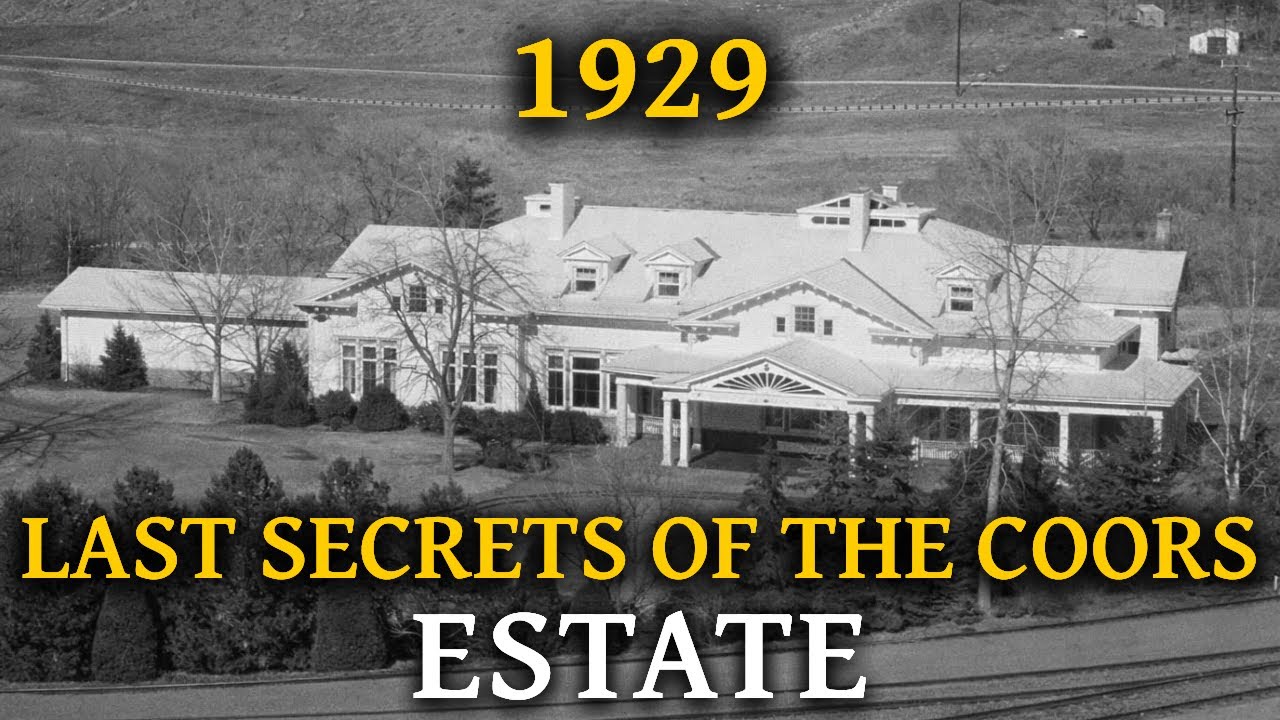
, Grover Cleveland, and Herman Frederick. Three daughters brought different energy to the household. As his family grew, so did his fortune. Beer sales climbed year after year, and in 1890, Adolf built a mansion worthy of a brewing king, a statement in brick and wood that said the stowaway orphan had conquered America.
The house rose on the brewery grounds in Golden, positioned so he could walk from business to home in minutes. It was a Victorian masterpiece with twenty-two rooms, a grand curved staircase, a library filled with German books, oriental rugs from Persia and Turkey, and a massive chandelier imported from Copenhagen. Every element proclaimed the same message: I made it. I succeeded.
I am worthy. But having everything doesn’t mean you have what you need. In 1916, Colorado became a dry state, three years before the rest of the nation. Alcohol was banned.
Adolf, who had spent his entire life perfecting the craft of brewing, suddenly couldn’t make beer. He converted his operation to produce malted milk, cement, and porcelain products. He survived prohibition through sheer stubbornness, but it hollowed something out inside him. He watched as beer changed.
Pasteurization became standard, and mass marketing transformed his craft into an industry he barely recognized. The man who had fought so hard to succeed began to question whether any of it had been worth it. By the late 1920s, his health was failing. In early 1929, he caught a severe case of influenza.
His doctor recommended Virginia Beach to recover. He checked into the Cavalier Hotel with his family, having recently celebrated his golden wedding anniversary, fifty years of marriage. On the morning of June 5th, 1929, something happened in room 606. Louisa would later testify that her husband woke early, made his way to the window, and without saying a word, either fell or jumped.
The mystery of that morning was never solved. Some believed it was an accident. Others, including an author who later wrote extensively about the family, became convinced it was a final step taken by a man who had become deeply unhappy despite having everything. Back in Golden, the flags at the brewery flew at half-mast.
His three sons took over the business without missing a beat. Prohibition ended in 1933, and Kors beer flowed again. The company grew larger. The mansion remained on the brewery grounds, becoming known among family members as the big house, a Victorian relic from another era.
Adolf Jr. ’s son, Adolf Kors III, known as Ad, was born in 1915. He followed family tradition to Cornell University, was a good student and a semi-professional baseball player. Despite one quirk, he seemed destined to lead the family business.
The quirk was this: Adolf Kors III was allergic to beer. In November 1940, he married Mary Urkart Grant, a Denver socialite. By 1960, at the age of forty-four, Ad had become the chief executive officer and chairman of the board of the Kors Brewing Company. He was quiet, competent, and reserved, with no known enemies.
He stuttered slightly when he spoke, which made him even more careful with his words. On the morning of February 9th, 1960, Ad kissed his wife goodbye and climbed into his International Travelall station wagon for the drive to work. The road took him across Turkey Creek Bridge near Morrison. But someone was waiting for him.
A man named Joseph Corbett Jr. had parked a yellow 1951 Mercury sedan in the middle of the bridge, making it look like the car had broken down. When Ad stopped to help, there was a struggle. Two shots were fired.
Blood spattered onto the bridge, and then Ad was gone. Around 11:17 that morning, a milkman noticed the vehicle blocking the bridge. The engine was running, the radio was playing, but the Travelall was empty. He moved the vehicle to the side of the road and noticed reddish-brown stains on the bridge and a hat floating in the creek below.
A state highway patrolman found the registration card listing the owner as Ad Kors. Two hats were found in Turkey Creek. One belonged to Ad. The other, a brown felt hat, would become a crucial piece of evidence.
The next morning, Mary Kors received a ransom note demanding $500,000 in used, non-consecutive, unmarked bills. The note warned that if she called the police or the FBI, her husband would die. But Mary didn’t know her husband was already dead. The FBI launched one of the largest manhunts in American history.
J. Edgar Hoover personally assured the family they would find the man responsible. Investigators traced the ransom note to a typewriter with distinctive flaws, and traced the torched yellow Mercury, found in a dump in Atlantic City, New Jersey, back to a used car dealer in Denver. The buyer had paid $900 in cash on January 9th, 1960, under the name Walter Osborne.
But Walter Osborne was an alias. The real name was Joseph Corbett Jr. , an escaped convict who had murdered before. Corbett had been born in 1928 in Seattle, a promising student who had been awarded a Fulbright scholarship and attended the University of Oregon studying premed.
But on December 22nd, 1950, he picked up a hitchhiking Air Force sergeant named Alan Lee Reed and shot him twice in the head. He was convicted of second-degree murder and sent to San Quentin. In 1955, he simply walked away from a minimum-security prison and vanished. He created a new identity, moved to Colorado, and lived undetected for nearly five years.
Investigators learned that Corbett had studied the Kors family extensively. He knew the daily route Ad took to work. He had scouted Turkey Creek Bridge multiple times. He believed he had thought of everything, but something went wrong.
Perhaps Ad fought harder than expected. Perhaps the gun went off by accident. Whatever happened, Ad Kors was shot twice in the back and his body dumped in the mountains. Corbett drove the Mercury to Atlantic City and set it on fire, but the serial number on the engine survived.
Mary Kors followed the ransom note’s instructions under FBI guidance, placing a coded advertisement in the Denver Post and waiting by the phone. The call never came. Corbett had already fled. Seven months passed.
In March, the FBI added Corbett to their ten most wanted list, saying they wanted him more than anyone since John Dillinger. Then, on September 11th, 1960, a hiker found a pair of discarded trousers with a penknife bearing Ad’s initials. Four days later, more items were found: a jacket with two bullet holes, a shirt, and skeletal remains. Dental records confirmed what everyone already feared.
Adolf Kors III had been found. On October 29th, 1960, after two Canadian citizens recognized Corbett from a Reader’s Digest article, police in Vancouver knocked on a motel room door. The man who answered looked at them calmly and said, “I give up. I’m the man you want.
” He was extradited to Colorado and stood trial. Corbett never testified and never explained what happened on the bridge. On March 29th, 1961, the jury convicted him of first-degree murder. Because there was no eyewitness or confession, he was sentenced to life in prison instead of death.
He spent nineteen years behind bars, always maintaining his innocence. In 1980, Corbett was released on parole. He violated the terms multiple times and was sent back each time, but officials finally gave him another chance. He lived quietly in southwest Denver, just ten miles from where he had killed Ad Kors.
In 1996, he told the Denver Post he had always been fascinated by the Lindbergh baby kidnapping case but insisted he had nothing to do with the Kors kidnapping. In August 2009, at age eighty, Joseph Corbett Jr. ended his own life with a pistol. He left no note and never admitted to his crime.
Mary Grant Kors, Ad’s widow, spiraled into alcoholism after her husband’s murder. The woman who had waited by the phone for instructions that never came never fully recovered. Ad’s brothers split his duties and carried on. Their father never publicly discussed his son’s disappearance.
It was the Kors way: keep your pain private, don’t show weakness, build your walls high and your doors locked. The Kors Brewing Company survived both tragedies and continues to thrive. The brand is known worldwide, and Kors Light remains one of the best-selling beers in America. The mansion in Golden still stands, surrounded by towering industrial structures.
It is not open to the public. The German books still fill the library shelves, the oriental rugs still cover the floors, the chandelier from Copenhagen still hangs, and the Steinway piano still waits in the music room. The house keeps its secrets close. Both tragedies share a common thread.
Wealth could not protect the Kors family from violence, from despair, from the darkness that sometimes hides behind success. Adolf senior had millions of dollars but couldn’t buy peace of mind. Adolf III had security and status but couldn’t avoid a desperate man with a gun. The mystery of what Adolf Kors was thinking when he approached that hotel window will never be solved.
Joseph Corbett took the full truth of what happened on Turkey Creek Bridge to his own final moment. The brewery keeps brewing. The mansion keeps standing.
And the story keeps being told, a reminder that even in America, where dreams come true, nightmares also find their way in.






