In January 1901, as Queen Victoria lay dying at Osborne House on the Isle of Wight, an unprecedented order rippled quietly through the royal court. The moment the Queen drew her last breath, a search would begin. The target was not an assassin, not a political rival, not a traitor to the state. It was an Indian clerk named Mohammed Abdul Karim—a man who had arrived in England fourteen years earlier as a humble dining-room servant, risen to become the Queen’s closest confidant and official teacher, and earned the distinction of being the most hated figure in the British royal household.
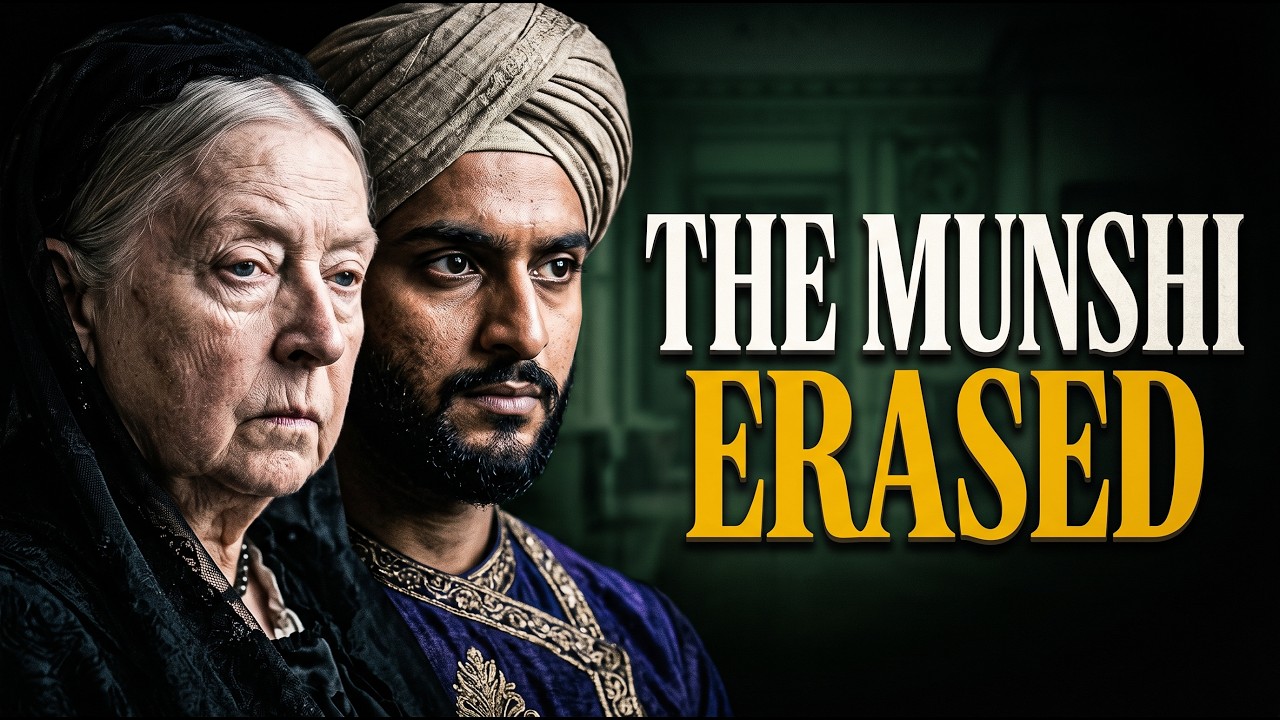
Within hours of Victoria’s death, her son and heir, now King Edward VII, launched a systematic campaign of destruction. Royal guards raided Karim’s cottage at Windsor Castle, seizing every letter, telegram, diary entry, and photograph the late Queen had written to him. In an open-air bonfire on Windsor grounds, decades of private royal correspondence turned to ash. Karim and his family were given hours to pack their belongings, then expelled from their home and banished permanently from Britain under armed guard.
For more than a century, the palace’s official historians worked to reduce Abdul Karim to a footnote, a curious anomaly in imperial history, or an ambitious charlatan who briefly exploited an aging monarch. But the purge failed. The evidence survived—hidden in private diaries, in unburned drafts, in archives long forgotten. This is the precise and true story of Abdul Karim, the farmer’s son who captured the heart of the Empress of India, the racial hysteria that nearly ignited rebellion in the British court, and the brutal imperial cover-up orchestrated by a king determined to erase his mother’s closest companion from history.
—
It was 1887, and the British Empire stood at the zenith of its power. Queen Victoria was celebrating her Golden Jubilee—fifty years on the throne—and London had become an open stage for imperial pageantry. Princes, maharajas, colonial governors, and European monarchs flocked to Westminster Abbey to pay homage to a queen whose realm spanned a quarter of the globe and ruled nearly a quarter of its people. Yet behind the dazzling public celebrations, the Empress of India was a reclusive widow consumed by grief.
Twenty-six years had passed since the death of her beloved husband, Prince Albert, and four years since the loss of John Brown, the rugged Scottish attendant who had served as her personal companion, protector, and emotional anchor. Victoria was sixty-eight, physically exhausted, nearly blind from cataracts, and suffocated by the arrogance of her stiff aristocratic court. She longed desperately for genuine human warmth—for someone who would not view her through the lens of political maneuvering or dynastic calculation. To mark the Jubilee, the British administration in India arranged a symbolic gift: two Indian servants to attend the Queen at her table.
Dr. John Tyler, the British superintendent of the central prison at Agra, was tasked with selecting candidates who were tall, handsome, and of upstanding character. Among those chosen was Mohammed Abdul Karim. Karim was twenty-four years old, the son of a hospital assistant from Lalitpur who had served with the British during the 1857 uprising.
Educated in Persian, Arabic, and Urdu, he worked as a clerk in the Agra prison administration. He was neither a nobleman nor a professional servant, but an ordinary administrative employee thrust into the heart of the most powerful imperial palace on earth. Dressed in white robes, crimson sashes, and gold-trimmed turbans designed by royal artists to embody an orientalist vision of colonial submission, Karim and his companion Mohammed Buksh boarded a steamer bound for England. Upon Karim’s arrival at Windsor Castle in June 1887, his duties were simple.
He was placed in the royal dining room to carry dishes, polish silverware, and stand silently behind the Queen’s chair. To the British court, these two men were decorative objects—living symbols of the Indian subcontinent, brought home to adorn the imperial dinner table. But Queen Victoria’s reaction was immediate and deeply personal. In her private diary that evening, she noted that Karim was tall, handsome, and possessed of a serious, dignified bearing.
While Buksh remained quiet and withdrawn, Karim had a natural warmth, a gentle manner of speech, and an emotional intelligence that pierced the Queen’s profound loneliness at once. Within weeks, Karim had surpassed his role as a dining-room servant. When the Queen complained about the heavy, flavorless English food served by the palace kitchens, Karim prepared an authentic chicken curry using spices he had brought from Agra. Victoria was so taken with Indian cuisine that she ordered Indian dishes to become a staple of her daily luncheon menu.
More importantly, Victoria began asking Karim about India. Though she had been proclaimed Empress of India in 1877 thanks to Benjamin Disraeli’s political maneuvering, Victoria had never once set foot on the subcontinent. The sea voyage was deemed too risky for her health, and her political advisors warned of the disruptions it would cause. For Victoria, India was a land of myth, romance, and imperial pride—yet she knew nothing of its spoken language, its literature, or the reality of its people.
Karim offered her a clear window into that world. In August 1887, just two months after his arrival, Victoria recorded in her diary: “I am learning some words of Hindustani to speak to my servants. It is a great interest to me. ” What began as a passing linguistic curiosity became an intensive daily routine.
Every morning, Karim would enter the Queen’s private sitting room, sit beside the monarch of the British Empire, and teach her to read, write, and speak Urdu. For Victoria, these lessons were an intellectual liberation. For Karim, they were the foundation of a stunning ascent. He was no longer merely a servant carrying a tray; he had become her secretary, her teacher, her guide, her confidant.
In a court where proximity to the monarch was the currency of power, an ordinary Indian clerk now enjoyed daily private access to the Queen of Great Britain. The shock to the royal household was immediate, and the battle lines were drawn. —
The promotion of Mohammed Abdul Karim from dining-room servant to the Queen’s official Munshi sent a violent tremor through the corridors of Windsor Castle, Balmoral, and Osborne House. In the rigid class consciousness of Victorian Britain, domestic service operated under a strict hierarchy.
Servants did not speak unless spoken to. They did not linger in royal chambers after completing their tasks. Above all, they never crossed the invisible, inviolable line between domestic service and personal companionship. That an Indian colonial subject had crossed this ancient domestic boundary within a matter of months was viewed by the royal establishment not merely as an infraction but as an existential threat to the dignity of the British Crown.
By late 1888, Queen Victoria made her sovereign intentions unmistakably clear. She issued a formal order striking Karim’s name from the official servant registers and bestowing upon him the newly created title of “Munshi of the Queen”—a position that made him a court clerk, a teacher of Oriental languages, and an official secretary. She commanded the royal tailors to design magnificent new outfits for him: vivid silk robes, embroidered tunics, crimson jackets trimmed with gold thread, and elaborate turbans rivaling the ornaments of Indian princes. She assigned him private apartments within the royal residences, complete with personal servants, silver tea services, and horse-drawn carriages at his disposal.
The man who had been brought in to pour gravy and carry soup plates suddenly traveled alongside the Empress of India on royal trains across Europe, seated opposite government ministers, foreign ambassadors, and the crowned heads of Europe. For the courtiers surrounding Victoria, this ascent was intolerable. The Queen’s private secretary, Sir Henry Ponsonby, watched with growing alarm as Karim’s daily access to the monarch eclipsed that of her most senior political advisors. Ponsonby, a seasoned courtier who had served the Queen discreetly for decades, found himself fielding mounting complaints from the royal family and the political elite.
Victoria spent hours each morning in private study with the Munshi, practicing Urdu calligraphy, translating classical texts, and discussing imperial administration. When the Queen traveled to the south of France or the Scottish Highlands, Karim was lodged in adjacent suites while senior British aristocrats were relegated to distant corridors. The aristocratic hatred directed at Karim was rooted deeply in imperial racism and class arrogance. To the British ruling class, the Indian subcontinent was occupied territory inhabited by millions of colonial subjects, to be governed with firm paternalism.
The British Civil Service in India operated under a strict system of segregation: no Indian, regardless of wealth or education, was permitted to enter whites-only clubs or sit as an equal with British officers. Yet here, inside the Queen’s private sitting room, an ordinary clerk from Agra wielded more influence over the Empress of India than the Viceroy himself in Calcutta. Courtiers referred to Karim contemptuously behind his back as “the brown John Brown,” a sarcastic allusion to the late Scottish ghillie whose rough, familiar manner had infuriated the court for decades. But unlike Brown, whose Scottish heritage at least guaranteed his belonging to the British Isles, Karim represented an ethnicity and religion that the Victorian upper aristocracy regarded with deep imperial suspicion.
Karim, acutely aware of his unique position, made no effort to appease the hostility around him. Instead of adopting the submissive, grateful posture expected of an Indian servant, he behaved with deliberate, unwavering pride. When British servants and palace staff treated him with veiled contempt or made insulting remarks, Karim appealed directly to the Queen. He refused to eat in the servants’ hall, demanding to be treated as a cultured gentleman and a court official.
When palace officials tried to accommodate his demands, Victoria intervened with fury. In a fiery diary entry written in her thick purple ink, the Queen berated her household for what she called their vile, petty, un-Christian racial prejudice. She declared that Karim was a gentleman of high morals, versed in the refined Oriental languages, and insisted that any courtier who showed him disrespect was guilty of insulting the Queen herself. The conflict escalated dramatically when Karim’s family joined the royal household.
Exploiting his favor with the Queen, he requested permission for his father, Haji Mohammed Wazir-ud-Din, the modest hospital assistant from Agra, to visit England. When the elderly man arrived, Queen Victoria received him with great warmth, assigned him royal accommodation, and provided medical care. Captivated by the old man’s dignified bearing, she later secured for him a generous pension from the Indian treasury. Shortly thereafter, Karim’s wife and nephew were brought from India and settled in a luxurious private residence known as “Karim Cottage” within the grounds of Frogmore in Windsor Home Park.
The country house was furnished entirely at the Queen’s personal expense, adorned with royal textiles, fine Victorian furniture, and luxury goods—an opulent oriental oasis set within the private grounds of the British royal family. —
Inside the court, organized resistance began to form. Queen Victoria’s children—chief among them Albert Edward, Prince of Wales, known as Bertie, and his sister Princess Helena—regarded Karim with intense loathing. The Prince of Wales, known for his love of pleasure and his careful attention to royal protocol, was offended by Karim’s public prominence.
He was repulsed by the sight of an Indian employee dining in the same railway carriage as the royal family, sitting in the front rows of private royal theatrical performances, and accompanying his mother on carriage rides through the streets of London. The royal children feared that Karim was not merely a teacher but an ambitious politician secretly poisoning the Queen’s mind against the British colonial administration, favoring Muslim interests in India, and draining vast wealth from the state treasury. Their fears intensified when Karim began offering unsolicited advice to the Queen on imperial affairs. When sectarian tensions erupted between Hindus and Muslims in India, Karim presented his view to the Queen, claiming that the British colonial administration showed systematic bias toward Hindu factions at the expense of Muslims.
Victoria, who considered herself the universal mother of all her Indian subjects, took these reports seriously. She wrote sharply worded letters to the Viceroy, Lord Lansdowne, and his successor, Lord Elgin, questioning colonial policy, rebuking British officials for their harshness, and demanding that the civil service show complete neutrality toward Muslims. The Viceroys were furious. It was unacceptable to the highest colonial authorities in Calcutta that their sovereign’s official correspondence reflected the political opinions of a twenty-six-year-old clerk from an Agra prison.
In a desperate attempt to discredit Karim, the British court enlisted the services of Indian intelligence and the secret police of the British Raj. Senior courtiers, coordinating with the Viceroy’s office, launched a secret investigation into Karim’s family history. They sent intelligence agents to Agra to search his family records, interrogate the local police, and scrutinize his father’s career. The palace was desperately seeking evidence of fraud, political extremism, or criminal associations that could be presented to the Queen to force his immediate dismissal.
The investigation revealed that Karim’s father was not a high-ranking Indian physician as Karim had claimed, but an ordinary pharmacist—and that Karim had indeed exaggerated his social standing to enhance his position at court. Armed with this intelligence file, Sir Arthur Bigge, Ponsonby’s successor as private secretary, accompanied by the Queen’s personal physician, Sir James Reid, confronted Victoria. They presented their findings, claiming that Karim was a fraud of humble origins who had systematically deceived the Crown. The confrontation produced a royal fury that shook the palace to its foundations.
Victoria flatly refused to believe the accusations. She accused Bigge and Reid of conspiring viciously and racially against a loyal, innocent man simply because of the color of his skin. She threw the papers across her desk, toppled crystal vases to the floor, and threatened to cancel high-level official engagements if her court refused to treat the Munshi with the respect due to a member of her personal staff. The crisis reached its peak during the royal family’s annual residence at Balmoral Castle in the Scottish Highlands.
The courtiers’ resentment had become unbearable over Karim’s insistence on dining with the royal family and his demands for accommodation rivaling that of senior nobles. They launched what became known as the Court Rebellion. A group of palace staff—including Bigge, Reid, and the Queen’s senior ladies-in-waiting—delivered an ultimatum: if Karim were permitted to join them at the official dinner table, they would refuse to serve and resign their positions en masse. It was a constitutional confrontation of enormous proportions: the Queen’s personal staff threatening a coordinated strike over an Indian employee.
When the ultimatum was presented to the Queen, her response was ruthless. She did not back down. Victoria summoned her private secretary and issued a harsh, uncompromising counter-threat: any courtier who refused to dine with the Munshi or insulted him would be dismissed immediately from royal service in disgrace. Faced with the reality of an absolute monarch willing to sacrifice her entire staff to defend an Indian servant, the aristocratic rebellion collapsed.
The courtiers retreated, forced to swallow their humiliation and endure Karim’s presence at court functions. But the bitter defeat only deepened their hatred. The Prince of Wales, Sir Arthur Bigge, and Sir James Reid retreated into the shadows, biding their time, knowing the Queen was approaching her eightieth year. Her health was steadily declining, and the moment she died, their revenge on Mohammed Abdul Karim would be total, merciless, and complete.
—
By the mid-1890s, the battle lines within the royal court had hardened into a permanent cold war. Having crushed the court rebellion at Balmoral with her sovereign authority, Queen Victoria set about transforming Abdul Karim into one of the most exalted figures in the British Empire. She was no longer content merely to defend his presence—she was determined to shower him with honors, public accolades, and material security befitting the established feudal nobility of Great Britain. To Queen Victoria, the Munshi was her faithful companion, her intellectual window onto an empire she had ruled without ever touching, and the only person in her vast royal household who treated her not as an ancient constitutional institution but as a living human being.
To the British ruling elite, every new honor granted to the Indian clerk was an intolerable provocation threatening the racial order of the British Empire. The Queen’s campaign to elevate Karim reached its zenith when she began proceedings to grant him a knighthood. Victoria approached Prime Minister Lord Salisbury with a direct request: she wished to confer upon Abdul Karim the title of Knight Commander of the Order of the Indian Empire (KCIE). The proposal sent shockwaves through the highest levels of the British government.
In colonial India, the KCIE was reserved for senior British governors, generals, and ruling Indian princes of ancient lineage. Granting this honor to a former prison clerk from Agra, whose father was a humble pharmacist, would be an imperial catastrophe that would permanently undermine the racial authority of the British Raj. Lord Salisbury, a seasoned Conservative statesman accustomed to managing diplomatic crises, recognized that open resistance to the Queen’s fervent demands would only provoke another storm of royal wrath. Instead, Salisbury worked secretly in coordination with the Viceroy of India and the Secretary of State for India to slow the process, offering polite bureaucratic resistance while coordinating quietly with the Prince of Wales.
Senior officials warned the Queen that knighting the Munshi would provoke widespread outrage among both the Anglo-Indian civil service and the Indian ruling aristocracy, who would see the honoring of a commoner as a grave insult to their hereditary status. Faced with unified political resistance, Victoria was forced to compromise—but she refused to surrender entirely. Instead of a knighthood, she conferred upon Karim the Companion of the Order of the Indian Empire (CIE) and the Commander of the Royal Victorian Order (CVO)—two sovereign, personal honors over which the cabinet had no veto power. The Queen’s devotion extended beyond medals and ceremonial sashes.
Victoria commissioned the renowned Austrian painter Heinrich von Angeli and royal court artist Rudolf Swoboda to paint full-length oil portraits of the Munshi. These were not modest depictions of a servant; Karim was painted standing tall and majestic in luxurious oriental brocades, gold-embroidered turbans, and jeweled tunics, assuming the bearing of an Eastern prince. Victoria ordered these portraits hung in prominent positions within the state rooms of Windsor Castle and Balmoral, alongside portraits of European emperors, British prime ministers, and her royal ancestors. Furthermore, the Queen ordered a magnificent estate to be secured for Karim in India.
Through her direct sovereign intervention, she pressured the colonial government in Calcutta to grant the Munshi a large plot of land in Agra, ensuring that upon his return home he would live as a wealthy, independent landowner backed by substantial personal fortune. Yet beneath the glitter of royal patronage, a far more dangerous drama was unfolding behind closed doors: the matter of imperial state secrets. As the Queen’s eyesight deteriorated rapidly from severe cataracts, she relied increasingly on Karim to handle her private papers. The Munshi had open access to the royal writing desks, where daily red boxes arrived containing secret government correspondence, imperial dispatches, and private political letters from London and Calcutta.
The political establishment was horrified that sensitive military and administrative documents—concerning the defense of India’s borders, intelligence operations in Afghanistan, and colonial administrative policies—were being openly viewed by a Muslim Indian clerk. The suspicions escalated into outright panic when British intelligence detected Karim’s close friendship with Rafiuddin Ahmed, an eloquent Indian Muslim lawyer and political activist residing in London. Ahmed was closely connected to the growing Islamic movement and was actively seeking to represent Indian Muslims politically in the British government. To British security services and the Viceroy’s council, this relationship appeared terrifyingly clear: Karim was passing classified information from the Queen’s private chambers to Ahmed, who was using his insider knowledge of the royal family to influence political discourse in London and India.
The head of the Indian Political Department warned that the palace was harboring a serious intelligence leak at the very heart of the state. When Sir Arthur Bigge and Sir James Reid attempted to raise these national security concerns with Queen Victoria, she responded with scathing contempt. She accused her officials of suffering from pathological racial hysteria, declaring that the allegations of political espionage were malicious lies invented by men whose pride was wounded because an Indian could read and write English better than they could. In a moving letter defending Karim, Victoria wrote that she had tested his loyalty time and again, that he was her most sensible and trustworthy subject, and that her family’s and household’s relentless persecution of her Munshi was a shameful act unworthy of Christianity.
She made clear that anyone attempting to question Karim was directly questioning the wisdom of the Queen herself. —
Within the royal household, Sir James Reid found himself trapped in a painful double life. As the Queen’s personal physician, he was among the few men with unrestricted daily physical access to her bedside. At the same time, Reid had become the primary liaison between the terrified courtiers, the anxious politicians, and the vengeance-thirsty Prince of Wales, all of whom yearned to find a way to break Karim’s hold over the Queen before her death plunged the institution into scandal.
Reid kept a secret diary in which he recorded with precise, devastating clarity the depth of the psychological attachment Victoria had developed to the Munshi. For Reid, the relationship was an emotional tragedy: an aging, dying queen clinging to the only genuine human affection in her final years, while her courtiers and children waited like vultures for the right moment to strike at the man who had brought her comfort. Reid’s diary reveals that as the Queen reached her eightieth year in 1899, the court had reached the brink of madness. Courtiers secretly searched the trash baskets at Karim’s house, monitored his visitors, and interrogated his personal servants, desperately seeking any financial impropriety or embarrassing love letters.
They knew the Queen’s health was deteriorating rapidly. Chronic rheumatism had severely impaired her ability to walk. Her voice was weakening, and she spent long hours dozing in her wheelchair at Osborne House on the Isle of Wight. But whenever she woke, her first question was almost always the same: “Where is the Munshi?
”
Karim remained by her side, sitting quietly beside her chair, massaging her swollen feet with aromatic oils, and reading to her in soft, flowing Urdu from the classical texts they had studied together for over a decade. In the dim, hushed rooms of Osborne House, as the Victorian age silently slipped toward its end, the aging Empress of India clung to the hand of her Indian clerk. For Victoria, he was a symbol of her imperial pride, her beloved India made flesh, and her only true friend in a court filled with cold, calculating dynastic ambition. Outside the bedroom door, the Prince of Wales, Princess Helena, and Sir Arthur Bigge stood in silent assembly, watching the dying Queen through the gaps in the heavy wooden doors.
Their faces were grim, hard, and devoid of pity. The Queen was still alive, and as long as she breathed, they could not interfere. But they had already drafted the administrative decrees, summoned the royal guards, and prepared the fires. The moment the Empress closed her eyes for the last time, the long-deferred reckoning against Mohammed Abdul Karim would be executed with cold imperial brutality.
—
On the evening of January 22, 1901, the long reign of Queen Victoria—sixty-three years—came to an end. In the quiet, dark bedroom of Osborne House on the Isle of Wight, surrounded by weeping children, grandchildren, and medical attendants, the eighty-one-year-old Queen passed away. The vast British Empire sank into collective mourning, and the Victorian age breathed its last. For the courtiers standing in the shadows of the bedroom, grief was immediately overtaken by a cold, calculating administrative matter.
The sovereign shield that had protected Mohammed Abdul Karim for fourteen years had vanished. Before the Queen’s body had even grown cold, Albert Edward—now King Edward VII—began operating the cruel machinery of erasure. The new king had harbored for decades a suppressed resentment toward the man who had occupied the throne of British aristocrats, dined in royal drawing rooms, and enjoyed his mother’s trust. Edward VII summoned Sir James Reid and royal military officers to his private residence and issued direct, unequivocal orders.
Karim’s residence was to be sealed immediately. Every document bearing the late Queen’s handwriting was to be confiscated. The court clerk was to be removed before the royal funeral began. The raid was executed with military precision.
Armed guards and senior palace officials descended upon Karim’s house in the Frogmore grounds of Windsor Home Park. Accompanied by Sir James Reid, tasked with executing the sovereign directive, the officials pounded on the front door, shocking the grieving Munshi and his family. Palace officers moved through every room with systematic thoroughness, tearing open mahogany writing desks, searching side-table drawers, lifting floorboards, and breaking into heavy iron-banded travel trunks. Their objective was clear: confiscate every letter, telegram, handwritten note, postcard, and scrap of paper written by Queen Victoria to Karim.
The royal family was terrified of what those documents contained. Over fourteen years, Victoria had written thousands of letters to her Munshi, often signing them with deeply affectionate, almost maternal phrases such as “your loving mother” and “your nearest and dearest friend. ” In the minds of the new king and his paranoid household, these private admissions represented an existential threat to the dignity and moral standing of the Crown. Had those letters been published, they would have shattered the empire’s illusions about the isolation of the sovereign and the racial hierarchy upon which it rested.
What followed was one of the most brazen acts of institutional censorship in modern British history. Outside Karim’s cottage, on the manicured lawns of Windsor, within sight of the royal mausoleum, palace guards lit an open-air fire. Box after box of handwritten sovereign correspondence was carried out into the cold January air. Handfuls of letters bearing the royal cipher of the Empress of India, private diaries recording her daily thoughts in Urdu, and personal telegrams accumulated over more than a decade were thrown directly into the flames.
Sir James Reid stood by the fire, watching the sparks fly into the Berkshire sky, ensuring that not a single page survived the destruction. Karim stood on the gravel path in a daze of helpless pain, watching his entire relationship with the Queen of the British Empire turn to ash before his eyes. He had served the Queen with unwavering loyalty, endured years of aristocratic abuse and court rebellions on her behalf—and now the record of their shared life was being deliberately obliterated as though it had never existed. The humiliation did not end with the bonfire.
While Edward VII grudgingly allowed Karim a brief private moment to cast a final glance at the Queen’s body lying in state at Osborne House—a concession granted only because Victoria had left strict written instructions demanding it—the Munshi was barred from any prominent ceremonial position in the public funeral processions in London. As foreign monarchs, imperial military leaders, and royal princes marched behind the Queen’s gun carriage in majestic formation, Karim was relegated to the far margins, under constant surveillance by plainclothes investigators tasked with preventing him from speaking to the press or approaching the new Queen. Once the funeral ceremonies concluded, the eviction order was issued, final and irrevocable. King Edward VII granted Karim and his family a few hours to pack their personal belongings, vacate Karim Cottage, and prepare for permanent departure from British soil.
All court privileges, access to the palace, and official allowances were cancelled immediately. Investigators accompanied the family to the port and ensured they boarded the steamer bound for Bombay without delay. The man who had traveled across Europe in private royal trains, met with prime ministers, and lived at the heart of global power was expelled from the kingdom as an undesirable. —
Upon his arrival in India in April 1901, Karim returned to his estate in Agra—property granted to him during Queen Victoria’s lifetime, which the new king could not legally confiscate.
Yet even across thousands of miles of ocean, the grip of the royal institution continued to pursue him. King Edward VII remained convinced that Karim had managed to conceal additional private letters from the Windsor raid. The King sent urgent secret telegrams to the Viceroy of India, Lord Curzon, demanding that Karim’s movements be monitored, his correspondence intercepted, and his home in Agra raided to seize any remaining royal artifacts. Lord Curzon complied with stern imperial efficiency.
British political officers and colonial police raided Karim’s home in Agra, subjected the former Munshi to fresh interrogations, and searched his personal luggage. Several additional letters, photographs, and personal diaries that Karim had hidden during the first raid at Windsor were confiscated and immediately shipped to London for burning in the fireplaces of Marlborough House. The British Raj placed Karim under informal surveillance, warning him that any public interviews, publication of memoirs, or political commentary would result in the immediate confiscation of his land and complete financial ruin. Broken in spirit, shunned by the colonial elite, and grieving the only sovereign who had ever treated him as an equal, Mohammed Abdul Karim withdrew into complete seclusion.
He lived a quiet, isolated life behind the walls of his mansion in Agra, surrounded only by the few family members who had accompanied him into exile. This elegant man, resplendent in his gold embroidery, who had once dominated the halls of Balmoral and Windsor, spent his final years in quiet solitude, his health gradually deteriorating under the weight of illness and isolation. In April 1909, only eight years after Queen Victoria’s death, Abdul Karim died in Agra at the age of forty-six. He had outlived his royal patroness by less than a decade.
He was buried in a modest mausoleum within the family cemetery, leaving behind no political party, no published memoirs, and no significant material trace of the extraordinary influence he had once wielded over the ruler of a quarter of the globe. With Karim’s death, King Edward VII believed his victory was complete. The official biographies of Queen Victoria, written by courtiers such as Arthur Benson and Lord Esher, systematically deleted the name of the “Munshi” from royal records. When he was mentioned at all, he was portrayed as a greedy, manipulative servant who had exploited an elderly woman’s weakness.
The letters were neglected, the house was moved, and the archives imposed disciplined silence. The British royal family closed ranks, confident that its most controversial friendship had been buried forever beneath the dust of imperial history. For nearly a century, the deliberate erasure orchestrated by King Edward VII appeared to have succeeded brilliantly. In the officially sanctioned histories of the British monarchy, Abdul Karim was either omitted entirely or reduced to a distorted caricature: a manipulative opportunist from the lower classes who had briefly managed to deceive a sad, aging queen in the twilight of her long reign.
Generations of court historians accepted the narrative crafted by Sir Arthur Bigge, Sir James Reid, and the Windsor establishment without question. The royal family believed that by burning the letters, exiling the man, and silencing the archives, they had purified the imperial record forever. But they had overlooked the silent endurance of the written word—and the fact that truth can survive even the most powerful dynasties on earth. —
The first major crack in the century-long cover-up emerged from the very palace archives that had sought to conceal it.
While King Edward VII had ordered the destruction of every private letter his mother had written in English to Karim, he had overlooked a complete set of leather-bound volumes sitting quietly on the shelves of the royal archives at Windsor Castle: Queen Victoria’s private diaries written in Hindustani. Written entirely in the elegant, clear Urdu script that Karim had taught her over thirteen years of daily study, these diaries had been preserved simply because no one in the royal court—including the King and his private secretaries—could read a single word of the language. To the English courtiers, those strange, curved lines appeared to be nothing more than ordinary school notebooks. In reality, they were private daily journals in which the Empress of India had recorded her deepest feelings, her reflections on Indian culture, and her profound affection for her Munshi.
Then came the discovery that definitively demolished the royal myth. In the late 2010s, the British-Indian writer and historian Shrabani Basu began meticulous research into the scattered references to Karim found throughout Queen Victoria’s residences. Basu traveled across England and India, tracing the lineage of Karim’s surviving family members. The journey ultimately led from the grand halls of Windsor to the bustling streets of Karachi, Pakistan, where Karim’s descendants had migrated after the bloody partition of India in 1947.
There, inside a worn, forgotten trunk passed down through generations of relatives who had kept it safe through wars, migrations, and decades of poverty, lay Abdul Karim’s personal diaries in his own handwriting. Written in Karim’s elegant, formal script, the diaries covered his fourteen-year residence at the British royal court. They contained a precise, detailed account of his arrival in London, his early tense meetings with the Empress of India, the intricate daily lessons in the royal reception rooms, and the intense racial hostility he faced from courtiers who conspired to bring him down. Far from the stereotype of the ignorant, deceitful fraud depicted by Edwardian aristocrats, the diaries revealed a cultivated, observant, and deeply sensitive man who genuinely loved the Queen, took immense pride in his cultural heritage, and maintained extraordinary dignity in the face of relentless aristocratic humiliation.
The discovery of Karim’s diaries forced a radical, worldwide reassessment of Queen Victoria’s reign and the essential nature of the British Empire. The narrative that had underpinned British imperial pride—of a benevolent, civilizing empire built on natural racial hierarchy—was exposed as hypocritical falsehood. At the summit of that global empire sat an Empress who was deeply fascinated by the language, poetry, and religion of the peoples her nation had colonized, choosing a Muslim Indian clerk as her closest emotional advisor, ahead of the highest dukes, prime ministers, and princes of Great Britain. The court rebellions and the horrifying Windsor bonfire were not born of a breach of palace protocol or the excessive influence of an ordinary servant.
They were driven by entrenched imperial fear—a terror of the collapse of the racial boundaries separating the white ruler from his colonized subjects, within the Queen’s own bedroom. If an Indian man could sit as an equal with the Queen at her table, teach her his native language, and advise her on colonial affairs, then the entire moral and political justification for the British Raj collapsed. King Edward VII did not burn his mother’s letters to protect her dignity. He burned them to protect the supremacy of the British white ruling class.
—
Today, Mohammed Abdul Karim has reclaimed his rightful place in history. His full-length oil paintings still hang in the royal collections at Osborne House and Windsor—no longer hidden in shame, but studied by millions of visitors from around the world as evidence of an extraordinary, daring human bond that defied the most powerful court on earth. His modest grave in Agra, long forgotten under the weight of time, is now recognized as the resting place of a man who transcended the boundaries of empire and shook the foundations of the British Crown. The story of Abdul Karim stands as a vital lesson in the face of dynastic power, imperial arrogance, and the erasure of history.
It proves that no matter how many fires a king may light, how many files a government may seal, or how hard any institution tries to rewrite its past, history cannot be permanently erased. In the end, the fire meant to reduce Abdul Karim to forgotten ash illuminated his extraordinary life for the entire world.
