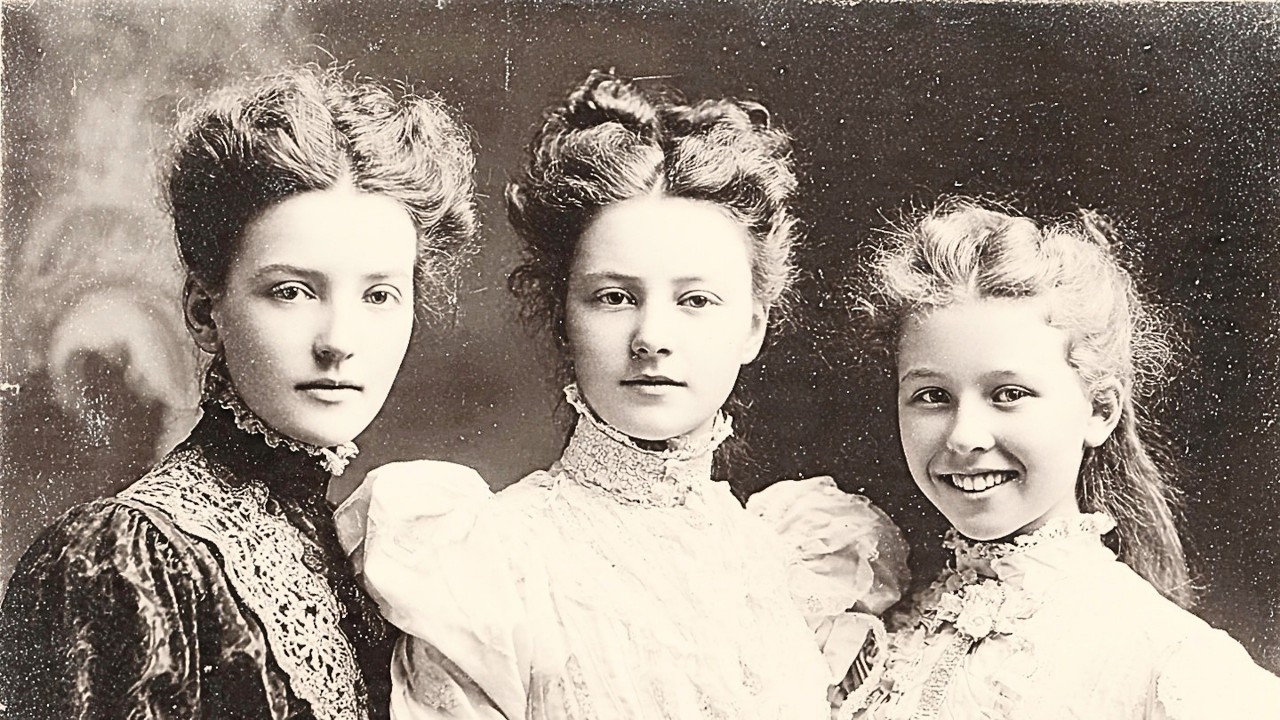
Three girls stand side by side in a photograph taken in 1891, and one of them should not exist. Not in the way one might think. This is not about ghosts or double exposures or darkroom mistakes. It is about something far stranger.
Marian Gephardt, a postal historian, stumbled into it on a wet Thursday afternoon in April 2019, while cataloging estate donations in the basement of the Haverhill Regional Archive in southern Vermont. She was not looking for a mystery. She was looking for stamps. Marian had worked at Haverhill for eleven years.
She knew the smell of old glue, the feel of foxed paper, the particular silence that settles over rooms full of forgotten correspondence. Her work was methodical, often tedious, and exactly that way she liked it. She would take a box, sort its contents, log what was valuable, and move on. The Pritchett estate donation was different from the start.
It arrived in forty-seven cardboard boxes, most of them water-damaged, all of them chaotic. No inventory, no order, just decades of one family’s paper trail dumped into containers and delivered by a law firm that wanted them gone. She had been working through the boxes for two weeks when she found the photograph. It was tucked inside a ledger from 1903, pressed flat between pages of grocery accounts.
The ledger itself was unremarkable. Flour, salt, lamp oil, the ordinary debris of rural life. But the photograph stopped her cold. Three young women stood in a row, arms linked, in front of a painted studio backdrop depicting a garden arbor.
They wore high-collared dresses with leg-of-mutton sleeves, their hair swept up in the tight formal style of the 1890s. The girl on the left looked to be about nineteen. The girl in the middle, perhaps seventeen. The girl on the right was younger, maybe fourteen or fifteen.
But it was not their ages that caught Marian’s attention. It was their faces. The two older girls looked directly at the camera with the rigid, unsmiling composure typical of long exposures. But the youngest girl, the one on the right, was smiling.
Not a polite, restrained smile. A genuine, open-mouthed grin. Her head was tilted slightly, as if someone had just told her something funny. And her image was perfectly sharp.
Anyone who knows early photography knows why that is wrong. Exposure times in the 1890s required subjects to remain absolutely still for several seconds. Even slight movement caused blurring. A turned head, a shifting hand, anything.
Yet this girl, clearly in motion, was as crisp and clear as her motionless sisters. Marian held the photograph under her desk lamp and examined it with a loupe. No blur. No softness.
No sign of movement at all, despite the unmistakable tilt of her head and the wide, unguarded smile. She flipped the photograph over. On the back, written in faded brown ink, were three names: Constance, Beatrice, and Opal Ferris. Studio of H.
Wickham, Dalton. June 1891. Marian photographed the image with her phone and sent it to a colleague at the Northeast Photographic Conservation Lab. She did not explain why.
She just asked whether the image showed signs of manipulation or retouching. The reply came within the hour. Albumen print. Consistent with the period.
No evidence of alteration. No double exposure. No montage work. A straightforward studio portrait.
Except it was not straightforward at all. She began searching for the Ferris family that same evening. Census records, birth certificates, newspaper archives. She found them quickly.
The Ferris sisters lived on a farm outside Dalton, Vermont, a town barely large enough to warrant a post office. Their father, George Ferris, was a wheelwright. Their mother, Lenora, died in 1889. The girls appeared in the 1890 census.
Constance, age eighteen. Beatrice, age sixteen. Opal, age thirteen. Then Marian found the obituary, published in the Dalton County Register on March 12th, 1891, just three months before the photograph was taken.
Opal Ferris, beloved daughter of George Ferris, departed this life on the 9th of March, aged 13 years. She is survived by her father and two sisters. Services held at the Methodist Church. Interment at Greenhill Cemetery.
Marian read it twice, then a third time. The girl on the right, the one smiling, the one whose image defied every rule of nineteenth-century photography, had been dead for three months when the picture was taken. She pulled the photograph up on her screen and zoomed in on Opal’s face. The smile was so clear.
So alive. So impossible. She did what anyone would do: she started looking for an explanation. A mistake in the records.
A misidentified name. A different Opal Ferris in a different town. But the deeper she dug, the stranger it became, because Opal was not just in the photograph. She was the only one smiling.
Marian printed the obituary and pinned it next to the photograph on her desk. Then she went looking for the grave. Greenhill Cemetery sits on a sloping hillside two miles east of what used to be Dalton. The town itself barely exists anymore.
A few houses, a defunct general store, and a historical marker most people drive past without slowing down. But the cemetery is still there, overgrown, unmaintained, but there. Marian drove up on a Saturday in early May with a notebook, a camera, and a printout of the death record listing Opal’s burial location. Section C, row seven.
The cemetery had no caretaker, no office, no map. Just a rusted gate hanging open and rows of tilted headstones disappearing into tall grass. She found section C by counting rows from the eastern fence. Most stones were worn smooth, names erased by a century of weather.
But Opal’s marker was still legible, a small granite stone, simple and unadorned. Opal Marie Ferris. 1877. 1891.
Gone to rest. Marian stood there a long time looking at the dates. Born 1877. Died 1891.
The math was clear. Opal had been thirteen when she died on March 9th. The photograph was dated June 1891, three months later. She photographed the headstone from every angle and checked the stones nearby.
George Ferris lay four plots over, died in 1904. No stone for Constance or Beatrice. They must have married, moved away, or been buried elsewhere. But Opal was here, confirmed dead before the photograph was taken.
Marian drove back to Haverhill that evening and spent the rest of the weekend searching for H. Wickham, the photographer whose studio name was written on the back of the portrait. She found him in a business directory from 1889. Harold Wickham, photographer, Main Street, Dalton.
He advertised portraiture of the finest quality and special rates for families. There were no surviving examples of his work in any regional archive, no advertisements after 1895, no death record in Vermont. He simply vanished from the documentary trail. But she found something else.
In the October 1891 edition of the Dalton County Register, buried in the back pages between farm reports and patent medicine ads, was a small notice: H. Wickham’s Studio of Photography would be closing its doors at the end of the month. Mr. Wickham expressed gratitude to his many patrons and wished them well.
All outstanding orders could be collected before October 30th. Four months after the Ferris photograph was taken, Wickham closed his studio and disappeared. Marian noted the timing. Then she went looking for anyone who might still know the story.
Dalton had a historical society, technically. It consisted of one woman, Pauline Driscoll, who ran it out of her living room and opened it by appointment only. Marian called her on a Monday morning. Pauline sounded delighted to hear from someone, anyone, interested in local history, and invited Marian to visit that same afternoon.
Pauline’s house was a small cape on the edge of town, its rooms crammed with filing cabinets, binders, and boxes of photographs. She had been the historical society’s sole member for sixteen years, ever since her husband died and she decided she needed a project. She knew every family tree, every property transfer, every minor scandal that ever passed through Dalton. Marian showed her the photograph.
Pauline put on her reading glasses and studied it in silence. Then she turned it over, read the names, and looked up with an expression Marian could not quite read. “You know about Opal,” Pauline said. It was not a question.
Marian nodded. “I found her grave and her obituary. She died three months before this picture was taken. ”
Pauline set the photograph down gently on the table between them.
“I’ve heard about this photograph my whole life. My grandmother mentioned it once. Said it was something people used to whisper about. A picture that didn’t make sense.
I always thought it was just a story. I didn’t think it actually existed. ”
“What did your grandmother say about it? ”
Pauline walked to one of her filing cabinets and pulled out a binder labeled Ferris family.
She flipped through plastic sleeves filled with census pages, land deeds, and newspaper clippings, then stopped on a photocopy of a handwritten letter. “This was written by Constance Ferris in 1932,” Pauline said. “She was living in Albany by then, widowed, no children. She sent this letter to a cousin who still lived in the area.
I got a copy years ago from an estate sale. ”
Marian leaned forward. The letter was three pages long, written in careful, elderly script. Most of it was mundane.
Health updates. Weather observations. But near the end was a paragraph that made Marian’s pulse quicken. “You asked about the photograph.
I don’t like to speak of it, but I suppose enough time has passed that it hardly matters now. Yes, it was taken after Opal died. Father insisted. He went to Mr.
Wickham’s studio and made some kind of arrangement. I don’t know what he said or what he paid, but Wickham agreed to do it. Beatrice and I thought it was madness. We had already mourned her.
But father couldn’t let her go. He wanted a portrait of the three of us together the way we should have been. Wickham took the photograph and when we saw it, we couldn’t understand what we were looking at. Opal was there, not as a shadow or a blur.
She was there. Smiling. Father wept when he saw it. He kept it on the mantel until the day he died.
I never wanted to see it again. ”
Marian read the passage three times. Pauline watched her carefully. “So it’s real,” she said quietly.
“The photograph is real. ”
“But how? ” Marian asked. “Constance says Wickham agreed to do it, like it was something he could arrange.
Like he had a method. But there was no technology in 1891 that could do this. No way to insert a dead girl into a photograph and make her look alive, in motion, smiling. ”
Pauline shook her head.
“I don’t know. ”
“But Wickham left town four months later and never came back. Maybe he knew he’d done something he shouldn’t have. ”
Marian photographed the letter, thanked Pauline, and drove back to Haverhill with more questions than she had started with.
That night she began searching for any other photographs produced by H. Wickham. If he had some technique, some process, there might be others. She combed through digital archives, historical societies, and museum collections across Vermont, New York, and New Hampshire.
She found nothing. No other photographs. No advertisements. No reviews.
No mention of Harold Wickham anywhere except that one business listing and that one closure notice. It was as if he had taken a single impossible photograph and then erased himself from history. But Marian was not done, because there was one more place she had not looked: the rest of the Pritchett estate boxes. She had found the photograph in box nine.
There were thirty-eight boxes left. If the Ferris family photograph had ended up in that estate, tucked inside a grocery ledger, there was a chance something else had survived. Something that might explain what Harold Wickham had done. She started going through the remaining boxes with a different focus.
She was not looking for stamps anymore. She was looking for anything connected to the Ferris family, to Wickham, to Dalton in the 1890s. It took her three days. Box twenty-two contained a stack of leather-bound journals.
Account books, mostly, records of transactions, debts, and payments. They belonged to a man named Raymond Pritchard, a grain merchant who had done business throughout the county in the late nineteenth century. Marian almost set them aside. But then she noticed that one journal had loose pages tucked inside the back cover.
She pulled them out. They were letters. Five of them, all addressed to Raymond Pritchard, all from the same sender. Harold Wickham.
The first was dated July 3rd, 1891, just weeks after the Ferris photograph was taken. “Dear Mr. Pritchard, I write to you in confidence, as you are a man of discretion and commerce both. I find myself in a position most unusual and, I confess, quite troubling.
A client recently commissioned a service from me that I fulfilled to his satisfaction, but which has left me deeply unsettled. I cannot discuss the particulars in detail, but I will say this. I have developed a photographic technique that produces results I do not fully understand. The images are flawless.
They are impossible. And I fear I have trespassed upon something I was never meant to approach. I am writing to ask if you know of any buyer who might be interested in purchasing the method, the equipment, and all associated materials. I wish to be rid of it entirely.
I will not practice this technique again. Your discretion is appreciated. H. Wickham.
”
Marian read the letter twice, then moved to the second, dated July 18th, 1891. “Dear Mr. Pritchard, thank you for your response. I understand your skepticism.
I would not believe it myself if I had not seen the results with my own eyes. You ask for proof, and I cannot provide it without revealing the client’s identity, which I am bound not to do. But I will tell you this. The method involves a pre-exposure process using a tincture of colloidal silver and a prepared emulsion I developed through extensive trial.
The subject need not be present during the second exposure. What is required is an object of intimate connection. Hair most effectively. Cloth worn by the subject.
Something that holds their essence, if you will permit the term. I know how it sounds. I know what you must think of me. But I have done it, and it works.
And I want no part of it anymore. Please let me know if you have found a buyer. H. Wickham.
”
Marian’s hands were shaking. The third letter was dated August 9th, 1891. “Dear Mr. Pritchard, I appreciate your efforts, but I must withdraw my offer.
I have decided to destroy the equipment and the formula. What I have created is not a tool of science. It is something else. I performed the process three times in total, and each time the results were the same.
Perfect. Impossible. Wrong. The third client brought me a lock of hair from her son, who had drowned the previous winter.
She wanted a portrait of him. I told her it could not be done. She offered me more money than I have ever been paid for any commission. I accepted.
God forgive me, I accepted. When I developed the plate, the boy was there. Standing in my studio. Smiling.
I have never met him. I have never seen his face. But there he was, as clear and real as any living child I have ever photographed. I gave the woman her portrait and told her I was closing my studio.
She asked if I could do it again for her daughter who died of scarlet fever. I refused. I burned the formula that night. Please do not write to me again.
I am leaving Dalton. H. Wickham. ”
The final two letters were brief.
Pritchard had written back, asking Wickham to reconsider. Wickham’s replies were terse, almost frantic. He wanted nothing to do with the process. He wanted to forget it existed.
The last was dated September 22nd, 1891. “Mr. Pritchard, I am leaving for Boston at week’s end. I will not be returning.
If anyone asks after me, please tell them nothing. I have made a mistake I cannot unmake. I have given people images of the dead, and those images are not photographs. They are something else.
I see it now. I see it in the way they look out from the paper, the way their eyes seem to follow you. These are not memories. They are intrusions.
Do not seek me out. H. Wickham. ”
Marian sat in the archive basement, surrounded by boxes, staring at the letters spread across the table.
Wickham had developed a technique that did not require the subject to be present. A method that used something personal, something connected to the deceased, and produced an image that should not exist. He had done it at least three times. The Ferris girl.
The drowned boy. Possibly others. Then he had fled. She scanned the letters and sent them to a colleague at the University of Vermont who specialized in the history of photography, asking without context if anyone had ever documented a technique like the one Wickham described.
The response came the next morning. “Never heard of anything like this. Colloidal silver was used in some experimental processes in the 1880s, but nothing involving absent subjects or objects of connection. Sounds more like spiritualism than photography.
Probably a hoax or a delusion. ”
But Marian had the photograph. She had Constance’s letter. She had Opal’s grave.
It was not a hoax. She went back to Pauline Driscoll’s house and showed her the letters. Pauline read them in silence, her expression growing more troubled with each page. “Do you think he really did it?
” she asked. “Do you think he actually found a way to photograph the dead? ”
Marian did not answer right away. She looked at the photograph again, at Opal’s smiling face, her tilted head, the impossible sharpness of her image.
“I think he believed he did,” Marian said slowly. “And I think the results were real enough to terrify him. ”
Pauline set the letters down. “There’s one more thing you should know.
My grandmother told me that after George Ferris died, Constance came back to Dalton to settle his estate. She burned everything in the house. Furniture, clothes, papers. Everything.
The neighbors thought she’d lost her mind. But she told someone, I don’t remember who, that she was burning it because she didn’t want anything of his to remain. She said he’d brought something into the house that shouldn’t have been brought. She said the photograph was still there, hanging on the wall, and she couldn’t make herself take it down.
”
“But she didn’t burn it,” Marian said. “No,” Pauline said. “She left it hanging there. And eventually, someone else took it.
And now it’s here. ”
Marian looked at the photograph one more time. Opal Ferris. Dead at thirteen.
Smiling in a photograph taken three months after her burial. Somewhere in that image, if Wickham’s letters were to be believed, was not a memory, but something else. She spent the next two weeks trying to find the other photographs Wickham had mentioned. The drowned boy.
Any others he might have created before he fled. She searched obituaries from 1890 and 1891 in Dalton and the surrounding towns, cross-referencing them with surviving photographic collections. She contacted historical societies, libraries, and private collectors across New England. She found nothing.
No photographs. No mentions of unusual portraits. No stories matching what Wickham had described. It was as if those images had been destroyed, hidden, or lost to time.
All except one. The Ferris photograph. But Marian could not let it go, because something in Wickham’s letters kept nagging at her. Something he had said in that final message to Pritchard.
These are not memories. They are intrusions. She kept coming back to that word. Not representations.
Not likenesses. Intrusions. What did Wickham mean? She decided to examine the photograph more closely, not with a loupe, but with modern technology.
She contacted a forensic imaging specialist named Dr. Elliot Moss at the Massachusetts Institute of Digital Preservation and sent him high-resolution scans of the photograph, asking whether he could analyze it for anomalies invisible to the naked eye in 1891. Dr. Moss called her three days later.
“I’ve been doing this for twenty years,” he said. “I’ve analyzed thousands of nineteenth-century photographs. Tintypes, daguerreotypes, albumen prints, all of them. I’ve seen every kind of manipulation, every darkroom trick, every technical flaw you can imagine.
”
Marian waited. “This photograph is wrong,” he said. “Wrong how? ”
“The girl on the right.
Opal. Her image has a different tonal depth than her sisters’. It’s subtle. You wouldn’t notice it without digital analysis.
But when I isolated the three figures and measured the light distribution, hers doesn’t match the studio lighting. It’s like she’s lit from a different source. Or like she’s not quite in the same room. ”
Marian felt her stomach tighten.
“Could that happen naturally? Some quirk of the development process? ”
“No,” Dr. Moss said.
“Albumen prints don’t do that. If all three subjects were photographed at the same time under the same lights, which they clearly were based on the backdrop and positioning, their tonal value should be nearly identical. But Opal’s aren’t. And there’s something else.
” He paused. “When I ran a pixel density analysis on her face, specifically her eyes, I found something I’ve never seen before. There’s a kind of layering, like her image is slightly out of phase with the rest of the photograph. It’s almost imperceptible, but it’s there.
It’s as if her image was added, but not through double exposure or montage. It’s like it was inserted into the photograph at a molecular level. ”
Marian did not speak. “Where did you get this?
” Dr. Moss asked. “In the state archive in Vermont. ”
“Do you know who took it?
”
“A photographer named Harold Wickham. He closed his studio four months after taking this picture and disappeared. ”
There was a long silence on the other end of the line. “Miss Gephardt,” Dr.
Moss said slowly, “I don’t know what this is. But it’s not a normal photograph. And I don’t think it was made using any technique I’m aware of. If you find out how he did this, I’d very much like to know.
”
Marian thanked him and hung up. She sat in her apartment that night with the photograph on the table before her. She had lived with it for weeks, studied it, researched it, tried to understand it. And the more she learned, the less sense it made.
Wickham had claimed he used colloidal silver in a prepared emulsion. He had said the subject did not need to be present. He had said all he needed was something of intimate connection. Hair.
Cloth. Something that held their essence. Marian thought about George Ferris, grief-stricken, desperate for a portrait of his three daughters together. She thought about him going to Wickham’s studio with a lock of Opal’s hair, or a ribbon she had worn, something kept from before she died.
She thought about Wickham preparing his emulsion, exposing his plate, developing the image. And she thought about what had appeared. Not a memory. An intrusion.
She opened her laptop and searched for one more thing, something she had been avoiding, but now needed to know. She searched for other reports of photographs that showed the dead. Spiritualist photography. Spirit images.
The Victorian obsession with capturing the departed. She found thousands of examples, because the late nineteenth century was full of them. Photographers who claimed they could capture ghosts, spirits, and the souls of the deceased hovering beside the living. But all of them were obvious frauds.
Double exposures. Mannequins. Models in sheets. Tricks designed to exploit grieving families.
None of them looked like the Ferris photograph. None of them showed a dead child standing solid and clear beside her living sisters, smiling as if she had just heard a joke, her head tilted in a way that should have blurred the image but did not. Then Marian found one account that stopped her cold. It was a letter published in the Journal of the American Society for Psychical Research in 1897.
A woman in Connecticut reported an unusual photograph taken of her family in 1892. She claimed her deceased brother appeared in the image standing behind her father, even though he had been dead six months. She said the photographer had seemed nervous when he presented the final portrait, that he had refused payment, and that he had closed his studio shortly after. The photographer’s name was not given.
But the letter included one detail that made Marian’s breath catch. My brother’s image was clear while the rest of us appeared somewhat softer, as if he were more present than we were. Marian closed her laptop. She looked at the photograph again.
At Opal. At that smile. And she realized what had been bothering her from the beginning. Opal was not just clear.
She was clearer than her sisters. More vivid. More present. More there.
As if the photograph belonged to her, not to them. She thought about Wickham’s final letter, about his fear, about his insistence that what he had created were not memories, but intrusions. She thought about George Ferris keeping the photograph on his mantel until he died, weeping when he first saw it. She thought about Constance refusing to take it down even when she burned everything else in the house.
And she understood. Wickham had not captured an image of Opal. He had brought something back. Something that wore Opal’s face and Opal’s smile, but was not quite Opal anymore.
Something that existed in the space between memory and matter, trapped in silver and paper, looking out from a photograph that should never have been taken. Marian never published her findings. She wrote a thirty-page report and filed it in the Haverhill Archives Restricted Collection. The photograph is still there, in a climate-controlled drawer, cataloged and preserved.
She never went back to look at it again. But sometimes, late at night, she thinks about that smile. About the way Opal’s head is tilted. About the impossible sharpness of her image.
And she wonders if Wickham was right. If what he created was not a photograph at all, but a door. One that George Ferris opened because he could not bear to let his daughter go. One that Wickham sealed shut by destroying his formula and fleeing into obscurity.
One that still exists, hanging in the space between what is and what was. Three sisters. Two living. One dead.
All of them together in a single frame. And only one of them is smiling.






