In the summer of 2011, a group of franchisees signed the papers that made them the owners of the entire A&W brand in America. They were not a corporation. They were not a private equity firm. They were the operators of the restaurants themselves—the people who had watched the chain shrink from two thousand locations to a few hundred.
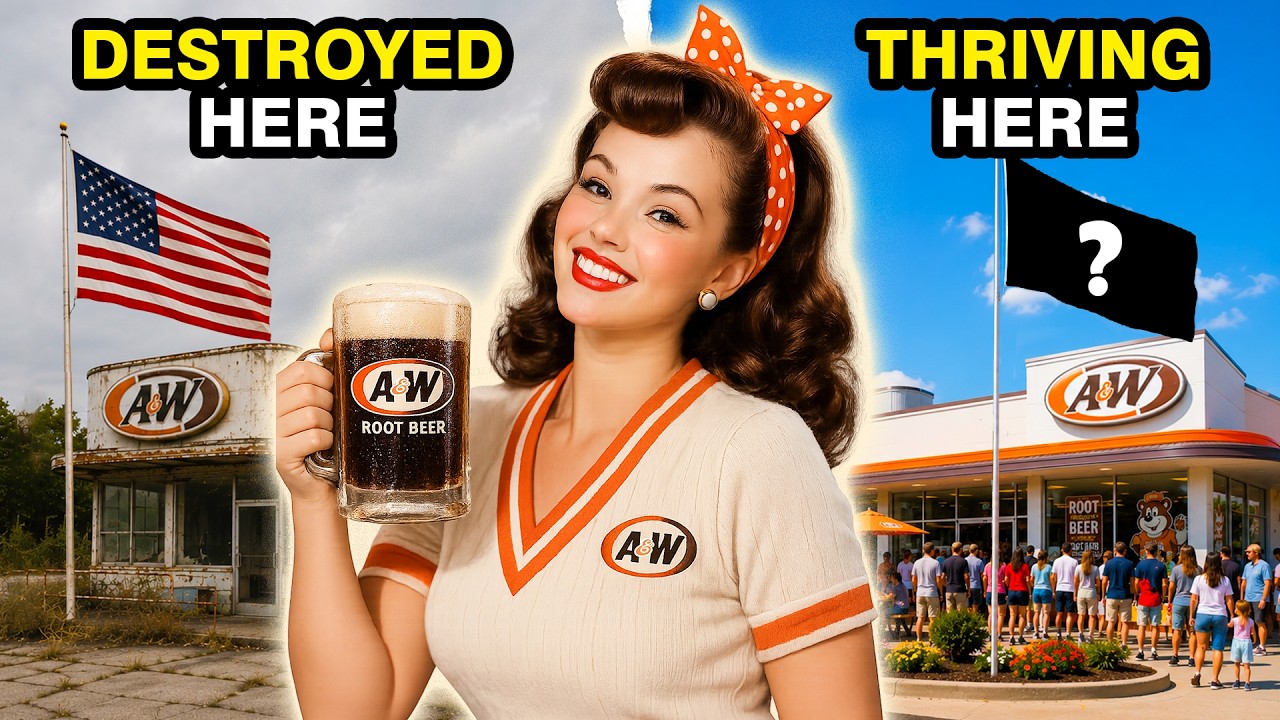
They had just bought a company that had been passed between six different corporate owners in less than fifty years, each with a different idea of what A&W should be. The franchisees were taking control of a brand that had been outmaneuvered, mismanaged, and nearly destroyed by the very people who were supposed to be running it. It was a remarkable turnaround. And it never should have been necessary in the first place.
The story begins in 1919. The First World War had just ended. Soldiers were returning from Europe exhausted, looking for something simple, familiar, and cold. Roy W.
Allen had that something. He opened a root beer stand in Lodi, California, and the veterans lined up. The drink was cold and sharp and sweet, a taste that felt entirely different after years abroad. Three years later, Allen took on a partner named Frank Wright.
Allen and Wright. A&W. By 1926, they were franchising the operation to other operators. At a time when there were no burger chains, no standardized fast food menus, no drive-through windows, A&W was setting the rules while everyone else was still trying to figure out the game.
McDonald’s did not exist yet. By 1960, A&W had an estimated two thousand restaurants across America. No one was close to them. They dominated the country before the country even knew what fast food meant.
Every condition was in their favor: the locations, the product, the head start. So what went wrong? The first mistake looked like a victory at the time. Before 1971, there was only one way to get an A&W root beer.
You had to come in person. They made it fresh. They served it in a heavy, frosty glass, cold and solid in your hand, with condensation beading on the outside. You could not buy it at a grocery store.
You had to park your car, roll down the window, and let the carhop bring it to you on a tray. In the nineteen-fifties and early sixties, that was an event. You cruised with your friends or came with your family, the speaker crackling from the pole, the window open, the smell of barbecue mixing with summer air, a drink so cold it hurt your teeth, and a burger for pocket change. That specific combination of food and atmosphere and ritual was what brought people back.
Not just the product. The whole experience. A&W was not selling a drink. It was selling the best part of a Saturday afternoon.
Drive-in culture peaked in America in the mid-fifties. By the late sixties, it was already starting to give way to the drive-through. A window in the wall instead of a carhop coming to you. Faster.
Cheaper to staff. The decision to bottle and distribute A&W root beer in 1971 landed in the middle of that cultural shift and accelerated a decline that had already begun. A company called United Brands set up A&W Beverages and put the root beer on grocery shelves from coast to coast. From the beverage trade’s point of view, it worked.
A&W became the dominant root beer brand in American stores. The restaurants paid the price. Before 1971, the only way to get A&W root beer was to go to an A&W restaurant. After 1971, you could pick it up off a shelf.
So why drive anywhere? The restaurant lost the one thing that made it special. The frosty glass, the carhop, the drive-in atmosphere—those things only mattered because you could not replicate them at home. Once the root beer was in every grocery aisle in America, the drive-in became just another burger joint.
The American branches swapped their real glass mugs for paper and plastic cups. It made sense on a spreadsheet. The Canadian branches never made that swap. Eat at a Canadian A&W today, and your root beer arrives in a genuine frosty glass.
That one detail tells the customer everything about who still understands the heart of what they are selling. America sold off the ritual that made the restaurant worth visiting. But losing the atmosphere was only the first problem. While that was happening, the brand identity was getting muddier in a way that would prove hard to fix.
In 1963, A&W had a moment of clarity. They introduced the Burger Family. The Papa Burger, the Mama Burger, the Teen Burger, and the Baby Burger. Every size had a name.
You knew exactly where you stood in that lineup. That is the kind of system that lodges in a customer’s mind and stays there. By 1974, the American chain retired the Burger Family and replaced them with a bear mascot. The records are inconsistent on its name—sometimes the Great Bear, sometimes Rudy the Great Bear.
Canada kept the family intact and even expanded it: the Grandpa Burger, the Uncle Burger, the Buddy Burger. Canada built its identity on what America had decided to throw away. Then A&W tried something they should not have lost at. Better burgers, better meat, same price.
They even won taste tests. And still the customers deserted them. It was the nineteen-eighties. The campaign was called “Third is the Word.
” A one-third-pound burger going up against the Quarter Pounder. A&W poured serious money into the campaign. Television, radio, newspapers, test markets in several cities. The product was objectively better on every measurable level.
Yet the customers walked away. A firm called Yankelovich ran focus groups to find out why. Most consumers believed a one-third-pound burger was smaller than a quarter-pound burger. Because three is a smaller number than four, the burger had to be smaller.
Some of them told the moderators they were annoyed. They did not want to pay the same price for what they believed was less meat. They were looking at more meat and seeing less. A large financial loss caused by a misunderstanding of fractions.
To be fair, some analysts say the fraction confusion was only part of the story. The stores looked shabby by then, and the brand message was muddled. A better product cannot sell itself inside a run-down building. A&W could not fix both problems at once.
And none of it helped when the people in charge kept changing. The third mistake was not a single campaign or a product decision. It was structural. A&W could not hold its course because it could not hold an owner.
Count them. In 1963, A&W was sold to J. Hungerford Smith, then to United Fruit, then to AMK, which restructured itself into United Brands, then to a billionaire mall developer named Alfred Taubman, then to Great Circle Capital, then to Yorkshire Global Restaurants, then to Yum Brands. Six different ownership groups between 1963 and 2011.
Six different ideas about what A&W should be. Imagine running the same restaurant for twenty-five years while the people above you keep changing the rules. That was actually the life of an A&W franchisee. In the seventies, United Brands tried to change how revenue was collected.
The original arrangement was clear. Corporate profits came from the root beer syrup sold to operators. United Brands wanted a two percent cut of gross sales instead. The franchisees who had signed twenty- and twenty-five-year contracts under the original terms were not prepared to accept that change.
They filed lawsuits. Development froze. Every operator caught up in that dispute could not plan an expansion, commit to a remodel, or launch a local ad campaign without wondering if the company behind them would even exist in the same form next year. While A&W was frozen, McDonald’s was rolling out the Happy Meal, the Egg McMuffin, and the Big Mac on a national level, all backed by a stable system and unified marketing.
A&W had nothing unified. You cannot build a national brand during a civil war. Then Taubman arrived in the eighties. He was a shopping mall developer.
He treated A&W the way a developer treats underperforming retail space. He cut ties with a hundred weak-performing franchises and reportedly let go of a large share of the corporate staff, though the exact numbers were never fully verified. The chain shrank to fewer than five hundred units. A brand that had two thousand restaurants in 1960 was down to a quarter of that number.
Six owners, no consistency, and one final decision left to come. That final mistake came from the company that owned A&W last before the franchisees finally took it back. In 2002, a company called Tricon Global Restaurants, later renamed Yum Brands, bought A&W along with Long John Silver’s. The combined deal was said to be worth roughly 320 million dollars.
Yum already owned KFC and Taco Bell. Their plan was co-branding: one building, multiple brands, more revenue per square foot. On paper, it looked efficient. But what happens when the thing people love about your brand is the atmosphere, and your growth plan strips it away?
You pull up to what used to feel like an A&W. Now the building is shared with KFC. The logo is on the sign, but you are ordering a root beer float under fluorescent lights while the smell of fried chicken comes out of the shared kitchen. Just a divided counter and a confusing menu.
Drive-through service slowed down as the kitchens tried to run two completely different operations at once. Customers could not tell what the place was anymore. By 2011, Yum sold A&W to a group of franchisees called Great American Brands. A&W became the only American restaurant chain fully owned by its own franchise operators.
A genuine achievement—that came nearly forty years after Canada chose a completely different path. And that is where this story turns. Here is what Canada did instead. A&W first reached Canada in 1956, opening in Winnipeg, Manitoba.
For sixteen years, the Canadian and American brands ran on parallel tracks. Then in 1972, a company called Unilever acquired the Canadian division. It looked like just another corporate deal. But it turned out to be the move that saved the brand.
Canada never went through the syrup franchise war, or the third-pound burger failure, or the KFC era. While the American brand changed hands six times, Canada was building something stable. Canada did not save A&W by reinventing it. It saved the brand by protecting what America had thrown away.
In 1995, a group of senior managers and Canadian franchisees bought A&W Canada from Unilever. They kept the Burger Family, the same lineup America had retired in 1974, and expanded it to include the Grandpa Burger, the Uncle Burger, and the Buddy Burger. They kept the glass mugs, the same ones the American branches had traded for paper years earlier. Walk into a Canadian A&W today, and that frosty glass still comes with your root beer.
It is a quiet signal that somebody still cares about the experience. Then came 2013. A&W Canada became the first national burger chain in the country to serve beef raised without steroids or hormones. It was not just a press release; it was a full commitment through the supply chain.
They sourced antibiotic-free chicken. One hundred percent Canadian milk for their cheeses. Onion rings fried fresh in every store, every day. They stepped out of the price war with McDonald’s entirely and moved toward quality.
The “better beef” campaign did something the brand did not fully anticipate. It gave Canadian customers a reason to feel good about their choice. Not just because the food was better, but because their money was going somewhere that cared about where the beef came from. That changes the relationship between a brand and its customers in a way pricing never can.
Canadian customers followed. Record sales numbers stacked up year after year. By 2024, A&W Canada operated more than a thousand locations and posted record sales of 1. 87 billion dollars, making it the second-largest quick-service burger chain in Canada.
They also struck a deal with a British coffee chain to bring their coffee into A&W stores and Canadian airports. Not a nostalgia strategy—a real move toward the morning customer. A brand with that kind of footing uses what it has protected to launch into new ground. America had the original A&W.
Canada got a corporate divorce in 1972 and turned it into a nearly two-billion-dollar-a-year business. The people running the American brand treated it as a business problem to be solved. What it needed was someone who understood that it was a memory worth protecting. The memory of a cold root beer in a frosty glass on a summer evening, in a place that felt like part of your neighborhood.
Canada understood that. They kept the things that actually mattered. That is why A&W still feels like A&W on a Canadian street corner.
While across most of America, it became just a sign on a building you drive past without slowing down.
