On October 2, 1919, Woodrow Wilson lay unconscious on the bathroom floor of the White House, his left side already paralyzed by a stroke. His wife, Edith, found him there that morning. The president of the United States could not sit up in bed. The Constitution had no answer for this.
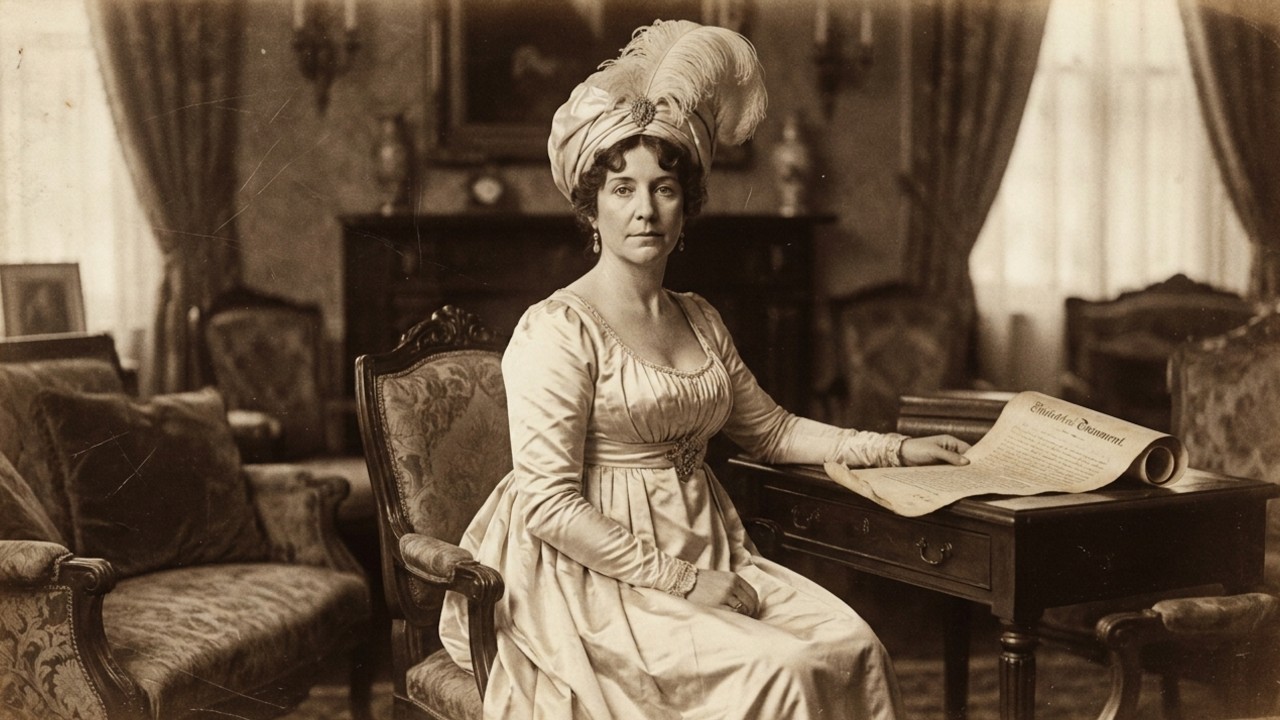
No procedure existed for presidential disability, and the vice president, Thomas Marshall, was a man nobody—including Edith—considered remotely adequate. The doctors told her that the presidency itself might be the only thing keeping Wilson’s will to live intact. So Edith Wilson chose. There would be no resignation.
There would be no public truth. With the White House physician, Dr. Cary Grayson, she sealed the sick room and announced that the president was suffering from exhaustion. Then she established the rule that made her, in practice, the head of the executive branch of the United States.
Nothing and no one would reach Woodrow Wilson except through her. Not a bill, not a senator, not a cabinet secretary, not a single sheet of paper. She called it her stewardship. The country, when it finally found out, would call it something else.
For seventeen months, senators, secretaries, and foreign governments addressed the United States government and got answers in a woman’s handwriting. Every document intended for the president went to Edith Wilson. She read it. She decided whether her husband would ever see it.
If she judged it worthy, she summarized it in her own words at his bedside. What came back out of that room were instructions written in her hand in the margins of state papers. “The president says,” the notes read. “The president wishes.
” Cabinet secretaries ran departments for months on notes like these, never knowing how much of each sentence was Woodrow Wilson and how much was his wife. Twenty-eight bills became law without the president’s signature because the constitutional clock simply ran out while paperwork waited outside a sick room. A cabinet was kept in the dark. A vice president was kept at a distance.
And the greatest foreign policy question of the age—the Treaty of Versailles—was decided while the man who negotiated it could not hold a pen steadily. Edith begged him to compromise with Senator Henry Cabot Lodge and accept the Senate’s reservations. The broken man refused, all or nothing. The treaty failed in November 1919 and failed again in March 1920, seven votes short.
The League of Nations went forward without the United States inside it. Washington was not entirely fooled. Secretary of State Robert Lansing began quietly convening the cabinet on his own authority, and for that act of initiative he was forced out in February 1920. The Senate sent Albert Fall of New Mexico, one of Wilson’s bitterest enemies, to test whether a president still existed.
“We have a petticoat government,” Fall had thundered. “Mrs. Wilson is president. ” Edith staged the visit like a theater director.
Wilson was propped up, his paralyzed side covered, his answers rehearsed. Fall left bested, and the regency rolled on. In August 1920, in the middle of this exact period, the Nineteenth Amendment was ratified. American women won the right to vote for president at the precise moment a woman who had never received a vote was, in practical fact, running the presidency.
Edith Wilson held more executive power than any American woman before her, months before most women in America had ever legally touched a ballot. Her stewardship ended with Wilson’s term in March 1921. She guarded him until his death in 1924 and guarded his legend for thirty-seven years after that, insisting in her memoir that she had never made a single decision regarding public affairs. Historians have weighed that claim against the record.
The record wins. Edith Wilson was not the first woman to find that the silence around her role was an opening rather than a limit. For two hundred years, the Constitution has never once mentioned the first lady. No law defines her power, no salary, no oath, no definition, and no limit.
The framers spent the summer of 1787 arguing over every word of the presidency—how a president would be chosen, how he could be removed, what he could and could not do—and never wrote a single sentence about the woman who would live beside him. That silence became the largest unregulated power vacuum in American history. The first lady eats breakfast with the most powerful man on earth. She hears him think out loud when the aides have gone home.
She knows which advisers flatter him and which ones lie to him. She controls the last conversation of his day and the first one of his morning. No cabinet secretary has that access. No senator has that trust.
And because no law defines her role, no law restrains it. She cannot be confirmed, so she cannot be blocked. She holds no office, so she cannot be impeached. The system has no tool to check her because the system pretends she is not there.
Five women understood that and used it, and each of them was attacked with the same accusation worded for her own century: Mrs. President, petticoat government, meddler, dragon lady. The insult never changed because the truth behind it never changed. Each of these women was doing the job.
The country just was not ready to admit the job was real. It begins on a farm in Massachusetts with a woman writing letters by candlelight while her husband helped invent the United States. Abigail Adams was born in Weymouth in 1744, the daughter of a minister, with no formal schooling at all. She taught herself in her father’s library.
By the time she married John Adams in 1764, she could argue politics, scripture, and philosophy with any man in the colony. John knew it. He called her his best, dearest, worthiest, wisest friend. He meant it as a compliment.
It was also simply an accurate job description. Their marriage became the longest political correspondence in early American history—more than 1,100 letters survived between them. While John sat in Congress and later served as a diplomat in Europe, those letters carried news, analysis, and advice in both directions. She told him what Massachusetts was thinking.
She measured the loyalty of his allies and the danger of his rivals. For roughly ten years of their marriage, an ocean sat between them, and she ran everything he left behind. Under the law of her era, Abigail Adams barely existed. The doctrine was called coverture, and it meant that a married woman’s legal identity dissolved into her husband’s.
She could not own property. She could not sign a contract. She could not keep her own wages. The law saw one person in that marriage, and it was not her.
Yet through the war, she managed the family farm in Braintree, handled tenants, paid wartime taxes, hired labor, and kept the family solvent through inflation that ruined her neighbors. She buried a stillborn daughter in 1777 and went back to the ledgers. Then she went further. John believed in land—land was safe, solid, respectable.
Abigail looked at the depreciated government securities trading at a fraction of their face value and saw what her husband did not. Working through her uncle Cotton Tufts, she quietly bought government paper with money she set aside and called her own pocket money. It was a maneuver around a legal system that said she could own nothing. When the new federal government later funded those securities at full value, her judgment was vindicated in hard numbers.
The investor in the Adams family wore a dress, and she outperformed a future president. By the 1790s, John Adams was vice president and then president, and Abigail’s counsel reached into appointments, foreign policy, and the press wars tearing the young republic apart. Her enemies noticed. In March of 1776, when Congress was moving toward independence, Abigail had seen the opening with perfect clarity.
If they were writing a new code of laws, she told John, then remember the ladies. Be more generous and favorable to them than your ancestors. Do not put unlimited power into the hands of husbands. Remember, she wrote, all men would be tyrants if they could.
And if women were ignored, she warned, they were determined to ferment a rebellion of their own and would not hold themselves bound by laws in which they had no voice. It is one of the most famous letters in American history. At the time, it accomplished nothing. John wrote back that he could not help laughing and joked that men knew better than to repeal their masculine systems.
The men in Philadelphia kept coverture. They kept it for nearly another century. But the letter survived, and the argument inside it never stopped being true. She had identified the floor in the founding while the founding was still wet ink.
Two decades later, she was first lady and the counsel had become operational. When the XYZ affair pushed the country to the edge of war with France in 1798, Abigail sat at the center of the Federalist information network, reading the dispatches, weighing the factions, sharpening her husband’s resolve. When opposition newspapers savaged the administration, she urged action against the editors, and she supported the Alien and Sedition Acts that made such prosecutions possible. History has judged those laws harshly, and her role in supporting them is part of her record.
Albert Gallatin, the leader of the Republican opposition in Congress, sneered that she was Mrs. President—not of the United States, but of a faction. Read that attack again slowly. The opposition leader of the United States Congress believed that to fight the president, he had to name the president’s wife.
The insult was meant to wound her. Instead, it certified her. In 1801, John lost to Jefferson and the Adamses went home to Quincy. Abigail died in 1818, six years before her son, John Quincy Adams, won the White House she had once run.
The adviser era was over. The next woman would not advise the machine from beside it. She would build a machine of her own out of candlelight, ice cream, and a guest list. James Madison wrote the Constitution, but he could barely work a room, so his wife built a weapon out of a parlor.
Madison was brilliant and tiny, a pale and awkward man who mumbled at dinner and froze in crowds. Dolley was his opposite in every visible way. Born to a Quaker family in North Carolina in 1768, she had survived the Philadelphia yellow fever epidemic of 1793, which killed roughly 5,000 people in a single season, among them her first husband and her infant son. She remarried in 1794, introduced to Madison by Aaron Burr.
She was twenty-six. He was forty-three. Washington society never produced a more effective partnership. Understand what the capital looked like when the Madisons reached the presidency in 1809.
Washington was a muddy village with marble ambitions, and its politics were poisonous. Federalists and Republicans did not merely oppose each other. They despised each other. Men settled political arguments with pistols at dawn.
Only five years earlier, the sitting vice president had shot Alexander Hamilton dead. There was no neutral ground anywhere in American public life. So Dolley Madison created one. Every Wednesday night, she opened the White House drawing rooms to everyone—both parties, friends and enemies, congressmen, diplomats, editors, and their wives.
As many as two or three hundred people packed in so tightly the press called the evenings “squeezes. ” She wore feathered turbans, served ice cream, remembered every name, and moved through the crowd, placing exactly the right rival beside exactly the right ally. It looked like a party. It functioned as a legislature.
Her parlor was the one room in America where opponents had to be civil to each other, and deals that could not survive daylight were made over her punch bowl. This was strategy executed weekly for eight years. While her husband struggled to charm a single guest, Dolley gathered intelligence, softened enemies, and counted votes by candlelight. The Federalists understood what was being done to them.
After Madison won the election of 1808, his defeated opponent, Charles Coatsworth Pinckney, reportedly admitted that he had been beaten by Mr. and Mrs. Madison and that he might have stood a better chance against Mr. Madison alone.
The quote survives secondhand, but the sentiment was universal in Washington. The presidency was a partnership, and everyone negotiating with it knew which partner controlled the room. By 1812, Dolley Madison was the most famous woman in America, and her Wednesday machine had helped carry her husband to a second term and through the outbreak of war with Britain. Then in the summer of 1814, the war came up the road toward her front door, and the hostess faced a test no guest list could solve.
On August 24, 1814, with British troops hours from the White House door, the most famous woman in America would not run. The American militia defending Washington had collapsed at Bladensburg. The president was away with the army. The cabinet had scattered.
Inside the White House, the dinner table was set for forty guests who would never arrive, and messengers galloped up every hour, begging the president’s wife to flee. Dolley Madison stood in the dining room with a spyglass and waited. She was not waiting for rescue. She was waiting for a painting.
Hanging in the state dining room was the full-length Gilbert Stuart portrait of George Washington, the image of the republic itself. Dolley understood instantly what its capture would mean. The British would parade it through London as a trophy—the founder dragged behind an enemy army. She refused to let the symbol fall.
The frame was screwed to the wall, and the screws would not give. So she ordered the frame broken. The canvas was pulled free and handed to two trusted men. And only then, with the portrait rolling away to safety and British torches almost in sight, did she leave.
Hours later, the White House burned to a shell. Of everything that filled the original mansion, the portrait she saved is the only object that remains in the White House today. It hangs in the East Room. She is the reason.
The legend was instant and permanent. In a war full of humiliations, the steadiest officer in Washington had been a woman in a turban. But history rarely pays its legends. Madison died in 1836, and Dolley’s later years became a long lesson in what the era did to women without a man’s income.
Her surviving son, Payne Todd, gambled and drank his way through the family fortune. She was forced to sell Montpelier itself in 1844. The woman who had run the capital lived across the square from the White House in genteel poverty, sometimes short of firewood. So she made her final moves with the only asset left: history itself.
She sold her husband’s papers to Congress—$30,000 for the first portion in 1837 and $25,000 for the remainder in 1848, with the second sum locked in trust where her son could not reach it. Even ruined, she calculated, and the capital never stopped bowing. In 1844, the House of Representatives granted her an honorary seat on its own floor, an honor invented for her. When she died in 1849, her funeral was the largest Washington had ever seen.
She had proven a parlor could govern. The next woman in this story would prove something far more dangerous: that a bedroom could. Edith Wilson drew one lesson from power. The next woman drew the opposite one.
She decided to wield it in broad daylight. Two days after her husband took office, Eleanor Roosevelt did something no first lady had ever done. She summoned the press herself. It was March 1933, the bottom of the Great Depression, and the new first lady invited reporters into the Red Room for her own press conference, separate from the president’s.
Then came the rule that revealed the strategist underneath. Men were banned. Only female reporters could attend. With one stroke, every news organization in America faced a choice: hire women or go blind to the first lady of the United States.
They hired women. She held 348 of those press conferences over twelve years, and an entire generation of female journalists owed their careers to a guest list. That was Eleanor Roosevelt’s signature. Where Edith Wilson had hidden power behind a locked door, Eleanor built power in public, piece by piece, and dared anyone to object.
Starting on the last day of December 1935, she wrote a newspaper column called My Day, six days a week, syndicated across the country to an audience that reached an estimated 4 million readers. No first lady had ever possessed her own national media platform. She used it for twenty-seven years. She earned her own money, too, from columns, lectures, and radio broadcasts—in some years as much as $75,000, rivaling the president’s own salary—and she gave most of it away.
She needed the independence because the marriage behind the partnership had already broken once. In 1918, she had discovered Franklin’s affair with her own social secretary, Lucy Mercer. The marriage survived as something colder and stronger, a political alliance between two professionals. And when polio took Franklin’s legs in 1921, the alliance found its shape.
He had the office. She had the mobility. She became, in his own description, his eyes and ears, and in practice, his legs—traveling the country to inspect coal mines, relief programs, and prisons, then reporting back to the most powerful desk on earth. Washington had never seen anything like her, and much of Washington hated it.
She was mocked in the press, caricatured without mercy, and watched by the FBI, which built one of the largest files in its history on the first lady of the United States. Her crime, in the eyes of her enemies, was motion. She lobbied for the National Youth Administration. She championed the unemployed.
And she pushed hardest exactly where the administration least wanted pressure. Franklin’s New Deal depended on the votes of southern segregationists, so the White House wanted the subject of race kept quietly buried. Eleanor refused to bury it. And in 1939, an organization of proud American ladies handed her the chance to show the whole country exactly what a first lady’s power could do.
When the Daughters of the American Revolution barred a black singer from their hall, the first lady of the United States resigned in public. The singer was Marian Anderson, one of the great contraltos of the century. In early 1939, the DAR refused to let her perform at Constitution Hall in Washington because she was black. Eleanor Roosevelt was a member.
On February 26, she resigned, and she did it in her column in front of 4 million readers, writing that the organization had set an example she could not follow. Then she went further. Working with the administration, she helped arrange something better than a concert hall. On Easter Sunday, April 9, 1939, Marian Anderson sang from the steps of the Lincoln Memorial before a crowd of 75,000 people and a radio audience in the millions.
The image of a black artist singing of her country at Lincoln’s feet became one of the founding pictures of the civil rights movement. A first lady’s resignation letter had built that stage. She kept pushing. In March 1941, she flew over Tuskegee, Alabama in a small plane piloted by Charles Anderson, the black chief flight instructor.
Her Secret Service detail objected. The photograph said what the White House could not say on the record: the first lady backs black military aviation. The men of Tuskegee went on to fly with distinction through the war. During that war, she worked herself to the edge of collapse.
In 1943, she made a Pacific tour of five weeks and roughly 25,000 miles, walking hospital wards island after island. By the military’s own estimates, she visited about 400,000 servicemen. Admirals who had dreaded the visit wrote afterward that she did more good than any other civilian who passed through. Then in April 1945, Franklin died, and with him the office her power had been built beside.
She told reporters the story was over. She was wrong by seventeen years. In December 1945, President Truman appointed her a delegate to the brand-new United Nations, where the diplomats expected a ceremonial widow and met a parliamentary fighter instead. She was elected to chair the Commission on Human Rights, and she drove the drafting of the Universal Declaration of Human Rights through committee sessions that ran past midnight, bridging American, Soviet, Chinese, and Lebanese delegates by sheer stamina.
On December 10, 1948, the General Assembly adopted the declaration by a vote of 48 to zero with eight abstentions. Then the delegates of the world stood and gave her an ovation. Truman called her the first lady of the world. The unelected role had just rewritten the rights of the human race.
There was one more era to come, and it would prove the pattern had never weakened. It had only changed clothes. By 1987, the pattern was two centuries old, and the most feared political operator in Washington had never held a single office. Her name was Nancy Reagan.
Her power was personnel. She did not write policy memos. She decided who got to write them. Her husband was genial, trusting, and famously allergic to confrontation—the kind of man who could not bring himself to fire anyone.
That created a vacuum at the center of the most powerful office on earth, and his wife filled it. She watched the staff the way Dolley Madison had once watched a drawing room, measuring who served her husband and who served themselves. The capital learned the rule quickly. Ronald Reagan forgave almost everyone.
Nancy Reagan forgave almost no one. The record runs back before the White House. In February 1980, with the campaign floundering, she was instrumental in the firing of campaign manager John Sears on the very day of the New Hampshire primary—a move that cleared the way for the team that won the presidency. Inside the administration, senior officials learned that her opposition could end a career and her protection could save one.
But her defining move came when the presidency itself was in danger. In November 1986, the Iran-Contra scandal broke. Secret arms sales to Iran, money diverted to the Contras in Nicaragua, and a White House in free fall. Reagan’s approval rating dropped roughly twenty points almost overnight, the worst collapse of his presidency.
The man at the center of the storm in Nancy’s cold judgment was White House Chief of Staff Donald Regan, the former Merrill Lynch chairman who ran the West Wing like a corporation and treated the first lady like an inconvenience. He had hung up the phone on her. It is hard to find a worse decision in the history of American staff work. What followed was a months-long campaign of removal waged through allies like the strategist Stuart Spencer, through carefully placed arguments, and through direct, relentless pressure on her husband.
The president resisted. He hated firing people. She did not relent. On February 27, 1987, Donald Regan resigned, and a steadier hand, former Senator Howard Baker, took his place within hours.
The chief of staff of the United States—the man who controlled the president’s door—had been removed by the woman who controlled the president’s trust. And the strangest part of her story was still waiting to come out. It involved a stopwatch, a San Francisco astrologer, and the schedule of the most powerful man in the world. After the bullet nearly killed her husband, Nancy Reagan began checking the presidential schedule against the stars, and the schedule obeyed.
On March 30, 1981, just sixty-nine days into the presidency, John Hinckley shot Ronald Reagan outside the Washington Hilton. The bullet stopped an inch from his heart. Nancy never recovered from that afternoon. Fear became her permanent residence, and fear went looking for a tool.
She found Joan Quigley, a San Francisco astrologer. For years afterward, the timing of presidential travel, announcements, and major events was quietly checked against Quigley’s charts, paid for privately, hidden even from most of the senior staff. The country learned about it only in 1988, when the fired Donald Regan took his revenge in a memoir, revealing that the schedule of the leader of the free world had been shaped by astrology. Washington laughed at her.
But notice what the scandal actually proved. Even her critics had to concede the premise. Whatever touched the president’s calendar touched the presidency, and she controlled the calendar. Her instincts, mocked at the time, kept being vindicated.
During Iran-Contra, the lawyers and loyalists told the president to admit nothing. Nancy told him the opposite. Take responsibility. Apologize, and the country will forgive you.
On March 4, 1987, days after Regan’s removal, Ronald Reagan delivered the address in which he accepted full responsibility for the affair, and his approval began to climb back. She pushed on the world stage, too. Against the hardliners in his own administration who distrusted any thaw, she consistently favored engagement with Mikhail Gorbachev, encouraging the summitry that helped wind down the Cold War. Hers was one voice among several, but it was the voice with breakfast access, and the policy she favored is the one history got.
Then came the longest assignment of her life. In November 1994, the Reagans released a handwritten letter announcing the president’s Alzheimer’s diagnosis, a disclosure that changed how America talked about the disease. For the next decade, Nancy was his caregiver and the custodian of his legacy, controlling the image, the library, the memory. In her final political act, she broke with her own party’s orthodoxy to publicly champion federal funding for embryonic stem cell research, lobbying senators in the disease’s name.
She died in March 2016 and was buried beside him. Set her beside the others and the pattern closes like a circuit. Abigail with her letters. Dolley with her guest lists.
Edith with her locked door. Eleanor with her press corps. Nancy with her personnel files. Five different centuries of tools.
One identical truth underneath. The Constitution still does not mention the first lady. And after two hundred years, that silence remains the most revealing sentence never written in American law. The system did eventually respond to these women in its own way.
After Edith Wilson’s hidden regency, it took the country another five decades, but in 1967 the Twenty-fifth Amendment finally wrote rules for presidential disability—a constitutional patch applied directly over the hole she had governed through. The East Wing grew a professional staff, a press office, a budget, an institution built to contain a role the founders never imagined. Containment mostly failed. Access cannot be legislated.
Trust cannot be confirmed by the Senate. The power these five women found will exist as long as presidents are human beings who talk to someone at the end of the day. Look at what that unofficial power actually produced. A founding correspondence of 1,100 letters that still teaches us what the revolution meant.
The only object from the original White House, still hanging in the White House. Seventeen months of an American presidency conducted in a woman’s handwriting. Three hundred and forty-eight press conferences, a concert before 75,000 people, and a declaration of human rights adopted 48 to zero for the entire human race. A chief of staff removed, a Cold War softened, a nation taught to say the word Alzheimer’s out loud.
None of it elected, none of it confirmed, all of it real. And every one of them paid the same tax for it. The accusation never changed, only the costume. Mrs.
President, they sneered at Abigail. Petticoat government, they thundered at Edith. Meddler, they sighed at Eleanor. Dragon lady, they whispered about Nancy.
Five eras of American men reached for an insult and grabbed the same one every time, because every time the charge underneath was identical: she is doing the job. The insult was never really a denial of their power. It was the receipt for it. They did not ask for permission.
They did not wait for an invitation. They were handed a role with no duties, no budget, no authority, and no existence in law. And they walked it into the room where the decisions were made. And they sat down.
Every woman who has since stood for office in her own name, every woman confirmed by a Senate that once could not touch her predecessors, every woman who reads a briefing book instead of smuggling one past a locked door—each of them inherits ground that was first held by women who governed without a title, because a title was the one thing America refused to give them. The Constitution never mentioned the first lady for two hundred years. That was supposed to mean she did not matter. These five women quietly proved it meant the opposite.
The most powerful women in America were standing in the one place the law never thought to look. And now that you know who was actually in the room, the official history of the United States reads differently.
