In the autumn of 1961, residents of Clearfield County, Pennsylvania, began reporting unsettling disturbances emanating from what locals had come to know simply as Thompson’s House. The isolated farmstead, situated approximately twelve miles northeast of the town of DuBois along a forgotten stretch of what was once Route 219, had stood empty for the better part of three years. The property encompassing nearly forty acres of dense woodland and overgrown pastures had belonged to the Thompson family since 1923 when Cornelius Thompson purchased the land with money inherited from his father’s timber business. What made the reports particularly disturbing was their consistency.
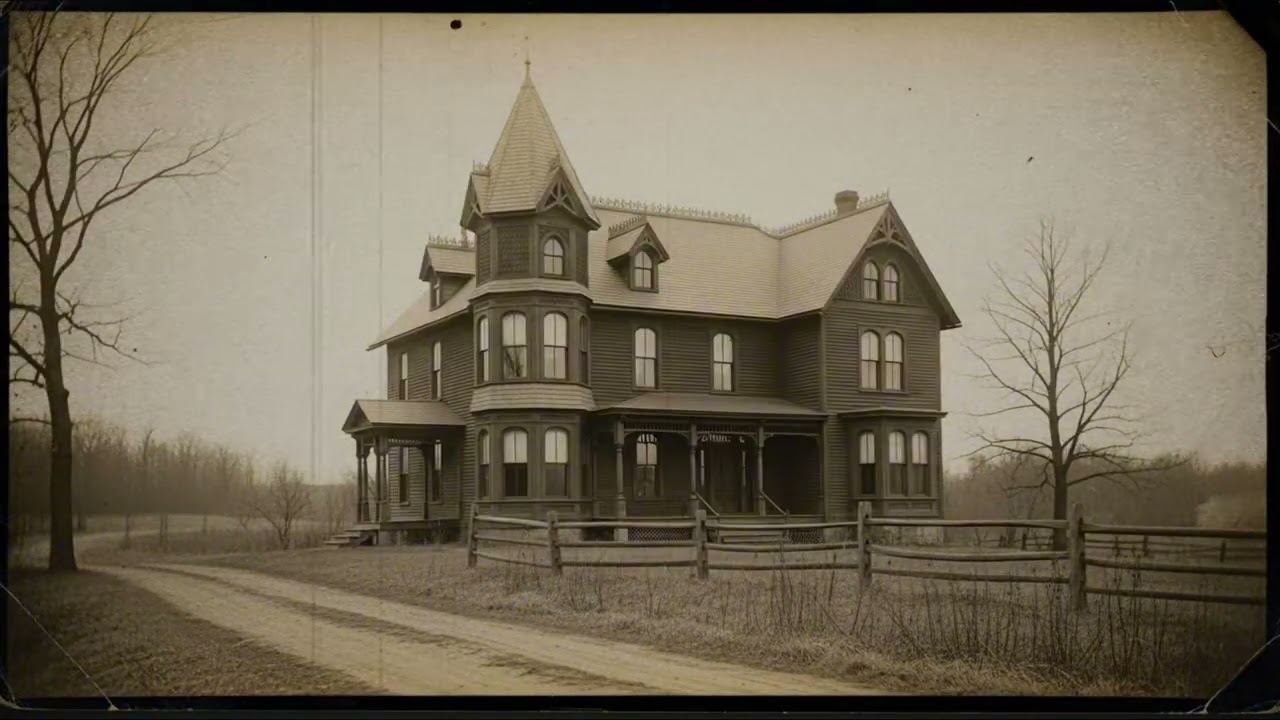
Night after night, residents driving past the property described seeing lights moving through the windows of the supposedly vacant house, wandering illumination as if someone was carrying a lantern from room to room in deliberate, measured patterns. Mrs. Gladys Peton, who operated the general store in DuBois, first brought these sightings to the county sheriff in early October 1961. She had driven past Thompson’s House on three separate occasions while returning from visits to her sister in Sandy.
Each time she observed the same phenomenon: lights moving through the downstairs windows in what appeared to be a systematic search pattern, pausing at each window for exactly the same duration before moving on. The Thompson family history, as recorded in county deed records and local church documents, reveals a pattern of isolation that had defined the property for decades. Cornelius Thompson had been a solitary man who rarely ventured into town except for essential supplies. His wife Millisent had died during the harsh winter of 1934, leaving him to raise their two adult sons, Jasper and Aurelius, alone on the remote property.
The sons, both in their twenties at the time of their mother’s death, had inherited their father’s reclusive nature. What struck those who encountered the Thompson men was their particular way of speaking. Ezra Whitmore, who operated the hardware store on Main Street until his retirement in 1958, recalled that the Thompson brothers always spoke in unison, finishing each other’s sentences with an unsettling precision that suggested either long-practiced coordination or something deeper and more troubling. When one brother would begin a request for supplies, the other would complete it, often without looking at his sibling or showing any awareness of the transition.
The property itself reflected the family’s peculiar nature. The main house, a two-story structure built in the Gothic Revival style popular in rural Pennsylvania during the 1880s, featured an unusually large number of windows for a farmhouse of its size. County building records from 1923 show that Cornelius had specifically requested additional windows be installed during renovations he commissioned shortly after purchasing the property. The modification required removing several load-bearing walls and installing steel supports, an expensive undertaking that puzzled local contractors.
More disturbing were the modifications made to the basement. According to invoices found among Cornelius’s papers after his death in 1958, he had commissioned the excavation of additional chambers beneath the house’s original foundation. The work was performed by a crew from outside the county, men who arrived in early spring 1924 and completed their work before the autumn harvest. No local residents recalled seeing these workers or their equipment, despite the fact that such an undertaking would have required heavy machinery and weeks of continuous labor.
The isolation of the Thompson property became more pronounced after Millisent’s death in 1934. Delivery drivers from DuBois reported that the family began requesting that supplies be left at the end of their long driveway rather than brought to the house. Mail was similarly collected from a box positioned nearly a quarter mile from the main building. The rural postal carrier Clement Thorp noted in his route logs that he never saw any of the Thompson family members during his twenty-three years of service despite making deliveries to their property twice weekly.
This arrangement continued without incident until the summer of 1958, when Cornelius Thompson’s death created the first significant disruption to the family’s carefully maintained isolation. The coroner, Dr. Marcus Kelner, was summoned to the property by Jasper Thompson on a sweltering July morning. According to Dr.
Kelner’s report, Cornelius had apparently died of natural causes, though the circumstances surrounding the discovery of his body raised questions that were never formally addressed. The body was found in the basement in one of the chambers that had been excavated in 1924. Cornelius was seated in an ornate wooden chair that appeared to have been positioned deliberately in the center of the room, dressed in his finest clothes with his hands folded precisely in his lap. What struck Dr.
Kelner as unusual was the condition of the room itself. The walls were covered with what appeared to be detailed maps and diagrams, all hand-drawn with meticulous precision. The drawings depicted the layout of the house and property but included notations in a language or code that Dr. Kelner could not identify.
More troubling was the discovery of multiple journals stacked on a table beside the chair. The journals, filled with entries dating back to 1923, documented what Cornelius described as evening observations and nocturnal confirmations. The entries were written in the same indecipherable code as the wall notations with occasional phrases in English that referenced monitoring patterns, response intervals, and behavioral modifications. Jasper and Aurelius Thompson seemed remarkably composed during Dr.
Kelner’s examination of their father’s body. They answered questions with the same synchronized speech pattern that had been noted by townspeople for years, providing information that was technically accurate but emotionally detached. When asked about their father’s activities in the basement, they explained that Cornelius had spent increasing amounts of time there in recent years, claiming to be completing important research. Cornelius was buried in a private cemetery on the property in a plot that appeared to have been prepared well in advance.
No funeral service was held and no death notice appeared in the local newspaper. The only official record of his death exists in county vital records filed by Dr. Kelner as required by law. Following their father’s burial, Jasper and Aurelius maintained the family’s reclusive lifestyle with even greater intensity.
Deliveries to the property became increasingly irregular, and the brothers seemed to have adopted their father’s practice of spending extended periods in the basement chambers. Smoke from the house’s chimney, once a reliable indicator of the family’s presence, began following unusual patterns, sometimes burning continuously for days, other times remaining cold for weeks at a time. The first indication that something had changed fundamentally came in late spring of 1958, just months after Cornelius’s death. Harold Fairchild, a traveling salesman who regularly drove past the property on his monthly circuit through Clearfield County, reported seeing both brothers standing motionless in the front yard at exactly midnight on three consecutive visits.
According to Fairchild’s account given to Sheriff William Torrance in June 1958, the brothers appeared to be engaged in some form of surveillance, standing perfectly still and facing toward the road as if waiting for something specific. Rather than acknowledging his passing automobile, Jasper and Aurelius remained completely motionless, their heads tracking the movement of Fairchild’s headlights in perfect synchronization. Fairchild described the experience as watching two pieces of machinery respond to a programmed stimulus, noting that the brothers’ movement was too precise and coordinated to seem natural. Sheriff Torrance’s investigation yielded little additional information.
When he visited the house the following week, he found the property apparently empty with no response to his knocks at the front door. The house showed signs of recent habitation—laundry hanging on lines, fresh tire tracks in the driveway—but the brothers themselves were nowhere to be seen. Torrance noted in his report that the silence around the property was unusually complete, with none of the typical sounds associated with rural life: no bird song, no insect activity, no rustling of small animals in the underbrush. The pattern of midnight appearances continued throughout the summer of 1958 with multiple witnesses reporting similar sightings.
Emma Caldwell, who lived on a neighboring farm approximately two miles south of Thompson’s House, began documenting these appearances in a diary that was later submitted to county authorities. Her entries, written in precise handwriting that reflected her background as a former school teacher, described nightly vigils during which she would position herself at her bedroom window to observe the Thompson property. According to Caldwell’s diary, the brothers maintained their midnight surveillance routine with clockwork regularity. Each night at exactly 11:58 p.
m. , lights would appear in the house’s downstairs windows. At precisely midnight, Jasper and Aurelius would emerge from the front door and take their positions in the yard. They would remain motionless for exactly seventeen minutes, then return to the house.
The lights would extinguish at 12:20 a. m. and the property would remain dark until the following evening. What concerned Caldwell most was the brothers’ apparent awareness of being observed.
On several occasions, she noted that one or both of them would turn their attention toward her house during their vigil, staring directly at her window, despite the distance and darkness that should have made her presence undetectable. These moments of apparent recognition lasted for exactly thirty seconds before the brothers would return their attention to their surveillance of the road. The autumn of 1958 brought an intensification of the disturbing activities. Residents of nearby Sandy began reporting that the sound of heavy machinery could be heard coming from the property during late-night hours, despite the fact that no construction equipment had been observed entering or leaving the area.
The sounds, described as similar to excavation or demolition work, would begin around 2:00 a. m. and continue until dawn, stopping abruptly with the first light of sunrise. Dr.
Kelner began receiving reports from farmers of unusual animal behavior that seemed to coincide with the nighttime activities. Livestock would become agitated around midnight, refusing to settle until well after dawn. Dogs throughout the area would begin howling in unison at exactly 2:00 a. m.
, the same time the mechanical sounds began. Most disturbing were reports of wildlife abandonment: deer, rabbits, and other small animals that had previously been common in the area had disappeared entirely from the vicinity of Thompson’s House. The situation reached a critical point in December 1958 when Caldwell’s nightly observations revealed a significant change in the brothers’ routine. Instead of their usual seventeen-minute vigil, Jasper and Aurelius began extending their surveillance periods, sometimes remaining in the yard until nearly dawn.
During these extended sessions, Caldwell reported seeing additional figures moving around the property, though she could never determine their identity or how they had arrived without being detected. More troubling was her observation that the brothers had begun to change physically. Through her binoculars, she noted that both men appeared to be losing weight rapidly, their clothes hanging loosely on increasingly gaunt frames. Their movements, previously characterized by unsettling coordination, became increasingly mechanical and stilted.
Most disturbing was her observation that the brothers seemed to be developing similar facial features, as if they were somehow becoming more alike with each passing week. The disappearance of Jasper and Aurelius Thompson was not immediately noticed due to the family’s long-established pattern of isolation. It was only when spring deliveries began accumulating at the end of their driveway that local authorities became aware something might be amiss. Sheriff Torrance’s welfare check in April 1959 found the house apparently empty with no signs of the brothers’ presence beyond personal belongings that remained undisturbed in their bedrooms.
The most significant discovery came when Torrance explored the basement chambers that Dr. Kelner had described following Cornelius’s death. The rooms beneath the house had been extensively modified, with new excavations extending the underground space considerably. The walls were now covered with thousands of detailed drawings and notations, creating a complex visual record that defied interpretation.
Central to these basement chambers was a room that appeared to have served as some form of observation center. Multiple chairs were arranged in precise formation facing a wall covered with maps, charts, and what appeared to be surveillance schedules. The maps depicted not only the Thompson property but the surrounding area for several miles in all directions, with specific attention paid to the locations of neighboring houses and the schedules of their inhabitants. Most disturbing were the documents found scattered throughout the basement chambers.
Thousands of pages of handwritten notes detailed the daily routines of every family within a five-mile radius of Thompson’s House. The observations were recorded with scientific precision, noting arrival and departure times, patterns of behavior, and what appeared to be predictions about future activities. The handwriting throughout these documents was identical, suggesting either that one person had produced the entire volume of material or that multiple individuals had developed remarkably similar writing styles. The final entry in these observation records was dated March 15, 1959, approximately one month before Sheriff Torrance’s discovery of the empty house.
The entry, longer and more detailed than typical observations, described what the author termed preparation for integration protocol. The language was technical and clinical, referring to subject selection, behavioral modeling, and implementation phases. The entry concluded with a notation that primary observation period concluded successfully, transition to active phase authorized. Sheriff Torrance’s investigation was complicated by the absence of any clear evidence of foul play.
The brothers’ personal belongings remained in their rooms, including clothing, personal items, and what appeared to be significant amounts of cash. No signs of struggle or violence were discovered anywhere on the property. Most puzzling was the fact that the brothers’ automobile remained parked in its usual location, making it unclear how they might have left the property. The case was further complicated by the testimony of area residents who provided conflicting accounts of the brothers’ final weeks.
Several witnesses reported seeing Jasper and Aurelius in town during March 1959 making their usual supply purchases and exhibiting their typical synchronized behavior. However, other residents claimed that the brothers had not been seen in public since the previous autumn, making it impossible to establish a clear timeline for their disappearance. Emma Caldwell’s diary entries from early 1959 provide the most detailed account of the brothers’ final weeks. According to her observations, the midnight surveillance routine had evolved into something far more complex and disturbing.
Instead of simply standing in their yard, the brothers had begun moving throughout the area under cover of darkness, visiting neighboring properties and apparently conducting detailed examinations of houses and outbuildings. Caldwell’s entries describe her growing fear as she realized the brothers were systematically studying every aspect of her neighbors’ lives. She documented instances where the brothers would spend hours positioned outside houses, apparently timing the movements of the inhabitants and taking notes on their observations. Most terrifying was her realization that the brothers had begun to mimic the behaviors they observed, practicing the mannerisms and routines of their neighbors with disturbing accuracy.
The final entry in Caldwell’s diary, dated March 20, 1959, describes an encounter that convinced her to cease her nightly observations and contact authorities. On that evening, she observed both brothers standing directly beneath her bedroom window, looking up at her with what she described as expectant expressions. When she moved away from the window, they remained in position, continuing to stare at the spot where she had been standing. They maintained this vigil until dawn, never moving or acknowledging her presence when she briefly returned to check on their location.
The investigation into the Thompson brothers’ disappearance was officially closed in October 1959, classified as a case of voluntary departure by adults with no evidence of criminal activity. However, Sheriff Torrance’s private notes, discovered among his papers following his retirement in 1963, reveal his continuing suspicions about the circumstances surrounding the case. His personal observations suggested that the brothers’ disappearance might have been part of a deliberate plan rather than an impulsive departure. The empty Thompson’s House remained undisturbed for nearly two years following the brothers’ disappearance.
The property, with no clear legal heir and no mortgage or tax liens, entered a complex legal limbo that prevented its sale or redevelopment. Local real estate attorneys advised that the house and land would likely remain in legal uncertainty for years, possibly decades, before ownership could be properly transferred. During this period, the reports of unusual activity at Thompson’s House began in earnest. The lights moving through the windows, first reported by Mrs.
Peton in October 1961, were only the beginning of a series of increasingly disturbing observations that would continue for years. Unlike the organized surveillance conducted by the Thompson brothers, these new activities appeared random and purposeless, as if someone unfamiliar with the house was exploring its rooms and passages. Harold Fairchild, the traveling salesman who had first reported the brothers’ midnight vigils, began documenting the new phenomena during his monthly trips through the area. According to his detailed logs submitted to county authorities in November 1961, the lights appeared to follow no discernible pattern.
Sometimes they would move rapidly from room to room. Other times they would remain stationary for hours. Most puzzling was the observation that the lights occasionally appeared in rooms that had no windows facing the road, suggesting that the illumination was somehow penetrating interior walls or that additional windows had been created. The mystery deepened when multiple witnesses reported seeing figures moving around the property during daylight hours.
Unlike the brothers, who had been easily recognizable even at a distance, these figures appeared indistinct and difficult to focus on. Witnesses described experiencing a peculiar visual phenomenon when attempting to observe these figures directly: the harder they concentrated on seeing clearly, the more the figures seemed to fade or become transparent. Dr. Marcus Kelner, whose medical background gave him a scientific approach to unusual phenomena, began conducting his own investigation of the reports.
His methodology involved positioning himself at various vantage points around the Thompson property and making systematic observations during different times of day and weather conditions. His findings, recorded in a personal journal that was later donated to the County Historical Society, revealed patterns that defied conventional explanation. According to Kelner’s observations, the figures around Thompson’s House appeared to be engaged in activities that mimicked normal human behavior but with subtle differences that created an unsettling effect. They would appear to be working in the yard, but upon closer observation, they were simply going through the motions without actually accomplishing any tasks.
They would walk along paths, but their movements were too regular and repetitive to seem natural. Most disturbing was Kelner’s observation that these figures seemed to be practicing human behavior rather than genuinely engaging in it. The winter of 1961–1962 brought an escalation in the unusual activities that attracted the attention of researchers from outside Clearfield County. Dr.
Helena Voss, a psychologist from the University of Pennsylvania who specialized in group behavior and social dynamics, learned of the case through Dr. Kelner’s correspondence with academic colleagues. Dr. Voss’s initial visit to the area in January 1962 was intended as a brief fact-finding mission, but the phenomena she observed convinced her to establish a more comprehensive study.
Dr. Voss’s research methodology involved recruiting local volunteers to serve as systematic observers, providing them with standardized reporting forms and observation schedules. The goal was to create a comprehensive record of activities at Thompson’s House that could be analyzed for patterns and potential explanations. The volunteers, primarily residents of DuBois and Sandy who had been observing the phenomena informally, welcomed the opportunity to contribute to a scientific investigation.
The data collected during Dr. Voss’s study revealed disturbing patterns that had been missed in earlier casual observations. The figures around Thompson’s House appeared to be engaged in a complex form of behavioral mimicry—not just copying human activities but studying and perfecting them through repetition. Different figures would practice the same activities repeatedly, gradually improving their execution until their movements became indistinguishable from normal human behavior.
More troubling was the evidence that these figures were specifically studying the behaviors of local residents. Dr. Voss’s team documented instances where the figures would practice activities that were unique to particular individuals in the area: Emma Caldwell’s specific way of hanging laundry, Harold Fairchild’s distinctive walking gait, even Dr. Kelner’s habit of adjusting his glasses while making observations.
The accuracy of these imitations was so precise that they could only have been based on detailed, prolonged observation. The breakthrough in understanding came when Dr. Voss discovered the connection between the figures’ activities and the extensive surveillance records found in Thompson’s basement. Comparison of the behavioral patterns being practiced by the figures with the detailed observations recorded by the Thompson brothers revealed an exact correlation.
The figures were not randomly mimicking human behavior. They were systematically working through the behavioral profiles that Jasper and Aurelius had so meticulously documented. This realization led Dr. Voss to a disturbing conclusion.
The evidence suggested that the Thompson brothers had not simply disappeared but had somehow been replaced by entities that were using their accumulated knowledge to practice human behavior. The surveillance records were serving as a training manual, providing detailed instructions for how to replicate the mannerisms and routines of the local population. The implications of this discovery prompted Dr. Voss to expand her investigation, seeking to understand not only what was happening at Thompson’s House but why such an elaborate deception was being attempted.
Her research into the history of the property revealed additional disturbing details that had been overlooked in earlier investigations. County land records showed that the Thompson property had changed hands unusually frequently during the late 1800s, with previous owners selling quickly and often relocating to distant areas. Church records from the period revealed additional anomalies: multiple families who had lived on the property were noted as having departed suddenly, often in the middle of the night and without providing forwarding addresses. Parish priests noted their concern about the frequent unexplained departures, but no formal investigation was ever conducted.
The pattern suggested that whatever was happening at Thompson’s House in the 1960s had historical precedents dating back decades. Dr. Voss’s investigation was abruptly terminated in March 1962 when she and her research assistant, graduate student Robert Chen, disappeared during a planned overnight observation session at Thompson’s House. The circumstances of their disappearance were remarkably similar to those of the Thompson brothers: no signs of struggle, personal belongings left undisturbed, and their automobile remaining at the research site.
The search for Dr. Voss and her assistant involved state police and volunteer search teams from surrounding counties. The extensive investigation of Thompson’s House and the surrounding property revealed evidence that the missing researchers had been present at the site but provided no clues about their fate. Most puzzling was the discovery that Dr.
Voss’s research notes had been systematically organized and filed in the basement chambers, as if someone had carefully reviewed and cataloged her findings. Sheriff William Torrance, who had investigated the original disappearance of the Thompson brothers, noted striking similarities between the two cases. Both involved individuals who had been studying or observing activities at Thompson’s House, and both resulted in disappearances that left behind no evidence of violence or struggle. Torrance’s suspicion that the house itself might somehow be responsible for these events led him to recommend that the property be condemned and demolished.
However, the legal complexities surrounding the property’s ownership prevented any immediate action. County officials determined that without clear evidence of criminal activity, they lacked the authority to seize or destroy private property. The house remained empty and undisturbed, while reports of unusual activities continued to accumulate in sheriff’s department files. The period following Dr.
Voss’s disappearance marked a significant change in the nature of the phenomena. The random lights and indistinct figures that had been reported previously were replaced by more organized and purposeful activities. Witnesses began reporting what appeared to be normal human inhabitants living in the house—individuals who could be seen through windows engaged in typical domestic activities such as cooking, cleaning, and reading. What made these observations disturbing was the recognition that the apparent inhabitants looked remarkably similar to missing persons from the area.
Emma Caldwell, who had resumed her nightly observations despite the dangers, reported seeing figures that resembled not only the Thompson brothers and Dr. Voss but other individuals who had disappeared from the area over previous decades. These figures moved through the house with familiarity, as if they were genuinely at home, but their activities had the same practiced quality that had characterized the outdoor phenomena. Harold Fairchild’s monthly trips through the area provided regular opportunities to observe the apparent inhabitants of Thompson’s House.
His detailed logs from 1962 and 1963 document a gradual increase in the number of figures visible through the house’s windows, as well as improvements in their apparent humanity. Early observations described movements that were stilted and unnatural, but later reports noted behavior that was increasingly indistinguishable from normal human activity. The most disturbing development came in late 1963 when residents of DuBois and Sandy began reporting encounters with individuals who claimed to be Thompson family members returning to the area. These encounters typically occurred in town during business hours, with the individuals appearing at local shops and services to conduct routine transactions.
Store owners and service providers noted that these supposed Thompson relatives looked familiar but couldn’t quite place them, creating an unsettling sense of recognition without clear memory. Ezra Whitmore, whose hardware store had served the Thompson family for decades, described his confusion during several of these encounters. Individuals who identified themselves as distant Thompson cousins would visit his store with specific knowledge of previous transactions and family history, but something about their appearance and manner felt wrong. Whitmore noted that these visitors seemed to be performing the role of Thompson family members rather than genuinely being related to the family.
The situation became more complex when county records revealed that several individuals claiming to be Thompson heirs had filed legal documents asserting their ownership of the property. These claimants provided detailed family histories and legal documentation that appeared legitimate, but investigations revealed inconsistencies that suggested deliberate deception. Most troubling was the discovery that some of these claimants bore striking resemblances to individuals who had disappeared from the area in previous years. Sheriff Torrance’s final investigation of Thompson’s House, conducted in preparation for his retirement in late 1963, revealed that the basement chambers had been extensively modified once again.
The observation center that Dr. Kelner had discovered following Cornelius Thompson’s death had been expanded into a complex network of rooms and passages that extended far beyond the original foundation of the house. The walls of these chambers were covered with thousands of additional documents, photographs, and detailed studies of human behavior. Most significant was Torrance’s discovery of what appeared to be a comprehensive archive of missing persons from throughout the region.
Files containing detailed biographical information, photographs, and behavioral analyses were organized with scientific precision. The archive included not only the Thompson brothers and Dr. Voss but dozens of other individuals who had disappeared from the area over several decades. Each file contained evidence of extensive surveillance and study, suggesting that the disappearances had been carefully planned and executed.
The final section of the archive contained what Torrance described in his report as implementation protocols—detailed instructions for assuming the identities of the archived individuals. These documents provided step-by-step guidance for replicating speech patterns, mannerisms, personal histories, and social connections. The protocols were written with clinical precision, suggesting that identity assumption was being conducted as a systematic process rather than random impersonation. Sheriff Torrance’s retirement in January 1964 effectively ended official investigation of Thompson’s House.
His replacement, Sheriff James Morrison, inherited a department with limited resources and pressing concerns in other areas of the county. Morrison’s approach to the Thompson case was to maintain basic documentation of reports while avoiding active investigation, a policy that remained in effect for several years. During this period of official inaction, the phenomena at Thompson’s House continued to evolve in ways that suggested increasing sophistication and organization. The individuals claiming to be Thompson family members became more successful in their integration into local society, establishing relationships and business connections that gradually made their presence seem normal and unremarkable.
Store owners and service providers who had initially felt confused by these individuals gradually became accustomed to their presence. Emma Caldwell, now in her seventies and increasingly frail, continued her documentation of activities at Thompson’s House until her death in 1965. Her final diary entries, discovered among her possessions by relatives, describe her growing fear that the entities at Thompson’s House had achieved their apparent goal of successful impersonation. Her last entry, dated two weeks before her death, expressed her belief that several individuals in town were not who they claimed to be, but she no longer felt capable of distinguishing between genuine residents and sophisticated imposters.
The death of Emma Caldwell marked the end of systematic civilian observation of Thompson’s House, as no other residents were willing or able to maintain the detailed surveillance she had conducted for nearly seven years. Without her documentation, official records of unusual activities at the property became sparse and irregular, consisting primarily of occasional reports from passing motorists and deliverymen. However, evidence suggests that the activities at Thompson’s House continued and possibly intensified during this period of reduced observation. County vital records from the mid-1960s show an unusual pattern of new residents arriving in the area, often claiming family connections to longtime residents who had died or moved away.
These new arrivals typically possessed detailed knowledge of local history and customs that enabled them to integrate successfully into the community. Dr. Marcus Kelner, whose scientific background had made him one of the most credible observers of the Thompson phenomena, began documenting what he termed social infiltration patterns in his personal notes during 1965 and 1966. His observations suggested that the successful impersonation techniques developed at Thompson’s House were being applied on a broader scale, with entities establishing themselves throughout the region rather than remaining concentrated at the original property.
Kelner’s notes reveal his growing concern that the phenomena had evolved from localized unusual activity into something with broader implications for the entire community. His medical practice provided him with intimate knowledge of local families, and he began noting subtle changes in longtime patients that suggested they might not be who they appeared to be. Changes in medical history, altered physical characteristics, and modified behavioral patterns convinced him that successful identity replacement had become widespread. The final entry in Dr.
Kelner’s notes, written shortly before his own sudden departure from the area in late 1966, expresses his belief that the entities at Thompson’s House had achieved complete success in their apparent mission. His conclusion was that the original human population of the area had been systematically studied, replaced, and integrated by entities whose ultimate purpose remained unknown. Kelner’s departure was officially attributed to retirement, but colleagues noted that he left suddenly and provided no forwarding address. The closing of the Thompson case in official county records occurred in 1967 when the property was finally sold to new owners who demolished the original house and built a modern residential structure.
The basement chambers that had served as the center of the mysterious activities were filled in and sealed, and the new construction eliminated any physical evidence of the previous phenomena. County officials expressed satisfaction that the demolition of Thompson’s House had resolved the longstanding questions about unusual activities in the area. However, residents with long memories noted that the resolution of the Thompson case coincided with a period of unprecedented population growth in Clearfield County. New families arrived regularly, often claiming connections to established residents and demonstrating remarkable familiarity with local customs and history.
The newcomers integrated so successfully into the community that their presence seemed natural and unremarkable, contributing to a general sense that the area was experiencing positive growth and development. The success of this integration was so complete that by the end of the 1960s, few residents remembered or discussed the unusual activities that had centered on Thompson’s House. The official files documenting years of strange phenomena were transferred to storage and eventually lost during a reorganization of county records. The detailed observations of Emma Caldwell, Dr.
Kelner, and other witnesses were scattered among private collections or discarded as the documents’ significance was forgotten. Today, the site of Thompson’s House is marked only by a small historical plaque noting the property’s role in early county development. The plaque makes no mention of the mysterious activities that occurred there or the numerous disappearances and unexplained phenomena that troubled the area for nearly a decade. Visitors to the site find only a peaceful residential neighborhood with well-maintained houses and friendly residents who demonstrate a remarkable knowledge of local history and traditions.
Those few researchers who have attempted to investigate the Thompson case in recent years have found that official records are incomplete, witness testimony is unavailable, and physical evidence has been eliminated through the property’s redevelopment. The case remains officially closed, classified as a series of unrelated incidents involving missing persons and unsubstantiated reports of unusual activity. No connection has ever been established between the various disappearances, and no evidence has been found to support claims of systematic identity replacement or social infiltration. Yet questions remain for those willing to ask them.
The remarkable success with which new residents integrated into the community during the 1960s, the unusual completeness with which official records were lost or destroyed, and the peculiar reluctance of longtime residents to discuss the Thompson case suggest that the phenomena may have achieved outcomes far beyond what was documented in official investigations. The house that stands on the Thompson property today is home to a family that claims multi-generational ties to the area, complete with detailed family histories and extensive knowledge of local customs. The family members are well regarded in the community, active in civic organizations, and indistinguishable from other longtime residents. They express polite confusion when asked about the property’s history, noting that they have heard vague stories about previous owners but have never experienced anything unusual during their residency.
Perhaps most telling is the observation that the current residents of the former Thompson property demonstrate the same remarkable coordination in their speech and movements that witnesses once noted in Jasper and Aurelius Thompson. They finish each other’s sentences with uncanny precision, move in unconscious synchronization, and share an awareness of each other’s thoughts and intentions that goes beyond normal family intimacy. These characteristics, however, are now regarded by neighbors as charming family traits rather than disturbing anomalies. The transformation of Thompson’s House from a source of mystery and fear into a symbol of community stability and growth represents perhaps the ultimate success of whatever forces were at work there during the 1960s.
The complete integration of the phenomena into normal community life has eliminated the need for secrecy or subterfuge, allowing the entities that once practiced human behavior in hidden basement chambers to live openly as accepted members of society. The lights that once moved mysteriously through empty windows now shine warmly from occupied homes. And the figures that once practiced human behavior in shadowy yards now live as respected neighbors and community leaders.
