On December 15th, 1942, just outside Stalingrad, a German platoon threaded its way through the ruins. Thirty-two men, hardened by months of unbroken combat. The morning was quiet—far too quiet. Snow lay over everything.
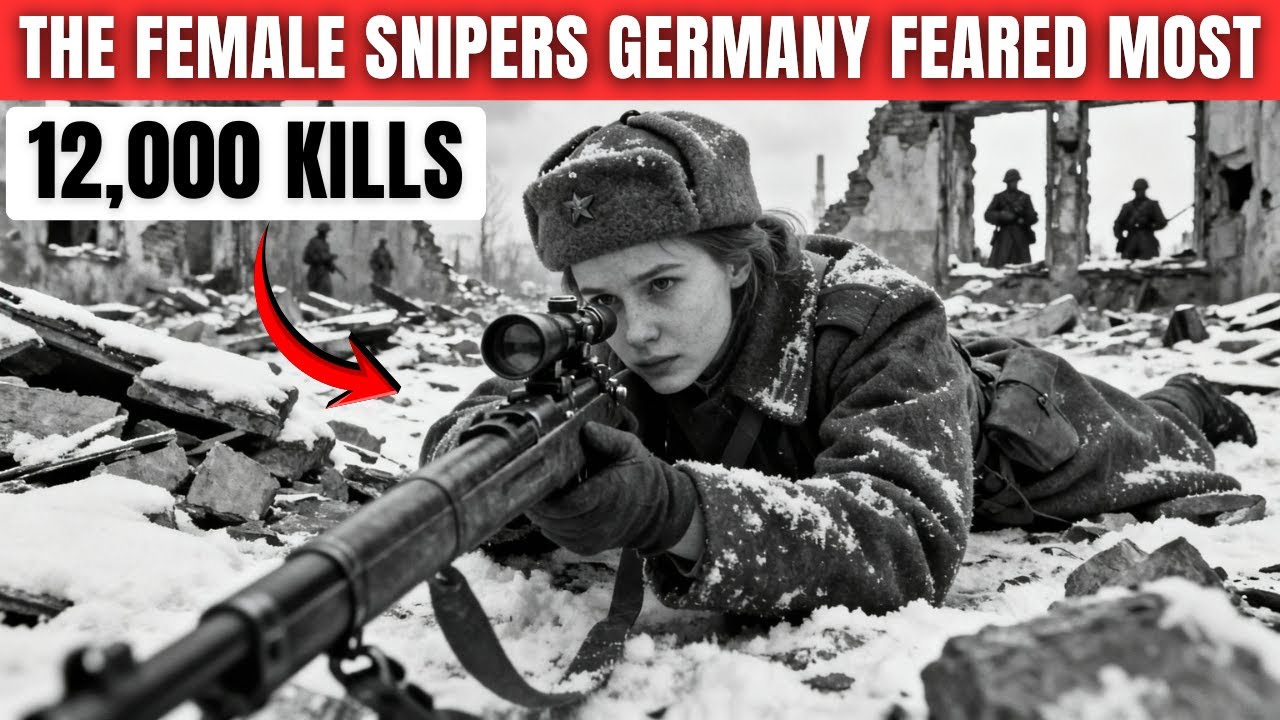
Then the firing began—not from ahead, but from above, from the flanks, from nowhere and everywhere at once. Three men went down in the first five seconds. The Germans scrambled for cover, but there was none, only rubble and corpses. More shots.
More men falling. The survivors screamed, bewildered, panicked. They couldn’t spot the enemy. They couldn’t work out where the fire was coming from, only the sharp crack of rifles and the screaming.
In ninety seconds, 21 Germans lay dead or dying. The 11 survivors fled. One of them, a sergeant named Klaus Fischer, wrote in his diary that night. He had fought in Poland, in France, and in Russia for six months, yet he had never been so frightened, because he never once saw who was shooting.
Before that day, Fischer had every reason to feel sure of himself. The Wehrmacht was the finest army in the world, and everybody knew it. They had smashed Poland in weeks. France had fallen in six weeks.
The Soviets were meant to be next. German soldiers were better trained, better led, better equipped. They had the finest tactics, the finest officers, the finest of everything. And the Russian soldiers?
The Germans laughed at them. Poorly trained, badly led, weak. The German High Command assured their men that Russia would collapse in three months, four at the most. When Operation Barbarossa began in June 1941, it seemed they were right.
The Germans drove hundreds of miles into Soviet territory. They took millions of Soviet soldiers prisoner. They wiped out thousands of tanks and planes. By December 1941, German soldiers believed they had won.
Moscow was nearly within their grasp. Victory was days away. They would be home for Christmas. Then winter arrived, and everything shifted.
The Soviets did not quit. They did not surrender. They simply kept fighting. And that was when the Germans began to notice something odd, something that made no sense to them.
Soviet snipers were killing their men—a great many of their men. But these were not the snipers they had expected. These snipers were different: quieter, more patient, more lethal. German soldiers began whispering about ghosts in the rubble, about invisible death, about shots that came out of nowhere.
Officers assumed their men were breaking under the strain, making excuses, imagining things that weren’t there. But the bodies kept accumulating. One shot, one kill, again and again. Company commanders began filing reports.
Something was going on. Their men were dying in ways that defied explanation. Sentries in perfect cover, officers standing among their troops, machine gunners in protected positions—all dead from single shots to the head. It took months before the Germans worked it out.
The Soviet snipers cutting down their best men were not the hardened male soldiers they had expected. They were women—young women, some barely 20 years old. Farm girls, factory workers, teachers, students. And they were better than nearly any sniper the Germans had.
The Wehrmacht had faced snipers before, good ones, but never anything like this, because these women possessed something the German soldiers had not counted on, something that made them more dangerous than any male sniper: patience, focus, and a burning hatred for the invaders who had destroyed their homes and killed their families. The Germans called them Nachthexen—night witches. They feared them more than tanks, more than artillery, more than air raids, because you could see a tank coming. You could hear artillery.
But these women—you never saw them. You never heard them. You simply died. The Soviet Union did something no other country in World War II did.
They put women on the front lines, not as nurses or clerks or support staff, but as combat soldiers, as snipers. And it was no small experiment. It was enormous. More than 2,000 women were trained as snipers.
By the end of the war, Soviet female snipers had killed over 12,000 German soldiers—confirmed kills, more than some entire divisions managed. The top Soviet female sniper, a woman named Lyudmila Pavlichenko, killed 309 Germans, more than almost any male sniper in history. The second best, Nina Lobkovskaya, killed 89. Dozens of others killed 50, 60, 80 Germans apiece, one shot at a time.
Here is what the Germans could not grasp. These women were not supposed to be good at this. Women were not supposed to be soldiers. That was what German commanders believed.
That was what their culture had taught them. Women were weak, emotional. They could not handle combat. They would panic under fire.
They would fail when it counted. The Germans were so certain of this that they never even bothered to train female snipers. It never crossed their minds. But the Soviets saw things differently.
They were desperate. The Germans had killed millions of Soviet soldiers. They had captured millions more. They had driven deep into Soviet territory.
The Soviet Union needed every person who could carry a rifle, man or woman. And when they began training women as snipers, they found something: women were often better at it than men. Not because they were stronger, not because they could shoot better, but because sniping is not about strength. It is about patience, discipline, focus, the ability to remain perfectly still for hours, to wait for the perfect shot, to control your breathing, your heartbeat, your emotions.
And women were very good at that. The first major battle in which German soldiers encountered Soviet female snipers in large numbers was Stalingrad, August 1942. The Germans were pushing into the city. They expected to take it in days, perhaps a week.
The city was already half destroyed. Soviet forces were falling back. It looked like another easy German victory. Then urban warfare began, and everything turned strange.
German soldiers started dying in ways that made no sense. A lieutenant would be speaking to his men. Crack. Dead.
Head shot from 400 meters. A machine gun team would be set up in a building. Perfect position. Good cover.
Crack. The gunner is dead. His replacement takes over. Crack.
He is dead too. Three gunners died in five minutes; the rest abandoned the position. An entire squad moving down a street. Crack.
Crack. Crack. Three men down. The others scatter, but there is nowhere to go.
More shots. More bodies. The survivors hide, terrified. They cannot see the shooter.
They cannot work out where the shots are coming from. They only know that if they move, they die. One German corporal, Heinrich Zimmer, wrote a letter home in October 1942. He said Stalingrad was hell, not because of the fighting, not because of the artillery or the tanks, but because of the snipers.
He wrote that you could never relax, never rest, never feel safe, even in buildings that seemed secure, even behind good cover. The snipers found you. They always found you. He wrote that his company had lost 43 men to snipers in two weeks.
That was nearly half the company. None of them ever saw the sniper who killed them, not once. Zimmer survived Stalingrad, barely. He was wounded three times, but he said the wounds did not frighten him.
What terrified him was the awareness that somewhere out there, a Soviet sniper had him lined up in her sights, and he would never know it until the round struck. The Germans threw everything they had at stopping the female snipers. They dispatched their own marksmen to track them down. Nearly all of those German snipers wound up dead.
They lobbed mortar shells into buildings where they suspected the snipers were concealed. The snipers simply relocated. They brought in dogs to track them by scent. The snipers shot the dogs.
They set out mannequins and decoys to provoke return fire. The snipers saw through the trick. They held out for genuine targets. The Germans began moving only after dark, but the Soviet women had already mastered shooting in darkness.
They committed distances to memory. They could identify the sound of German boots. They understood how German soldiers carried themselves. They knew it all.
And they were perpetually on watch. Soviet command recognized they had something remarkable on their hands, so they constructed an entire training program around these women. The Central Women Sniper School opened its doors in 1943. It would train more than 1,300 female snipers.
The curriculum was punishing: six months of relentless instruction. The women were taught to fire at ranges reaching 800 meters. They were taught to factor in wind, temperature, humidity. They were taught camouflage so effective that you could pass within a few feet of them without ever spotting them.
They were taught to remain utterly still for eight, ten, twelve hours—no food, no water, no bathroom breaks, only observing, only waiting. They were taught to govern their breathing so the rifle stayed steady at the moment of the shot. They were taught to slow their pulse before squeezing the trigger. They were taught to fire in the gaps between heartbeats, that fraction of a second when the body is entirely motionless.
And they were taught something more, something grimmer. They were taught to hate. The majority of these women had already had everything taken from them by the Germans. Their homes reduced to ash.
Their families slain. Their cities razed. They had witnessed things no person should ever witness: mothers shot down before their children, children shot down before their mothers, whole villages erased. So when they peered through their scopes at German soldiers, they did not see human beings.
They saw invaders, killers, marks. And that turned them merciless. No wavering, no pity, no reconsidering. Only aim, breathe, fire.
On to the next target. A male sniper might carry guilt, might dwell on the man he had just killed, might wonder whether that German soldier had a family, children, a wife. The women gave no thought to any of it. They simply did not care.
Each German they eliminated was one fewer invader on their soil, one fewer danger to their people, one step nearer to driving the fascists out. The figures shook the Germans once they finally grasped what was taking place. Soviet female snipers were not accounting for ten or twenty Germans apiece. They were accounting for dozens, hundreds.
Across a single eight-month stretch, Pavlichenko recorded 309 confirmed kills—more than one kill every day, day after day, for eight months without pause. And she was far from the only one. Nina Lobkovskaya recorded 89. Aliya Moldagulova recorded 92 before she fell in action at the age of 20.
Roza Shanina recorded 59 confirmed kills and was renowned for her double-taps: two targets, two shots, two kills in under three seconds. Nataliya Kovshova and Mariya Polivanova worked as a sniper duo. Between them they killed more than 300 Germans. When German troops finally encircled them, they battled until their ammunition was gone, then detonated grenades on themselves rather than be taken prisoner.
The Germans discovered their bodies ringed by dead Wehrmacht soldiers; estimates suggest they took another 20 Germans down in that last stand. Yet the most dreaded Soviet female sniper was not the one with the highest tally. It was a woman by the name of Nina Petrova. She did more than kill Germans.
She hunted German snipers specifically. She analyzed their habits, determined where they preferred to conceal themselves, how they went about their work. Then she laid traps. She would wait for them, at times for days on end, and when they finally showed themselves, she took them out.
German snipers began declining assignments in sectors where Petrova was known to operate. They would sooner face a court-martial than face her. One German sniper, a veteran with more than 100 kills to his name, recorded in his diary that he had spent three weeks hunting Petrova. He believed he had worked out her position and arranged himself to take the shot, only to grasp too late that she had been observing him the entire time.
She allowed him to settle in, allowed him to believe he was secure, then she killed him. His body was discovered with a note pinned to his chest. Written in German, it read: “You were too slow.” Petrova came through the war with 73 confirmed kills, 50 of them enemy snipers.
The German military attempted to minimize what was unfolding. They informed their soldiers that Soviet female snipers did not exist—it was propaganda, fabrication. The women were most likely mere spotters. The genuine snipers were men, and the women were claiming the credit.
But the soldiers understood the truth, because the casualties kept mounting. Directives arrived from German High Command: any Soviet female sniper taken alive was to be shot at once—not dispatched to POW camps, not interrogated, simply executed where she stood. The Germans asserted this was because these women were partisans, unlawful combatants. The actual reason, though, was fear.
These women had killed too many Germans, generated too much dread, made the Wehrmacht appear feeble. They had to be halted. And if they could not be halted, they had to be wiped out. Yet here is what the Germans never grasped.
You cannot halt someone who has already lost everything, someone battling for their home, their family, their nation, someone prepared to die so long as they take you with them. The Soviet female snipers understood they most likely would not live through the war. Most of them did not. Out of the 2,000 women trained as snipers, only roughly 500 survived.
The remainder perished in combat, were captured and executed, were killed in artillery barrages, succumbed to wounds. Yet each and every one of them, even knowing they would probably die, continued to fight, continued to shoot, continued to kill Germans. That was what they had enlisted for—not for glory, not for medals, but to halt the invasion, to safeguard what remained of their country, to make the Germans answer for every meter of Soviet ground they had seized. American industrial might was enormous in World War II; America produced more planes, more tanks, more ships than anyone else.
But the Soviet female snipers demonstrated something altogether different. You do not require enormous industry to win battles. At times you simply require resolve, ability, and the determination to fight. These women fought with standard Mosin-Nagant rifles, plain bolt-action weapons that had existed since 1891.
Nothing remarkable, nothing advanced, only iron sights and solid training. Meanwhile, German snipers possessed the finest scopes, the finest rifles, superior equipment in every respect. Yet it made no difference, because the Soviet women were superior. Not on account of their gear, but on account of their training, their patience, their absolute unwillingness to give up.
The legacy of the Soviet female snipers is a complicated one. After the war, Stalin had little desire to discuss them. It did not suit the Soviet narrative. Women were meant to be rebuilding the nation, bearing children, serving as mothers, not killing Germans by the hundreds.
And so their stories were minimized, kept out of sight. Plenty of them earned medals, yet never got the recognition that was their due. Lyudmila Pavlichenko turned into a hero—she traveled across America, met Eleanor Roosevelt, delivered speeches. But the majority of the other women slipped quietly out of history.
They returned to ordinary lives, turned into teachers, doctors, factory hands. They never spoke of what they had done, and their country never asked. It took decades before historians began to seriously examine what these women had achieved, how deadly they had been, how much fear they spread through German ranks. The figures are astonishing: more than 12,000 confirmed kills.
12,000 German soldiers who never came home, killed by women the Germans had assumed could not fight. Klaus Fischer lived through the war. That German sergeant, so frightened outside Stalingrad, surrendered to American troops in 1945. Years afterward, he sat for an interview with a German newspaper.
They asked him what had been the worst part of the war. He did not name the cold, or the hunger, or the wounds. He named the Soviet female snipers. He said they were not human.
They were ghosts, death itself. You could stand against a tank, against a machine gun nest, against artillery, because you could see those things approaching. You could fight back. But the snipers?
You never saw them, never heard them. You simply died. And realizing that some of those snipers were women somehow made it worse—not because women were incapable, but because it showed the Soviets were so desperate, so resolute, that they would send anyone to fight. Man, woman—it made no difference.
Everyone. And that was the moment Fischer said he understood Germany would lose. Not in 1945 when they surrendered, but in 1943 when he came up against those female snipers. Because a country that committed like that, that threw every last person into the fight, could not be defeated.
They would die before they quit. The Soviet female snipers proved that war is not merely a matter of who has the most tanks or planes or ships. It is about will, determination, the refusal to surrender however bad things become. The Germans had better equipment, better training at the start, better tactics.
But they lacked what the Soviets had. They lacked people ready to die defending every meter of their homeland. The German soldiers fought for conquest, for their Führer, for an empire. The Soviet soldiers, including those 2,000 women with rifles, fought for survival, for their homes, for their families.
And that changed everything. By the war’s end, more than 12,000 German soldiers had been killed by Soviet female snipers—more than the entire population of some towns. And those are only the confirmed kills. The true number is likely far higher, because amid the chaos of war, not every kill is recorded, not every shot is counted.
But 12,000 confirmed means 12,000 times a Soviet woman looked through a scope, found a German soldier, and pulled the trigger. 12,000 families in Germany who never saw their son or husband or father again, killed by women the Germans claimed could not fight.
