He entered the world at the zenith of European power, an archduke of the House of Habsburg, a grand admiral of the fleet, and a man who was openly offered a crown. Yet he turned his back on his imperial dynasty, declined the throne, and chose to die an ordinary citizen in a country that had been wiped from the map. His name was Archduke Charles Stephen. How did a man born to rule the Austrian Empire end up committing what the Nazis later called racial treason?
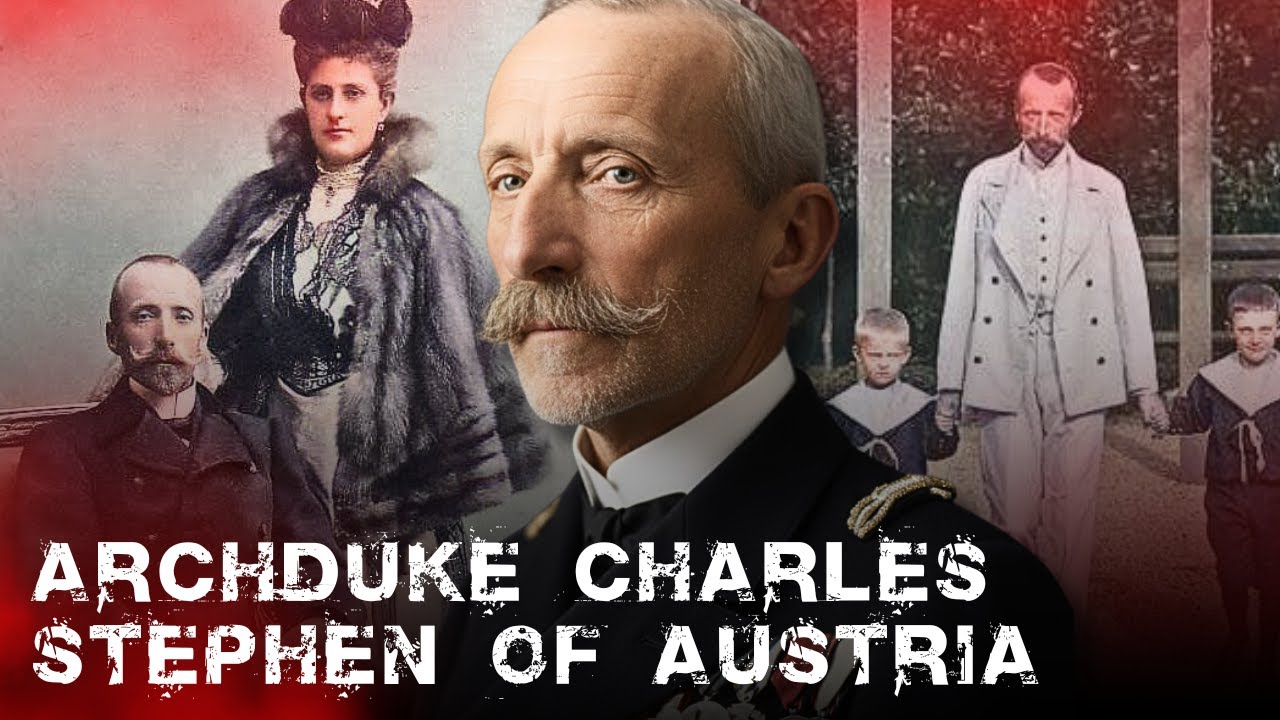
And why did his refusal to wear the crown lead his family not to a palace, but to a Gestapo torture cell? That tragedy was inevitable. Charles Stephen was crushed between two worlds that could never be reconciled: the rigid imperial past he was born to govern, and the chaotic nationalist future he was forced to navigate. But given the tragedy and greatness of his life, we cannot begin at the end.
We cannot begin with the silence of the garden in 1932. We must travel back across the chasm of the Great War, back to before the invention of the airplane, before the telephone, before the electric light bulb. We must return to the height of Habsburg monarchy, to a time when the fate of millions was decided in whispered conversations inside Vienna’s velvet salons. We must return to the autumn of 1860.
That year was a turning point in human history. In America, a lawyer named Abraham Lincoln was campaigning for the presidency, and the clouds of civil war were gathering on the horizon. In Italy, the revolutionary Garibaldi was leading his Red Shirts through the south, tearing apart the old maps of the peninsula. And in central Europe, the Austrian Empire was holding its breath.
It was an ancient, sprawling creature, an empire that encompassed what is today Austria, Hungary, the Czech Republic, Slovakia, Croatia, Slovenia, Bosnia, and parts of Italy, Romania, Poland, and Ukraine. It was a kaleidoscope of languages, religions, and cultures, bound together by only one thing: the House of Habsburg. For 600 years, the Habsburgs had married, conquered, and maneuvered their way to dominance. They believed with religious fervor that they were chosen by God to rule.
Their jawlines were famous, their etiquette suffocating, their authority absolute. But by 1860, cracks were beginning to show in the marble. The young Emperor Franz Joseph I, the man who would become a symbol of the nineteenth century, had sat on the throne for twelve years. He was a man of severe discipline, a bureaucratic monarch who slept on a soldier’s bed and rose at four in the morning every day to sign papers.
He was trying desperately to freeze time, to hold back the waves of nationalism and democracy sweeping across Europe. He believed that if he worked hard enough, if the army remained loyal enough, the empire would endure forever. And into this world of golden restraints and ancient duties, Charles Stephen was born. The location was Groß Seelowitz, a magnificent castle in Moravia, in what is now the Czech Republic.
The date was the fifth of September, 1860. It was a Tuesday. In the crisp air of the early harvest season, the cries of a newborn echoed through the castle, announcing the arrival of a new archduke. But Charles Stephen was not born into the main line of the family.
He was not destined for the Viennese throne. He was born into the Teschen branch of the Habsburg dynasty. And that distinction is crucial. The Teschen line was different.
They were the soldiers. They were the practical Habsburgs. While the main line in Vienna concerned itself with court protocol and the divine right of kings, the Teschen branch concerned itself with maps, fortifications, and artillery. They were enormously wealthy, perhaps the richest branch of the entire family, thanks to their vast landholdings and industrial investments in Silesia.
But their identity was forged in war. Charles Stephen’s grandfather was the legendary Archduke Charles, Duke of Teschen, the man who did the impossible: he defeated Napoleon Bonaparte on the battlefield at Aspern-Essling in 1809. That legacy, the legacy of the warrior hero who saved the dynasty, hung over the family like a heavy tapestry. Charles Stephen’s father was Archduke Karl Ferdinand.
He was the second son of the great hero, a cavalry general who lived his life to the rhythm of the bugle call. Karl Ferdinand was an old-fashioned man, blunt and simple in his tastes, utterly devoted to the army. He was not an intellectual. He did not spend his evenings discussing philosophy or contemplating the stars.
For him, the world was ordered and clear. There was the Emperor. There was the army. And there was God in that system.
He looked at his newborn son, Charles Stephen, and saw what every Habsburg father saw: a future officer. A man who would learn to ride before he learned to read, who would wear the white uniform of the infantry, who would marry a German princess and keep the dynasty going. But biology is a strange thing. And inheritance is never a straight line.
Because Charles Stephen was also his mother’s son. Archduchess Elisabeth Franziska was a woman of immense complexity. She was Habsburg by birth, but her soul was Hungarian. Her father had been the Palatine of Hungary, the viceroy who ruled Budapest.
She grew up listening to the loud, emotional music of the Hungarian plains, surrounded by a culture that valued passion, poetry, and rebellion. Tragedy had already touched her life before she married Karl Ferdinand. She was a young widow, her first husband, a cousin from the Este line, having died at an early age, leaving her with a daughter and a broken heart. When she married Karl Ferdinand, it was a practical marriage, a dynastic arrangement to consolidate family wealth.
But she brought something utterly foreign into the stern military household of Teschen. She brought imagination. She brought a sensitivity to the cultures of the empire that her husband lacked. While Karl Ferdinand saw the empire as a map of garrisons and fortresses, Elisabeth Franziska saw it as a tapestry of peoples.
She understood that Hungarians, Czechs, and Poles were not merely subjects to be commanded. They were peoples with souls. That was the genetic mixture that created Charles Stephen. On one side, the iron-willed, rigid discipline of the Austro-German military machine.
On the other, the romantic, adaptable, culturally sensitive spirit of the Hungarian aristocracy. From the moment he took his first breath, a war was being waged inside his DNA. A war between the past and the future, between the rigid order of the parade ground and the fluid chaos of the real world. His early years at Groß Seelowitz were a textbook lesson in isolation.
A Habsburg childhood in the 1860s was not filled with playdates or fun. It was a job. From the age of four or five, Charles Stephen and his brothers Friedrich and Eugen were placed under the care of tutors and governesses. Their day was divided into precise time blocks.
6 a.m.: wake, wash in cold water, pray, breakfast. 7 a.
m.: Latin. 8 a.m.
French at 9 a.m., then mathematics at 10 a.m.
Fencing at 10 a.m. The whole curriculum was built to shape a ruler, not a thinker.
History was on the timetable, but a very particular brand of it: the chronicle of Habsburg greatness. The lessons taught that his family stood at the heart of Europe, an impregnable bastion holding back disorder. German came naturally, since it was the tongue of command, and he picked up the empire’s other languages too, though usually by rote, valued mainly as instruments for relaying orders down the chain. Even so, Charles Stephen was a quiet boy.
He watched and absorbed. His elder brother Friedrich, destined one day to command the Austro-Hungarian army, took to boisterous military games by instinct, brandishing a wooden sabre and shouting commands at the servants. Charles Stephen, by contrast, was usually discovered in the library. Globes held him spellbound. He would set the big globe in his father’s study spinning, one finger following the blue stretches of ocean.
For a Habsburg, caring about the sea was like a lion wanting to fly. It went past unusual into something close to eccentric. Yet Charles Stephen detected something in those maps that none of his tutors ever pointed out. He saw that water bound the world together.
He devoured accounts of the British Empire, of how a tiny island nation came to rule the globe through sea power. He read about the American Civil War, in particular the naval blockade that choked the Confederacy. With a clarity beyond his years, he started to grasp that the future would belong to those who commanded technology and commerce, not simply those who could march in perfect lines. As adolescence set in, the gap between him and everything around him only widened.
The 1870s were hard years for the family. His father, Archduke Karl Ferdinand, passed away in 1874, when Charles Stephen was just fourteen. The blow came without warning. That towering figure of authority, the living tie to the glories of the Napoleonic age, was suddenly gone.
The young archduke was left an orphan, pressed still deeper into the dynasty’s severe demands. Friedrich, the elder, was at once groomed for the soldier-prince role, inheritor of the Teschen military tradition. In every sense, literal and symbolic, Friedrich took their father’s place. Charles Stephen was the spare.
And into the void his father’s death had opened, he made a choice that jolted the Viennese court. A second son was normally handed a cavalry regiment, a fine uniform, a hollow title, and an easy life in the capital. Charles Stephen would have none of it.
He approached his guardian, his uncle Archduke Albrecht, the hardline, deeply conservative patriarch of the family, and requested leave to enter the navy. Not as some honorary admiral occupying a desk. He wanted to enlist as an officer cadet. He wanted to go to sea.
Picture how staggering that was. The navy. That was where commoners went, technicians, men who got their hands black with coal and grease. It was no place for imperial blood.
Yet the Habsburgs held to one rule: every male had to serve. And if the boy was stubborn enough to crave the sea, maybe it would knock it out of him. Maybe a few months of seasickness and brutal deck discipline would send him scurrying back to the comforts of the cavalry. So the permission came, but it came with a sneer.
Let the boy play with his boats. He would come back. They were mistaken. In 1879, at nineteen, Archduke Charles Stephen stepped aboard the SMS Seeda.
He came aboard as an officer holding the rank of Seefähnrich, the most junior officer grade. He set aside the velvet and silk of his upbringing and put on the rough wool of the naval uniform. He asked for no private cabin. He demanded no servants to dab his brow.
He meant to master the craft from the ground up, quite literally. And there, on the rolling decks of a wooden cruiser, amid the tang of salt spray and tar, Charles Stephen discovered his first taste of freedom. For the first time in his life, he was more than a Habsburg relic put on display for admiration. He was a junior officer with duties to perform.
He had to master navigation. He had to grasp the physics of wind and sail. He had to learn to lead men, not as subjects but as a crew. His first significant voyage was no leisurely excursion.
It was a transatlantic crossing to Brazil and North America. Consider what that did to him psychologically. While his brother Friedrich was reviewing barracks in dusty provincial towns of Hungary, Charles Stephen was crossing the equator. He was gazing on the rainforests of Brazil.
He was touring the bustling, chaotic, fast-industrializing cities of the United States. He saw New York. He felt the energy of the New World. He came back to Europe a different man.
He had measured the true scale of the world. He saw how small, cut off, and brittle the Austro-Hungarian Empire really was. He saw that while Vienna brooded over the past, the rest of the globe was hurtling toward the future. He saw that the empire was a landlocked dinosaur in a sea of sharks.
But those ships taught him something else as well, something that would shape his political destiny. Aboard an Austrian vessel, the crew was the empire in miniature. There were Italians from Dalmatia hauling on the ropes, Croatian gunners, Austrian officers, Hungarian engineers, Czech stokers.
On dry land, these groups frequently squabbled and clashed over language rights and frontiers. But on a ship caught in a storm, none of it counted. If the Croatian failed to haul the rope in time with the Italian, the ship went down. They had no choice but to work as one.
The ship forced cooperation. It forged a kind of artificial unity that the empire desperately needed. Charles Stephen looked at his crew and glimpsed what Austria-Hungary might become. He glimpsed “United Danube States,” a federation in which loyalty to the whole outranked the narrow nationalisms of its parts.
He fell in love not only with the sea but with the notion of the navy as a unifying force. Yet as he climbed the ranks, lieutenant in 1881, captain soon after, he started to see that the men in Vienna did not share his vision. To the court, he remained merely the odd cousin. But Charles Stephen was maturing.
He was turning into a man of real weight. And he understood that if he wanted to make a genuine difference, being a sailor alone would not suffice. He required a base of operations. He required a partner.
And he needed to shape his own fate, clear of the stifling hierarchy of the Viennese court. In the mid-1880s, he met the woman who would become his partner in destiny: Archduchess Maria Theresa of Austria-Tuscany. She was no timid, withdrawn figure. She came from the Tuscan branch of the family, another secondary line, another circle of outsiders.
She possessed intelligence, deep piety, and a burning ambition for her family’s advancement. Their February 1886 wedding in Vienna was a magnificent affair, honoring the joining of two branches of Europe’s mightiest dynasty. Yet for Charles Stephen and Maria Theresa, it marked the launch of something else entirely—a venture of their own. They had no intention of dwelling in the Emperor’s shadow.
A decorative royal couple, appearing at the opera and exchanging court gossip, held no appeal for them. They craved a mission. And soon after the wedding, Charles Stephen found himself studying the map of the empire once more. This time, his attention shifted from the water to the soil.
Yet his gaze did not fall on Austria. It did not fall on Hungary. It turned northward. It settled on a territory infamous for its poverty, its rutted roads, and its defiant, unruly population.
He fixed his eyes on Galicia. This was the Austrian portion of partitioned Poland—a country of enormous woodlands, gentle hills, and a history steeped in tragedy. Its Polish nobility was haughty, bitter toward German authority, and passionately devoted to its own traditions.
Most Habsburgs steered clear of Galicia whenever possible. It carried the reputation of a half-savage borderland. Charles Stephen, however, perceived something there worth seizing. He had come into possession of the Saybusch estate—or, as the Poles named it, Żywiec.
It was an enormous holding: tens of thousands of hectares of woodland and fields, along with an aging castle in need of repair. In the early 1890s, Charles Stephen took a step that would determine his entire future. He gathered up his household. He took his young wife and their ever-growing brood of children.
And he departed from Vienna. He relocated to Żywiec. This was more than a change of address. He was stepping onto a cultural bridge that offered no way back.
He was walking straight into the stronghold of Polish nationalism—not carrying a whip, but extending a hand in peace. He was on the verge of launching one of the most remarkable social experiments in the history of royalty. He was about to try to remake a Habsburg archduke into a Polish prince.
As the train bore him and his family northward through mountain passes into the fog-wrapped valleys of Galicia, Charles Stephen could not have guessed that he was traveling toward a crown made of dreams. He could not have guessed that he was putting himself at the very center of an approaching upheaval. He knew only that he had discovered a home and a calling. The sailor-prince had found his anchorage.
Yet the tempest was only gathering. When Charles Stephen and his family reached Żywiec in the mid-1890s, they were not stepping into a storybook. They were stepping into a stronghold set in a land haunted by the past. For over a hundred years, the Poles of this region had lived beneath Austrian authority.
They had seen their kingdom wiped from the map, their revolts put down, their culture pushed to the margins. To the local people—the peasants working the soil, the proud but poor Polish gentry in their decaying manor houses—the arrival of a Habsburg archduke to dwell among them was no reason to rejoice. It was reason to be wary. Was he an agent dispatched from Vienna?
Was he a jailer arriving to draw the chains tighter? The locals observed the castle with distrustful eyes. They braced for arrogance. They braced for the clatter of military boots and the harsh ring of German orders.
What greeted them instead was quiet—and then a surprise that reverberated through the whole province. Charles Stephen did not treat Żywiec as a seasonal retreat or a colonial outpost. He treated it as a small realm of his own. He brought the same discipline to running the estate that he had once brought to commanding a warship.
He rose before sunrise. He studied the ledgers. He traversed the forest not merely to hunt, but to grasp how the land was managed. Yet the true upheaval was unfolding inside the castle walls—in the nursery, in the drawing rooms.
Charles Stephen and Maria Theresa reached a decision that, by the standards of nineteenth-century Habsburg royalty, was nothing short of revolutionary. They resolved that their children would not merely reside in Poland; they would become Polish. In Vienna, the Imperial court existed as a German-speaking enclave. At Żywiec, by contrast, Charles Stephen engaged Polish tutors.
He recruited Polish governesses. He insisted that the household tongue—the language of play and of prayer—be Polish. Picture the bewilderment of an Austrian official paying a visit. He reaches the castle anticipating the rigid ceremony of the Viennese court.
Instead, he discovers the archduke’s children racing through the corridors, calling to one another in the Slavic speech of the local folk. And he discovers the archduke himself seated in his library, absorbed in the poems of Adam Mickiewicz—the towering Polish romantic nationalist whose verses were all but rebel anthems. This was no pastime. This was a profound reinvention.
Charles Stephen was carrying out a project of self-transplanting. He grasped something the unbending men of Vienna could not: a people cannot be governed without respect. If the Habsburg Empire hoped to endure in this modern era of nationalism, it must cease being a prison of nations and become their home. He was constructing a model of a new sort of monarch.
One that blended into the peoples themselves. The castle at Żywiec started to transform. It shed its character as a forbidding stronghold and took on the life of a cultural salon. Charles Stephen threw open its doors to the Polish intellectual elite.
Painters from the Academy of Fine Arts in Kraków, professors from the Jagiellonian University, writers, poets, historians—all started to receive invitations to Żywiec. At the outset, they came out of curiosity. Why would an imperial cousin wish to speak with them? But they remained because of his genuineness.
They discovered a man who listened more than he talked, a man who posed genuine questions about Polish history, who engaged Polish artists to paint, who gave to Polish charities without seeking recognition. He became a patron of the arts, a benefactor of the Kraków Academy of Sciences. Slowly, the frost started to thaw. In the cafés of Kraków and Lwów, the nickname began to spread.
He was no longer referred to as the Austrian. People started murmuring about the Polish Archduke. Yet Charles Stephen was leading a double existence. While he was becoming a Polish patriarch in the mountains, he remained an inspector of the navy on the coast.
He was shuttling between two worlds. And even as he was remaking his identity in Galicia, he was battling to modernize the empire’s fleet in the Adriatic. The turn of the century saw a naval arms race erupt across the globe. Britain and Germany were turning out enormous dreadnoughts—floating steel fortresses with guns capable of striking far beyond the horizon.
Charles Stephen saw clearly that Austria-Hungary was slipping behind. The old wooden vessels he had sailed in his youth were now outdated. He pressed, he pleaded, he mustered backing for steel, for turbines, for torpedoes. He stood as an advocate for technological advancement in an empire that distrusted machines.
Here lies a deep contradiction. Charles Stephen was striving to rescue the empire in two distinct manners, in two distinct locations, simultaneously. Down in the south, he was assembling a steel fleet to guard the empire’s body. Up in the north, he was constructing a bridge of culture to guard the empire’s soul.
He was the most industrious man in the dynasty. Yet his most perilous wager was still ahead. As his daughters reached womanhood, the matter of marriage came up. Within the Habsburg family, marriage was never a private decision.
It was a question of national security. One had to wed one’s equals. One had to wed into royal houses: Bourbons, Wittelsbachs, Savoys. Wedding beneath your rank, even to high-ranking nobles, counted as a morganatic marriage.
It meant your children would forfeit their rights of succession. It amounted to a kind of dynastic suicide. By 1910, Charles Stephen’s daughters had come of marriageable age. They were lovely, affluent, and thoroughly educated.
Any prince in Germany or Italy would have been keen to wed them. The Emperor in Vienna, old Franz Joseph, anticipated conventional marriages. Charles Stephen approached the Emperor with a different proposition. He sought permission to wed his daughters to Poles.
Not to the Polish royal family, since the Kingdom of Poland did not exist, and so there were no kings. He wished to wed them to Polish nobles. The Radziwiłł and Czartoryski princely families. These were ancient lineages, older and wealthier than many royal houses, yet within the rigid hierarchy of the Habsburg court, they were regarded as subjects.
It was unprecedented for an archduchess to wed a subject. It violated centuries of protocol. But Charles Stephen argued his case with the exactness of a naval tactician. He told the Emperor: “If we wish to retain Galicia’s loyalty, we must tie ourselves to them by blood.
We must show them that we are partners, not occupiers.” The weary Emperor, alarmed by the growing tide of Polish nationalism, gave way. He granted permission. He acknowledged these marriages as equal.
In January 1909, Archduchess Renata wed Prince Hieronim Radziwiłł. Afterward, her sister Mechthild wed Prince Olgierd Czartoryski. The weddings were political earthquakes. When a daughter of an imperial archduke said “I do” to a Polish prince, it sent a shockwave across Eastern Europe.
The Polish press was overjoyed. For the first time since the eighteenth-century partitions, a major European power was treating them as equals. They no longer viewed Charles Stephen merely as a friend. They viewed him as a candidate.
If the Habsburgs were prepared to marry Poles, were they prepared to be ruled by one? The whispers started to harden into a concrete plan: the Trialist solution. The concept was to convert the dual monarchy of Austria-Hungary into a triple monarchy of Austria-Hungary-Poland. And who would occupy that third throne?
Who else but the man who resided in Żywiec, spoke the language, and was the father-in-law of the Radziwiłłs. Charles Stephen sat at the heart of this network, watching and waiting. He never campaigned openly. He was too disciplined, too devoted to the Emperor to seem like a usurper.
But he made preparations. He trained his sons, Karl Albrecht and Wilhelm, to be soldiers for this new future. Yet even as he built this dream, a fissure was opening inside his own house. A fissure that echoed the tragic fault lines of the region.
His youngest son, Wilhelm, was the unpredictable one. While the rest of the family was turning Polish, Wilhelm was gazing further east. He was captivated by the other great oppressed nationalism of the region: the Ukrainians. The Poles and Ukrainians in Galicia were fierce rivals.
Both laid claim to the same land. Both sought independence. And while Charles Stephen was becoming the Poles’ champion, his son Wilhelm was quietly falling in love with the romantic nationalism of Ukraine. He learned the language.
He journeyed to the Hutsul villages in the Carpathian Mountains. He started dreaming of his own crown, a Ukrainian crown. The father was building a Polish kingdom. The son was dreaming of a Ukrainian kingdom.
Beneath the roof of Żywiec Castle, the future civil war of Eastern Europe was being rehearsed at the dinner table. But for the moment, they remained a family, bound together by the admiral’s quiet authority. By the spring of 1914, Charles Stephen was fifty-three years old. He stood at the peak of his powers.
He had managed to integrate his family with the Polish nation. He was a respected admiral. The fleet was being modernized. The Emperor was old, but the empire appeared stable enough.
Sunday, June 28, 1914, was a sweltering day. Charles Stephen was probably at Żywiec, perhaps enjoying the garden’s shade, or discussing crop yields with his sons-in-law. Far off, in the city of Sarajevo, a young student named Gavrilo Princip stood on a street corner with a pistol in his pocket. He was awaiting the carriage carrying Charles Stephen’s cousin, the heir to the throne, Archduke Franz Ferdinand.
The bullets that killed Franz Ferdinand did more than kill a man. They killed the nineteenth century. They smashed the delicate stained-glass window that Charles Stephen had spent twenty years building. The telegram arrived at Żywiec that evening.
The air was motionless and foreboding. War was approaching. Charles Stephen must have glanced at his sons, Karl Albrecht and Leo Wilhelm. He must have glanced at his Polish sons-in-law.
With a strategist’s instinct, he understood the gaming table had just been flipped over. The meticulous diplomacy, the gradual cultural integration, the peaceful marriages, all of it was about to be tested by fire. He laid down his garden shears. He donned his admiral’s uniform.
He boarded the train to Vienna. The admiral was reporting for duty. But he was not sailing the Adriatic. He was sailing into a hurricane that would sweep away crowns, borders, and empires.
The Polish experiment was no longer a theory. It was about to become a desperate wager for survival in a world ripping itself apart. The summer of 1914 died swiftly. It did not fade quietly into autumn.
It was assassinated. When the war telegrams went out in late July and early August, the mood in Vienna, and indeed in Berlin, Paris, and St. Petersburg, was one of wild, drunken optimism. They called it the “Spirit of 1914.
” Crowds gathered on the Ringstrasse, flinging flowers at the columns of marching soldiers. Officers in their crisp uniforms toasted with champagne to a new and joyful war. They believed, with a naivety that is heartbreaking in hindsight, that they would be home by Christmas. But in Żywiec Castle, Charles Stephen was not drinking champagne.
He was studying a map. And what he saw was a nightmare. While the world’s attention was fixed on the Western Front, on the German invasion of Belgium and the race to Paris, a catastrophe of mythical proportions was unfolding in the East. Galicia, Charles Stephen’s adopted homeland, was not merely a backdrop to the war.
It was the battlefield itself. The Russian Empire, that colossal machine, had mobilized with a speed nobody had anticipated. Millions of Russian troops were spilling over the frontier, swamping the Austrian-held portion of Poland. For Charles Stephen, this war was no abstract geopolitical struggle.
It was unfolding in his own backyard. It was happening to his tenants, his neighbors, and most alarmingly of all, to his children. The archduke’s sons, reared in the dual-identity, dual-language world of Żywiec, were by now officers in the Imperial army. Karl Albrecht, the heir, took on his responsibilities with the strict sense of duty his father had drilled into him.
Leo went into the cavalry, eager to charge with sabers in an era of machine guns. And Wilhelm, the romantic Ukrainian dreamer, was given command of Ukrainian troops, seeing the war as the opening step toward his private ambitions. They were Habsburgs, to be sure, but they were fighting on soil they regarded as home, leading men who spoke their languages. This was no colonial expedition.
It was a fight for their very survival. Yet the defense crumbled. By September 1914, the Austro-Hungarian army was falling apart. The Russians shattered the lines.
The fortress city of Lemberg, Lwów, was lost. The Imperial army pulled back in a muddy, disorderly rout, abandoning thousands of dead in the foothills of the Carpathians. The war came to the gates of Żywiec. The Russian push was unrelenting.
Panic tore through the aristocracy. Most Polish nobles gathered up their silver, their jewels, and their furs, escaping westward to the safety of Vienna. They abandoned their estates for Cossacks to plunder. Charles Stephen was faced with a decision: run or remain.
Protocol demanded that no member of the Imperial family be taken captive. That would be a humiliation. So, heavy-hearted, the family evacuated Żywiec for a time, withdrawing to the safety of Vienna. But this was no retreat into luxury.
To Charles Stephen, Vienna in 1914 was a place of anguish. He was an admiral with no fleet to command in the north, forced to watch the army generals wreck the army his family had spent centuries building. He saw the refugees pouring into the capital. He saw the hospitals filling with faceless men, bodies shredded by modern artillery.
And he saw something more. He saw the empire’s fissures opening wider. Czech soldiers were surrendering to the Russians. Italian subjects were growing restless.
But the Poles, the Poles were fighting. Led by a socialist revolutionary named Józef Piłsudski, the Polish Legions were battling for Austria against Russia. Not out of love for the Habsburgs, whom they despised, but because they loathed the Russians more. Piłsudski’s plan was straightforward: exploit the war to bring down the powers that had carved up the country.
Side with Austria to beat Russia, then turn on Austria for independence. Charles Stephen observed Piłsudski from a distance. He admired the man’s fire. He understood that the Polish question could no longer be answered with half-measures.
You could not simply hand the Poles better roads or a handful of parliamentary seats. They had tasted blood. They wanted a homeland. And when 1915 came and the German and Austrian armies unleashed a massive counteroffensive, the Gorlice-Tarnów offensive, to push the Russians out of Poland, the question changed from how to defend Galicia to what to do with the conquered land.
The Central Powers had occupied the Russian zone of Poland. They now held Warsaw. They controlled millions of Poles. And they had a dilemma.
They needed more soldiers. The war was becoming a furnace, consuming men by the hundreds of thousands. Germany and Austria required fresh bodies to feed the trenches. The German military dictators Hindenburg and Ludendorff had a cynical scheme.
Promise the Poles a kingdom, and they will supply us an army. They cared nothing for Polish independence. They wanted a buffer state, a puppet kingdom to shield Germany from Russia, and a source of recruits for cannon fodder. But a kingdom requires a king.
The hunt for a king of Poland got underway in earnest in 1916. It was a strange political beauty contest staged amid a slaughterhouse. The Germans put forward a German prince. The Austrians objected loudly, a German on the Polish throne would entirely surround Austria.
The Austrians suggested the Emperor himself take the Polish crown. The Germans refused, that would make Austria too strong. A compromise was needed. Someone Austrian enough to satisfy Vienna, independent enough to satisfy the Poles, and well-connected enough to satisfy the Germans.
Every finger on the map pointed to Żywiec. Archduke Charles Stephen was the sole logical candidate. The pieces were coming together. Charles Stephen was approached.
He was wary. He was not a vain man. He informed the diplomats: “I will not accept a crown that is nothing but an empty prop. If I am to be king, I must have a real government, a real army, and real borders.
” He started drafting a constitution. He conferred with Polish leaders. He prepared his sons. Karl Albrecht was to become Poland’s crown prince.
They were ready. But history seldom runs in a straight line. It is a chain of trains colliding. On November 5, 1916, the manifesto of the two emperors was released.
Germany and Austria-Hungary formally announced the creation of an independent Kingdom of Poland. It was a historic occasion. For the first time in 121 years, the name Poland had reappeared on the political map of Europe. But there was a condition.
The proclamation did not set the borders. And it did not name a king. It was a kingdom without a king. A blank check signed by two empires sliding toward bankruptcy.
The Poles were not fools. They spotted the hidden terms. Piłsudski, the commander of the Legions, famously declared: “Not a drop of Polish blood for German interests. ” He would not recruit soldiers for this phantom kingdom until a real government existed.
Charles Stephen watched this bungled launch with frustration. He knew the Poles could not be fooled. They had to be led. He was prepared to step forward and fill the vacuum, to be the king who transformed the paper promise into reality.
And then, eighteen days later, the world shifted once more. Emperor Franz Joseph I died. He had ruled for 68 years. He was the only emperor most people had ever known.
He was the glue that held the empire’s chaotic mosaic together. With his death, the psychological anchor of the monarchy dissolved. The funeral was the last grand parade of the old world. A black funeral carriage pulled by black horses.
The streets were lined with soldiers in gray, the air thick with incense and dread. Charles Stephen walked in the procession, his face somber. He was mourning more than his cousin. He was mourning the stability of the world he had known.
The new Emperor was Charles I. He was young, just twenty-nine. He was decent, pious, and desperate for peace. He admired his uncle Charles Stephen and looked up to him.
Yet he also feared him. Why? Because Charles Stephen was popular in a crumbling empire, and popularity is a dangerous thing. The young Emperor Karl had a problem.
If Charles Stephen took the Polish throne, he could end up wielding more power than the Emperor of Austria himself. A Habsburg Poland under the energetic, Polish Charles Stephen might eclipse a weakening Habsburg Austria. Jealousy works slowly, like a poison. Karl did not turn Charles Stephen down outright.
He simply wavered. He delayed. He told him: “Let us wait until we have won the war.”
But the war was not moving toward victory.
1917 was the year everything came apart. In the east the Russian Revolution erupted, pulling Russia out of the war but spreading the virus of Bolshevism. In the west the United States joined the fight, adding an industrial power the Central Powers could never equal. At Żywiec, Charles Stephen existed in an odd state of suspension.
He was the chosen king, greeting delegations, drafting plans for a Polish navy, designing Polish currency. Yet he wielded no power. He was a performer waiting in the wings while the theater burned. And his own blood was making the script more tangled.
We must turn back to Archduke Wilhelm, the Red Prince, the Ukrainian dreamer. While Charles Stephen readied himself for the Polish crown, Wilhelm was advancing toward the Ukrainian crown. Russia’s collapse had left a vacuum in Ukraine, much as it had in Poland. The Ukrainians wanted a state of their own.
Wilhelm saw his fate. He cast himself as a champion of Ukrainian independence, frequently in opposition to Polish interests. Picture the dinner-table conversations at Żywiec in 1917. The father, Charles Stephen, was the candidate for the Polish throne.
The son, Wilhelm, was the candidate for the Ukrainian throne. The Poles and Ukrainians were locked in a bitter border war over who owned the city of Lwów. It was a Greek tragedy performed with a German accent. The House of Habsburg-Teschen was winning the game of thrones, but it was playing on two separate boards that were crashing into each other.
Charles Stephen tried to restrain his son. He was a disciplined naval officer. Wilhelm was a reckless romantic. But the chaos of 1917 let him run free.
He was bargaining with Ukrainian warlords, wearing embroidered shirts, and earning the hatred of the Poles his father was trying to court. Then came the Oath Crisis. Józef Piłsudski played his strongest card. He forbade the Polish Legions from swearing loyalty to the German Kaiser and the Austrian Emperor.
He declared their loyalty belonged to Poland alone. The Germans, enraged, arrested Piłsudski and locked him in Magdeburg prison. This was a catastrophe for Charles Stephen’s candidacy. Piłsudski was the only man whose moral authority could unite the Poles.
With Piłsudski imprisoned, the Kingdom of Poland looked like a fraud to the people. Charles Stephen had gambled on being a constitutional monarch who worked with leaders like Piłsudski. Now he was being pressed to serve as a puppet for the Germans who had jailed the Polish national hero. He refused.
He sent word to Vienna and Berlin: “I will not accept the crown under these circumstances. I will not be a king imposed by bayonets.” It was a moment of absolute integrity. The title could have been his.
He could have put on the velvet robes and set the golden crown on his head. But he knew it would be a lie. He chose honor over power. Yet the vacancy remained.
The throne stood empty. The wind whistled through the Royal Palace in Warsaw. And as 1917 gave way to 1918, the mood turned from political maneuvering to sheer survival. While the Polish dream stumbled, the nightmare came back to the sea.
Charles Stephen was still an admiral, and the fleet he loved, the fleet he had modernized, was starving. The blockade was biting hard. Sailors were eating biscuits crawling with worms. They had not seen their families in years.
They had heard of the Russian Revolution, of sailors who seized ships, shot their officers, and proclaimed freedom. In February 1918, the inevitable came: the Cattaro Mutiny. The red flag went up over the flagship Sankt Georg. The sailors aimed their guns at the officers’ quarters.
They called for peace and bread. The Empire panicked. If the navy collapsed, the army would follow. They needed a man who inspired respect.
They needed an elder of the sea. Emperor Karl wired Żywiec: go to Cattaro, fix this. Charles Stephen put on his admiral’s uniform once more. He studied himself in the mirror, older, grayer, the phantom Polish crown pressing heavily on his forehead.
He was leaving the wreckage of his political ambition to try to save the wreckage of his military career. He boarded the train south, departing the misty forests of Poland for the sunny, rebellious coast. He was marching toward a mutiny armed with nothing but his reputation. He did not yet know it, but this would be his last great command.
The admiral was about to confront the current of history. And for the first time, he would discover that the current was stronger than the ship. In February 1918, the Bay of Cattaro was arguably the most beautiful prison on earth. It was a natural fjord, a deep-water harbor ringed by towering limestone mountains that shut out the sun early in the afternoon.
For three years, the pride of the Austro-Hungarian navy had been decaying here. The great battleships, the Sankt Georg and the Kaiser Karl VI, were floating steel fortresses, yet they were frozen in place. Blockaded by the British and French fleets in the Adriatic, there were no great battles left to fight. There was only boredom, the damp chill on the iron decks, and the deadly emptiness of hunger.
The sailors were starving. The Empire had exhausted its food. The daily ration had dwindled to a few ounces of bread made from flour cut with sawdust. Clothing was in tatters.
And while the sailors shivered, the officers drank wine in the wardrooms and slept in warm cabins. On February 1, 1918, the tension snapped. It did not start with a speech. It started with a sound.
A gunshot rang out aboard the flagship, followed by cheers. Then, slowly, terrifyingly, red flags began to climb the masts. Not the Emperor’s eagle, but the red flag of revolution. By the time the Archduke’s train was hurtling south through the Balkans, the Cattaro Mutiny had drawn in 6,000 sailors and 40 ships.
This was the nightmare scenario. If the ships aimed their guns at the shore fortifications, or sailed off to defect to the Italians, the war would be finished. When Charles Stephen arrived, the physical mutiny had already been put down by loyal ships that had come from Pola. But the psychological wound ran deep.
The authorities were preparing a bloodbath. They meant to execute hundreds of sailors to restore honor. Charles Stephen stepped onto the pier at Cattaro not as an executioner, but as a judge. He was the senior admiral, the old man, and he carried an authority the loud politicians in Vienna did not have.
He walked through the prison cells. He looked into the faces of the mutineers. They were men he had trained. They were Croats, Slovenes, Hungarians, and Italians.
He saw at once that this was not simple treachery. It was desperation. He penned a blistering report to the Emperor. He placed no blame on the sailors.
He blamed the system. He blamed the chasm between aristocratic officers and multi-ethnic crews. He blamed the sheer inertia of the command. He urged clemency.
Although four of the mutiny’s leaders were shot by firing squad before he could intervene, he spared the lives of hundreds more. He halted the campaign of collective punishment. But he did something else as well. Something that would reverberate through history in ways he never foresaw.
He understood the navy required fresh blood. The old admirals with their titles were worthless. He looked for a man who was tough, aggressive, modern. He found a forty-nine-year-old captain named Miklós Horthy.
Horthy was Hungarian, a pioneer of naval aviation, a man of iron discipline. Charles Stephen recommended Horthy be promoted over dozens of senior admirals to become Commander-in-Chief of the Fleet. The irony is staggering. By promoting Horthy, Charles Stephen kept the navy alive for a few more months, but he also set in motion the career of the man who would later become Regent of Hungary, a right-wing dictator who would ally with Hitler in World War II.
In trying to patch a leak in 1918, Charles Stephen unknowingly helped shape the fascism of the 1930s. But in that moment, standing on the deck at Cattaro, Charles Stephen felt he had done his duty. He had steadied the fleet. He had averted a civil war aboard the ships.
He took the train north, back to his beloved Poland, believing the worst was behind him. He was wrong. While he was saving the ships, the diplomats were busy sinking his kingdom. To grasp what happened next, you must understand the concept of the Bread Peace.
By the spring of 1918, the people of Vienna were surviving on dog and horse meat. The Empire was starving. They needed grain. The only source of grain was Ukraine, Europe’s breadbasket.
The new Ukrainian People’s Republic was aware of this. They made an offer to the Central Powers: we will supply you with millions of tons of grain, but in exchange, you must cede us the region of Chełm. Chełm was historically Polish. Its population was mixed, but the Poles regarded it as sacred ground.
On February 9, 1918, in the town of Brest-Litovsk, the Austrian and German diplomats signed the treaty. They sold Chełm to Ukraine for bread. They did not consult the Poles. They did not consult Charles Stephen.
They simply traded away a piece of Poland to fill the bellies of Vienna. When the news reached Żywiec, it was like a bomb detonating inside the archduke’s study. For twenty years, Charles Stephen had told the Poles: “Trust me. Trust the Habsburgs.
We are your friends.” With a single stroke of a pen, Vienna had turned him into a liar. The reaction in Poland was explosive. The Polish Archduke suddenly became just an ordinary archduke again.
How could he claim to be King of Poland while his family was carving up the country like a Thanksgiving turkey? Crowds in Kraków tore down the imperial eagle emblems. Polish officers in the Austrian army ripped the badges from their caps and ground them into the mud. The Regency Council in Warsaw, the provisional government, resigned in protest.
Charles Stephen felt shattered. He sent furious telegrams to Emperor Karl: “You have destroyed everything I built. You have made my position impossible.” But the tragedy carried a painful personal sting.
Do you recall his son, Archduke Wilhelm, the Red Prince who loved Ukraine? Wilhelm backed the treaty. Wilhelm was elated. His beloved Ukraine was gaining new territory.
He was leading the Ukrainian Sich Riflemen, marching with the Austrian army into Ukraine to secure the grain. Father and son were now effectively on opposite sides of a war. Charles Stephen was the candidate for a Poland that felt betrayed. Wilhelm was the hero of a Ukraine that was committing that betrayal.
The Habsburg family, once a symbol of unity, was now a mirror reflecting the ethnic hatreds tearing the region apart. Spring turned to summer. The grain from Ukraine never arrived as hoped. The railways were in complete chaos.
The sacrifice of Polish trust had been for nothing. Charles Stephen withdrew into a deep, melancholy silence at Żywiec. The crown dream was fading. The diplomats in Vienna and Berlin were still arguing, proposing new candidates, making absurd plans.
But Charles Stephen knew the truth. The window of opportunity had closed for good. The Poles no longer wanted a Habsburg king. They wanted independence.
They wanted out. As the summer of 1918 dragged on, a strange, feverish mood settled over the Empire. It was the summer of illusions. The German army launched a final, massive offensive in France, the Kaiserschlacht.
For a few weeks, it seemed they might win. The maps showed German gains. But at Żywiec, Charles Stephen saw the reality. He read letters from the front.
Soldiers were deserting in droves. They were hiding in the forests of Galicia. They were called the “Green Cadres.” Bandits, deserters, and revolutionaries.
The countryside was growing dangerous. And a new silent killer was moving through the train stations and barracks: the Spanish flu began reaping what the bullets had left behind, adding a layer of grisly horror to the atmosphere. In August 1918, Emperor Karl made one final, desperate visit to see Charles Stephen. It was a meeting of ghosts: the young failed Emperor and the old never-quite-king.
Most likely they met at the spa town of Baden near Vienna. Karl was frantic. He was searching for a way out of the war. He asked Charles Stephen: “Can we still save Poland?
Will you still accept the crown?” Charles Stephen looked at the young man with pity. He reportedly said: “It is too late, Your Majesty.” You cannot offer a crown you no longer possess.
He returned to Żywiec to await the end. October 1918 was the month every foundation collapsed. On October 7, the Polish Regency Council in Warsaw proclaimed Poland’s independence. They did not mention a king.
They did not mention Austria. They proclaimed a free and united Poland. On October 16, Emperor Karl issued a manifesto. He offered to transform the Austrian Empire into a union of free states: “Austria shall become a federal state.”
It was a noble idea. It was exactly what Charles Stephen had proposed thirty years earlier. But in 1918, it was a joke. The peoples of the Empire did not want a federation.
They wanted secession. The response to the Emperor’s manifesto was derision and secession. The Czechs declared independence. The South Slavs declared independence.
The Hungarians declared the union at an end. At Żywiec, the ground was shaking beneath Charles Stephen’s feet. He was no longer a powerful archduke in his own domains. He was a stranger in a strange land.
The Polish Liquidation Commission, the new local authority, dispatched envoys to the castle. These were men who, just a few years before, would have bowed before him. Now they stood with their hats still on their heads, meeting his gaze directly. They wanted to know where his allegiance lay.
Are you an Austrian archduke? they wanted to know. Or are you a Polish citizen? This was the decisive moment.
The moment that every immigrant, every exile, every person torn between two worlds dreads. He was forced to choose. If he answered Austrian, he would be driven out. His estates would be seized.
He would turn into a refugee, an elderly man drifting through Europe’s railway stations with a suitcase in hand. If he answered Polish, he would betray his own blood. He would disown the dynasty that had reigned for 600 years. He would commit treason against the Emperor to whom he had pledged his loyalty.
He glanced at his wife, Maria Theresa. He glanced at the portraits of his forebears hanging on the walls: the Duke of Teschen, the victor of Aspern. He drew a deep breath. He did not sign as an Archduke.
He did not sign as an Imperial Highness. He started to draft the declaration that would cut him off from his past for good. But before the ink had dried, turmoil broke out beyond the gates. The war did not conclude with a whistle.
It concluded with a deafening implosion. The Austrian army disintegrated on the Italian front. The front lines melted away. Hundreds of thousands of soldiers were making their way home, bitter, armed, and starving.
They were marching directly through Galicia. Żywiec was no longer a refuge. It was a mark. When we think of November 1918, we usually think of the armistice on the Western Front.
We think of the stillness that descended on the trenches in France at the eleventh hour of the eleventh day. We think of jubilant crowds in London and Paris. We think of peace. But in Galicia, there was no peace.
There was only a dreadful void. The Austrian Empire had not merely capitulated. It had dissolved into thin air. The police vanished.
The judges vanished. The army broke apart into bands of armed, famished, furious men trudging homeward. And in the forests around the Żywiec estate, a new terror appeared: the Green Cadres. These were bands of deserters, radicalized peasants, and criminals who had fled into the woods.
They were heavily armed with stolen military rifles. They were hungry, and they were hunting for prey. To them, the castle on the hill was not the residence of a Polish patriot. It was a symbol of centuries of tyranny.
And a depot of food and silver. For Charles Stephen, the nights of November 1918 were a siege. The man who had once commanded battleships was now commanding a small group of loyal gamekeepers and servants, nailing windows shut and scanning the treeline for any sign of movement. Every shadow might be an assassin.
Every snap of a broken branch might signal the beginning of a Bolshevik-style uprising. We must keep the context in mind. Only four months earlier, in July 1918, the Russian Tsar Nicholas II and his whole family, Charles Stephen’s cousins, had been slaughtered in a cellar in Yekaterinburg. The Habsburgs were aware of this.
They knew that when empires crumble, the blood of kings is often the ink used to write the next chapter. Most of the Austrian aristocracy fled. They packed their belongings and escaped to Switzerland. But Charles Stephen remained.
Was it bravery? Or was it an inability to decide? Or a calculated wager that his Polish experiment would rescue him? And on a cold morning in late 1918, the test arrived.
A delegation from the new Polish authorities appeared at the gates of Żywiec. They were not the deferential aristocrats of the old days. They were officials of the Polish Liquidation Commission. Their task was to wipe out the Austrian presence from Polish territory.
They presented Charles Stephen with a choice that felt like a pistol pressed to his head. The ultimatum was unambiguous: the House of Habsburg is an enemy of the Polish people. If you are a Habsburg, you are an enemy. And if you are an enemy, your lands will be confiscated, and you must depart or face arrest.
Yet they knew who he was. They knew about his daughters. They knew about his backing for the Academy of Sciences. So they handed him a legal escape route.
If you wish to stay, they told him in effect, you must cease being who you are. You must become a citizen of the Republic of Poland. To us today, this looks like a mere bureaucratic change. But for a man born in 1860, who believed in the sacredness of his dynasty, this was a spiritual death.
It meant giving up the privileges of the House of Habsburg. It meant bowing to a republic. It meant accepting equality with his own gardener. Charles Stephen did not waver.
He faced the officials and answered in fluent Polish. He told them that for years he had regarded himself as a Pole by choice. In 1919, the paperwork was finalized. The Archduke was no more.
In his place stood Pan Karol Stefan Habsburg, Citizen Charles Stephen Habsburg. He was permitted to keep his estates. He was permitted to remain alive. But the cost was his legacy.
He was now a private landowner in a country struggling to be born. And Poland’s birth was violent. The end of World War I was merely the start of the Little Wars, the savage border conflicts among the new states. The greatest danger came from the east: from the Bolsheviks.
Lenin’s Red Army was advancing westward, determined to export communist revolution to Berlin and Paris over Poland’s corpse. This was the Polish-Soviet War. And here, the family of Charles Stephen paid the blood price for their new citizenship. His son, Archduke Karl Albrecht, now simply “Pan Karol,” did not hide in the castle.
He enlisted in the Polish army. Consider the symbolism. A Habsburg prince fighting for the Polish Republic against the Russian communists. Karl Albrecht fought with courage and honor.
He commanded troops at the front. He demonstrated under fire that the family’s “Polonization” was not a sham. It was a reality. But while one son was a hero, the other was turning into a specter.
We must go back to Wilhelm, the Red Prince, the dreamer of Ukraine. While Karl Albrecht fought for Poland, Wilhelm fought against it. He had cast his lot with the Ukrainian People’s Republic. He was a colonel in the Ukrainian army.
And who was the Ukrainian army fighting? They were battling the Poles for control of Galicia, specifically the city of Lwów. It is nearly impossible to write a tragedy this perfect: two brothers, one father, two opposing armies. Charles Stephen, sitting at Żywiec, watched his sons wage a proxy war against each other.
The Polish press uncovered Wilhelm’s activities. They were outraged. They branded him a traitor. They called him “the Habsburg who kills Poles.
This threw a dark pall over Charles Stephen. How could the Polish government place its trust in Citizen Habsburg when his youngest son was commanding Ukrainian troops against Warsaw? Charles Stephen faced the most agonizing choice a father can be forced to make. In effect, he renounced Wilhelm.
He severed him completely. To protect the rest of the family, he had to publicly separate himself from his cherished, eccentric son. Wilhelm was left to roam, an exile drifting through Europe’s nightclubs, a prince with no homeland, chasing a vision of Ukraine that would never come to be. He was never again welcome at Żywiec.
The family lay in ruins. In August 1920, the Red Army stood at the gates of Warsaw. The fate of Europe trembled in the balance. Should Warsaw fall, communism would pour across Germany.
At Żywiec, Charles Stephen gathered his belongings. If the Bolsheviks reached him, they would surely put him to death. The Red Army commissars harbored a particular loathing for the Habsburgs. Then the miracle came.
Piłsudski, the very man Charles Stephen had once hoped to rule, devised a masterful counterstrike. The Red Army was shattered. Poland was rescued. The immediate peril receded.
Yet the world that rose from the ashes was gray and cheerless. For Charles Stephen, the 1920s brought a slow, steady decline. He was safe, it was true. He was a citizen, it was true.
But he was also forgotten. Here was a man who had nearly worn a crown. Now he fretted over taxes. The young Polish state was desperately short of money.
Heavy taxes were imposed on the nobility. Land reform laws carved away portions of the great estates. Charles Stephen, once among the wealthiest men in Europe, discovered he was rich in land but poor in cash. He passed his days overseeing the brewery.
The Żywiec Brewery was the family’s anchor. The admiral of the fleet turned master brewer. He grew fixated on the quality of barley and hops. He pushed his beer aggressively in the market.
It was an odd retirement. The man who had debated naval strategy with emperors now pored over beer sales figures from Kraków. Yet there was a quiet dignity in it. He never uttered a word of complaint.
He never gave interviews bemoaning his lost crown. He made peace with his lot. He would stroll the streets of the town of Żywiec, raising his hat to the shopkeepers, a familiar presence, the gentleman from the castle. But within the castle walls, the silence deepened.
His wife, Maria Theresa, was growing old. His sons were dispersed or struggling through their difficult lives inside a republic that hardly knew what to make of them. And Charles Stephen started to feel the burden of his own failing health. The body that had endured Atlantic gales and the strains of the Great War was at last beginning to give out.
Yet history had not finished with him. One last, bitter turn remained. A reminder that in the twentieth century, safety is never guaranteed. In 1926, Józef Piłsudski launched a coup and seized control of Poland.
He became a dictator in everything but title. Piłsudski was a socialist, yet also a romantic. He recalled 1916. He recalled that Charles Stephen had turned down the crown offered by the Germans.
He recalled the Archduke’s sense of honor. One account, perhaps legend, perhaps genuine, holds that Piłsudski briefly weighed restoring the monarchy, convinced Poland required a king to steady its parliamentary turmoil. And of whom did he think? He thought of the old man at Żywiec.
But it was a dream, a whisper on the wind. The era of kings had ended. The age of dictators had dawned. From his window, Charles Stephen watched the world grow dark once more.
He watched Mussolini’s ascent in Italy. He watched the rise of a loud agitator in Germany named Adolf Hitler. He understood what these men stood for. They were the opposite of everything he held dear.
He had defended a traditional, Catholic, multi-national order. They preached racial purity, pagan might, and total annihilation. With the foresight of a man who had watched empires crumble, he must have known another storm was gathering. A storm that would reduce World War I to a mere skirmish.
By the early 1930s, Charles Stephen was shut away in the castle. Illness had claimed him. He passed his days in prayer and recollection. He had survived beyond his own era.
He was a Victorian man caught in the terrifying modernity of the 1930s. One final duty remained: to die before the world ended once more. On April 7, 1933, barely two months after Hitler became Chancellor of Germany, Archduke Charles Stephen died. He was 72 years old.
He died as he had lived, quietly and with dignity, within the home he had chosen for himself. His funeral was an unusual affair. It was not an official state funeral. No representatives of the Austrian court came, for that court no longer existed.
But the people of Żywiec came. Polish peasants, factory workers, old soldiers. They filled the streets. They were not grieving a Habsburg archduke.
They were grieving a kind neighbor. They grieved “Pan Habsburg.” He was laid to rest in the crypt of the family church. His wife, Maria Theresa, joined him only a month later.
It was as though she could not endure the approaching darkness without him. Yet while Charles Stephen found rest in the crypt, he left his children above ground to confront the inferno. The chapter of his life had closed. But the epilogue, the tale of his children, was a horror film.
Charles Stephen died believing he had safeguarded his family’s future by becoming Polish. He thought the surrender of his title had purchased their safety. He was mistaken. The Nazis were on their way.
And Citizen Habsburg meant nothing to them. What mattered to them was blood. They looked at Charles Stephen’s son, Karl Albrecht. And they did not see a Polish patriot.
They saw a German traitor who had refused to be German. And they were coming to make him pay. When Adolf Hitler studied a map of Europe, he did not see states. He saw races.
And when he looked upon the Habsburg family at Żywiec, he saw a provocation. A family of pure German blood, the finest blood in the German sphere, presuming to call themselves Polish. To Nazi ideology, this was more than a political decision. It was a biological offense.
It was racial treason, Rassenschande. When the Wehrmacht occupied Żywiec in the opening days of September 1939, the Gestapo came with a particular assignment. They were not there to seize random civilians. They were there to set the Habsburg situation right.
They carried a document known as the Volksliste. The offer was straightforward. If Karl Albrecht, Charles Stephen’s son, put his name to the paper declaring himself German, all would be restored. They would be honored as royalty within the Third Reich.
Their property would be given back. They would be secure. All he had to do was declare: “I am German.” Karl Albrecht stood in the very library where his father had taught him Polish history.
He looked at the Gestapo officer. He was a colonel in the Polish army. He had fought the Bolsheviks. He said: “I do not recognize any German nationality.
I am a Polish officer.
The response came swiftly and without mercy. The Nazis were unaccustomed to being refused, least of all by royalty. Karl Albrecht was taken into custody.
He was not held as a prisoner of war. He was held as a traitor. First he was cast into a prison in Cieszyn, then moved to a gloomier and far more dreadful place. The torture started there.
We cannot know the exact particulars of each interrogation, yet the result is clear. He was beaten. He was shut away alone in complete darkness and biting cold. They wrecked his body in an attempt to wreck his will.
What they sought was the propaganda triumph of a Habsburg bowing to Hitler. He did not break. Yet the cost was dreadful. By the time he was freed years afterward, he was almost blind, partly paralyzed, and his health had been ruined beyond recovery.
He was a martyr who lived on, which can at times be harder than death. But while the Nazis believed they had shattered the family’s resolve by destroying Karl Albrecht, they badly misjudged the Habsburg women. Karl Albrecht’s wife, Alice, was born Swedish but Polish in her convictions. As her husband wasted away in a Gestapo cell, she did not go into hiding.
She enlisted in the Home Army, the Polish underground resistance. Picture that scene. A Habsburg Archduchess, living in the servants’ quarters of her own confiscated estate, slipping information to the resistance so they could strike at the Nazi occupiers. She had transformed her family’s tradition of service into a weapon of war.
In time the Nazis seized her. She was sent to a forced labor camp. The children were separated and scattered. The estate was converted into a holiday retreat for the Hitler Youth and the Luftwaffe.
The castle where Charles Stephen had dreamed of a kingdom now rang with Nazi chants. And while the tragedy played out at Żywiec, a parallel nightmare was swallowing another branch of the family. What of Wilhelm, the rebellious son, the dreamer of Ukraine? His tale is the tragic subplot running alongside the horror at Żywiec.
Wilhelm passed the interwar years in Paris as a playboy and a spy, still nursing his dream of Ukraine. When war came, he walked a fine line. He loathed the Nazis, yet he loathed the Soviets more. He remained in Vienna throughout the war, spying for the Western Allies, relaying intelligence on the German army to the British and French.
But Hitler was not his enemy. Stalin was. When the war was over, Wilhelm believed he was secure in the British zone of Vienna. Then Soviet SMERSH agents, the unit whose name meant “Death to Spies,” seized him in broad daylight.
They carried him east to Kyiv, the city he had briefly governed as a young prince in 1918. Not as a king. He came back a prisoner bearing the number 291. For months he was interrogated.
They pressed him to admit he was an agent of the West. He died in 1948 in the Lukyanivka prison hospital in Kyiv. His body was cast into an unmarked grave. The man who dreamed of being King of Ukraine became part of its soil, but in the harshest way imaginable.
At Żywiec, the liberation of 1945 brought no freedom. It merely changed the guards. The Nazis fled and the Soviets came in. Karl Albrecht, shattered and blind, had outlived the Nazi torture.
He came back to his family. But Poland’s new communist government had no place for Citizen Habsburg either. To the communists he was a class enemy. He was a landowner.
He was a parasite. The agrarian reform decree came down. The whole Żywiec estate was taken into state hands: the castle, the forest, the brewery, the farms. They were allowed only hours to gather their things.
The furniture could not go with them. The artwork could not go with them. Only personal belongings were permitted. Karl Albrecht, the man who had refused to be German in order to keep his property, lost it in any case.
He had given up his health and his estate for Poland. And Poland, following Soviet orders, drove him out. They settled into a small apartment in Kraków. They lived in utter poverty.
The neighbors knew who they were, the royal family, and would occasionally leave food at their door, a quiet tribute to what they had sacrificed. Alice, the fierce resistance fighter, was at last able to draw on her Swedish connections to get the family out. In 1951 they were permitted to leave communist Poland for Sweden. Karl Albrecht never set eyes on Poland again.
He died in Sweden in 1951, soon after arriving. He died in exile. The castle at Żywiec was turned into a technical school. The gardens were opened to the public.
The brewery became a state-run enterprise. For forty years, behind the Iron Curtain, the Habsburg name was spoken in whispers but officially wiped away. Charles Stephen’s experiment, the dream of a Polish dynasty, lay buried beneath concrete and ideology. But Charles Stephen’s life had ended.
His truth was only starting to surface. If you study a spreadsheet of his existence, the accomplishment column looks pitifully bare. He built a modern navy for an empire that disappeared. He built a Polish identity for a family that was driven into exile.
He prepared for a throne that never came to be. By the cold arithmetic of power, he was a failure. But history is not a spreadsheet. Its meaning is not inscribed in laws or borders.
It is inscribed in the survival of a radical idea: that culture is a choice, not a prison. In an age of savage nationalism, when people were killing one another over language and blood, Charles Stephen dared to show that you can love a country not because you were born in it, but because you believe in it. He was a German-speaking Archduke who chose to become a Polish citizen. He showed that identity is not a question of DNA, but of heart.
Consider the courage that demanded. When the world insisted he be one thing, an oppressive Habsburg, he chose to be a partner. And when the Nazis afterward insisted his son be a German master, his son chose to be a Polish victim. That choice still echoes.
It echoes in the fact that democratic Poland today recalls the Habsburgs of Żywiec not as enemies, but as patriots. And there lingers the haunting question: what if? What if Vienna had listened? What if Charles Stephen had been crowned king in 1916?
Picture a stable Polish constitutional monarchy standing as a shield between Hitler and Stalin. Might the catastrophe of the twentieth century have been averted? We will never know. It is the ghost history that runs alongside our own.
A timeline in which the admiral sailed the ship to safety rather than watching it go down. Charles Stephen the Austrian was the king who never was. But in his failure he displayed a dignity greater than that of many successful rulers. He teaches us that loyalty is not found in blindly following orders.
It is found in serving the people you swore to protect even after the orders cease. He teaches us how to lose. To lose everything, your crown, your fleet, your empire, your wealth, and still keep the only thing that matters: your soul. He died a simple citizen, Mr.
Karol Habsburg, in a world that had no room for archdukes. Yet in the hearts of the people of Żywiec, and perhaps now in your own heart, he bears a crown that no revolution can ever strip away.
