She arrived at the Oscars in a glittering gown, nominated for Best Supporting Actress for her very first film. She was twenty-four years old. No one in that room knew it. She had told everyone she was eighteen.
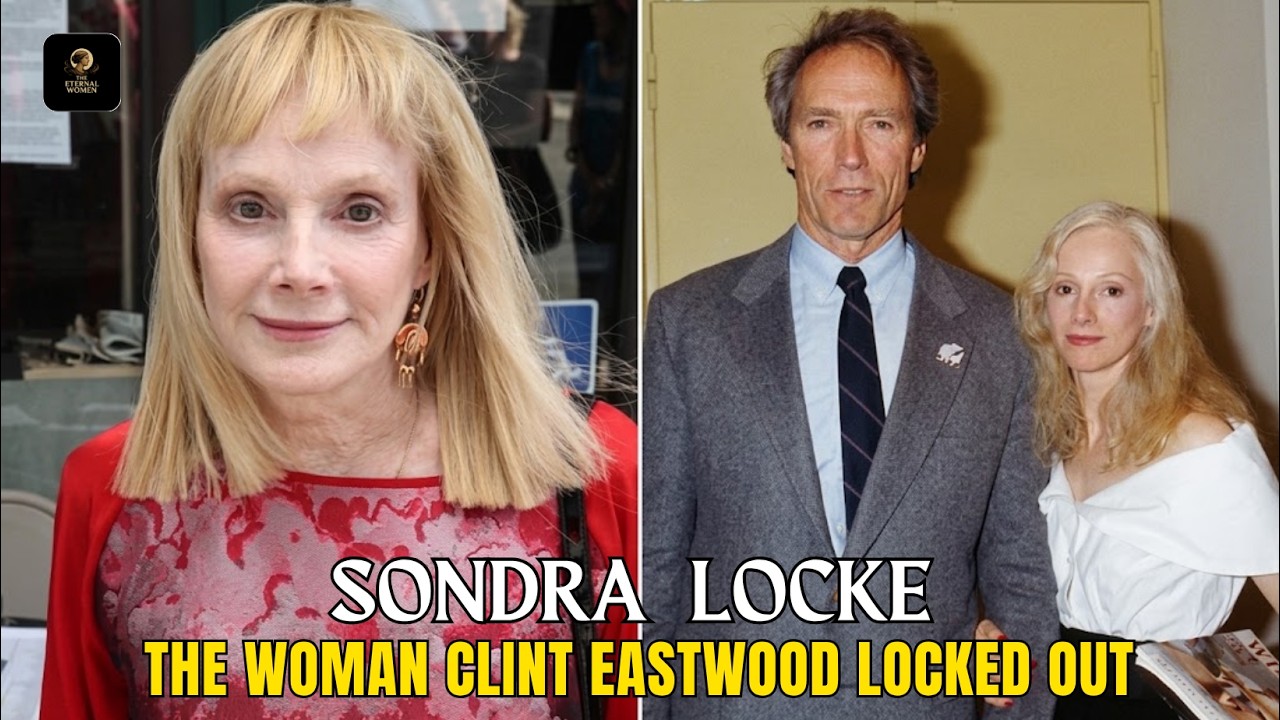
Her name was Sondra Locke, and she came from Shelbyville, Tennessee, carrying nothing but her talent and a carefully constructed lie about her age. She had beaten out more than five hundred other women for the role that earned her the nomination. She bound her chest, lightened her eyebrows, and subtracted six years from her birth date to become the teenager the part required. It worked, completely and convincingly, for years.
Because when Sondra Locke decided to become someone, she committed to it to the end. Twenty years later, she returned home from a film set to find the locks on her front door had been changed. Her belongings were packed in boxes. A letter waited for her, addressed not to her but to her husband.
The man who had done it was Clint Eastwood. The man she had spent fourteen years loving, working beside, and building a life with. She fainted when she heard those words. This is the story of Sondra Locke.
Sondra Locke was born on May 28, 1944, in Shelbyville, Tennessee, a small town in the middle of the state, roughly fifty miles southeast of Nashville. Nothing about her upbringing pointed toward the entertainment industry. She was not the daughter of performers. She was not discovered at a Hollywood party or plucked from obscurity by an agent in a shopping mall.
She came from Tennessee with talent, chose entertainment deliberately, and pursued it with the patience the field demands of those who arrive without family connections or inside access. That starting point matters. The distance between Shelbyville, Tennessee, and an Oscar nomination is not a distance many people travel. The fact that she crossed it in her very first film is the most important fact about who Sondra Locke was before Clint Eastwood ever entered her professional life.
She brought herself to Hollywood. She earned a role in a significant literary adaptation of a famous American novel. She delivered a performance opposite a major dramatic actor that the Academy recognized among the five best supporting turns of the year. She did all of that before she ever set foot on one of his sets.
Clint Eastwood did not discover her. She had already found herself before he arrived. She had married Gordon Anderson in 1967. Anderson was gay, and the marriage was an arrangement built on mutual understanding and genuine affection.
It was a legal and social structure that gave both of them cover in a world not yet ready to accept their truths. They were close friends and loyal companions, and they remained legally married for the rest of her life. The marriage gave them what that era required, and it gave Sondra a particular kind of stability. Someone who knew the full truth of her situation was present as a companion and partner in her life’s journey, even in the absence of the traditional romantic dimension of marriage.
Twenty-two years later, that marriage became the central legal complication in her palimony suit. When Eastwood’s lawyers sought to dismiss her claim against him, they pointed to Gordon Anderson. They argued she had a husband. That she was not Eastwood’s wife in any legal sense.
Fourteen years of domestic partnership fell outside the legal framework that would have granted her automatic spousal rights. The very arrangement that gave her social stability in 1967 became, in 1989, the tool a lawyer used to argue that her claim to the man she had actually lived with for fourteen years was legally insufficient. In 1968, Sondra Locke made her film debut in The Heart Is a Lonely Hunter. It was Robert Ellis Miller’s adaptation of Carson McCullers’s famous novel about loneliness, communication, and the particular pain of a person who cannot make himself understood in the world around him.
Locke played Mick Kelly, a teenager with musical ambitions who lives next door to a deaf-mute man named John Singer, played by Alan Arkin. A genuine relationship develops between them, built on misunderstanding and on each needing something from the other that the other cannot truly provide. McCullers wrote about isolation with precision born of personal experience. She understood what it meant to be the person whose inner life is richer and more complex than the world around them can absorb.
Locke brought that understanding to Mick Kelly and made it visible in the specific way great performances make intangible things tangible. Not by describing the feeling, but by inhabiting it so completely that the audience cannot look away. The Academy of Motion Picture Arts and Sciences nominated her for Best Supporting Actress. For her first film.
That almost never happens. The nomination was real and deserved, and it signaled a career path that, by Hollywood’s usual calculations, should have produced decades of significant work. She did not win. The award went to Ruth Gordon for Rosemary’s Baby, a brilliant performance in a landmark film.
But the nomination remained on the record. It was a standing credential. In Hollywood in 1969, an Oscar nomination for a debut performance was the kind of thing that opens doors, ensures a career, and tells the industry this person is worth investing in. What happened to Sondra Locke after the nomination does not match what Hollywood’s usual calculations predict.
It is what happens when a woman’s professional story is absorbed into the story of a more powerful person. When individual talent dissolves under the institutional weight of a relationship. When an industry that should have been able to tell the difference cannot, or chooses not to. To understand what Locke walked into in 1975, you must understand who Clint Eastwood was at that specific moment in American cultural history.
By 1975, he was one of the most commercially powerful figures in Hollywood. The Dirty Harry films had made him a box-office institution: Dirty Harry in 1971, Magnum Force in 1973, The Enforcer in 1976. His western collaborations with Sergio Leone, A Fistful of Dollars, For a Few Dollars More, The Good, the Bad and the Ugly, had given him international fame that transcended the American market and produced a particular kind of cultural myth that few artists achieve. The squint, the poncho, the delivery of lines that carried entire philosophical positions in a single pause.
He was not merely famous. He was an icon in the precise sense, his image a shorthand for something larger than the films he appeared in. He ran his own production company, Malpaso Productions, which gave him a degree of control over his career that few in Hollywood history have possessed. When Malpaso produced a film, Eastwood held the power to approve casting, script, budget, and distribution in ways the normal studio-system arrangements did not allow most directors or producers.
He was functionally a self-contained entertainment enterprise that happened to exist within Warner Bros. ‘ larger infrastructure, tied to the studio by a long and fruitful relationship, but operating according to his own priorities. That institutional independence matters. Eastwood was not merely powerful in a general cultural sense.
He was a man who could pick up the phone and arrange things. He could arrange a development deal for a woman to be secretly funded by his own company while it appeared to her as a real studio contract. He could arrange for thirty projects to be rejected without explanation. He could shape the collective industry attitude toward a person so that she would not be taken seriously.
That is specific institutional power, and it is the mechanism that made everything that happened to Sondra Locke after 1989 possible. He had also directed Play Misty for Me in 1971, establishing himself not only as an actor but as a director who understood the full structure of filmmaking. He was building a directorial reputation alongside his acting one, and that reputation was serious. He was still legally married to Maggie Johnson, his first wife, in 1975.
Their divorce was not finalized until 1984. He maintained a legal marriage, a public image, and a home life with Sondra Locke simultaneously, managing all three with the compartmentalization the entertainment industry requires and enables for its most powerful figures. Locke first met Eastwood in 1972, when she auditioned for his directorial project Breezy, a film about a relationship between a middle-aged man and a younger woman. She was twenty-seven at that audition.
He decided she was too old for the younger role, which ultimately went to actress Kay Lenz. She was twenty-seven. Too old. That detail is worth holding onto as you read the rest of the story.
The man who decided a woman of twenty-seven was too old for a role in a film began a fourteen-year domestic partnership with her three years later, and managed that partnership in ways that drained fourteen years from her career. Three years later, she auditioned for The Outlaw Josey Wales. She was thirty. He was forty-five.
She was cast as Laura Lee, one of the film’s central female characters. The chemistry that developed on set was, by multiple accounts, real. He pursued her. He was persistent and confident in the specific way of powerful men accustomed to getting what they want, men who possess enough institutional standing to make that pursuit feel like an opportunity rather than pressure.
She moved into a house he provided. They lived together while he remained legally married to Maggie Johnson until 1984. Practically speaking, they were in a domestic partnership, sharing a home and a professional world, appearing together publicly without the legal recognition that would have granted her the rights she later had to fight two lawsuits to partially recover. She later said in her memoir that the love was real, that the relationship was genuine, that she did not enter it understanding how real love and systematic professional exploitation could coexist in the same arrangement without one canceling out the other.
She was not naive. She was in love. And love, in the specific context of a relationship where one party holds institutional power to build or end careers and the other does not, operates very differently from how it looks from the outside and from how it feels from the inside until the incident that makes the difference visible occurs. That specific, undeniable incident occurred on April 10, 1989, while she was on the set directing her own film.
But it had been building for fourteen years in the gap between what the relationship appeared to be and what it actually was. Between 1976 and 1983, Sondra Locke appeared in six films directed or produced by Clint Eastwood. The Outlaw Josey Wales in 1976, The Gauntlet in 1977, Every Which Way but Loose in 1978, Bronco Billy in 1980, Any Which Way You Can in 1980, and Sudden Impact in 1983, in which she played the lead as a rape victim seeking justice herself, a performance critics considered her most complete in Eastwood’s world. Serious dramatic work in a serious dramatic role, proving what she was capable of when the material matched her abilities.
In a 1996 interview with the Los Angeles Times, she said the sentence that must be quoted to understand everything that followed: “I didn’t want to be there with the orangutan. I was there because I was in love and Eastwood wanted me to be there. And I loved working with him and we were together, but I didn’t want to be there. ”
Read that carefully.
She did not want to be in Every Which Way but Loose, a Clint Eastwood comedy in which she co-starred with an orangutan named Clyde. She was there because Eastwood wanted her there. She was making his films because he wanted her in his films. She was building his filmography at the expense of her own, and she knew it even then.
She knew it while it was happening. She stayed because the love was real, and because the professional cost of leaving, of separating from Eastwood’s world and trying to build independently from scratch, seemed greater than the cost of staying. The industry watched and drew the conclusion it always draws. She was there because she was his girlfriend, not because she was talented.
That perception, the girlfriend theory of her casting, followed her through all fourteen years and never fully shifted. The professional equity she was building by appearing in six major films was constantly devalued by the belief that it was not earned on merit. The work was real. The work was good.
And yet the diminished assessment was applied because the industry had a story about why she was there, and it was simpler and more comfortable than the actual truth. She directed Ratboy in 1986 under the Malpaso umbrella, a real directorial project that proved she was building something beyond acting. Then she directed Impulse in 1990, a Warner Bros. production, not Malpaso, truly her own.
During the production of Impulse, at the most professionally independent moment of her decade, he changed the locks on the house. She fainted on set. She recovered. On April 26, 1989, sixteen days after the locks were changed, she filed a lawsuit claiming her financial rights as a partner.
She was ready to fight because she had spent years adapting, and she was done adapting. Adaptation had been the pattern for fourteen years. She adapted to his marriage to Maggie Johnson, which meant the relationship could not be formalized during those years. She adapted to his preference for her appearing in his films rather than building an independent career.
She adapted, as she later said, because the love was real, because being in his world meant being close to him, because she was trying to do both things at once, appear in his films and build something of her own. She adapted to the abortions. She adapted to the parallel life she knew nothing about until she discovered the children. She adapted to the specific dependency of her professional identity on his for fourteen years while trying to preserve enough of her own identity to build something that would last after the relationship ended.
The relationship ended with a locked door and a letter addressed to someone else. The adaptation ended with a lawsuit. That transition, from adaptation to litigation, from private accommodation to public legal action, is the specific turning point in Sondra Locke’s story that deserves the most attention. Because most people in her position at that specific moment in 1989 would not have filed that lawsuit.
The institutional weight against her was enormous. Clint Eastwood was one of the most powerful figures in Hollywood. He had access to the best lawyers money could buy. He had access to institutional relationships that could shape how the industry received the lawsuit, whether it was treated as a legitimate legal claim or as a bitter ex-girlfriend making trouble.
He had every structural advantage available to a man in his position. She filed the lawsuit anyway. She had spent fourteen years adapting. She was done.
The end of the relationship was not just the changing of the locks. The locks were the visible act, the specific, dated, documented moment she could name, the foundation of the lawsuit. Beneath it was a history of accumulated years she carried mostly privately, only becoming fully public when her memoir gave her the space to document it completely. During the relationship, she became pregnant twice.
Both pregnancies ended in abortion. She said in her memoir and subsequent interviews that Eastwood pressured her to terminate the pregnancies, that he did not want children with her, that his existing family obligations and parallel relationships made adding a child with Sondra logistically and personally unacceptable from his point of view, and that the pressure was persistent and real. She was not making an abstract argument about reproductive coercion. She was describing specific conversations, specific pressures, and specific outcomes she lived with for years before making them public.
Two pregnancies. Two abortions under pressure from the man she loved and lived with in a relationship where the power imbalance was vast and the institutional weight was almost entirely on his side. This is the detail in Sondra Locke’s story that receives the least attention relative to its true weight in the experience she was describing. The lock change gets covered.
The fake Warner Bros. deal gets covered. The two abortions tend to be mentioned briefly and dismissed as marginal rather than as a central fact about what the relationship demanded of her. They are not marginal.
They are among the most specific and personal costs she paid. Costs that no legal settlement can adequately compensate. Costs that no fraud lawsuit can address. Costs that exist in the category of permanent, irreversible things that happened inside a relationship and cannot be undone after it ends.
And while she was in the relationship undergoing those abortions at his encouragement, Clint Eastwood was having children with other women. He had a son, Scott Eastwood, born March 21, 1986, with Jacelyn Reeves, a flight attendant. He had a daughter, Kathryn Eastwood, born February 2, 1988, also with Jacelyn Reeves. Two children born during his informal relationship with Sondra, from a woman he never told her about.
He had encouraged her to end two of her pregnancies. He had, at the same time, with another woman, created the family he refused to create with her. She discovered Scott and Kathryn. She discovered them with the shock of a person who has made irreversible decisions.
Decisions she would have to live with forever, based on a picture of the situation that turned out to be incomplete. The picture he had given her of why children were impossible in their relationship did not include the information that he was having children in another relationship running parallel to theirs. She had terminated two pregnancies based on information she now realized was incomplete. That is the moral core of what happened before the locks were changed.
Everything that followed, the lawsuit, the fake deal, the fraud case, the memoir, was consequence. It was the result of a woman discovering that the man she loved had been manipulating her with incomplete information for years, and that the decisions she made in good faith based on that incomplete picture were decisions she was now stuck with forever. Describing her state of mind in the period before the lock change, she said: “In my mind, I think I knew it was over, but in my heart, the bond between me and Clint wasn’t broken. ” She knew it mentally.
She had not accepted it emotionally. The changing of the locks, the letter addressed to Mrs. Gordon-Anderson, the luggage packed into boxes, the information sent not to her but to her husband’s address, was the act that closed the distance between what she knew mentally and what she could no longer avoid accepting emotionally. She almost fainted, then recovered.
She filed the lawsuit sixteen days later. She was determined to fight because she had spent years conceding, and her time for concessions was over. The palimony suit was settled in April 1990, after nineteen months of litigation, a period during which Sondra Locke was also diagnosed with breast cancer, underwent a double mastectomy, and received chemotherapy. Nineteen months.
She fought the lawsuit through all of it. The settlement included the house in Bel Air. It included $450,000 for work she had done at Malpaso. It also included a three-year development deal at Warner Bros.
worth $350,000 per year to develop and direct films. The development deal was the most important element for her professional future. On paper, it was the thing that made the settlement a real solution rather than just a payout. A structure designed to give her the professional foundation she needed to rebuild the directing career the relationship had drained.
She had been trying to build a directing career for a decade. This deal was supposed to make that possible. What it actually was, as she discovered about two years after signing it, was fraud. A mechanism carefully designed to create the appearance of a real professional opportunity while guaranteeing that opportunity produced nothing.
She submitted more than thirty projects to Warner Bros. during the three-year term of the deal. Thirty projects. Screenplays, concepts, treatments, and proposals.
The full range of material a director with a studio development deal submits. Every single one was rejected. Not a majority. Not most.
All thirty. Over three years, throughout the term of the contract, Warner Bros. rejected every project Sondra Locke submitted. They provided no substantive feedback.
They suggested no revisions. They offered none of the iterative development processes studio deals are supposed to provide, which sometimes end in rejection but usually end in revision toward a producible work. Silence was the mechanism. Not overt hostility, not direct refusal, just thirty consecutive rejections without explanation over three years until the contract expired and she had gained nothing and achieved no professional progress.
When she investigated through her lawyers, when the inquiries her new agent helped her conduct uncovered the documentary evidence she needed, she found what she had suspected and feared. Eastwood had secretly arranged through Malpaso to compensate Warner Bros. for the cost of her deal. He was paying the studio to maintain the appearance of a real development contract while simultaneously ensuring, through his influence inside the studio he had worked with for decades, where his business relationships carried real weight, that the contract produced nothing for her.
The studio’s persistent negative response to her projects had nothing to do with the quality of those projects. It had to do with a private financial arrangement she was never told about. The projects she submitted included what later became Junior, the 1994 production directed by Ivan Reitman starring Arnold Schwarzenegger as a pregnant man alongside Danny DeVito. It became a major studio release.
She had pitched the idea during the period when Warner Bros. was rejecting everything she submitted. And what later became Addicted to Love, the 1997 production starring Matthew Broderick and Meg Ryan, directed by Griffin Dunne, another major studio release. Another idea she developed and submitted during the fake deal period.
Both were rejected. Both were later made by other people after her chance to make them had evaporated. Her lawyer described what Eastwood had done as the ultimate betrayal. The term is specific because the act was specific.
He had taken the legal settlement that was supposed to grant her a professional future and secretly arranged through his money and institutional relationships that it would produce nothing. He made a false promise and paid money to ensure it remained false. He spent money to ensure that a woman he had lived with for fourteen years would not be able to work. On June 5, 1995, she filed a second lawsuit for fraud and breach of fiduciary duty against Eastwood directly, and against Warner Bros.
for their participation. The Warner Bros. case was initially dismissed on procedural grounds. She appealed.
The appellate court remanded the case on August 26, 1997. The case went before a jury. The jury sided with her on liability by a vote of ten to two. Ten jurors agreed that what she had endured constituted fraud.
Two disagreed. Nine votes were required for a verdict in California civil cases. The jury moved on to deliberate damages. A settlement was reached on May 24, 1999, minutes before jury selection was scheduled to begin for the damages phase.
Eastwood was listed as a key witness. He chose settlement over testifying under oath about what he had arranged. Minutes before a jury that had already found against him ten to two was prepared to hear evidence about the value of the damages she should be awarded. That is not the action of a man confident that the truth told under oath would favor him.
Let us return to 1990 for a moment, because the legal timeline tends to obscure something the public never gave enough attention. Sondra Locke was fighting the palimony lawsuit while simultaneously dealing with a breast cancer diagnosis that arrived in the middle of the legal proceedings. She underwent a double mastectomy on September 12, 1990. She underwent chemotherapy.
She was doing all of this in the midst of a legal dispute with one of Hollywood’s most powerful men, while facing the professional and personal consequences of the catastrophic end of a fourteen-year relationship, without a support structure that would have made any one of these things more manageable on its own. She kept the diagnosis largely private. This is a pattern that recurs constantly in these stories. A woman dealing with a tragic personal reality while the public sees only the visible dispute or the surface career.
Locke’s cancer was not a major part of the public conversation around the palimony suit in 1990. It became known and was mentioned in later coverage, but it was not the story. The lawsuit was the story. The cancer was something she handled in parallel.
What the public saw in 1990 was the lawsuit. What the public did not see was a woman undergoing chemotherapy, double mastectomy surgery, and a complete restructuring of her professional and personal life all at once, without a partner, without institutional support, in a city and industry that had received the message that she was not to be taken seriously. She continued fighting the lawsuit while cancer consumed her body. She kept fighting for nineteen months.
She reached a settlement in April 1990, then discovered two years later that the major component of that settlement, the development deal, was fraud, and went back to fighting. She filed the second lawsuit in 1995. She won again in 1999. Breast cancer did not leave her after the double mastectomy and chemotherapy.
It was controlled, suppressed, and monitored, but it did not go away. It spread to her bones over the following decades. The specific progression of bone metastases that characterizes secondary breast cancer, causing the kind of chronic pain and physical deterioration that is managed rather than cured. She lived with it for twenty-eight years after the initial diagnosis.
She handled it with privacy and constancy, with the same determination she showed in everything else. In 1997, she published a book called The Good, the Bad and the Very Ugly. The title carries the full weight of the Leone reference. She was describing a moral world where good and evil meet in the same person, where the relationship was a reality that held opposites together, where love was real and exploitation was also real, and neither truth canceled the other.
She was not writing a simple story about a villain. She was writing a complex and honest account of something that was more than one thing at once. In her memoir, she described the abortions with the precision of a person naming something important. She described discovering Scott and Kathryn Eastwood.
She described the changing of the locks and the letter delivered to Gordon’s address. She described the Warner Bros. deal and the thirty rejected projects, and what her investigation revealed about who was funding the deal and why it produced nothing. She described the breast cancer and the double mastectomy.
She put her name on all of it in a culture that would have been far more comfortable if she had accepted the settlement money and maintained dignified silence. She did not maintain dignified silence. She kept a documented record. The memoir did not produce the public accounting she deserved.
By 1997, Eastwood was more powerful and more celebrated than ever. Unforgiven had won Best Picture and Best Director at the 1993 Academy Awards, considered the crowning achievement of a major filmmaker’s career. The narrative surrounding him in 1997 was not receptive to any reevaluation. The dialogue the memoir provoked was much smaller than the truth it contained.
She wrote a book the culture was not yet ready to fully absorb. The cancer spread. She lived with it. She directed Clean and Narrow in 2000.
She lived in Los Angeles, in the house she had won in the palimony settlement, and built the life available to her in the space the lawsuits had carved out. She was present. She was working. She was herself.
The disease that would eventually kill her was with her for twenty-eight years before it did. On November 3, 2018, Sondra Locke died in her home in Los Angeles. The cause was cardiac arrest brought on by breast and bone cancer. She was seventy-four years old.
The Associated Press obtained her death certificate from the medical examiner’s office and published its contents. That is how the world learned. Not through a statement from a partner, not through an announcement from the people closest to her at the end, not through any of the channels that surround people who are cared for by those who love them. The Associated Press filed a request for the death certificate and published what it contained.
She died on November 3. The news became public in December. Five weeks passed between her death and the public learning of it. Clint Eastwood, according to multiple published reports, was not informed of her death until days after the public announcement.
The man she spent fourteen years with as a partner, the man who changed the locks on their shared home, the man who secretly paid Warner Bros. to reject her projects, the man whose name appeared in two lawsuits and who settled both rather than testify under oath about what he had done, learned of her death only when he read about it somewhere. That is not a moral judgment on his character. It is information about what those fourteen years actually were, and what the twenty-nine years after their end produced between them.
There was no ongoing relationship. There was no contact. She died, five weeks passed, the world learned, then he learned. The person who had been the central focus of her adult life for fourteen years, the person whose films she appeared in and from whose home she was evicted, the person she fought two legal battles around spanning more than a decade, learned of her death from a news report.
That is the distance the relationship ultimately left behind. That is what fourteen years of love, institutional exploitation, and legal warfare produces in the end. A man who did not know of his former partner’s death until he read about it in the news weeks after it happened. She left behind an estate estimated at approximately twenty million dollars.
It was the accumulated result of the palimony settlement, the fraud settlement against Warner Bros. , and careful management of those resources over nearly three decades. She was one of the most financially successful litigants in the history of Hollywood palimony and fraud cases. This number is sometimes cited as evidence she won.
More accurately, it represents the legal system’s attempt to place a monetary value on losses that cannot be priced. What was taken from her was not just money. It was fourteen years of her professional prime, the years between thirty and forty-four, when actresses of her generation and standing were building independent careers that would support them into their fifties and sixties. It was the promise of the Oscar nomination, the career that nomination indicated, which never materialized because the years that should have built it were spent in his films, building his filmography instead of hers.
It was the two pregnancies she lost under sustained pressure. It was the professional reputation the industry consistently misread as the product of a relationship with the director, rather than genuine talent he recognized and wanted to work with. It was the thirty rejected projects over his secret instructions, including ideas that later became successful films in other hands and under other names after her contract expired. And this too.
Clint Eastwood received the American Film Institute Life Achievement Award. He received the Academy Award for Best Picture and Best Director for Unforgiven. He received the Presidential Medal of Freedom in 2024. He has been celebrated, honored, and recognized across the full range of what American cultural institutions offer to those they consider their most distinguished figures.
He is one of the most decorated filmmakers in American film history. Sondra Locke learned of the death of the man she lived with for fourteen years weeks after it happened. That disparity is not incidental. That disparity is the core of the story.
It is a story the entertainment industry has never told with enough force or enough recognition of what it represents. The man who orchestrated the rejection of her projects sits at the top of the industry’s pyramid of recognition. The woman who proved his actions in a court of law, where ten of twelve jurors sided with her on liability, is known primarily as his ex-girlfriend. The career her talent promised was owed to her.
She deserved her Oscar nomination to be the beginning of something, not the peak of something later steered onto another course. She deserved thirty honest evaluations of thirty projects she submitted. She deserved a real development deal rather than a mechanism for silencing her. She deserved professional accountability that should have followed two successful lawsuits.
She deserved a public conversation about what was done to her proportional to the documented evidence of what she endured. What she got instead was the memoir she wrote. The truth she told under her own name. The two lawsuits she won, the house she kept, the twenty million dollars, and the private, personal satisfaction, small by the standards of what was taken from her but real, of completing the record while she was still alive.
The good, the bad, and the very ugly. That was the title of her book. That was her complete and honest assessment of fourteen years and everything that followed. She was right about all three.
The good was real. The love was real. The fourteen years were real. The bad was the changing of the locks and the letter addressed to someone else.
The very ugly was the fake deal and the secret children and the thirty rejected projects and the jury that voted ten to two in her favor before he settled minutes before the damages phase. She named all three and put her name on the cover of a book you can still read today. Sondra Locke told the truth. She proved it twice in court against one of the most powerful figures in Hollywood history.
She survived cancer. She endured the lawsuits. She wrote the memoir. She died in her own home.
Hollywood forgot her. But she never forgot herself.
