In the winter of 1900, a twenty-three-year-old inventor named Joshua Lionel Cowen stood in a cramped, coal-stained workshop in New York City surrounded by batteries, brass tubes, and failed ideas. He was not trying to build toys. He had spent his efforts on industrial equipment: detonators, fuses for photographer’s flash powder, even designs for naval mines that the Navy had examined but declined to buy. Nothing was selling.
His business was collapsing. What sold, almost against his will, was a wooden cigar box with a small fan motor screwed to its underside, painted red and stenciled with the words Electric Express. Cowen had built the device as a window display for a novelty shop on Cortlandt Street owned by Robert Ingersoll. His theory was simple: motion attracted attention.
If something moved in the shop window, people would stop, and if they stopped, they might come inside to buy watches and jewelry. He mounted the motor to the cigar box, connected it to wheels with a reduction gear, laid down strips of brass on wooden ties to form a circular track, and placed the contraption in the window. The next day, Ingersoll reported that he had not sold a single watch. But he had sold the train.
Customers pressed their faces against the glass, pointed at the red box rattling around the track, and asked how much it cost. Cowen tried to explain it was only a display prop. They did not care. By the end of the week, Ingersoll had sold the display model and demanded another.
Then he sold that one, and the next. Cowen did not see toys as a serious business. He saw them as a waste of good metal. But he was pragmatic.
The market was telling him something, so he pivoted, abandoning his dreams of industrial detonators and incorporating the Lionel Manufacturing Company. He refused to make toys in the traditional sense. He had no interest in whimsy. He was interested in realism, in weight, in machines that functioned like real machines.
His early trains were not delicate playthings. They were heavy, built of stamped steel and cast iron, painted in the somber colors of actual railroads: Pennsylvania Railroad Tuscan Red, New York Central Gray, Midnight Black. When you held a Lionel locomotive, you felt its weight. It felt like a tool.
Cowen aimed his marketing not at children but at fathers. He sold the idea that a Lionel train was an educational investment, a way to teach boys about electricity, mechanics, and logistics. The strategy worked. By 1906, he had introduced standard gauge track, wider and more stable than anything competitors offered.
It was a brilliant monopolistic move. Once a father bought a Lionel set with standard gauge track, he was locked in. Trains from other manufacturers would not fit. Cowen had built a walled garden before the concept of brand loyalty had even been articulated.
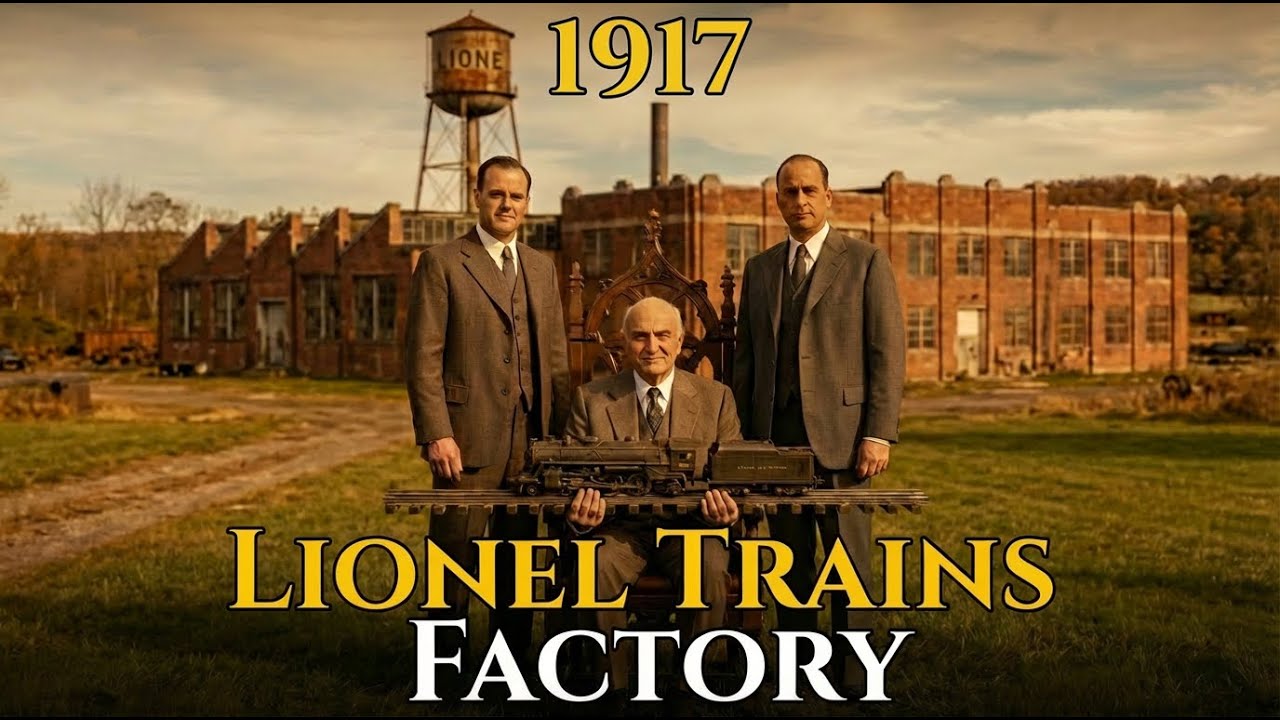
The company grew. It moved from Manhattan to a larger facility in Irvington, New Jersey, and eventually, by the mid-twentieth century, to Hillside, New Jersey. The Hillside factory opened in the 1930s and reached its peak in the 1950s. It was not a toy workshop.
It was an industrial fortress: massive brick and steel, multiple stories, high ceilings, reinforced floors to support the weight of hydraulic presses. The air vibrated with machinery. Presses stamped out sheets of cold steel. Furnaces cast molten zinc into complex molds.
Miles of copper wire were wound into motors. It looked more like an industrial plant than a place that made toys, and that was intentional. Cowen despised the word toy. He viewed Lionel as a manufacturer of precision machines.
The defining feature of a 1950s Lionel train was its weight. A Hudson steam locomotive, one of the most popular models, weighed several pounds. When a child picked it up, his wrist dipped. Cowen hated plastic.
He viewed it as cheap and dishonest. His trains were built of diecast metal and stamped steel, materials that could survive almost anything. The genius extended beyond the metal. In 1946, Lionel introduced the smoke pellet, a small white tablet dropped down the locomotive’s smokestack onto a heating element.
As the train moved, the pellet melted, and a small piston puffed rhythmic clouds of chemical smoke into the air. It smelled not like burning coal but like wax and hot oil, a distinct industrial scent that became, for an entire generation, the olfactory signature of Christmas morning. Combined with the sharp metallic tang of ozone from the sparking electrical contacts, a running Lionel train created its own atmosphere. It smelled like work, like power.
In the 1950s, a Lionel train set was not just a gift. It was the centerpiece of the American home, circling the base of the Christmas tree. Fathers, many recently returned from World War II, bonded with their sons over wiring diagrams and track layouts. Boys learned about voltage, amperage, and switching.
They learned that if you ran the train too fast on a curve, it would derail and gouge the floorboards. This was the Lionel education. It taught consequences. It taught respect for the machine.
By the mid-1950s, Lionel was the largest toy company in the world. The Hillside factory ran twenty-four hours a day. Night shift workers walked out as the day shift walked in. The furnaces never went cold.
It seemed as though it would last forever. But Joshua Lionel Cowen was getting old. By the late 1950s, he was approaching eighty. His intellect was fading.
Workers later described him wandering the factory floor, confused by changes, yelling at machines that were not there. He was vulnerable. In American business, vulnerability is an invitation. In 1959, a man named Roy Cohn approached the Cowen family.
Cohn was not a toy maker and not an industrialist. He was a lawyer who had served as chief counsel to Senator Joseph McCarthy during the Red Scare. He made his living destroying reputations and manipulating power. He was also Joshua Lionel Cowen’s great-nephew.
Cohn presented himself as a savior, a brilliant legal mind who could modernize the business and protect the family fortune. It was a lie. But Joshua, in his diminished state, could not see it. His son Lawrence lacked his father’s vision and was struggling to keep the company afloat.
The family agreed to sell their controlling interest to Cohn and a syndicate of investors. The moment Cohn walked into the boardroom, the soul of the company evaporated. He had no interest in trains. He looked at the intricate diecast locomotives that had defined the brand for fifty years and saw not magic but unnecessary expense.
His first act was a purge. He fired the engineers, the designers, and the factory floor managers who carried the company’s institutional knowledge. He replaced them with accountants. Then came what is called value engineering: taking something good and making it cheaper to save money.
Cohn ordered a switch from heavy, durable materials to cheap, brittle plastic. The diecast shells that could survive a fall down the stairs were replaced by injection-molded shells that cracked easily. The magnets were weakened or removed. The motors were cheapened.
The trains that had once weighed ten pounds now felt hollow. When a child picked up a Cohn-era train, the sensation was not power but disappointment. The disconnect was perhaps best illustrated by an earlier misstep. In 1957, just before Cohn’s takeover, Lionel released the Lady Lionel, a “girls’ train.
” Executives had noticed they were only selling to boys. Rather than asking whether girls liked trains, the boardroom decided the only reason girls did not buy them was that they were not pink. They took a standard freight set and painted it in pastel pink, lilac, and robin’s egg blue. Girls did not want it because it looked ridiculous; if a girl wanted a train, she wanted the powerful black Hudson her brother had.
Boys would not touch it because it was for girls. The set sat on shelves gathering dust, a testament to a company that had lost touch with reality. Under Cohn, the Hillside factory transformed from a cathedral of industry into a hollow shell. He sold off assets and licensed the Lionel name to products unrelated to trains.
He treated the company like a personal bank account, draining cash reserves for other ventures. The atmosphere on the factory floor shifted from pride to fear. Workers saw the returns piling up: broken motors, snapped couplers, melted smoke units. Parents who had grown up with Lionel trains bought new sets for their children expecting the same quality, only to find that the new trains would not stay on the track.
Joshua Lionel Cowen died in 1965, just as the empire he built was crumbling. He was spared the sight of the bankruptcy court but died knowing his life’s work had been derailed by the family he tried to protect. By 1967, the money was gone. The Lionel Corporation filed for bankruptcy.
In 1969, the order came to cease operations at Hillside. The hydraulic presses that had pounded out the rhythm of American childhood for half a century were turned off. The furnaces went cold. The tooling, the heavy steel molds used to cast the legendary locomotives, was packed up and shipped away.
Some of it was sold for scrap, melted down for pennies on the pound. The skilled workers walked out of the gates for the last time. The brand was sold to General Mills, a company best known for breakfast cereal. The company that had built the iron horse, that dealt in steel and electricity and danger, became a subdivision of a corporation that made Cheerios.
Production moved to Michigan, then to Mexico in a desperate bid to cut costs. The trains that came off these new assembly lines were ghosts of their former selves. Heavy diecast metal was replaced by lightweight plastic. Vibrant enamel paints were replaced by colored plastic that looked cheap and waxy.
The wheels were often plastic, lacking the weight to stay on the rails. Quality control evaporated. Trains arrived with missing parts. Motors burned out after an hour.
The proud Made in USA stamp was gone. Children who received these sets in the 1970s and 80s felt a strange disconnect. Their fathers told them stories about Lionel trains, about machines that were heavy, powerful, indestructible. But the object in the box was flimsy.
It rattled. It felt disposable. The continuity of the experience was broken. The magic had been cost-cut out of existence.
The Hillside factory is gone now. The site has been redeveloped, the bricks scattered or paved over. But the brand refused to die. Today, you can still buy a Lionel train, but they are not toys.
They are expensive collectibles for adults, priced in the thousands of dollars, meant to sit on shelves rather than run on rugs. The toy that Joshua Lionel Cowen built, the rugged, accessible, dangerous machine that every boy could own, is extinct. Cowen started with a mistake, a fan motor on a cigar box, and built it into an empire because he respected the intelligence of the child. He believed children wanted to master the real world, not hide from it.
He gave them weight. He gave them consequences. He gave them a machine that demanded respect. Roy Cohn and the corporate leaders who followed him operated on the opposite philosophy.
They believed that a brand was just a name, that the product did not matter as long as the marketing was good, that you could take the soul out of the machine and nobody would notice. They were wrong. Children noticed. They felt the difference in their hands.
They knew the ghost train was a fake. When the weight was gone, the feeling was gone, and once the feeling was gone, the train had truly left the station for the last time. What remains is the echo of a whistle blowing in the dark.