In 2012, Ethel Kennedy sat before a camera held by her daughter and refused to answer. Rory Kennedy had built her name on documentaries about difficult subjects—addiction, Abu Ghraib, poverty in Appalachia. She knew how to make people talk. In that film, which HBO aired in October 2012, she sat with her mother and opened the subject of June 1968.
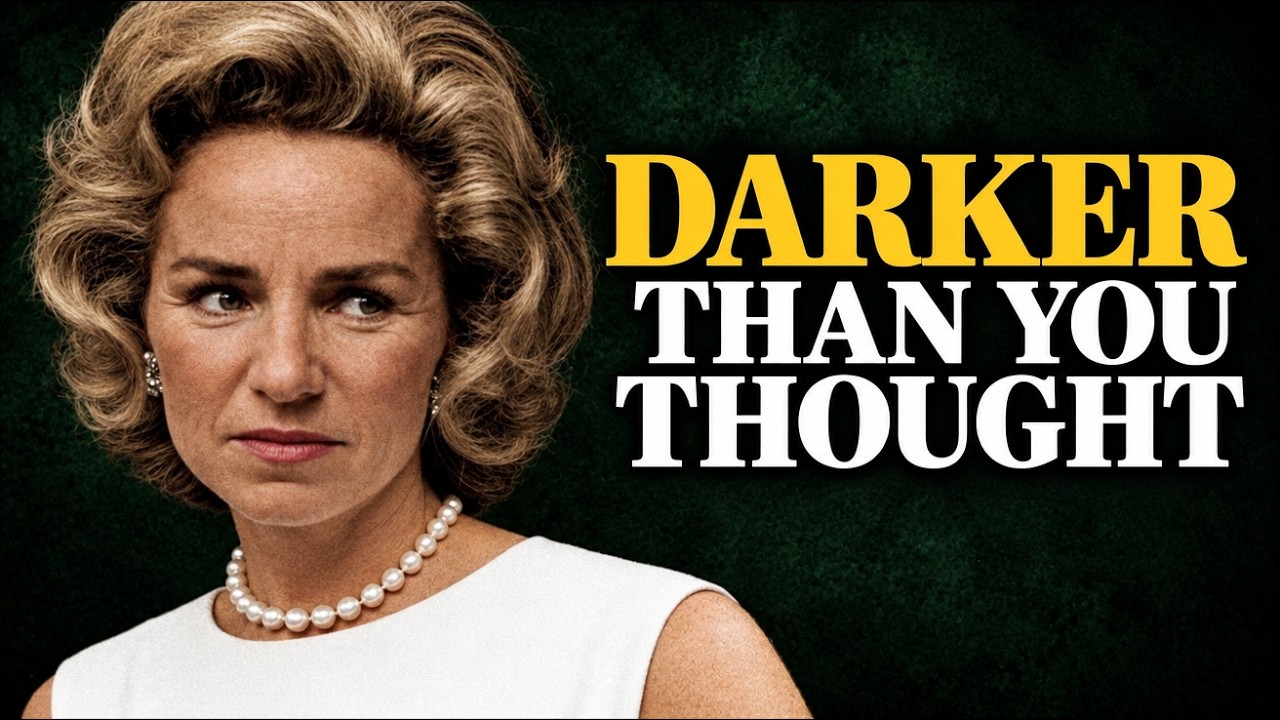
Ethel, then 84, told her she did not want to go into it. Not with a speech, not with tears. She closed the door politely, and the camera kept rolling, and the daughter left the scene in the final cut. Think about what that means for a moment.
This was the only Kennedy family documentary made by a Kennedy about a Kennedy, with full family cooperation, full access, siblings on camera, home movies no one outside the house had ever seen. It was the most censored piece of public storytelling the family ever produced about Ethel. And inside that work, the main character draws a red line, and the filmmaker, her daughter, honors it on screen. This is not a woman losing control of her story.
This is a woman proving she controls it. So the question underneath everything is not the one the title suggests. Everyone wants the bad stories—the firings, the unpaid bills, the guests pushed into the pool, the staff given twenty minutes to pack. We will get there, all of it documented.
But those bad stories are only a sideshow. The real story is about power, and it runs opposite to what you might assume. Ethel Kennedy married a man who was above her in fame and below her in money. In 1950, the Skakel fortune was newer, louder, and in some ways more liquid than anything Bobby personally owned.
His father controlled the trust fund and its terms. Her father had built his company from nothing. By the end of her life, the situation had completely reversed. She lived on Kennedy land in a Kennedy house supported by Kennedy institutions, while the wealth she was born into evaporated, mostly in her brothers’ hands.
The heiress became a dependent. And here is the part that makes it interesting rather than merely sad: as the money faded, her grip tightened on the thing that replaced it. Not wealth. Narrative.
Who was invited? Who got the photo? Whose phone call was returned? Who was allowed to publish?
For 56 years she was the widow of a man the country decided to canonize, and she was the keeper of the gate. That refusal in 2012 was not weakness. It was inventory management. To understand how she became so good at it, you have to go back to the house she grew up in.
Everything people later called cruelty was behavior she learned there and saw no reason to abandon. The place was called Rumble Rides, on Lake Avenue in Greenwich, Connecticut. About thirty rooms. The Skakels bought it in 1935, and by then George Skakel Sr.
had done the thing America pretends to love and secretly trusts. He made himself. Quickly. From a clerk’s job in the Midwest to founder of Great Lakes Carbon, which supplied steel and aluminum industries with coke and carbon products.
During the war years that company printed money. He did not go to Harvard. He did not marry into wealth. He built it himself.
Ann Brannack Skakel ran the household, and she ran it strictly Catholic—priests at dinner, Mass as scheduled agenda, charity given by check as duty. There were seven children: George Jr. , Jim, Rushton, Georgianna, Pat, Ethel, and Ann. The house had a character visitors never forgot.
Noise, competition, violence, practical jokes bordering on injury, cars driven at insane speed down Lake Avenue, guns everywhere, private planes. Much of what is repeated about the Skakels comes from Jerry Oppenheimer’s 1994 book, which the family never cooperated with and hated, and should be treated as hostile and unauthorized rather than established fact. But the broad outlines are not controversial because the Skakels themselves told versions of them for decades, and because the plane crashes and car crashes are a matter of public record. This was a family that moved fast and assumed the world would absorb the shock.
There was staff, a great deal of it—cooks, maids, gardeners, drivers. Ethel grew up with people whose job was to fix what she broke, clean what she spilled, and never be mentioned. That is not psychological theory; it is a household structure, and it produced a specific assumption in the child. There is always someone else to handle it, and consequences happen only to other families.
Hold on to that idea. It explains the pool, it explains the bills, and it explains forty years of suppliers in McLean, Virginia, who told reporters they never got paid. She was the sixth child, and in a house like that the sixth child either disappears or becomes loud. Ethel became loud.
Inventing family nicknames, the athletic spirit, the insistence—it was all an attempt to claim space in a crowded room, and she was very good at it. She could make herself the most interesting person at the table. That is a real skill, and it was the skill that later made her the most popular Kennedy wife, and the most underestimated by people who assumed noise meant simple. She went to Manhattanville College of the Sacred Heart, the place Catholic families of a certain income sent daughters they wanted educated without trouble.
Rose Kennedy had studied there. So had the Kennedy daughters. And Ethel’s roommate was Jean Kennedy. That is the turning point, not an accident but an institutional meeting.
By the mid-1940s, Bobby, Jean’s brother, was in the picture. In his twenties, seventh of nine, the youngest in a family where being the youngest was a genuine problem for your career. He was shy in a way the other Kennedys were not, religious in a way they were not, thin, serious, and trying hard. For a while he dated Pat Skakel, Ethel’s older sister, not Ethel herself.
In the winter of 1945, Bobby went on a ski trip to Mont Tremblant in Quebec with the Skakel sisters, as Pat’s escort. He came home having noticed Ethel. The family was never shy about this story. It was told at weddings, in interviews.
It is part of the approved narrative, which tells you something. This is a story the family decided was charming rather than something to bury. Look at it again, though. A woman in her twenties watches her older sister bring her roommate’s brother home, sizes him up, and goes and wins him.
Over several years, not one weekend. Because it did not happen immediately. There was a long period when nothing happened, and a period when Ethel seriously considered entering a convent. That part is documented and consistent across all accounts, including friendly ones.
She talked about taking vows. People who knew her at Manhattanville believed she meant it. A religious teacher close to her encouraged the idea. But she did not go.
She wrote her thesis, graduated in 1949, and married Robert Kennedy the following summer. No one can tell you what was in her head in those years, and anyone who claims to is selling something. But the two choices she was weighing are worth contemplating because they are less different than they look. A convent is a total institution with permanent vows, strict hierarchy, obedience, no exit, a life entirely organized around a figure you will never personally possess.
That, as it happened, also applied to marrying a Kennedy. She chose the option that involved children. Here is what each of them actually got, and it is worth being blunt because seventy years of family myth has polished this fact. Bobby got money that was not his father’s money.
That mattered more than people realize. Joseph Kennedy’s trusts gave his children security and gave Joseph Kennedy permanent leverage over all of them. A wife with independent Skakel wealth loosened that grip a little. He also got something most of his brothers’ girlfriends did not have: a fierce, uncomplicated, unembarrassed Catholicism from a family with money but no social polish, which meant she would never outclass him socially and would never compete with him.
Jack would marry a woman who matched him in intelligence and outmatched him in taste, and spent her marriage one step outside the family. Bobby married a woman who wanted to go all the way in. Ethel got the name. Her father could have bought Greenwich.
He could not buy what the Kennedys had been building since the 1920s. The ambassador, Harvard, London, the Church, and the political future. The Skakels had money and crashed airplanes. The Kennedys had a project.
The romance was real. The letters, the devotion, the fact that she organized her entire existence around him—none of it was acting. She was genuinely, uncomplicatedly in love with him, even people who hated her said so. The deal was also real.
Both things are true at once, and the family never liked hearing the second one said aloud. What you would not have known in 1950 was which of those two fortunes would last. She brought the money and got the name. Within twenty years the money was fading and the name was everything.
And the name belonged to a man who would die at forty-two. The wedding was June 17, 1950, at St. Mary’s Church in Greenwich. Jack Kennedy stood as best man, the Skakels paid for everything.
Seventeen hundred guests by most accounts. Eight bridesmaids and a crowd of ushers. The reception at Rumble Rides with tents on the lawn, and a bachelor dinner for the Kennedys and Skakels the night before that wrecked enough furniture to become a family anecdote rather than a scandal, because Skakel money paid for the furniture and no one wanted to make a fuss. Photographs of that day are everywhere.
Bobby smiling, the bride radiant, the future president beside them looking like he would rather be sailing. It looks like a merger of two Irish Catholic fortunes, and that is how the press covered it. But look at who controlled the terms. The Skakels wrote the checks.
The Kennedys made the rules. Because from the honeymoon onward, the governing document of that marriage was written by neither of them. It was Joseph P. Kennedy’s operating system, and it contained certain non-negotiable clauses.
Commitment to Catholicism, publicly and permanently. Reproduction, many children, early. Men work the project, women support the project. Nothing leaves the family.
Nothing at all. Ethel accepted every clause without a single visible moment of hesitation, and that is the most important thing about her early marriage. Jackie Bouvier spent years negotiating with that system, mocking it in private, slipping out of its rooms. Joan Bennett, who married Teddy in 1958, was destroyed by it.
Ethel did not negotiate. She out-Kennedied the Kennedies. She played football harder. She went to Mass more often.
She had the babies faster. Kathleen in 1951, Joseph in 1952, Robert Jr. in 1954, David in 1955—and that was just the first five years. Joseph Kennedy adored her for it.
Rose, who was hard to please, approved. And Bobby, who had spent his entire childhood as the overlooked one in that house, married a woman who put him at the center of a world his family never had. That was the original deal, and it worked. For years, it genuinely worked.
Anyone who tells you this marriage was fake from the start is lying to you. The marriage became an institution in 1957, in a specific address. Hickory Hill was a six-acre estate in McLean, Virginia, a white Georgian house with a garden, a pool, stables, and lawn space for a hundred people. Jack and Jackie bought it in 1955.
Jackie decorated it, including the nursery while pregnant. In August 1956 she gave birth to a stillborn daughter. After that she could not bear to remain in the house. They sold it to Bobby and Ethel in 1957.
The seat of Ethel Kennedy’s life, the house she owned for more than fifty years, the house that made her famous as a hostess, the house her children grew up in, came to her because her sister-in-law lost a baby and could not walk past the nursery. Ethel filled the house immediately. Seven more children were born there. She filled it with everything else too.
Dogs, horses, a sea lion in the pool at one point—a documented fact, not a joke—which escaped and was found in a neighbor’s yard. Ponies. A donkey. There was a real menagerie of animals and a real menagerie of people.
The Hickory Hill seminars began in the early sixties. In the evenings government officials, journalists, and ambassadors sat in that house and listened to historians and scholars talk. Arthur Schlesinger was among the organizers. That is the respectable version, and it is real.
The Attorney General of the United States ran an intellectual salon from his living room. The other version is also real, the one that put her in the gossip columns. There was a party in 1962 that ended with guests in the pool, including a federal judge, whose chair went in with him. There is a well-known story about Arthur Schlesinger falling in.
There was a plank over the pool at one point. Press coverage of these parties was gleeful and continuous, and the Kennedy administration made a real effort to control it, because seeing the Attorney General’s wife throwing people into a pool while an assistant secretary watched was not the dignified image the New Frontier was selling. Now put those two scenes side by side, because that is where you start to see the real woman. In the same house, in the same years.
Nobel-grade thinkers discussing policy and guests falling into the water fully clothed. Ethel ran both. She was the organizing mind behind both. She could seat a Supreme Court justice next to a nuclear physicist, and she could decide who got wet.
And the second one was a loyalty test as much as a joke. There is a difference between being thrown in the pool at Hickory Hill and not being invited to Hickory Hill at all. Everyone in Washington knew which side of that line they stood on. That is power.
It is the only kind available to a Kennedy wife in 1962, and she was better at it than anyone else in the family. Downstairs, away from the parties, the staff situation was something else entirely. Turnover at Hickory Hill was legendary, and no one seriously disputes it, including sources close to her. Nannies, cooks, maids, gardeners came and went constantly.
Some were fired. Many quit. The children themselves described, decades later, a house so chaotic it lacked real supervision for long stretches, with staff changing faster than anyone could form attachments. Then there were the bills.
This is the part of the story people treat as a funny Kennedy quirk, but it was not funny if you were the one holding the invoice. Over decades, local McLean merchants, caterers, stable hands, landscapers, clothing stores, anyone who worked at the house, reported great difficulty getting paid. Some sued. Washington papers covered it periodically from the seventies onward.
The pattern was consistent enough to become known local fact rather than allegation. You could do business with Hickory Hill and wait a year, and possibly end up in court. Here the childhood trace of Rumble Rides shows most clearly. She was not a con artist.
She did not need the money, not in those years. She was simply operating on an assumption she grew up with: there is always someone who will handle it, and the bill matters less than the party. The people handling it were increasingly not hers. The Joseph Kennedy family office controlled the money that mattered.
Bobby’s income came through that structure. And with every year the Skakel fortune shrank, the Hickory Hill budget depended more on a system that belonged to her husband’s family. She was a very rich woman with less and less of her own money. No one in Washington could see the difference.
For a long time, neither could she. The fading began on October 3, 1955. George Skakel Sr. and Ann Brannack Skakel boarded a company plane in Tulsa for a hunting trip.
The plane exploded in midair and crashed near Union City, Oklahoma. Both were killed. Ethel was 27. She had four children and was pregnant with David.
She lost both parents in a single afternoon in a crash of a plane owned by the company that paid for everything. What she did next is the first time you can see the mechanism that would run the rest of her life. She did not withdraw. She did not talk about it.
She went home, had her baby, and raised the tempo of her life. Friends who tried to raise the subject found the door closed. Her faith absorbed it, not exactly as comfort but as an archival system. God had His reasons.
It was not her place to question why, and discussing it was a form of weakness. That is not a theory. It is a documented behavioral pattern that continued her whole life, confirmed by her sons on camera sixty years later in her daughter’s film. In 1966 it happened again.
Her brother George Jr. , who had taken over Great Lakes Carbon, died in a plane crash in Idaho. Months earlier his wife Georgianna had died in a bizarre household accident, choking at dinner. Within a year the Skakel family lost the man who ran the business and most of what remained of its coherence.
The company stayed in family hands a little longer, profits kept coming, but the person who knew how to run it was gone, and the brothers who remained were not George Sr. The slow unraveling had begun, and it would take about two decades to complete. Ethel’s reaction to the 1966 deaths matched 1955 exactly. Mass, silence, forward motion.
This is the first real category, and it matters for everything that follows. What everyone called her toughness, that legendary Kennedy-wife resilience, the woman who never broke, was not serenity and was not denial in the simple sense. It was a method. Grief was routed through the Church and then sealed off.
It worked for her for a very long time. It also made her almost incapable of tolerating anyone who grieved differently. Her sons would find that out. So would she, in the worst season of her life, when the person falling apart in front of her was her husband.
November 22, 1963. Bobby Kennedy was at Hickory Hill when the call came from J. Edgar Hoover. He was having lunch by the pool.
Ethel was there. From then on, for about a year, by nearly every account of everyone who knew him, Robert Kennedy fell apart in a way his wife could not reach. He stopped eating properly. He wore his brother’s coat.
He walked alone at night. Schlesinger, who was close to him and a family friend, described a man in genuine spiritual crisis. He read the Greek tragedies, Aeschylus and Camus, which Jackie had given him. He questioned his faith, the one thing Ethel never questioned in her life.
She prayed harder, organized more, kept the noise of the house going—and that was the only tool she had, and it did not work on him. The person who reached his grief was his brother’s widow. They had been something like rivals before Dallas. Jackie found Ethel exhausting and had said so privately.
The pool parties, the animals, the relentless cheer—it was everything she had fled when she sold Hickory Hill. Bobby was the family’s fixer, the one who handled problems, and Jackie had been a problem more than once. After November 1963 they became the two people who understood the same thing. He handled the funeral arrangements.
He stayed close to her through the winter. He was with her when she left the White House, when she chose the Arlington site, when she tried to figure out what a 34-year-old widow with two small children was supposed to do with the next fifty years. They traveled together. They were photographed together.
By 1964 they were close enough that Washington was talking. Now, the rumor version. C. David Heyman, in books published decades later, claimed a sexual relationship.
Heyman is a writer whose sources have been seriously and repeatedly challenged, including documented cases where interviews he cited could not be verified. Treat it as unproven. Evan Thomas and Arthur Schlesinger, who had real access and actual documents, described something else: a strong, mutual, visible bond between two people going through the same loss. That is as far as the reliable record goes, and anyone who tells you it goes further is exceeding the evidence.
And here is why it matters, the part the rumor version actually obscures. Whether or not anything physical happened, Ethel spent the worst year of her husband’s life watching him draw comfort from someone else. The grief he could not bring into his own house he carried to Jackie’s. That is documented behavior, not speculation.
He was at her apartment. He talked to her on the phone. He read the book she gave him. And Ethel’s reaction was entirely consistent with her character, and devastating in retrospect.
She doubled down on being what she had always been. She became pregnant. Christopher was born in July 1963, Matthew in January 1965, Douglas in March 1967. She remained, by far, the most fiercely loyal person in his orbit.
When he decided to run for Senate in New York in 1964, an outsider campaign everyone advised him against, she was with him on the plane, in the crowds, on the stage. She did not become more interesting to him in his grief. She became more necessary to his recovery. Those are not the same thing, and I suspect she knew it.
The 1964 Senate race is where the partnership regained its strength, because campaigns were the one environment where her nature was a pure asset. She could do fourteen stops. She could remember the name of the county chairman’s wife. She could stand in the motorcade and absorb the crowd’s energy and give it back.
Bobby was still publicly awkward in those years, thin, hesitant, clearly not his brother. She covered the difference. By 1966 and 1967 the marriage had settled into something that looked from the outside like the most solid marriage in the family. Eleven pregnancies by the time it ended.
Hickory Hill running again. The children like a traveling public exhibition. And Bobby, who had spent 1964 reading Aeschylus, had become the most overtly emotional politician in America. Then he decided to run for president, and she was pregnant again.
That is the final chapter of the marriage. She campaigned through the spring of 1968 carrying her eleventh child. California, Indiana, Nebraska, Oregon. There are photographs of her in open cars, in motorcades where the crowds pulled at him hard enough to tear his cufflinks, and she is laughing in most of them.
June 4, 1968. They had won California. The Ambassador Hotel in Los Angeles, just after midnight. He finished his speech.
He went through the kitchen. Ethel was behind him in the crowd, got separated from him, and reached him on the floor. The photographs from those minutes are among the most reproduced of the twentieth century, and she appears in many of them—kneeling, waving people back, asking for air. There is one of her face.
She was three months pregnant. He died 26 hours later at Good Samaritan Hospital. She was in the room. What she did in the following week is the clearest evidence of what this woman was.
She flew back with the body. She stood through the Mass at St. Patrick’s on June 8. Then there was the funeral train, eight hours from New York to Washington.
Two million people standing along the tracks. Some were killed when a speeding northbound train struck a crowd in Elizabeth, New Jersey. For most of that journey, Ethel Kennedy walked the length of the train. She moved from car to car, shaking hands with mourners heading to the burial.
She thanked them. She asked about their families. She was 39 years old, widowed four days, pregnant, and she worked the train. People who were on that train later described it with a kind of awe that freezes a little every time you think about it.
Because what was that? Grace under unimaginable pressure, clearly. And also, exactly the same mechanism she had used in 1955 and 1966. Grief converted into motion, sealed off, translated into performance.
He was buried at Arlington that night, near his brother, by floodlight. She was 39. She lived 56 more years and never remarried. The question of why is something people have politely avoided for decades.
The polite answer is Catholicism, and it is partially true. The 1968 Church did not forbid widows remarrying, but the culture Ethel lived in treated it as a lack of devotion. Her faith was absolute and her identity was built on it. The honest answer involves something less flattering and more interesting.
Widowhood was the most powerful position Ethel Kennedy ever held. Think about her reality on June 5, 1968, and what she became on June 6. Before, she was one of several Kennedy wives—the loud one, the one with all the children, whom Washington columnists treated as comic relief, married to a man about to become either the most powerful person in the world or a two-term senator, and in either case the central figure. Afterward, she was the widow of a martyr, guardian of eleven children bearing the most valuable name in American public life, and the only person on earth who could say what Robert Kennedy wanted.
She had not planned for it. No one plans for it. But she understood the value of that asset the moment she possessed it, and she never gave it up. And she did something with it that is badly underrated because of everything that came later.
The Robert F. Kennedy Memorial Foundation was founded in 1968, within months. It was not a plaque. It was a working foundation with money, a board, and a grant program, and Ethel ran it.
She chose the issues: farmworkers, prison reform, housing, Native American education, civil rights litigation. She hired a young staff and gave them room to work. The RFK Book Award began in 1980. The Human Rights Award began in 1984, given to activists in places where going to prison was a normal consequence of the career.
People in Chile, South Africa, the Philippines. Part of the award was that the organization kept working on their cases afterward. Not just a check and a dinner. Follow-up.
She made the trips herself. She showed up in places where there were no photographers. She lobbied Congress on specific bills. She was arrested in 1988 outside the South African embassy in Washington over apartheid, something a 59-year-old mother of eleven sons was not required to do.
That foundation still exists. It changed its name to Robert F. Kennedy Human Rights in 2013, and it still funds litigation and gives awards. She built it, and that reputation outlived the house, the fortune, and most of her children.
So let us be fair about the ledger here, because the ugly picture of Ethel Kennedy is easy to draw but incomplete. The same woman who left a caterer unpaid for eleven months spent decades getting dissidents out of foreign prisons. Both things happened. And they happened because of the same quality: an absolute, almost frightening certainty about who deserved her attention and who did not.
The years after 1968, by nearly everyone who was there, were the years Hickory Hill truly thrived. The house filled up again. Astronauts, athletes, singers, politicians. The seminars returned.
The children had free run of six acres, carried a famous name, and had a mother who was magnificent in public. And there was Andy Williams. He had sung at the funeral Mass, “Battle Hymn of the Republic,” at St. Patrick’s Cathedral, and he was a constant presence in the years after.
Ski trips, holidays, at Hickory Hill, at his own house in California. His marriage to Claudine Longet was ending during that period. The gossip columns speculated endlessly. Both denied a romance and kept denying it for the rest of their lives, and Williams, in his 2009 memoir, described the relationship as a deep friendship and nothing more.
There is no reliable evidence it was anything else. The fact is that for several years, America’s most famous widow had a constant companion and escort, and the gossip pages never stopped talking. She never stopped seeing him, and she never explained herself to anyone. That is worth noting, because it is the first real signal of how she intended to behave.
She was not going to defend herself, deny, or show regret. She was going to move forward. The trouble, when it came, did not come from the press. It came from the eleven children in that house.
It came because the method that got her through 1955, 1966, and 1968—routing grief through the Church, sealing it off, and moving on—was a method she expected everyone under her roof to use. The oldest were teenagers. David, eleven, was alone in a hotel room in Los Angeles watching his father on television when the shooting happened. Bobby Jr.
was fourteen. Joe was fifteen and had just become, by family logic, the man of the house. What they needed was someone to sit in the room with them and talk about it. What they got was a mother who found that conversation nearly unbearable, a house with rotating staff, and a surname that guaranteed no one outside would ever treat them as ordinary people.
Within five years the consequences began to show, and they showed in public. August 13, 1973, Nantucket. Joe Kennedy, 21, drove a Jeep carrying six passengers, mostly family and friends, on a road near Dionis Beach. He swerved and it rolled.
It threw his brother David out and fractured his vertebrae. A 19-year-old passenger named Pam Kelley was permanently paralyzed from the waist down. Joe was fined for reckless driving. The Kennedys settled with the Kelley family and covered medical costs that ran into the millions over the decades.
What matters here is the family’s reaction, which is documented and distinctive. The family handled it the way it handled everything: financially, privately, file closed. Pam Kelley later spoke publicly about the aftermath, about feeling the Kennedys’ involvement in her life recede sharply once the arrangements were made. Joe himself said years later it took him a long time to face what he had done.
The injured girl was the second story. The first story was the family. David never fully recovered from that summer. He was given painkillers for his vertebrae, and the drug use that followed lasted a decade.
He was beaten and robbed in a Harlem drug den in 1979, an incident the papers covered and the family worked hard to keep out of the news. He went through treatment repeatedly. He came in and out of Hickory Hill, and there were long periods when he was simply not welcome. That is not rumor.
His siblings and cousins have discussed it, and the pattern is consistent across accounts. Ethel’s response to her children’s addiction was anger, not accommodation. She could not treat it as an illness. She treated it as a failure of will, exactly the way she had been raised to handle her own grief.
April 25, 1984. David Kennedy was found dead in a room at the Brazilian Court hotel in Palm Beach. He was 28. The medical examiner found a combination of cocaine, Demerol, and an anti-anxiety drug.
The family was there for Easter. His grandmother Rose was staying at the Palm Beach house. Ethel did not go to Palm Beach. Family members handled the arrangements.
The reports at the time and the later accounts agree on the basic fact that she was not the one who went. I will not claim to know what a mother feels after losing a child that way. No one has the right to tell that story. But the behavior is recorded, and it is the same behavior as 1955 and 1966.
Contain it, deflect it, do not discuss it, move forward. At the funeral she was composed. In the years after, she was said to refuse to discuss David at all. The surviving children learned the rule.
You were a Kennedy in that house, or you were a problem, and there was no third category. Meanwhile the money was draining away. Great Lakes Carbon was the engine of everything, and after George Jr. ‘s death in 1966, the Skakel brothers ran it without him.
The company went through restructuring and partial sales through the seventies and eighties, and family control faded. The exact dollar figures were private and always had been, but the trajectory is not in dispute. By the eighties the Skakel fortune was a fraction of what it had been, and Ethel’s share no longer covered the cost of running Hickory Hill. And the cost of running Hickory Hill was enormous.
Six acres, horses, staff, a house that operated as a public institution for a famous family. So she did what she had to do, the quiet reversal at the heart of this whole story. She went to the Kennedys. Robert Kennedy had died nearly broke, in the sense that most of what he owned sat inside the family trust structure his father had built.
Ethel’s income came mainly through that structure, run by Stephen Smith’s operations at Park Agency in New York, and after his death in 1990, the next generation of family managers took over. For decades, the woman who entered the Kennedy family with more liquid wealth than her husband ever personally owned had to ask her in-laws’ office for money. And they were not always happy about it. Reports during the eighties and nineties describe recurrent friction over Ethel’s spending, the condition of Hickory Hill, and the family’s willingness to keep funding it.
The unpaid McLean vendors were no longer a quirk. There were lawsuits. There was a period when local businesses simply stopped extending her credit. She had not changed.
She was doing exactly what Rumble Rides taught her in 1938. There is always someone to handle it. The difference was that the someone was now her brother-in-law’s office, and it kept a ledger. That is the real reversal, and it has nothing to do with scandal.
The heiress had become a tenant of the name she married into, which brings us to what she did with the only asset no one could repossess. If you wanted to reach Robert Kennedy in the fifty years after Arlington—his letters, his home movies, his friends, his sons, his widow, the family’s blessing to write about him—you went through Hickory Hill. The decision was Ethel’s. Arthur Schlesinger got cooperation, and his 1978 book remains the authorized friendly biography.
Evan Thomas, writing in 2000, got substantial access and produced a tougher, better work. Those were authorized. Jerry Oppenheimer was not. His 1994 book about Ethel was unauthorized and hostile, built largely on interviews with disgruntled former staff, estranged Skakel relatives, and people outside the inner circle.
It is the source from which many of the ugliest stories about her derive. The family boycotted the author and attacked the book, and it should be read for what it is—a hostile account assembled from interested sources, not a documentary record. Some of it is probably true. But none of it should be repeated as established fact.
That distinction matters, and it is precisely the distinction Ethel spent her life enforcing. She did it through access control. Friendly authors got the home movies. Unfriendly ones got nothing, and doors closed to them in Washington and Hyannisport.
Because a phone call from Ethel Kennedy still meant a great deal to the many people who remembered 1968. She controlled the photographs. She controlled the annual pilgrimages, the Hyannisport summers where an invitation was a form of citizenship within the family. She controlled which anniversaries were marked and how.
She controlled the foundation’s shaping of her husband’s image, which is why the public memory of Robert Kennedy is largely the 1968 version—Delano, the Indianapolis speech, the wave of hope—and not the 1957 version, the committee counsel who worked for Joe McCarthy and wiretapped Martin Luther King as Attorney General. That editing was not dishonest, exactly. It was selective, and it was relentless, and it worked. The Robert Kennedy that Americans under sixty imagine is, to a remarkable degree, the Robert Kennedy his widow curated.
Then there was the nephew. In 1975, a 15-year-old girl named Martha Moxley was beaten to death with a golf club in Greenwich, across the street from the Skakel home. The case went unsolved for more than two decades. In 2000, Michael Skakel, Ethel’s nephew and Rushton’s son, was charged, and in 2002 convicted of murder.
The Kennedy family’s reaction split. Robert Kennedy Jr. became Michael’s most public defender, writing long articles asserting his innocence and eventually publishing a 2016 book on the case. The conviction was overturned in 2018, and the state declined to retry him in 2020.
Ethel said almost nothing. For twenty years, through the arrest, trial, conviction, appeal, and reversal, in a case involving her nephew, in her hometown, on the street where she grew up, the most quoted widow in America refused to be quoted. Compare that choice with her son’s. Bobby Jr.
spent years and wrote a book on the subject. His mother spent nothing. She understood something he did not. The Skakel name had become a liability to the Kennedy name, and the correct move was distance.
Distance meant silence. Silence was always her preferred tool. People misread it as dignity, or devotion, or an old woman’s fatigue. It was a tool she had used since 1955.
She used it again in December 1997, when her son Michael died after hitting a tree while skiing in Aspen during a family football game on the slopes. He was 39. Six months earlier the Boston Globe had reported allegations of his involvement with a teenage babysitter for the family, beginning when the girl was 14. A grand jury investigated.
No charges were filed. The young woman and her family declined to cooperate. Michael was living apart from his wife at the time. The family issued a statement.
And on Christmas Day, two weeks before the new year, he died on the mountain without a helmet. Ethel had lost a second son. The press wanted her comment on the babysitter story, the investigation, the family’s conduct. She gave them a funeral and nothing else.
She buried four of her eleven children in total. David in 1984. Michael in 1997. Kathleen in 2011, from complications of an illness, at 60.
And her granddaughter Saoirse in 2019, at 22, at the Hyannisport house, a death that put the word “overdose” in every obituary, and about which the family said almost nothing. In 2003, Hickory Hill went on the market. She listed it for $25 million. That number tells you how she still thought of the place in 2003: six acres in McLean, ten minutes from Georgetown, the house where a sitting Attorney General ran a political salon and planned a presidential campaign by the pool.
In her accounting, it was a national landmark with a garden. The market disagreed. The house had been used hard for 46 years by eleven children and a rotating collection of animals, and the physical condition was not what the price suggested. There were offers, and there were pullouts.
In 2005 a buyer signed a contract and the deal collapsed over inspections. The property sat. And sat. She finally sold in 2009.
The price was about eight and a quarter million dollars—a third of the asking price, after six years on the market. The buyer was the Alan Dabbiere family, a tech executive, who spent years and a great deal of money restoring it, because large parts of the house were beyond saving by then. Understand what that sale really represented in this woman’s life. Hickory Hill was the only significant asset she ever personally controlled.
Not a trust, not an allowance—a deed. She bought it in 1957 from a sister-in-law who could not bear to live in it and turned it into the most famous private house in Washington. And when she gave it up at 81, she accepted a third of what she thought it was worth and moved to Cape Cod, to Hyannisport, to the compound. To Kennedy land, in a Kennedy house, surrounded by Kennedy relatives, inside the arrangement her father-in-law built in the twenties.
The heiress from Greenwich ended as a resident of another family’s property. And here is the thing no one writing the sad version of that story understands. It did not diminish her. Not outwardly, not for a single moment.
She ran Hyannisport the same way she ran McLean. She decided who came, who stayed, who got the good room, and who was quietly not invited back that summer. The boat races, the Mass schedule, playing football well into her eighties. The person who lost the money and the house but still controlled the guest list had lost less than you think.
In 2012, the documentary appeared. It was the logical next step. Rory had the credentials, she had the access, and there was no one else alive who had both. The film is emotional and beautifully made, with footage that exists nowhere else.
Bobby with the children on the lawn, the house at the height of its noise, Ethel in her thirties looking like she had never been tired in her life. Her surviving children sit on the sofas and talk about their father and about her. And it ends up being a film with many visible gaps. And the gaps are the point.
David barely appears. Michael’s final year is never seriously discussed. The babysitter investigation is absent. The financial side is absent.
The Skakel case is absent. Joan Kennedy, Jackie, the comparative fates of the other Kennedy wives—absent. And when Rory asks her mother about the night of her father’s murder, Ethel refuses to answer, and the film honors the refusal, and that is where it ends. A daughter makes a two-hour authorized documentary about her mother, and the mother sets the boundary on camera, and the daughter films herself accepting it.
That is not a failure of journalism. That is the exhibit. You are watching the actual mechanism of fifty years of Kennedy family memory management happening in real time, at a kitchen table, between two women who love each other. In 2014 she received the Presidential Medal of Freedom.
Barack Obama presented it in the East Room, and the citation spoke of the foundation and the human rights work, which was the correct honor, because that work was real and it was hers. She was in her mid-eighties by then, a widow for 46 years. She outlived the Skakel fortune. She outlived the house itself.
She outlived Jackie, who died in 1994. Joan outlived her, but Joan had long since withdrawn from the family’s public life. She outlived Teddy, the last brother, who died in 2009, the same year she sold Hickory Hill. But she did not outlive the thing she guarded, and in her final years that thing crumbled before her eyes.
In 2024 her son Robert Jr. , who had spent years defending his Skakel cousin, ran for president as an independent, lost momentum, and in August announced his endorsement of Donald Trump. The family did not accept it in silence. His sister Kerry, his sister Rory, his brother Joe, and the children of their sister Kathleen—in a signed statement earlier that year, five of his siblings had already called his campaign dangerous to the country and a sad end to a sad story.
After the endorsement, more of them made more statements. Kerry Kennedy wrote publicly that her brother’s decision represented a betrayal of the values their father died for. Read that sentence again. The dispute inside the family was about who owned the meaning of Robert Kennedy, the dispute Ethel had adjudicated, alone and successfully, since 1968.
She was 96 and had suffered a stroke by then, and there is no reliable public account of what she thought about any of it. That absence is itself a kind of final consistency. She gave the press nothing about Michael in 1997, nothing about the Moxley case for twenty years, nothing about David, nothing about this. She died on October 10, 2024, at 96.
The announcement came from Joe. She was buried at Arlington, next to Bobby, 56 years after that light went out. Fifty-six years. He had been dead longer than she had been alive when she married him, and she spent every one of those years as his widow, in the formal, professional, complete sense of the word.
So what was that marriage? It lasted eighteen years. It produced eleven children. By every account in the record, it was a marriage of genuine love.
The letters, the campaign plane, the way he pulled her up onto the stage with him, the way she organized her entire existence around his. No one who looks at the evidence can call it fake, and I will not. It was also a deal made by a 22-year-old woman who knew exactly what her family had and what it lacked. George Skakel could buy Greenwich.
He could not buy his daughter a place in the only Irish Catholic family in America with a plan. She brought money to a man whose money came with his father’s strings attached, and she got a name. Then history did something no one could have engineered. It killed him at the height of his powers, in front of the country, while she was in the same room.
The deal she made in 1950 paid off in ways she could never have negotiated and would never have chosen. That is the part that is hard to say cleanly. Ethel Kennedy’s power began the night her husband’s ended. Everything she became—the foundation, the arrests outside the South African embassy, the awards, her role as gatekeeper, the fact that she could freeze an author out of Washington with a phone call forty years after her husband’s death—all of it stood on the floor of that Los Angeles pantry.
She did not want it. But she used it completely. Both things are true, and neither cancels the other. The bad version of her is fully documented and entirely real.
And now you can see what it actually was. The suppliers who went unpaid, the staff who never lasted a month, the guests thrown in the pool and the ones who stopped getting invitations, the son who could not come home while using, the subjects you could not raise in her house. That is not a secret vice. That is the single operating principle of a woman applied without exception for 96 years.
I decide what is absorbed and what is discussed, and nothing crosses that line without my permission. Applied to a caterer in McLean, it was shabby. Applied to a dissident in a Chilean prison, it helped get one out. Applied to her grieving children, it caused real damage that many of them never recovered from.
Applied to Robert Kennedy’s memory, it built the version half this country still carries, the one that includes Indianapolis and ignores the wiretaps. She never wrote her memoirs. Think about that for a moment, in a family that produced dozens. Jackie sat for oral history and then sealed it.
Joan talked. Rose published. Many of the children published. Ethel Kennedy, who had more to tell than any of them, wrote nothing and gave almost no real interviews in 56 years.
That was not shyness. The woman who could spend eight hours on a funeral train shaking hands was not shy. And now go back to the kitchen table in 2012, with the camera running and her daughter asking about June 1968. The easy reading is the one the film invites you to take.
An elderly woman too wounded to revisit the worst night of her life, protected by a loving daughter. That reading is convincing because it is partly true, because it flatters everyone in the room, and because it is the reading she wanted you to adopt. Here is the other reading. By 2012 the Skakel money was gone.
Hickory Hill belonged to someone else. Four of her children were in the ground. Her nephew’s case had been publicly argued by her own son, and the family office in New York had been writing the checks for decades. Almost nothing legal and personal remained that was hers alone.
Except the thing she said no to. She learned in a thirty-room house on Lake Avenue that there was always someone else to pay the bill. She learned on October 3, 1955, that the only safe place for a catastrophe was behind a closed door. And she spent the next seventy years discovering that what she refused to say was the one asset no one could audit, subpoena, inherit, or sell for a third of the asking price.
She took June 5, 1968, with her to Arlington.
