There are mountains in West Virginia where the snow does not fall the way it falls anywhere else. It comes down slower. It settles in the wrong places. And on certain nights in the deep cuts of Pocahontas County, the wind moves through the trees with a sound that does not belong to any wind at all, but to whatever it has passed through on its way down.
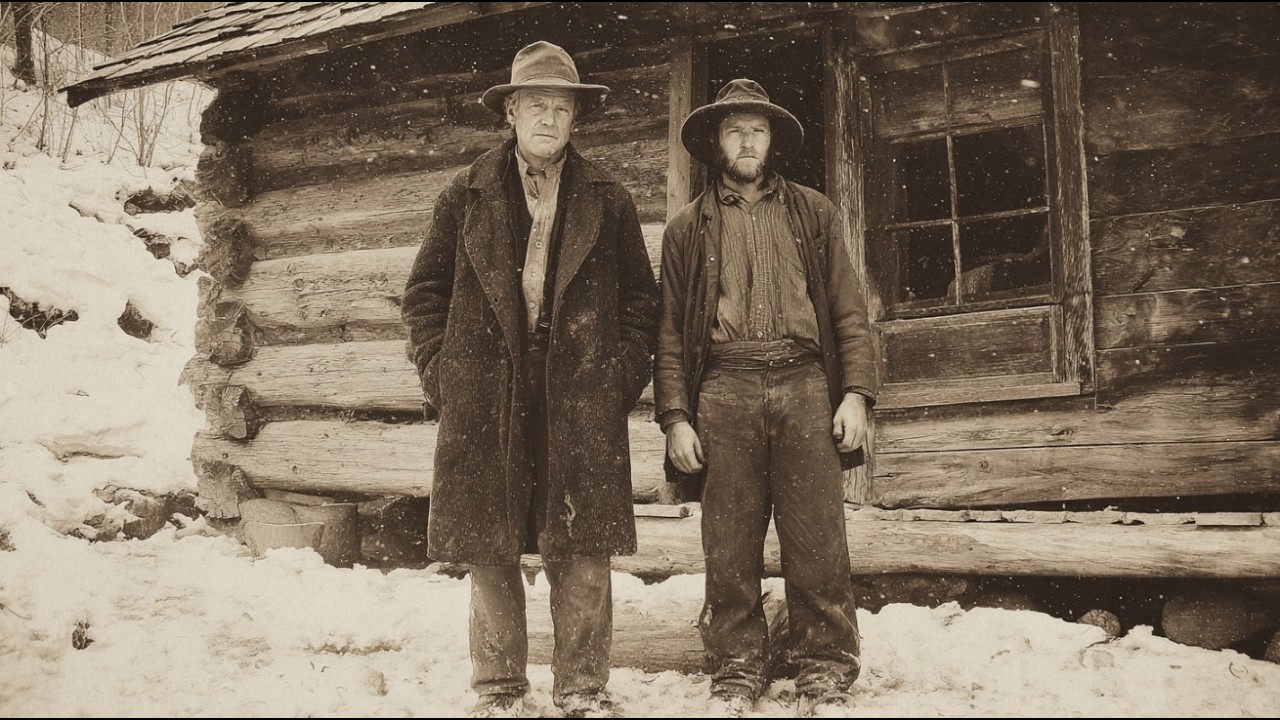
This is the story of two brothers who lived alone in those mountains, the winter that came too early, and the four men who finally went up to look for them in February of 1956 and came back changed in ways their wives would describe years later as a quiet kind of broken. Their name was Purnell, two brothers. The older was Octavius Purnell, 47 years old that winter, a tall and lean man, the kind of lean a body gets from eating light for years and working heavy for longer. His shoulders sloped a little to the right from a fall off a hayloft when he was 22.
His hands could be read like pages, scarred across the knuckles, fingernails thickened by cold and labor, with a small white mark on the web of his left thumb where a horse had bitten him as a young man. He had pale eyes, almost no color in them. People in the valley said they did not catch the light the way other eyes did, and that was not a metaphor, just the kind of observation country people make and do not think twice about. The younger brother was Lucius Purnell, 41, shorter than Octavius by half a head and thicker through the chest, with a black beard he had never trimmed properly and a way of standing that made him look like he was bracing against something invisible.
He did not speak much. Some folks down in Marlinton said they could not remember ever hearing his voice. Others said they had heard it once when he was angry and did not care to hear it again. The two of them had lived alone on Strangler Ridge since their father died in 1938.
There had been a sister once, of marrying age, who went south to live with an aunt in Virginia in the early ’40s, and from what the postmaster could piece together, she never came back. After her, it was just the brothers, the cabin, the ridge, and a small herd of half-wild hogs they kept in a pen on the south slope. They came down into Marlinton twice a year, once in the spring to sell furs, once in the fall to buy flour, salt, lamp oil, and tobacco for Octavius’s pipe. You could set your calendar by it.
The shopkeeper, a man named Burl Hatcher, told this story for the rest of his life, and he always started it the same way. “Those brothers came in the second Saturday of October every year that I can remember. Same Saturday, same hour, same order on the counter. And then, in October of 1955, they came down on the third Saturday instead.
And Octavius didn’t buy tobacco. And he looked at me like he was trying to remember who I was. That was the first thing. ”
The second thing was the dog.
The brothers had a dark, square-jawed mutt they had kept for nine years, named Brody. Brody always came down with them and waited at the door of the store while they shopped, because Hatcher’s wife did not like animals on the floor. On that third Saturday of October, the dog was not with them. When Hatcher asked after it, Lucius did not look up.
Octavius said in a low voice, “He went off. ” That was all. Hatcher told his wife about it that night. She said dogs go off all the time.
He agreed. He went to bed, but he did not sleep well, and he did not know why. Strangler Ridge sat above the head of a narrow valley, about nine miles east of Marlinton, up a logging trail that even in good weather was no easier than a creek bed. To reach the Purnell cabin you climbed for three hours on foot through second-growth oak, past a stand of dead chestnuts killed by the blight back in the ’20s and still standing, gray and tall like a kind of bone forest.
Then you crossed a saddle where the wind always blew from the wrong direction. Then you came up over a shoulder of rock and saw the cabin in a small clearing, with its single chimney, its hog pen, and its woodpile that Octavius kept stacked with the obsessive neatness some men get when they live alone too long. That clearing, that ridge, that cabin—1956 was not the first time strange things were said about it. The original cabin had been built around 1880 by an old timber surveyor named Gideon Crooke, who was rumored to have walked off it one winter and never come back.
The Purnells’ father bought the land off Crooke’s estate in 1910, when no one else wanted it. Folks in Marlinton would tell you, if you asked, that the ridge had a reputation even before Crooke. The Shawnee had a name for it the white settlers could not pronounce, and a story about it they did not want to repeat. The Purnells’ father never spoke of any of that.
He had been a hard, quiet man who believed superstition was a kind of laziness, and he raised his two sons to believe the same. But superstition is patient. It waits for you. The first sign that something was wrong on the ridge that winter came in early November.
A hunter named Vester Cooms was tracking a wounded buck up the eastern slope of Strangler Ridge and lost the trail in a hollow about a mile below the Purnell cabin. He stopped to drink from his canteen, and as he stood in the silence of late afternoon, he heard, faint and far off, a sound he could not identify. He described it later as a low, slow humming—not a man, but shaped somehow, patterned, like someone working their way through a song they had forgotten halfway through and were trying to remember by feel. Cooms was not a fanciful man.
He had served in the Pacific in the war and seen things that make a man permanently uninterested in ghost stories. But he turned around in that hollow and walked back down the mountain, and when his wife asked why he had come home empty-handed before sundown, he said only that there wasn’t anything up there worth getting. He never hunted that side of the ridge again. The second sign came in late November.
A man named Orris Pendry, who ran a small trapline along the creeks east of Strangler Ridge, found three of his fox sets sprung but empty, and a fourth set with a fox still in it, still alive. But the animal was looking up. Not down at the trap, not out at him, not anywhere a trapped animal looks. It lay flat on its side, looking straight up into the trees with its mouth half open, like it was watching something the trapper himself could not see.
Orris dispatched the animal, gathered his line, and went home. He did not run that trapline again that season. These things were not reported to any authority. Mountain men in West Virginia in the ’50s did not go down to the courthouse to file accounts of bad feelings in the woods.
They told their wives. They told a brother. They told the same friend at the same kitchen table over the same cup of coffee. The story spread sideways across the valley, the way stories spread in places without television, without much radio, without much trust in outsiders.
By the middle of December, three or four men in Marlinton had heard one or both of those stories. By the end of December, when the snows came in heavy and the Purnell brothers had not been seen for two months, a few of those men began to think about it more than they wanted to. The first big snow of that winter fell on the night of December 23rd, 1955. A foot and a half by morning.
Another foot on the 28th. Then a long, quiet, brutal cold snap through January pushed the lows below zero for nine straight nights. Even by the standards of those mountains, it was a hard winter, the kind you survive by not asking too much of the world. There was no telephone line up to Strangler Ridge, no road you could drive in January.
The Purnells had wintered alone up there for almost 20 years, and no one had ever felt the need to check on them, because checking on the Purnells was the kind of thing the Purnells would have considered an insult. But Burl Hatcher kept thinking about Octavius’s face on that third Saturday in October, the way Octavius had looked at him like he was trying to remember who he was. He kept thinking about the dog, and about Vester Cooms walking down the mountain empty-handed, and about the fox. In the last week of January, Hatcher walked down to the small house of a man named Talcott Reeves, a friend of the Purnells’ father back in the ’20s, now 68 years old, white-haired, but still strong in the way mountain men are strong well into their late years.
Hatcher said, “I think someone needs to go up there. ”
Talcott said, “I’ve been thinking the same. ”
They did not say more than that. They did not need to.
They agreed to wait for a break in the weather and to bring two more men with them when they went. That break came on February the 11th, 1956. There were four men who walked up Strangler Ridge that February morning. Burl Hatcher, the shopkeeper, 53 years old, a heavy man with a slow walk and a slower temper.
Talcott Reeves, 68, the old friend of the family, lean and bent and quiet. A young deputy from the Pocahontas County Sheriff’s Office named Wilcum Rines, 26 years old, sent along because the sheriff considered it a courtesy more than an emergency. And a man named Audrick Soule, 44 years old, a logger by trade, brought because he knew the trail better than any of them. They left Marlinton before sunup, took a small wagon as far as the wagon would go, then went on snowshoes with rifles and a sled and enough food for two days in case the weather turned again.
The sky was the color of old tin. The cold was bearable but not friendly. They climbed for most of the morning. Audrick, walking ahead, was the first to notice that the woods were quiet.
Not the kind of quiet you get in deep snow, which is a quiet with edges, a quiet you can hear your own breath inside. This was different. Flatter, as if the whole mountain was holding its breath, waiting to see what they would do. There were no tracks anywhere.
Not deer, not squirrel, not bird. Audrick mentioned this to Talcott. Talcott nodded once and did not answer. They crossed the saddle around noon.
The wind there was, as always, blowing in the wrong direction. They came up over the shoulder of rock about an hour later and saw the cabin. It was still standing. The chimney was cold.
The hog pen was empty, the gate open. Snow on the small porch had drifted halfway up the door. But here is the thing the four of them noticed at the same time and could never quite agree on afterwards: the woodpile was full, stacked neatly, the way Octavius had always stacked it. No one had been burning that wood.
The brothers had not run out of fuel and walked off. They had simply stopped using their stove. Wilcum, the young deputy, called out as they crossed the clearing, calling both brothers by name. He called twice.
There was no answer, no movement at the cabin window, no smoke from the chimney, no sound from the hog pen, although they could see even from the edge of the clearing that the pen gate had been pulled open from the outside and tied that way with a length of dark cord. Talcott was the one who stepped onto the porch first. He brushed the snow back with his boot, knocked on the door, and when there was no answer, tried the latch. The latch lifted.
The door swung in. What he saw made him stop in the doorway for a long moment and not enter. The other three came up behind him. How to describe what they found in that cabin?
The way the four of them described it, which is to say, carefully. Some of what was in there is the kind of thing not to be repeated directly. The deputy’s report, filed in March of ’56, was redacted at the request of the county coroner, and that redacted document is the only official account that survived. But what those four men told their wives and close friends and eventually a small handful of investigators from the state has been written down in pieces, in letters and notebooks, and what follows is drawn from those.
The cabin was warm. That was the first thing. It should not have been warm. There was no fire in the stove, and no fire for a long time; you could tell by the ash, old and pressed and dry.
But the air had a temperature that was wrong for the cold outside. It was not summer warm. It was the warmth of a closed room where someone has been breathing for too long. The second thing was the smell.
Not the smell of two men who had died in a cabin, although that, the four of them knew, was what they had come up expecting. It was different. Burl Hatcher would later tell his wife it reminded him of the smell of his grandmother’s root cellar in the summer, but with something else underneath. A sweetness.
A patience. The third thing was that the brothers were not in the front room. The front room was perfectly ordinary. Two chairs, a table, a kettle on the cold stove.
A lamp unlit, the oil filled to the line. Octavius’s pipe sat on the table with a thumb of tobacco in the bowl and a match laid beside it, as if he had been about to light it, been interrupted, and simply not come back. The two beds in the side room were made. There was no sign of struggle, no sign of illness, no sign of a meal half-eaten or a chore half-finished.
The cabin looked as if the brothers had stood up from whatever they were doing, walked into the back room, and not returned. Talcott opened the door to the back room. It was a small low-ceilinged space the brothers used for storage: furs, tools, salt, a few crates of canned goods Octavius had brought up from Marlinton over the years. It had a single small window and no other light.
The window was covered from the inside with a piece of dark cloth, nailed up neatly all the way around the frame. In the dim light that came through the open door behind them, the four men saw, at first, only that the room was almost empty. The crates had been moved. The tools had been moved.
Everything once stored along the walls had been carried out and stacked very neatly in the corners. And in the center of the bare floor, the brothers were sitting. Cross-legged, facing each other, about three feet of empty floorboard between them, the way two men face each other across a checkerboard. Their eyes were open.
They were not dead, but they were not, in any sense the four rescuers could understand, alive in the way a man is alive. The Purnell brothers were breathing. Their chests rose and fell at the slow even pace of sleep. Their hands rested palms up on their knees.
There was no injury on either of them. No blood. No rope. Nothing in the room explained why they sat there in the cold and the dark, facing each other in silence.
Wilcum, the young deputy, would later tell the sheriff that his first thought was not that something terrible had happened to the Purnell brothers. His first thought was that he had walked in on something he was not supposed to see, and that the polite thing, the natural thing, would be to back out of the room, close the door, and pretend he had not been there. He did not back out, but he wanted to, and he never forgot wanting to. Talcott spoke first.
“Octavius. ” Octavius did not move. “Octavius, can you hear me? ” Octavius did not move.
Talcott crossed the room, knelt beside the older brother, and put a hand on his shoulder. Through his glove he could feel the steady rise and fall of breath. He could feel warmth. He shook Octavius gently, the way you shake a man you are trying to wake from heavy sleep.
Octavius’s eyes shifted. They did not blink. They did not focus on Talcott. They shifted slowly to a point somewhere over Talcott’s shoulder and fixed there, as if Octavius had heard something behind Talcott that interested him more than the hand on his shoulder.
Talcott turned to look. There was nothing behind him. The open door. The other three men.
The front room with its cold stove and unlit lamp. Nothing for Octavius to be looking at. But Octavius was looking at it. Audrick Soule, the logger, said later that this was the moment he understood he was not in a rescue.
He understood he was in something else, although he could not have said what. He took two steps backward into the front room and did not go back into the back room of that cabin for the rest of the day. Burl Hatcher went to Lucius. He did the same.
Spoke his name. Shook his shoulder. Got the same response, or the same absence of response. Lucius’s eyes shifted slowly and fixed on a point in the air behind Hatcher and stayed there.
Here is the part the four men could not speak of for a long time, the part that took weeks before they could put it into words for each other, never mind for their wives. The brothers were looking past their rescuers at the same point. Hatcher and Talcott stood on opposite sides of the room. Octavius and Lucius faced each other, three feet apart.
There was no single point in the room that both brothers could have been looking at over the shoulders of the men crouched beside them. Unless that point was not in the room. Unless it was something neither in the room nor outside the room, but in some third place the brothers had been watching together for so long that they had forgotten how to look at anything else. Talcott was the one who finally tried to lift Octavius up.
He worked his arm under the older brother’s shoulder and tried gently to raise him to his feet. Octavius did not resist. Octavius did not assist. His body had the loose unresisting weight of a sleeping man.
Talcott managed to get him to a half-stand, leaning against his hip. And at that moment Octavius opened his mouth. His eyes were still fixed at that same impossible point over Talcott’s shoulder, but he opened his mouth, and in a slow dry voice, the voice of a man who has not used his throat in a long time, he said one sentence. Talcott never spoke that sentence aloud to anyone.
He told his wife about it 22 years later, on the night before he died, in the kind of confession a dying man makes when he has carried something heavy for too long. His wife wrote it down and kept it folded in the front of her Bible. After her own death in 1984, her niece found the paper and burned it without reading it, because she said the room felt wrong while she was holding it. So we do not know exactly what Octavius said.
But we know what happened immediately afterward, because all four men were in that cabin and all four men agreed. When Octavius spoke, Lucius, on the other side of the room, smiled. He had not moved. His eyes were still fixed on his own point in the air.
His body was still slack. But his mouth turned up at the corners in a slow, deliberate smile, as if he had heard his brother say something pleasing, as if the two of them were sharing a private joke no one else could be expected to understand. Audrick, from the front room, heard Burl Hatcher say very quietly, “Oh. ” Just that.
“Oh. ” The way a man says it when he has just understood something he did not want to understand. They did not stay in that room any longer than they had to. They got the two brothers up.
It was easier than it should have been. The brothers walked when they were led. They sat when they were sat down. They did not speak again.
They did not look at the men around them. They looked at the air, always at the air, always at the same air, even when they were carried out of the cabin and across the clearing and down toward the saddle, even when they were strapped into the sled. Wilcum would say later that what made the walk down the mountain hardest was not the weight of the brothers but the angle of their eyes. As the sled tilted on the trail, their bodies tilted with it, but their eyes stayed locked on the same point in the air above the trees, as if there were something up there, as if it were moving with them.
The deputy walked the last hour of that descent looking at his boots. They reached the wagon by full dark and Marlinton just before dawn. The brothers were carried into a small back room at the doctor’s house. Marius Pelletier had been the only physician in that part of the county for 31 years.
He examined them both, found no injuries, no fever, no frostbite, no sign of starvation. Their pulses were slow but steady. Their pupils responded to light. They swallowed water when it was given to them, although they did not seem to notice they were swallowing.
By all medical signs, the Purnell brothers were two healthy middle-aged men in better condition than most farmers their age who simply did not seem to be present in their own bodies. Pelletier sat up with them through the next day and night. On the second night, around three in the morning, he wrote a note in his casebook that has survived. It says only this: “Both brothers stirred at the same instant.
Neither awoke. Both turned the head equally to face the eastern wall of the room. Held this position for 41 minutes. Returned equally to original posture.
I do not know what they are listening to. ” Pelletier never wrote about the Purnell brothers in his casebook again. By the end of the week, word reached the sheriff’s office in Charleston. A man came down from the state hospital with a younger doctor and a notebook full of questions.
The brothers were transferred to the hospital in the second week of February and placed in a small ward in beds that faced each other, because the staff quickly discovered that placing them in beds facing any other direction caused them, slowly and without ever quite waking, to turn their bodies through the night until they faced each other again. They lived in that ward for the rest of their lives. Octavius died in 1963. Lucius died 11 days later.
There is no record that either of them ever spoke again, or ate without being fed, or recognized any face that came near them. The hospital records describe their behavior as catatonic, but with what the chief physician once called, in a private letter to a colleague, an unusual quality of attention. “The brothers were not absent,” he wrote. “They were occupied.
” That was the word he used. Occupied. The cabin on Strangler Ridge was searched twice more that spring and again the following autumn by men more thorough than the four who had gone up first. They found nothing in that back room beyond what the rescuers had found.
The dark cloth on the window. The crates stacked neatly in the corners. The empty patch of floor where the brothers had been sitting. The boards in that patch were polished to a soft sheen, as if two men had sat there perfectly still for so long that they had worn the wood smooth without ever moving a muscle.
The dog, Brody, was never found. The hogs were never found. The cord that had tied the hog pen gate open was examined by the deputy and described in his report as a length of dark, finely braided fiber of a kind he could not identify and that no one in the county recognized when he asked. The cabin was left standing.
No one bought the land. Talcott Reeves’s youngest son, who inherited his father’s farm in the ’70s, would say that hunters from out of state still occasionally asked about the trail up to Strangler Ridge. He told them all the same thing. “There’s a trail.
There’s a cabin at the end of it. Don’t go. ” Some went anyway. Most came back down and never said why they had come down so quickly.
A few did not come back down at all, and were found later by their families in their own homes, in their own beds, perfectly healthy, and not looking at anything anyone else in the room could see. That last detail might be a rumor. It might not be. Mountain stories carry their own weight, and they do not always check in with the truth before they travel.
But here is the part that is not a rumor. Burl Hatcher, the shopkeeper, died in 1971 at 68 years old. He had not been the same man, his wife said, after that February. He was quieter.
He flinched at sudden sounds. He kept the lamp burning in the bedroom every night until the day he died. When she asked why, he said, “Only I don’t want anyone to think I’m not here. ”
Talcott Reeves lived to 90.
He died in 1978. On the night he died, he gave his wife the sentence Octavius had spoken. We do not know what it was, but she would tell her sister years later that when Talcott repeated it, he did not say it the way you repeat something you remember. He said it the way you say something you have practiced not saying for a very long time.
Audrick Soule, the logger, lived in Marlinton until 1982. He never spoke about the cabin again to anyone. When asked, he would shake his head and change the subject, and people learned not to ask. His daughter said after his funeral that the only thing he ever told her about the Purnell brothers was a single line.
“Sometimes a man’s eyes get pulled somewhere, and they don’t come all the way back. ”
Wilcum Rines, the young deputy, left the sheriff’s office in the summer of 1956. He moved his family to Ohio, took a job in a feed store, and lived a long, quiet life. He did not return to Pocahontas County for any reason, not even for his own brother’s funeral in 1974.
When he died in 2004 at 74, his obituary mentioned that he had served briefly in law enforcement in West Virginia as a young man and gave no further details. He had asked in his will that no details be given. The Purnell cabin is, by all accounts, still standing. The roof has fallen in on the front room.
The hog pen is gone. The trees have come back across the clearing, and the woodpile has rotted down to a low ridge of pale, soft wood that does not burn anymore. But the back room, according to hunters who have been there in recent years, is in remarkably good condition for a building not maintained in 70 years. The dark cloth is still nailed across the window.
The patch of floor in the center of the room is still polished smooth. A hunter from Virginia took photographs of that floor in 2012 and showed them to a folklorist in Charleston. The folklorist asked how long he had stayed in the room to take the pictures. He said he had not stayed long.
He had taken the pictures from the doorway. He had not stepped inside. When she asked why, he thought about it for a long time, then said something she wrote down in her notes that night. “There was a place in the middle of that floor where I felt like if I sat down in it, I’d find out what they were looking at.
” And then he said, “And I didn’t want to know. ”
The folklorist closed her notebook, thanked him, and filed the photographs. The file is still in the archive of the West Virginia Folklore Collection under a number you can request if you know how to ask. The photographs show a small dark room with a window covered in dark cloth and a patch of pale floorboards in the center, polished to a soft sheen.
In two of the photographs, there is what looks like a faint shadow on the wall behind that patch of floor: a long, thin shape sitting upright. It could be a trick of the light. It could be a stain on the wood. It could be the place where Octavius leaned against the wall before he came to sit cross-legged on the floor for the last time, facing his brother, watching whatever it was that they had decided was worth watching forever.
The folklorist’s note on the file says only this: “Possible photographic artifact. Do not enlarge. ”
