At its peak, the Joseph Schlitz Brewing Company was producing more than twelve million barrels of beer a year, enough to fill roughly four billion cans. For a time, it was widely considered the largest brewery on Earth, not just in America but anywhere. The brand was so deeply woven into working-class life that a cold Schlitz in a frosted mug was as much a part of Friday night as the ball game itself. The slogan, “The beer that made Milwaukee famous,” was not creative writing.
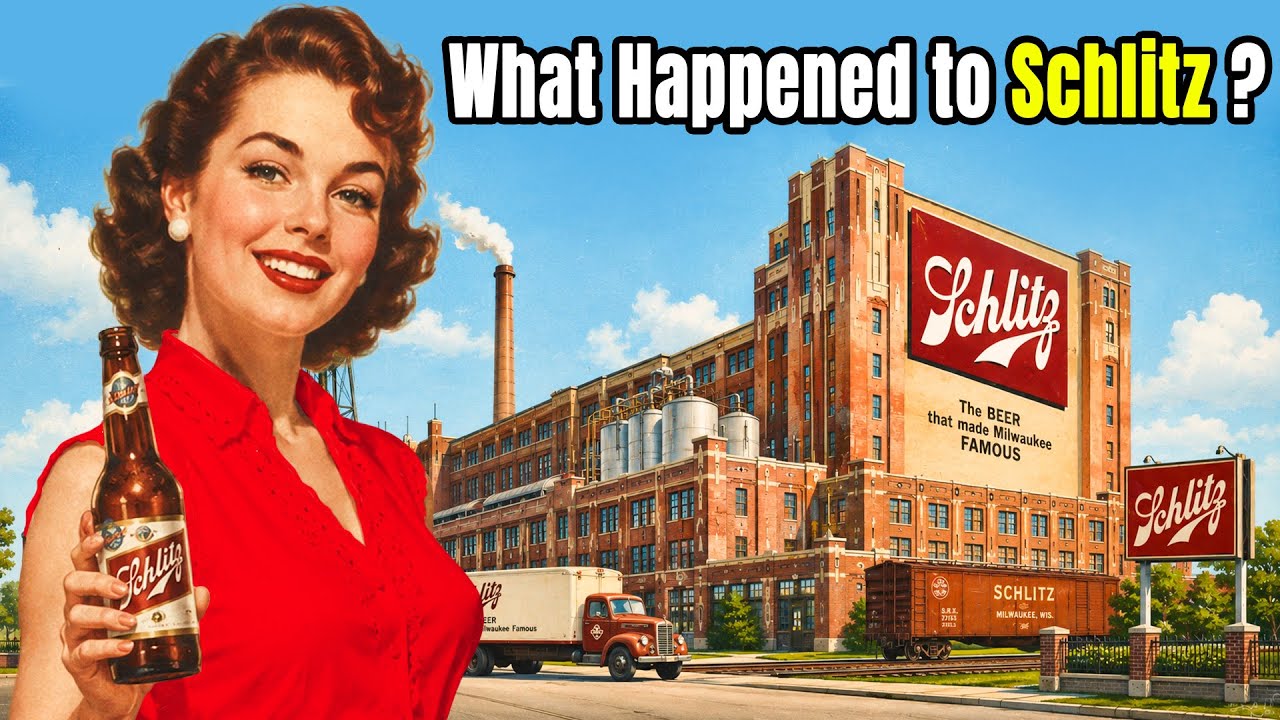
It was a plain fact. Then the company found a way to make more beer, faster, cheaper, and more efficiently than ever before. It looked brilliant on paper. Within eight years, the company was unrecognizable.
Within a decade, it was gone. The story begins in Milwaukee in 1849, when a German immigrant named August Krug opened a small brewery. His bookkeeper, a young man named Joseph Schlitz, learned the business from the ground up. When Krug died, Schlitz married his widow and took over the entire operation.
The pivotal moment came in 1871, when the Great Chicago Fire burned the city to the ground. Clean water was gone and people were desperate. Schlitz loaded wagons and shipped beer south, not as a marketing stunt but as a genuine lifeline. Chicago drank Schlitz while rebuilding itself from ash, and that kind of story builds a reputation that lasts generations.
By 1902, roughly fifty years after Krug’s little tavern brewery first opened, Schlitz was the largest brewery on the planet. In the 1950s, it was in every bar in America, in every TV sports broadcast, in the cooler at the company picnic, and in the fridge at the union hall after the night shift. For millions of American men, Schlitz was simply the beer, the one your dad drank, the one that meant the week was finally over. But being number one puts a target on your back.
By 1957, Budweiser had closed the gap and then crossed it. Anheuser-Busch took the top spot, in part because Schlitz got into a labor dispute and shut down production for two and a half months over wages. Just like that, the title they had held for decades was gone. Schlitz settled in at number two, still enormous, still pulling in millions of barrels a year, but number two.
And the man who inherited control of the company was already thinking about how to fix that. His name was Robert Uihlein Jr. , fourth generation of the family that had owned Schlitz since 1875. He was chairman, president, and the man who signed every check.
Uihlein looked at the numbers and made a logical call. If Schlitz could not beat Budweiser on total sales, it could win on profit per barrel. Make more money on every single unit than any competitor. Be leaner, faster, more efficient.
So he changed the recipe gradually. A swap here, a shortcut there. Things a customer might not notice right away. He pushed the fermentation process harder, cutting aging and storage times that used to take weeks down to days.
He cut back on quality ingredients and swapped in cheaper alternatives throughout the brewing process. He added a silica gel stabilizer to keep the beer looking clear in the fridge, compensating for a fermentation cycle that no longer had time to work the way it used to. Every change compounded the one before it. On paper, every one of those changes made sense.
Faster production, lower ingredient costs, higher margins. The spreadsheet looked great. There was just one problem. The beer tasted different.
Not subtly. Noticeably, unmistakably different. The men who had been drinking Schlitz every Friday for twenty years knew on the very first sip that something was off. They did not write letters to the company, file complaints, or organize.
They just quietly grabbed a Budweiser instead, and they did not come back. By 1973, Schlitz hit its all-time production record of more than twelve million barrels. From the outside, the company still looked like a giant. Inside, the complaints were already stacking up.
Then came the ingredient that pushed everything off a cliff. Around that time, the FDA signaled it might start requiring breweries to list their full ingredient panels on the label. Schlitz switched to a different stabilizer, one called Chillguard, that could be filtered out before bottling, which meant it technically would not need to be declared. It seemed like a clean solution to a regulatory concern.
Nobody at Schlitz knew what would happen when Chillguard hit the foam stabilizer already present in the beer. When a customer pulled a bottle from the fridge, cold, the way you are supposed to drink it, proteins settled out of solution. At its mildest, it looked like tiny white flakes drifting through the beer. At its worst, drinkers described it the same way, over and over.
It looked like snot floating in their beer. Schlitz’s internal response was that the substance was harmless, that not much beer would be refrigerated long enough to trigger the reaction. The customers were probably overreacting. But bars across America were sending full crates back.
Customers were pouring bottles down the sink. The phone lines were ringing. Schlitz pulled the product quietly, no press release, no public acknowledgement, no apology. They recalled ten million bottles and cans and hoped the story would not get out.
The recall cost $1. 4 million, but the real cost, the destroyed trust of millions of loyal customers, had no price tag at all. Robert Uihlein died of cancer that same year, 1976, without ever seeing the full consequences of what the company had become. Here is where most companies facing a crisis like this would go quiet.
Fix the product, come clean, earn the trust back slowly and honestly. Schlitz did the opposite. With sales cratering and distributors losing confidence, the company brought in Leo Burnett, one of the most respected advertising agencies in the country, and gave them one instruction: Get something on air fast that makes people love Schlitz again. In September 1977, Leo Burnett unveiled four TV spots.
The concept was rugged, masculine Schlitz drinkers reacting when an off-screen voice suggests they try a different beer. A boxer in a gym. A lumberjack standing next to his pet mountain lion. The voice floats the idea of switching.
The characters respond with veiled threats. “I’m going to play Picasso and put you on canvas. ” The tagline: “If you don’t have Schlitz, you don’t have gusto. ” The ads were shot first-person, camera to eye.
The threats came straight at you. It did not feel like a playful beer ad. It felt like being cornered in a parking lot by someone who needed you to like them very badly. The campaign was immediately nicknamed by the public, not by Schlitz, “Drink Schlitz or I’ll kill you.
” The commercials ran for ten weeks. Then Schlitz pulled them. Leo Burnett was fired. A company spokesman later admitted it was a really great tragedy, really, really bad.
The campaign did not destroy Schlitz on its own, but it did something worse than hurt sales. It put a face on the panic, and that face was holding a mountain lion and threatening your living room. Between 1976 and 1981, Schlitz’s sales fell seventy-five percent, three-quarters of the business gone in five years. From the number two beer in America to a brand that some bartenders were quietly steering customers away from.
Meanwhile, the entire beer industry was changing shape. Miller launched Miller Lite. Bud Light followed close behind. Light beer was not a trend.
It was a revolution that rewrote the whole category. Schlitz made a brief run at it with Schlitz Light in 1976, with actor James Coburn in the ads. It gained no traction. The company was too busy managing catastrophe to build anything new.
By 1980, production had dropped to under six million barrels, a loss of more than half the business in seven years from the peak of twelve million barrels in 1973. In 1981, Schlitz shut down its Milwaukee brewery. The company that literally made Milwaukee famous closed its original operation in the city that built it. That same year, shady accounting practices triggered a federal SEC investigation, a labor dispute, creditors closing in, everything landing at once.
In 1982, what had been the number two beer in America just a decade earlier was sold to Stroh Brewery Company. Stroh kept it alive but could not fix the underlying problem. The trust was gone. You can change an owner, but you cannot change a memory.
In 1999, Pabst Brewing Company bought Schlitz from Stroh along with a portfolio of other American legacy brands. It survived the way old things sometimes do, not really living so much as waiting. Name still on a can, somewhere in the back of a cooler, twenty-five cents cheaper than everything else on the shelf. In May 2026, Pabst put Schlitz Premium on permanent hiatus.
Rising costs, declining demand, the usual language companies use when they do not want to say the word dead. A brewmaster in Verona, Wisconsin, named Kirby Nelson decided the brand deserved better than just quietly stopping. He brewed the final batch, eighty barrels, using the original 1948 recipe, the one from before all of this happened. Packaged in 16-ounce four-packs, pick up only, you had to drive to Verona yourself to get them.
The beer that once filled every bar in America ended that way. Eighty barrels, a drive to Wisconsin, and one man who thought something that old deserved a proper goodbye. The story is not complicated. Consumers will wait for something.
They will pay more. There is an enormous amount of goodwill sitting in a brand that has been in people’s lives for decades. But there is one thing they will not do. They will not keep coming back once they feel like the thing they trusted quietly became something else.
Once the taste changes and the company says nothing. Once the product comes back wrong and the response is a threatening man on TV. Once the gap opens up between what they remember and what is actually in the glass. The truly painful part is that none of it was necessary.
The product was already good. The brand was already trusted. The loyalty was already there, 130 years of it, built one Friday night at a time by people who never asked for anything more than a cold beer that tasted the same as the last one.
All they had to do was not ruin it.
