In September 1583, Catherine Jagiellon, queen of Sweden, lay dying in Stockholm. She was fifty-six years old, and her body had long since surrendered to the damage inflicted by four years of imprisonment in a freezing medieval dungeon. As she faded, she knew her life’s work hung by a thread: her son, Sigismund, a devout Catholic raised in secret defiance of the Lutheran kingdom he was meant to inherit, stood poised between two empires. She had survived a mad king, a siege, a prison birth, and a revolution, yet her final battle was against time itself.
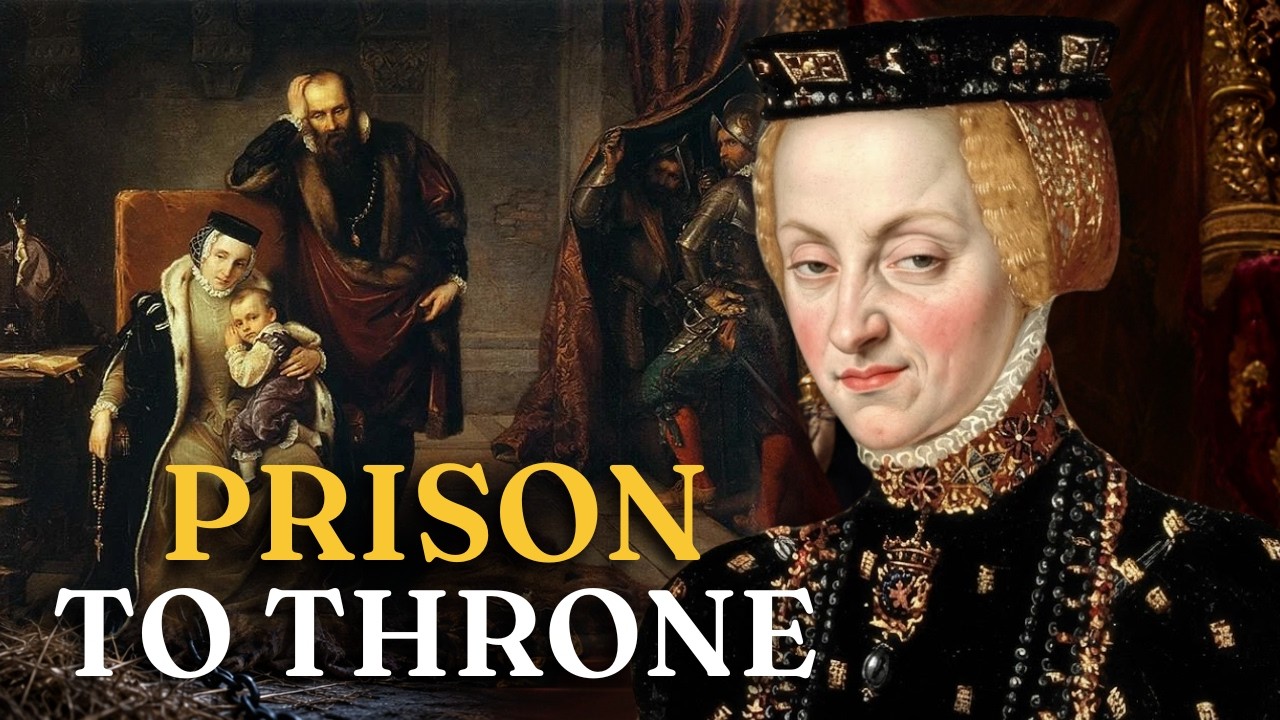
She was determined to see her son crowned before she died, convinced that his destiny lay not in Sweden alone but across the Baltic, in her native Poland. Her path to that deathbed began decades earlier, in 1526, when she was born inside the sunlit walls of Wawel Castle in Kraków. She was the youngest daughter of Sigismund I of Poland and Bona Sforza, an Italian princess of formidable political instincts. The Polish-Lithuanian court was a center of Renaissance culture, rich in art, scholarship, and religious tolerance.
Catherine received an exceptional education, mastering Latin, German, and Italian while absorbing the brutal mechanics of European diplomacy. She understood early that royal daughters were not raised to be individuals but geopolitical currency, pawns to seal treaties and purchase alliances. Her mother trained her to suppress fear and accept that her body belonged to the state. Catherine watched her older sisters dispatched across the continent as strategic assets, and she knew her own value was measured only by her usefulness.
Yet the years passed, and Catherine remained unmarried into her twenties and thirties. Her father died in 1548, and her brother, Sigismund II Augustus, took the throne. Her mother lost a bitter power struggle and fled to Italy, where she was poisoned. Catherine drifted through a volatile political landscape, a frozen asset whose value diminished with each passing year.
Then, in 1560, the political situation across the Baltic shifted. The Swedish House of Vasa, a family that had seized the throne only recently, was looking to expand. When King Gustav Vasa died that year, he left his kingdom divided among his sons. The eldest, Erik XIV, became king.
Brilliant and cultured, Erik was also dangerously unstable, tormented by paranoid fears of usurpation and consumed by jealousy of his younger half-brother, John, Duke of Finland. John was ambitious and restless in his secondary role. He controlled Finland but wanted more, and he knew he needed powerful allies outside Sweden to protect himself from his brother’s instability. He looked across the Baltic and saw Poland.
He saw Catherine Jagiellon. In 1561, John began negotiations for marriage, seeking a military alliance against the growing Russian threat. King Erik immediately recognized the danger: if John married a Jagiellon princess, he would gain the backing of the Polish army and become impossible to control. Erik forbade the marriage outright.
John defied him. Catherine, now thirty-six and a seasoned observer of court politics, understood exactly what she was walking into. By accepting John’s proposal, she was inserting herself into an armed conflict between two heavily armed brothers. Her marriage was an act of high treason against the Swedish crown.
On October 4, 1562, John and Catherine married in a solemn Catholic ceremony in Vilnius. The following year, John brought his bride to his ducal court in Turku, Finland. Catherine carried with her a vast Polish retinue, along with tapestries, silver, and Renaissance literature, trying to recreate Kraków in the dark pine forests of the north. But King Erik’s shadow hung over everything.
Every messenger arriving at Turku Castle carried the possibility of a death warrant. Shortly after they arrived, Erik convened the Swedish parliament and declared John a traitor to the realm. In the summer of 1563, he sent a force of ten thousand Swedish soldiers across the Baltic with orders to besiege Turku, crush the rebellion, and return John to Stockholm in chains. The siege was a brutal awakening for Catherine.
She had been raised to believe that royal blood was a shield, that it commanded respect and guaranteed safety. Cannonballs crashing against the stone walls shattered that illusion. The artillery did not recognize pedigree. As the siege dragged on for weeks, supplies rotted and dwindled.
Catherine walked among wounded soldiers, distributing what little bread and wine remained. She watched her loyal Polish attendants, who had followed her expecting a life of exile and prestige, succumb to disease and despair. She saw her husband, once arrogant in his defiance, now pacing the crumbling ramparts as his options faded. The siege systematically destroyed their dignity before destroying their defenses.
By August 1563, starvation and illness had broken the garrison. Turku surrendered. The victors did not treat John and Catherine as defeated royalty. They were stripped of their finery, their household was arrested, and many of John’s closest advisors were summarily executed.
Catherine was forced to watch as the life she had tried to build was systematically looted and destroyed. They were herded onto a ship bound for Sweden, confined in cramped, damp quarters below deck, sailing directly into the hands of a man with absolute power and no self-restraint. Erik XIV was descending into madness. Modern psychiatrists have suggested he suffered from a severe form of schizophrenia accompanied by violent paranoia.
He experienced auditory hallucinations, believed the stars foretold his assassination, and was deeply suspicious of anyone with blond hair. He maintained a secret network of spies who fed his delusions and justified his bloody purges. Yet despite his madness, Erik retained a cunning political instinct. He knew that executing his own brother would cause a domestic scandal, and he knew that executing a Polish princess would provoke an immediate and devastating war with Catherine’s brother, King Sigismund II Augustus of Poland.
Erik did not want a war with Poland. He wanted John isolated and destroyed. So Erik offered Catherine a deal. She would be granted safe passage back to Poland, allowed to keep her wealth, her jewels, and her royal titles.
The Swedish crown would issue a formal apology to the Polish king. There was only one condition: she had to leave John behind, formally abandoning him to Swedish justice, which meant a sham trial and the executioner’s axe. From a purely practical standpoint, the offer made sense. In the patriarchal logic of the sixteenth century, a woman’s marriage was a political contract, and if that contract became a burden to the state, it could be dissolved.
Erik assumed Catherine, after surviving the horrors of the siege and facing the prospect of a frozen dungeon, would do what royal women were trained to do: survive, obey the reigning king, and return home to await a new assignment. He underestimated her. According to the historical record, Catherine raised her hand and held it before the king’s face, pointing to the gold wedding ring on her finger. Engraved on the metal was a Latin inscription: Nemo nisi mors, nothing but death.
She told Erik that she had sworn an oath before God, and no earthly king had the right to break it. She chose the dungeon. This act was not merely romantic devotion. For thirty-six years, Catherine had been a passive instrument of the state.
Her father, mother, brother, and finally her husband had dictated where she lived, whom she married, and the purpose of her existence. Now, standing before the most powerful man in Scandinavia, facing the destruction of her physical comfort and freedom, she finally had a choice that was entirely her own. By refusing Erik’s offer, she seized control of her fate. Her loyalty to John became her only physical shield, because as long as a Polish princess shared his cell voluntarily, Erik could not easily execute his brother without turning a domestic matter into an international crisis.
Enraged by her defiance, Erik ordered them stripped of their remaining dignity and transferred to Gripsholm Castle, a fortress built on the shores of Lake Mälaren, designed not for comfort but for containment. When the heavy wooden doors of the tower closed behind them, Catherine confronted the reality of her choice. The luxurious tapestries and sunlit halls of her childhood were gone forever. She was now locked in a small, damp suite of rooms with thick stone walls and narrow barred windows offering only intermittent views of the frozen lake.
The guards reported directly to the paranoid king in Stockholm. Their food rations were strictly controlled, dependent on the whims of a monarch whose mind was rapidly deteriorating. John, stripped of his titles, his army, and his pride, slipped into a profound depression. He spent his days pacing the stone floor, oscillating between blind rage and paralyzing despair, terrified that every approaching footstep signaled the arrival of the executioner.
Catherine became the anchor of their existence. She managed their meager household, negotiated with the guards for firewood and better rations, and absorbed her husband’s endless waves of despair. She understood that if she collapsed, they would both die. Her training as a Jagiellon princess, learning to endure the intolerable, to suppress panic, to maintain absolute dignity regardless of physical reality, became her greatest weapon.
Then, in the midst of that first horrifying year of captivity, her body revealed an impossible new reality. She was pregnant. In the sixteenth century, childbirth was dangerous even in the wealthiest palaces surrounded by the best physicians money could buy. To be pregnant at thirty-nine, living in a damp, frozen cell, was effectively a death sentence.
Catherine suffered from the cold, from inadequate nutrition, and from the crushing fear of what would happen to her child if she somehow survived the birth. She knew that any child of John’s represented a direct threat to the paranoid king in Stockholm. She was not merely carrying a baby. She was incubating a political crisis.
While her pregnancy progressed through Sweden’s brutal winter, Erik’s grip on reality continued to crumble. He became convinced the Swedish nobility was conspiring to kill him. His court transformed into a theater of horror governed by sudden arrests, torture, and arbitrary executions. Catherine received only fragmented and terrifying reports filtered through her guards, each one suggesting that Erik was becoming more deranged and more prone to fits of lethal violence.
Knowing that her life and her unborn child’s life depended entirely on the neurological stability of a madman provoked a level of maternal terror that was difficult to describe. On June 20, 1566, labor began. There were no silk sheets, no royal physicians, no choirs singing hymns of salvation. The birth of Sigismund III Vasa was brutal, bloody, and desperate, conducted in the dim light of a prison cell.
When the infant finally cried, the sound echoed off the stone walls, a fragile spark of defiant life in a tomb designed for forgotten people. The survival of both mother and child was a biological miracle, but Catherine had no time to recover. The birth of Sigismund increased the danger immediately. Erik now had a nephew, and in the cruel calculus of dynastic politics, this infant was a potential rallying point for any faction seeking to overthrow the mad king.
Catherine nursed the baby herself, trusting no one, raising him in secret within the suffocating silence of the dungeon. Even in this misery, her political mind never stopped working. She realized that as long as she and her son remained alive, they had value. She began to exert her influence, using a combination of bribery, charm, and sheer force of will to sway some of the guards.
She established a secret line of communication, smuggling coded messages from Gripsholm Castle across the Baltic to her family in Poland. These were not pleas for rescue. They were intelligence reports. She informed the Polish court of Erik’s deteriorating madness and detailed the growing discontent among the Swedish nobility.
She reminded the European powers that the sister of the King of Poland was being held hostage by a madman. She was systematically preparing the ground for a political crisis, maneuvering a vast geopolitical chess game from inside a locked cell. Her timing proved perfect. In the spring of 1567, Erik completely collapsed.
The event that shattered the Swedish state became known as the Sture Murders. Erik, obsessed with the powerful Sture family, ordered the arrest of several of its leading members and had them thrown into the dungeons of Uppsala Castle. A hasty mock trial was convened, but Erik did not wait for the verdict. On May 24, driven by a violent psychotic episode, the King of Sweden personally stormed the dungeons, drew his dagger, and stabbed Nils Svantsson Sture to death.
He then ordered the guards to slaughter the remaining prisoners, leaving behind the butchered bodies of noblemen. Erik fled the castle in complete delirium, running into the surrounding forest disguised as a peasant, wandering aimlessly for days while his kingdom sank into paralysis. For Catherine and John, imprisoned at Gripsholm, news of the Sture Murders was the spark they had been waiting for. A king who slaughtered his own nobles in a fit of madness could not remain on the throne for long.
Suddenly, the guards were hesitant, unsure who was really in charge of the country. The prison’s strict discipline began to crack. Catherine looked at her husband, who was slowly emerging from his years-long depressive fog, and at her one-year-old son, the boy born on cold stone who was now the only stable royal alternative to a murderous madman. Years of hunger, bitter winters, and the terror of giving birth in captivity had forged them for this exact moment.
The lock on their cell door was still sealed, but the Swedish state was disintegrating around them. In the forests of Uppsala, a mad king wandered in the dirt, talking to ghosts. Inside Gripsholm Castle, a Polish princess held her son and prepared for war. In the fall of 1567, Erik was brought back to Stockholm, a broken man haunted by the blood of the Sture family.
When his mind briefly cleared, leaving him with the horrifying realization of what he had done, he was consumed by a frantic, unstable guilt. In a desperate attempt to appease the terrified nobles, and perhaps to bargain with his fractured conscience, he issued a shocking directive: he ordered the release of his brother, Duke John, and his sister-in-law, Catherine Jagiellon, from Gripsholm Castle. After four years of imprisonment, the transition was not a cinematic moment of joyful liberation but a brutal psychological shock. Catherine stepped out of the castle into clean sunlight, carrying her one-year-old son who had spent his entire life inside a dungeon and had never seen the horizon.
She also supported a husband emotionally shattered by captivity. They were free, but they were stepping into a political minefield. Erik’s momentary lucidity had not saved his life; it had sealed his fate. By releasing John, the mad king had handed his brother the weapon that would destroy him.
The Swedish nobility, traumatized by the Sture Murders, yearned for a change of regime. They could no longer trust their lives to a king who imagined assassins everywhere. Duke John, despite his recent deterioration, was the only available alternative. The nobles flocked to him, motivated not by deep loyalty but by sheer necessity.
John, emerging from his depression, understood the geopolitical reality instantly. In the summer of 1568, the revolution erupted. It was swift, brutal, and highly organized. John, joined by his younger brother Charles, gathered an army and marched on Stockholm.
Catherine did not lead troops on the battlefield, but her role was crucial. Her presence legitimized John’s rebellion in the eyes of the European powers. She managed the rapidly expanding court, won the loyalty of key factions who remembered her dignity during the siege of Turku, and served as living evidence of Erik’s cruelty. By September 1568, rebel forces stormed the gates of Stockholm.
King Erik XIV was captured, abandoned by his guards and his sanity. John ascended the throne as King John III of Sweden. Erik was formally deposed, stripped of his crown, and subjected to the same nightmare he had inflicted on his own family, imprisoned in a series of increasingly harsh cells. In the spring of 1569, in a solemn ceremony at Uppsala Cathedral, the prisoner of Gripsholm Castle was crowned Queen consort of Sweden.
It was a stunning personal triumph, but Catherine soon realized the throne was merely a different kind of fortress. The physical prison had been replaced by a psychological one. She was now queen of a country deeply hostile to her identity. Sweden was a staunchly Lutheran nation, and the clergy viewed the Pope in Rome as the literal Antichrist.
Catherine’s arrival with her Polish priests, her rosaries, and her own Catholic Mass provoked panic among the Swedish religious establishment. They demanded she convert. She refused. As she had pointed to her wedding ring in the face of Erik’s death threats, she now pointed to her conscience in the face of the Swedish church.
Yet Catherine was too politically astute to attempt to impose Catholicism on Sweden by force, a move that would have triggered immediate civil war. Instead, she chose diplomacy. She secured the right to maintain her private Catholic chapel and priests within the royal palace, creating a safe haven for Catholicism in the heart of Protestant Stockholm. She engaged actively in charity, funded the reconstruction of monasteries destroyed during the Reformation, and patronized the arts, bringing the refined humanist culture of the Polish Renaissance to the austere Swedish court.
She worked tirelessly to prove to the nobles that a Catholic queen could be a loyal and stabilizing force for a Protestant state. Her influence on John III was profound. Under her influence, John pursued a risky theological experiment, seeking a compromise. In 1576, he issued the “Red Book,” a hybrid church ordinance that preserved the basic structure of Swedish Lutheran liturgy but reintroduced many traditional Catholic elements, vestments, and rituals.
For John, it was an attempt to bridge the gap between Rome and Luther. For the Swedish clergy, it was absolute heresy, a Trojan horse devised by Queen Catherine to return Sweden to papal control. The Red Book ignited a sharp theological and political crisis, galvanizing hardline Protestants led by John’s own brother, Duke Charles. Catherine’s greatest geopolitical masterpiece, however, was not the Red Book but her son Sigismund.
She controlled his education absolutely. Despite furious protests from the clergy and nervous warnings from the nobles, she insisted Sigismund be raised and educated as an orthodox Catholic. She imported Jesuit tutors, surrounded him with Polish advisors, and instilled in him an unshakable faith. This was an enormous political gamble.
By raising the heir to the Swedish throne as a Catholic, she was effectively guaranteeing future conflicts. She was exposing her son to intense hatred from the people he would one day need to rule. Why would a woman who had devoted her life to political survival make such an apparently reckless choice? Because Catherine was not looking only at Sweden.
She was looking across the Baltic, to Poland. Poland was an elective monarchy. When her brother, King Sigismund II Augustus, died without an heir in 1572, the Jagiellon dynasty ended and the Polish throne fell vacant. Catherine knew that her son carried Jagiellon blood.
If he remained a devout Catholic, he would be the ideal candidate for the Polish nobility to elect as their king. She was playing a geopolitical chess game that spanned generations, willing to risk her son’s popularity in Sweden to secure the vast, wealthy, ardently Catholic Polish-Lithuanian Commonwealth. She imagined a future where her son, the boy born in poverty, would unite the Vasa and Jagiellon dynasties, ruling a personal union stretching from the Arctic Circle to the borders of the Ottoman Empire. By the early 1580s, Catherine had achieved a geopolitical miracle, but her body was paying the price.
The four years she spent imprisoned within the cold, damp walls of Gripsholm, deprived of adequate nutrition and sunlight while pregnant with the heir, had permanently damaged her health. She suffered from chronic, painful attacks of gout and rheumatism. In the cruel theater of sixteenth-century monarchy, however, physical pain was a luxury a queen could not afford. She knew that the moment she showed weakness, the fragile political system she had devoted her life to building would begin to collapse.
The Protestant nobility of Sweden was waiting for her death, and she refused to give them the satisfaction of an easy departure. As her health declined in the fall of 1583, the delicate religious compromise she had engineered with her husband began to unravel. The Red Book was rejected with equal violence by both Rome and the Swedish clergy. From her sickbed, Catherine continued to hold secret meetings with papal delegates such as the Jesuit diplomat Antonio Possevino, desperately trying to secure international support for her son.
She knew John’s resolve would waver after her death. He was a man who needed a strong anchor, and she had been his anchor since the day she refused to leave him to Erik’s executioner. On September 16, 1583, Catherine Jagiellon’s exhausted body gave out. She died in Stockholm at the age of fifty-six.
Her death was not merely the passing of a queen; it was the removal of the keystone holding the Swedish state together. Without Catherine to moderate his impulses and soothe the nobles, John III’s reign became increasingly turbulent and isolated. He eventually abandoned the middle-ground theology she had championed, and the Swedish church sank back into bitter factional strife. But her grand strategy, the masterpiece she had planned in the darkness of Gripsholm Castle, survived her death.
In 1587, four years after she was buried in Uppsala Cathedral, the Polish throne fell vacant. The Polish-Lithuanian nobles looked north, to Catherine Jagiellon’s son. Sigismund, carrying the blood of Poland’s ancient kings and the unwavering Catholicism his mother had instilled in him, was elected King of Poland and Grand Duke of Lithuania. When Sigismund III Vasa traveled to Kraków to be crowned in Wawel Castle, the very halls where his mother had grown up, it was a decisive triumph for Catherine’s suffering.
The boy who had taken his first breath on the cold stone of a Swedish prison cell, awaiting his mad uncle’s order of execution, was now the absolute ruler of the largest and most populous empire in Eastern Europe. Five years later, John III died, and Sigismund inherited the Swedish crown, uniting two great empires under a single monarch. Catherine’s dream of a vast Vasa-Jagiellon union had been realized, but it was a project doomed from the start. The fatal flaw in her design was that she had built a Catholic king for a Protestant world.
When Sigismund returned to Sweden to claim his inheritance, the cultural and religious clash was catastrophic. He arrived not as a son returning home but as a foreign Catholic ruler backed by a Polish army. The Swedish nobility, terrified of a forced Counter-Reformation, rallied around Sigismund’s uncle, Duke Charles. The struggle Catherine had spent her entire reign trying to suppress finally exploded into open war.
Uncle and nephew clashed in a brutal civil war that culminated in the Battle of Stångebro in 1598. Sigismund’s forces were defeated. The Swedish parliament formally deposed him, stripping the boy born at Gripsholm of the crown his mother had fought so long to secure. Duke Charles took the throne, eventually crowning himself King Charles IX.
The deposition of Sigismund was not the end of the conflict but the spark that ignited a devastating continental war. Sigismund refused to accept the loss of the Swedish crown. Throughout his long life, he used the wealth and power of the Polish-Lithuanian Commonwealth to wage relentless war against Sweden to recover his lost throne. This dynastic feud, born from the psychological wounds of a fractured family, escalated into a series of destructive conflicts known as the Polish-Swedish Wars.
They continued for over sixty years, long after Sigismund’s death. They culminated in the mid-seventeenth century during a catastrophic period known in Polish history as the Deluge. Swedish armies, led by the descendants of Duke Charles, marched into Poland, systematically burning, looting, and destroying the country. The destruction was immense, devastating the Renaissance culture that Catherine Jagiellon had so valued.
The geopolitical union she had engineered to protect her son became, in the end, the instrument that burned her homeland to the ground. This is the terrible irony of royal history. Catherine Jagiellon’s motivations were profoundly human. She endured a madman’s dungeon because she loved her husband.
She weaponized her son’s religion because she wanted to protect him from a hostile court and secure his legacy. She did what any fiercely intelligent mother does when cornered: she fought to ensure her child’s survival. Yet because she was playing the game of empires, her maternal instinct became foreign policy. Her refusal to compromise on her son’s Catholic identity, which had held them together in the darkness of ignorance, ultimately cost hundreds of thousands of lives across the Baltic over the following century.
Catherine Jagiellon was not evil, and she was not a saint. She was a woman trapped in a system that demanded human sacrifice disguised as governance. Today, in Uppsala Cathedral, her marble tomb rests beneath the crown of Sweden, surrounded by the austere Protestant aesthetic she had silently and stubbornly resisted her entire life. But her real monument is not made of marble.
It is found in the dark, frozen waters of Lake Mälaren lapping against the brick walls of Gripsholm Castle. It is found in the terrifying silence of a prison cell, where a starving, terrified woman of thirty-nine gave birth to a king while a madman paced the corridors above her. History often remembers the men who waved swords and signed treaties, but the structure of history is frequently built on the quiet, agonizing resilience of women who were told to be pawns yet chose to be players. Catherine was offered a comfortable life if she would step aside and let the machinery of state crush the man she loved.
Instead, she raised her hand, pointed to a gold ring, and with three words broke a king’s plans and changed the fate of Europe. Nothing but death. She walked into the darkness, and in doing so, she proved that while men’s systems are built on violence, absolute power lies in the refusal to break.
