The photograph was perfect. That was the problem. October 1968. A small chapel on a private Greek island, rain falling soft on the cypress trees.
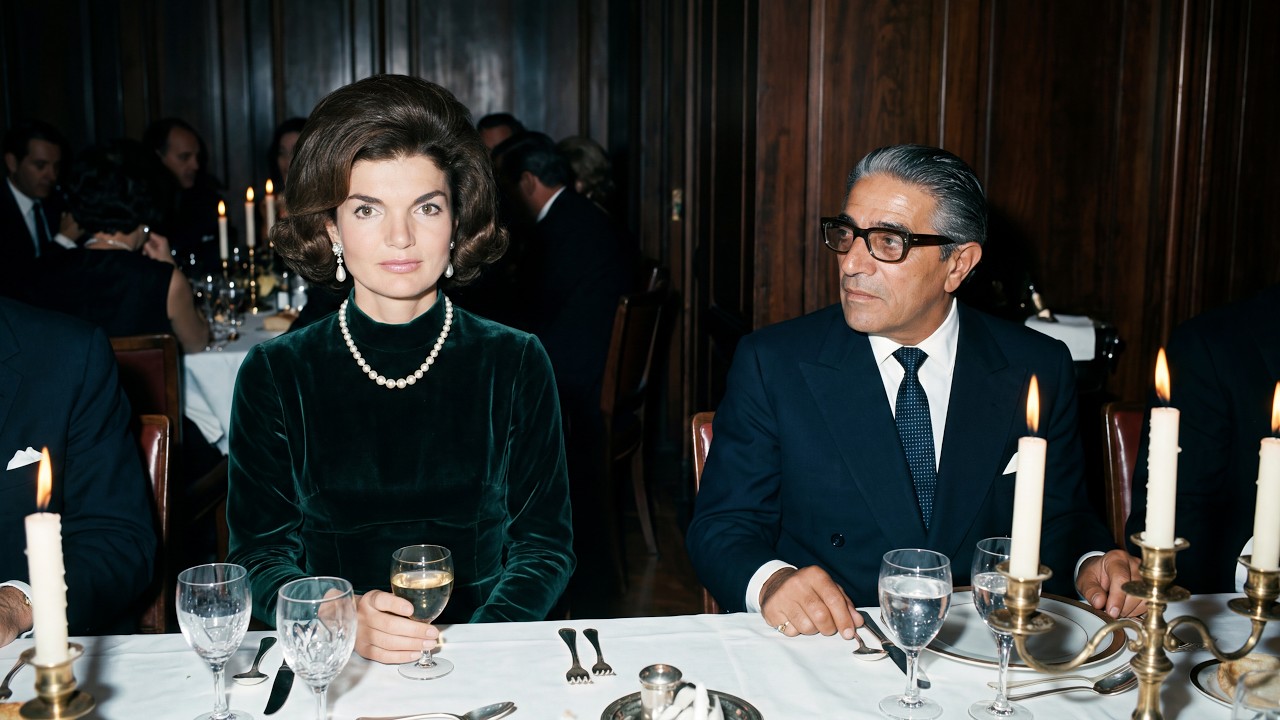
The most famous widow in the world taking the hand of one of the richest men alive. The cameras sold it as a rescue. But the woman in that photograph was walking into a cage, and she knew it. She was 39 years old.
Five years earlier, the whole planet had watched her walk behind a horse-drawn caisson in a black veil, two small children at her side. She was Jacqueline Bouvier Kennedy, widow of a murdered president, and the world had assigned her a role: keeper of the flame, mourner-in-chief, a national monument in a pillbox hat. Now, without permission, she was marrying Aristotle Onassis, a Greek shipping magnate more than twenty years her senior, a man with a weathered face, thick glasses, and a reputation for buying whatever he wanted. Her children were there.
Caroline was ten. John was seven, nearly eight. They stood in the candlelight of that small whitewashed chapel—called Panagitsa—on the island of Scorpios in the Ionian Sea while their mother married a stranger. Fewer than thirty people stood inside.
Outside, a small navy of reporters bobbed in hired boats, kept at a distance by Onassis’s security men, straining for any frame they could sell. The headlines the next morning ranged from sentimental to savage. One paper called it the marriage that shocked the world. Another simply asked how she could.
Across America and Europe, people looked at the same picture and decided what it meant. Here is what almost none of them decided: that the woman in the photograph was frightened. That she had chosen this man not out of passion but out of a hunger for safety so deep it had swallowed everything else. That the marriage she was entering had already been written down, negotiated, priced, and signed like the sale of a fleet.
That within a handful of years, the man holding her hand would come to despise her and would spend his final strength trying to cast her out with nothing. The camera cannot show you fear. That is the first thing to understand about this entire story. A photograph is a surface, and a surface is exactly what the twentieth century built around women like her.
The more perfect the image, the more completely it hides. The world thought it was seeing security. Onassis was reported to be worth around $500 million—an almost unimaginable fortune in 1968, when a new house in the suburbs cost about $15,000 and a good yearly salary was under $10,000. He owned an airline.
He owned tankers by the dozen. He owned the very island the chapel stood on. He owned a yacht anchored offshore worth millions on its own. To a public that had watched Jackie survive the worst day in living memory, this looked like the universe finally paying a debt.
The widow had been made safe. That was the story. That was the caption everyone wrote under the photograph in their own heads. The reaction was instant and enormous.
In the United States, the response was closer to grief than joy. People felt obscurely that something had been taken from them. A newspaper in Stockholm ran the line that America had lost a saint. In Rome, one paper called her a fallen idol.
Around the world, the same photograph ran under a hundred different captions, and almost every one was about what the writer felt, not what Jackie felt. That is the strange thing about the most photographed woman of her century. The images of her were everywhere, and they were always about the viewer, never about her. She had become a mirror.
The whole world looked at Jackie and saw itself reflected back, and the actual person behind the glass went unseen in plain sight—more visible and less known than almost anyone alive. On her wedding day, at the very center of the world’s attention, she was completely alone. And she had chosen it because alone and safe seemed better to her than seen and afraid. To understand why she married him, you have to understand what she was running from.
It was not poverty, not obscurity, not loneliness in any ordinary sense. It was fear. Specific, rational, blood-soaked fear. Begin on the 22nd of November, 1963.
She was 34 years old, sitting beside her husband in an open car in Dallas, wearing a pink suit and a matching pillbox hat, when John Fitzgerald Kennedy was shot to death inches from her. The evidence of that day was on her clothing. She refused to change out of the stained suit for hours. When someone suggested she clean herself up before the cameras, she said no.
She wanted them to see what they had done. For five years after that, she was the most watched woman in America and one of the least free. She moved to New York, to an apartment on Fifth Avenue, and tried to build a normal life for two small children who had lost their father in front of the world. But she was never left alone.
Photographers followed her. Strangers wept at the sight of her. She had become a monument, and monuments do not get to be people. Then came the second blow.
On the 5th and 6th of June 1968, her brother-in-law, Robert Kennedy—who had become a kind of protector to her and her children—was shot in a hotel kitchen in Los Angeles during his own run for the presidency. He died the next day, and something in Jackie broke that the public did not see. She had now watched two Kennedy men murdered. She began to say to the few people she trusted that she was afraid.
She reportedly told a friend that she hated this country, that they were killing Kennedys, and that she wanted to get her children away from America. If they were killing Kennedys, she said, her children were targets too, because they were Kennedys. The woman who married Aristotle Onassis four months after Robert Kennedy’s assassination was not a giddy socialite chasing a fortune. She was a mother in a state of terror, convinced that staying in her own country could get her son and daughter killed.
Onassis offered something no American man could. He offered elsewhere. A private island in another sea, guarded by his own men, beyond the reach of the country that kept murdering the family she had married into. He offered walls.
He offered distance. He offered money on a scale that could build a fortress around two children. Money mattered to Jackie in a way people who have never been afraid of losing it rarely understand. Her own father had been charming and unreliable, a man who drank and gambled and let the family’s standing slide.
She had grown up watching wealth as something that could vanish, learning to marry it and manage it rather than trust it. The Kennedys, for all their power, had kept her on something close to an allowance. After the president’s death, her long-term security was not the guaranteed thing the public imagined. Onassis erased all of that.
With one signature, the fear of not having enough was gone forever. So she made a trade. She traded the role of national widow for the role of protected wife. She traded a country that frightened her for an island that felt safe.
She traded her autonomy for a cage with a very high, very golden fence. For a few months, the fairy tale was almost real. And that is what makes the rest unbearable. In the first season of the marriage, before the resentment set in, before the cruelty, Aristotle Onassis did what he had always done with the things he wanted.
He lavished them. He had bought Scorpios years before and poured a fortune into it: thousands of trees planted, gardens laid out, a pink villa and guest houses built, paths winding down to private coves. It was a kingdom of one family, staffed by people paid to make problems disappear. For a woman who had spent five years unable to walk down a New York street without being photographed, an island where the only cameras were the ones she allowed must have felt like oxygen.
She swam. She walked. She let her children run on beaches no stranger could reach. Then there was the yacht.
The Christina O was not really a boat in the way ordinary people understand boats. It was a converted wartime frigate more than three hundred feet long, refitted at staggering cost into a floating palace. It had a swimming pool whose mosaic floor could rise on hydraulics to become a dance floor. It had a bar with stools upholstered in soft leather, and Onassis liked to tell guests, with a showman’s grin, exactly what animal the leather had come from.
It had a crew of dozens, a seaplane, priceless art, and bathroom fixtures reported to be solid gold. On that yacht, Onassis had entertained Winston Churchill, Greta Garbo, Maria Callas, and half the famous names of the age. Now Jackie was its mistress. The gifts came in a flood.
In the early weeks of the marriage, he reportedly gave her jewelry on a scale that stunned even people accustomed to wealth: rubies set with diamonds, a ring so large the tabloids wrote about it as if it were a small country. There are stories—hard to fully verify, but consistent with the man—of him handing her jewels the way another husband might bring home flowers. Against that ocean of money, the reported $30,000 a month he set aside for her personal spending was a rounding error. Pocket change dressed up as generosity.
The pictures from that season were among the most sought-after photographs on earth. Jackie in enormous sunglasses stepping off the seaplane. Jackie tanned and smiling on the deck of the Christina O. Editors paid small fortunes for a single clear frame.
The performance was flawless. That was the problem. A performance that flawless leaves no room in the frame for the truth. Before the wedding, a United States senator flew to a Greek island to bargain over a woman’s future.
His name was Edward Kennedy, the youngest of the Kennedy brothers, the last one still standing. He traveled to Scorpios in the months before the marriage, and the purpose of the trip was not to give a blessing. It was to negotiate terms. Because this was not a courtship that ended in a proposal.
It was a transaction that ended in a contract. Ordinary people fall in love and then sometimes sort out the money. The very rich sort out the money first. The legend of that contract has grown enormous.
The famous claim is that the agreement ran to 170 separate clauses, guaranteeing her a lump sum in the millions, a personal allowance of $30,000 a month, money for her children, sums for bodyguards, and a defined payout if the marriage dissolved. It is said to have specified separate bedrooms. It is a document that sounds less like a marriage and more like a lease. Honesty requires a flag: that precise figure of 170 clauses and most of the exact dollar amounts come from sensational books written in the years after the wedding by authors chasing scandal, not from any contract ever made public.
The specific numbers should be treated as rumor dressed as receipt. What is not in doubt—what every serious account agrees on—is that a detailed financial agreement absolutely existed, that it was negotiated hard by both sides, and that it reduced the marriage to a schedule of payments before a single vow was spoken. The clause count may be invented. The coldness at the heart of it was real.
Jackie had grown up inside this system. Her own mother had drilled into her that a woman secured her future through the man she married. She was not naive about any of it. She knew exactly what she was signing.
And that is the quiet horror of it. She went in with her eyes open because the system had taught her that this was simply how a smart woman protected herself. And the first sign that the price was too high for him came not from any lawyer, but from a woman on the far side of Paris who had never truly left his life. Her name was Maria Callas, and she was not a footnote in this marriage.
She was its central wound. Callas was one of the greatest opera singers who ever lived, a soprano of such intensity that audiences wept and rioted and worshipped. Onassis had met her in the late 1950s, and their affair had begun around 1959 aboard the Christina O—the same yacht that would later carry Jackie. It was a volcanic, public, all-consuming relationship.
Callas left her husband for him. She reshaped her life around him. She believed for years that she would become his wife. And then in 1968, she learned that the man she had given herself to was marrying the widow of an American president.
But here is the part that turns this from a love triangle into something colder. He did not actually let Callas go. His longtime secretary, a woman named Kiki Feroudi Moutsatsos, who watched the whole thing from inside his houses, later put it in words that leave no room for doubt. They never stopped seeing each other, she said.
Never. Within months of the Scorpios wedding, Onassis was back in Paris, seen with Callas again. He kept an apartment on the Avenue Foch. She lived nearby on the Avenue Georges Mandel, close enough that a car could cross the distance in minutes.
And he crossed it. He dined with her. He was photographed with her. The reunion was open enough that it became a standing humiliation for his new wife.
Onassis himself in private told confidants that Callas was the true love of his life. He is said to have described his marriage to Jackie as a betrayal—not of his wife, but of his mistress. Think about the arithmetic of that. He married Jackie and privately mourned it as a betrayal of the woman he actually loved.
Jackie was never the woman he chose. She was the woman he acquired, a name to hang on his arm, while his heart stayed on the Avenue Georges Mandel. Callas paid for all of it with her health and her happiness. There are credible accounts that she ended a pregnancy under pressure from him, a loss she never recovered from.
Her voice, the miracle that had made her famous, was fading. She lived out her last years in that Paris apartment alone with her records and her memories. She died there in September of 1977 at the age of 53, two years after Onassis. Two women, one married to him and one kept beside him, and neither of them ever truly had him.
They were married for years and spent most of it in different countries. That was by design. He was in Paris or Athens or Monte Carlo or on the deck of the Christina O somewhere in the Mediterranean. She was in New York in her apartment on Fifth Avenue, raising Caroline and John and keeping them in American schools.
For long stretches an entire ocean lay between them. When Onassis came to New York on business, he often did not even stay in her apartment. He kept his own suite at the Pierre Hotel and slept there instead. The reported separate bedrooms of the contract were not a late development.
They were the plan. And into the space between them poured the one thing that could reliably bring them into conflict: money. Onassis had married Jackie imagining a serene, iconic ornament. What he got, in his eyes, was a bill.
In the first year of the marriage alone, her spending was reported at around $1. 5 million. She bought clothes by the rack, some of which she wore once and then sold. And Onassis, who had handed her the checkbook as a gesture of power, discovered that he hated watching it drained.
The $30,000 a month reportedly set aside for her became, in his mind, evidence of a woman taking advantage of him. The very spending that his fortune had invited curdled into a grievance he would nurse for the rest of his life. The point was control. A wife who spent freely was a wife acting on her own will.
Onassis did not buy the most famous woman in the world in order to watch her exercise a will of her own. Do the arithmetic and the pettiness of his fury becomes clear. Her entire year of spending amounted to less than one-third of one percent of his fortune. A man could have handed over that sum every year for three hundred years and still died a rich man.
And yet it gnawed at him. It might have gone on like that indefinitely—a hollow, functional, transactional marriage. Many such marriages simply endure cold and permanent until one party dies. This one did not get the chance to grow old quietly.
Because there was one person in Aristotle Onassis’s life whom he loved without reservation, without contract, without condition. And in January of 1973, that person climbed into a small plane at an airport in Athens. His name was Alexander Onassis. He had been born in New York in the spring of 1948.
The boy who was meant to inherit the empire—the heir to the ships and the airline and the island and the name. Whatever coldness ran through Onassis’s dealings with wives and mistresses, his feeling for Alexander was the one warm and uncomplicated thing in him. Their relationship was not simple. Alexander was headstrong and resented some of his father’s choices, including pointedly the marriage to Jackie, which the young man is said to have disliked.
He carried on a long relationship with an older woman, a former model, of which his father disapproved. He worked in the family businesses but was kept on a surprisingly tight rein, earning a modest salary and chafing at the limits. Yet beneath the friction was a bond that Onassis considered the deepest of his life. On the 22nd of January 1973, at the airport in Athens, that love put Alexander aboard a small amphibious aircraft, a Piaggio, for what should have been a routine flight.
There was a new pilot being checked out on the plane that day, and Alexander went up with him. The aircraft climbed, and then, within seconds of leaving the ground, something went catastrophically wrong. The plane banked hard, lost control, and crashed almost immediately after takeoff. It was in the air for less than half a minute.
Fifteen seconds, by some accounts, from wheels up to disaster. A quarter of a minute between an ordinary morning and the end of everything Aristotle Onassis had built his life around. Alexander suffered devastating head injuries. He was rushed to a hospital, and his father summoned specialists from around the world, spending without limit, chartering aircraft, trying to buy the one thing his fortune had never been able to buy: the survival of the person he loved most.
It did not work. Alexander Onassis died of his injuries the following day, the 23rd of January, 1973. He was 24 years old. The richest man many people had ever heard of stood in a hospital and learned that the one thing he could not buy was the only thing he wanted.
Alexander was not simply a son. He was the entire point of the fortune. A man like Onassis did not accumulate half a billion dollars in order to spend it. He accumulated it to found a dynasty, and Alexander was the dynasty.
Every plan Onassis had ran through Alexander. And in fifteen seconds at an airport in Athens, all of it turned to nothing. Something in Onassis died in that hospital alongside his son. Everyone who knew him afterward described the same thing: a man hollowed out, aged overnight, drained of the ferocious appetite that had defined him.
He could not accept that it had been an accident. He became convinced, without real evidence, that his son had been murdered, that enemies had sabotaged the plane. He would later offer an enormous reward for proof of foul play. He needed it to be someone’s fault.
He needed a hand to blame. And as he searched in his grief for someone to hold responsible, his gaze began to turn toward the wife he had never loved. He started to speak of Jackie as a curse, as a jinx, as a source of the misfortune that had swallowed his family. It was not logical.
Jackie had nothing whatsoever to do with a plane crash in Athens. But grief is not logical. He needed the disaster to have a meaning, and the meaning he reached for was that this American woman he had brought into his life had poisoned it. In the eyes of the public, the marriage was still more or less the fairy tale.
Newspapers ran sympathetic pieces about the grieving parents. What was actually happening inside that marriage was that the husband had begun in his heart to regard his wife as the author of his ruin. She would arrive to comfort him and find a man who looked at her with something close to loathing. She could not simply leave.
The contract, the children, the settlement—the whole architecture of the marriage—held her in place. She was trapped inside a grief that was not hers, blamed for a catastrophe she had no part in. In the last year of his life, he stopped wanting to leave her quietly and started wanting to destroy her. According to the biographer Arianna Stassinopoulos, who documented his final years in her study of Maria Callas, Onassis instructed a lawyer to begin preparing divorce proceedings.
And he did something uglier. He hired a private detective with a specific assignment: follow Jackie, watch her, and produce evidence of adultery. Sit with what that means. The most famous woman in the world was being followed through her own life by a man paid to catch her in an affair so that her husband could divorce her on humiliating grounds.
Onassis reportedly wanted the separation to be as public and as shaming as he could make it. There is a particular cruelty in surveillance as a weapon against a woman whose whole adult life had been lived under observation. The man who had promised to give her walls and safety had turned the very instrument that had stolen her peace—the watching eye—into a tool for her destruction. But detectives and divorce lawyers were only part of it.
Because Onassis, who thought in fleets and fortunes, went to work on the law itself. Greece, like many countries with roots in older legal traditions, had what is called forced heirship. Under those rules, a spouse and children are legally entitled to fixed shares of a person’s estate, no matter what the will says. A husband cannot simply write his wife out entirely.
Onassis set out to lower that floor. According to multiple accounts of his final years, he actively lobbied for changes to Greek law that would limit how much a foreign spouse could claim from an estate on death or in a divorce. A husband was working to alter the inheritance law of an entire country so that his own wife specifically would be entitled to less. Most unhappy husbands rewrite their wills.
This one tried to rewrite a nation’s statutes. The will itself was already being shaped against her. When the dust finally settled after his death, the structure of his estate told the story plainly. The bulk of his fortune—more than half, somewhere around 55 percent—was directed to his daughter Christina.
A large share of the rest, roughly 45 percent, went to endow a foundation established in the name of his dead son. And Jackie, the widow, the woman the world assumed would inherit a share of one of the great fortunes of the age, was left comparatively little: an annuity commonly reported at around $250,000 a year. For most people, that would be riches. For the widow of a man worth $500 million, it was a deliberate insult, a sum calculated to remind her exactly how little he had come to value her.
There is every reason to believe that if he had lived even another year or two, Jackie Onassis would have been divorced on humiliating grounds, publicly disgraced, and left with a settlement engineered down to the smallest number he could manage. Only one thing stopped it. His own body gave out before his plan could be finished. The disease that took him was myasthenia gravis, a cruel neuromuscular condition in which the signals between nerve and muscle fail and the body’s own strength drains away.
The illness attacked his muscles, including the muscles of his face. His eyelids began to droop and would no longer stay open on their own. In the last stretch of his life, the great Aristotle Onassis reportedly had to have his eyelids taped open so that he could see. He deteriorated through the winter of 1974 into 1975.
Eventually he collapsed and was flown to Paris, to the American hospital, where he underwent surgery on his gallbladder. He did not recover. He lingered for weeks, fading, and on the 15th of March 1975, Aristotle Socrates Onassis died. He was by the standard reckoning in his late sixties, though even his age was uncertain.
Jackie was not at his bedside. By the widely reported account, she was in New York when he died, an ocean away, exactly as she had been for most of their marriage. She flew to Paris, but she arrived to a man already gone. He was buried on Scorpios, on his own island, in a grave next to his son.
In death, as in the last years of his life, it was Alexander he wanted to be near. The divorce had been in preparation. The detective had been hired. The lobbying and the will had been arranged.
Every piece of the machine that would have divorced and disgraced and stripped Jackie was assembled and waiting. And then, before the lever could be pulled, the man who had built the machine died. There is a grim symmetry. Alexander died in an instant, fifteen seconds of mechanical chance, and that instant emptied his father of everything and set the marriage on its path to ruin.
Onassis died slowly, over months, and those months of chance ran the other way, running out his clock before his plan against Jackie could be finished. She was saved by a clock, and the clock this one time happened to run in her favor. The husband was buried beside his son, and within days, the widow and the daughter went to war. Aristotle Onassis had barely been laid in the ground before the fight over his fortune began.
It was a fight between Jackie and Christina Onassis, the daughter who had despised her stepmother from the moment the marriage was announced. Jackie’s lawyers made it clear she intended to press her claim under Greek forced heirship. She was prepared to challenge the will, to drag the Onassis fortune through the courts. For Christina, a court fight was a nightmare.
She wanted her father’s empire consolidated in her own hands. So the two women did what people at that level of wealth almost always do in the end. They settled. In 1977, after two years of maneuvering, Jackie agreed to relinquish all further claims on the estate in exchange for a single lump sum.
The figure most commonly reported is $26 million, though some accounts place it closer to $20 million. The exact number is disputed, but the scale is not. In today’s money, the settlement is often estimated at well over $100 million. Whatever the precise figure, it was many times what the will had tried to leave her.
The marriage that had begun with a contract ended with one. A price at the start, a price at the finish. Jackie took the settlement, took her freedom, and walked away from the Onassis name and fortune and grief. She never looked back.
But the fortune she walked away from went on destroying the people it touched in a pattern so relentless the world came to call it the Onassis curse. Alexander, the heir, dead at 24 in a plane that flew for fifteen seconds. Aristotle’s first wife, Tina, Christina’s mother, dead in 1974 of a suspected overdose. Maria Callas, the great love, dead alone in her Paris apartment in 1977 at 53.
And Christina herself, who had won the fortune, inherited with it what looked like a sentence. She cycled through four marriages. She struggled with depression and a dependence on pills. In 1988, in Argentina, she died of heart failure at the age of 37, leaving her entire fortune to her three-year-old daughter, Athena, the last of the line.
Within the span of about fifteen years, this one fortune buried nearly everyone attached to it. Jackie escaped that curse. She took her settlement, turned her back on all of it, and never reached for a single dollar more. Then she did something that none of the other women in this story were allowed to do.
She built a life that was entirely her own. At the age of 46, a widow twice over, one of the wealthiest women in America, she got a job. She went to work as a book editor, first at Viking Press and then, for the rest of her working life, at Doubleday—an office in New York like any other editor, reading manuscripts, meeting authors, shaping books. She did not need the salary.
She did it because she wanted work of her own, an identity that did not depend on the name of a man. She stayed at it for nearly two decades. Colleagues described a serious, hardworking professional who wanted to be treated as a colleague, not as a monument. She also, at last, found a relationship that asked nothing of her but her company.
In her later years, she built a long and steady partnership with a man named Maurice Tempelsman, a Belgian-born diamond merchant and financier. He never married her, and she never needed him to. He was a companion, a friend, and a shrewd steward of money. He took the settlement she had won from the Onassis estate and invested it wisely, and over the years it grew several times over until Jackie died a genuinely rich woman in her own right.
She raised Caroline and John to adulthood, fiercely protecting their privacy. By every account, she succeeded in the one thing she had married Onassis to secure: getting her children safely through. She kept her silence about the marriages. She never wrote the tell-all memoir the world would have paid a fortune for.
She never explained herself, never defended herself, never sold the story of what those years had actually been. In the spring of 1994, she was diagnosed with cancer, and it moved quickly. On the 19th of May 1994, Jacqueline Kennedy Onassis died in her apartment in New York at the age of 64, with her children and Maurice Tempelsman near her. She was buried not on a Greek island and not beside a shipping magnate, but at Arlington, next to John Fitzgerald Kennedy and the two infant children they had lost, back where her public story had begun.
We have looked at that wedding photograph for more than fifty years, and we still see the wrong thing. October 1968. The little chapel on Scorpios. The rain on the cypress trees.
The most famous widow in the world taking the hand of one of the richest men alive. For half a century, we have filed that image under happy ending: the rescue, the fairy tale, the moment the tragic princess was finally made safe. And every single thing we read into that picture was false. You have now seen what the photograph could not.
The frightened mother who married for walls and distance, not for love. The contract that priced her before the vows were spoken. The mistress on the Avenue Georges Mandel who was never truly given up. The ocean between the beds.
The spending war. The small plane in the air for fifteen seconds. The grief that curdled into blame. The detectives.
The divorce he was preparing. The law he tried to bend. The will that reduced her to a token. A man spending the last strength of his life trying to cast his wife out in disgrace, and dying with the plan unfinished.
The most photographed woman in the world was the least seen. Every flashbulb that ever went off in her face captured the surface and missed the person. She kept her silence to the end. So the looking is left to us now.
What do we owe a woman whose entire public life was a performance of a safety she never had? At the very least, the honesty of finally seeing the photograph for what it was. Not a rescue. A woman walking into a cage in the rain, holding the hand of the man who built it, smiling for a camera that would never tell you she was afraid.
Look at it again. This time, see her.
