There was a book you could buy in 1890. It was called Titled Americans, and it worked like a catalog. On one side, the eligible noblemen of Europe, each listed with his title, his castle, and the size of the debt he needed a wife to clear. On the other side, the daughters of American millionaires, priced by the fortune behind them.
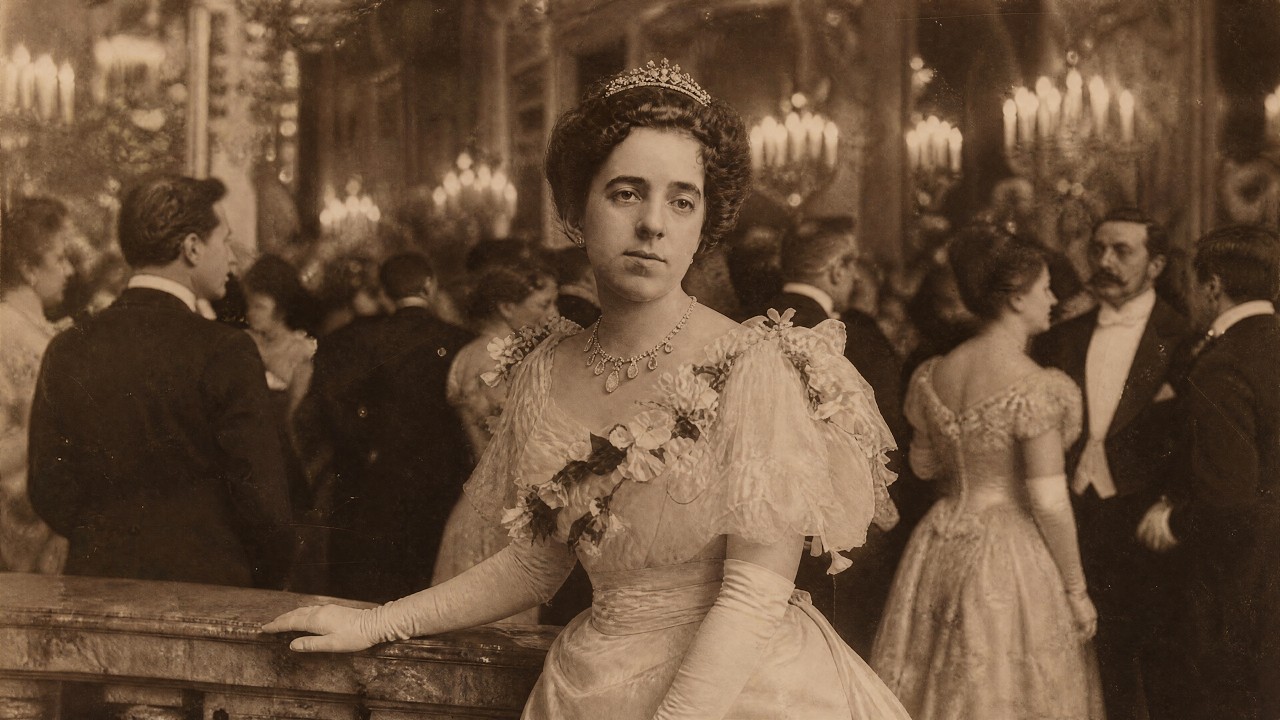
By 1915, 454 of those daughters had been matched to a European coronet. This is the story of five of them—not the famous ones, but the ones whose bargains went strange and dark: a pink marble palace, a runaway violinist, a slap at the opera, a bankrupt duke, a wedding held hostage at the altar. The most successful marriage broker of the Gilded Age was not a person at all. It was a printed book, updated and reprinted like a stock listing.
Inside, on facing pages, it laid out the two halves of a trade. On one side, the noblemen of Europe who were looking for a wife, each entry noting his rank, his estate, and the money he was short. On the other side, the American heiresses who had already made the leap, listed as proof that the thing could be done. To understand why that book existed, you have to understand two collapses that happened at the same time, one in Europe and one in America.
They fit together like a lock and a key. The first collapse was European and made of grain. From the middle of the 1870s, cheap American wheat poured across the Atlantic on cheap steamships and flooded the markets of Britain. The price of grain fell, and with it fell the rents that the great landed families had lived on for centuries.
Agricultural rents in Britain dropped by roughly a quarter between the mid-1870s and the mid-1890s, and the capital value of farmland fell by around 30 percent. Then, in 1894, the government added a new tax on the value of estates at death. The old aristocracy still had the castles, the titles, and the ancient names. What it no longer had was cash.
The second collapse was American and made of snobbery. In New York, the richest families in the country were being turned away at the door. Society was ruled by Caroline Astor and her lieutenant Ward McAllister, who decided that fashionable New York contained only about 400 people worth knowing. The new fortunes—railroad money, oil money, steel money—were dismissed as vulgar.
A family could own a bank and still be shut out of the right ballroom. There was one thing all that American money could not buy at home at any price: rank. McAllister told a newspaper in 1888 that beyond those 400 people, “You struck people who were not at ease in a ballroom. ” When the excluded new-money families, the Vanderbilts and the Morgans among them, found the old opera house would not give them boxes, they built their own, the Metropolitan Opera, and opened it in 1883.
So the key turned in the lock. A cash-rich American family that could not buy status in New York could buy it in Europe, where a cash-poor noble family was desperate for exactly the thing the Americans had too much of. An heiress married a title. The title got her father’s money.
The father got a daughter who was now a countess, a princess, a duchess—someone no New York hostess could ever again refuse. Everybody, on paper, won. By the time Titled Americans printed its 1915 edition, 454 American women had married into the European aristocracy. Between 1870 and the First World War, more than 100 British aristocrats alone, including six dukes, took American brides.
Anna Gould inherited about $15 million and married a man who treated that fortune as the budget for a private Versailles. She was the youngest daughter of Jay Gould, the railroad speculator whose very name made respectable men flinch. When Jay Gould died in 1892, he left an estate appraised at somewhere around $72 million, split among his six children. Anna’s share came to roughly $15 million, held in trust—a small detail that would matter enormously.
She was not a conventional beauty by the standards of her set, and the newspapers were unkind about it. But she was one of the richest unmarried women in the world, and that made her the most watched heiress in America. Into her orbit came Boni de Castellane, called Boni, a young French count from one of the oldest noble families in France. His family had rank stretching back centuries.
What it did not have was money. Boni came to New York in 1894 with a clear, unsentimental purpose: he was hunting an heiress, and Anna Gould was the largest quarry in the field. They married on the 4th of March 1895 in New York, and then Boni took his American fortune home to Paris and began to spend it with an imagination that has rarely been matched. Boni de Castellane did not merely live well.
He turned spending into an art form, a performance, a philosophy. The centerpiece was the house. He commissioned a palace on the avenue that runs from the Arc de Triomphe, an avenue known today as the Avenue Foch. He had it built in pink marble, modeled on the Grand Trianon at Versailles, the little palace of the French kings, but raised to nearly double the height.
It was called the Palais Rose, the pink palace. The land alone cost $3. 5 million francs. The building itself came to around $3 million.
Inside went tapestries from the royal workshops and paintings by Rembrandt, Van Dyck, and Gainsborough. It was one of the most expensive private houses in Paris, and every stone of it was paid for with Gould railroad money. Then there were the parties. On the 2nd of July 1896, for Anna’s 21st birthday, Boni staged a fête on a lake in the Bois de Boulogne meant to recreate a day of festivities from the wedding of Louis XIV.
It became legend almost immediately, and the legend grew in the telling until it included thousands of guests and orchestras beyond counting. What is certain is that it was one of the most extravagant private entertainments of the age, that it cost a fortune, and that the fortune was hers. Consider the arithmetic of this marriage, because it is the engine of the whole story. Anna Gould came to Boni with an inheritance of about $15 million, throwing off an income estimated near $500,000 a year.
Over roughly eleven years, Boni de Castellane spent something close to $10 million of it. Around $7. 5 million went in the first five years alone. He bought a steam yacht for about $200,000.
He bought a château in the French countryside. He ran, at Anna’s expense, for a seat in the French Chamber of Deputies. Two royal tapestries were bought for a quarter of a million francs in cash, and roughly $300,000 was poured into a single failed campaign. Because Boni had decided that a man of his magnificence belonged in politics too.
For a while, Anna went along with it. She had married into a world she had been raised to want, and Boni was charming, and the life was dazzling. But a woman whose money is being burned in front of her tends in the end to notice the smell of smoke. And Anna Gould was a Gould.
She had watched her father build and defend a fortune against every kind of predator. The turning point was structural, and it came from the way the money had been arranged. Anna’s inheritance sat in trust. Boni could spend the income lavishly, but he could not touch the principal, and he could not force her to hand it over.
As the spending spiraled, her family moved. Her brother George was brought in to guard the accounts. Boni, who had been living as though the well was bottomless, found himself watched, questioned, and eventually reined in, reduced to an allowance he considered an insult: $300,000 a year. To a man who had spent millions on a whim, it felt like poverty.
To Anna, it was the first tug on a leash she had decided to hold. In 1906, she divorced him and kept everything that mattered. Divorce in the Catholic aristocracy of France at the turn of the century was not a private sorrow; it was a public scandal. For an American heiress to divorce a French count, dragging his infidelities and his extravagance into open court, was to invite the contempt of the entire society she had married into.
Anna Gould did it anyway. The grounds were not hard to establish. Boni had been unfaithful, spectacularly, and with partners of both sexes, and he had spent her fortune into the ground. The court granted the divorce and gave Anna custody of their children.
She had three sons who survived infancy, and she kept them. Then Boni made a mistake that reveals everything about the man. He wanted to remarry within the Catholic Church, and for that a civil divorce was not enough. He needed the church to declare that his marriage to Anna had never truly existed.
So he petitioned Rome for an annulment. The annulment was refused. Boni fought for it through roughly six trials and appeals over more than a decade. In the end, the highest tribunal of the Vatican, a commission of nine cardinals, ruled against him and upheld the marriage as valid.
Anna had beaten him in the civil court and then beaten him again in Rome. Two years after the divorce, in 1908, Anna Gould married again. Her second husband was Hélie de Talleyrand-Périgord, Boni’s own first cousin. The woman the Castellane family had used as a source of cash married back into that same family on her own terms, to a better man with a better future.
In 1910, Hélie succeeded his father and became the fifth Duke of Talleyrand. Anna, the railroad speculator’s daughter, was now a duchess in her own right, and this time the title came without the fortune hunter attached. The second marriage was by every account genuinely happy. There was no affair, no burned fortune, no public war.
It lasted 29 years, until Hélie died in 1937. Later, Anna was made a chevalier of the Legion of Honor for funding a hospital for wounded soldiers of the First World War. After Hélie died and after her sister followed, Anna returned to America, dividing her time between a suite at the Plaza Hotel and Lyndhurst, the great Gothic mansion above the Hudson River. During the Second World War, she auctioned her enormous collection of orchids, some 5,000 plants grown in a greenhouse two blocks long, and gave the proceeds to the American Red Cross.
She was the last private owner of Lyndhurst, and she willed it to the nation as a museum. Her life was not without private grief. Her son Howard, aged 19, shot himself in 1929 after his parents refused to let him marry before he came of age. But in the specific game these five women were forced to play, Anna Gould is the one who won.
She died in Paris in 1961 at 86, a duchess twice over, her money largely intact, her name attached to a museum rather than a scandal. She did it with a trust, an instrument built by lawyers to keep a fortune out of her husband’s hands, and with the nerve to use it. Clara Page Ward was 16 when she became a Belgian princess and 23 when she threw the whole title into the fire. She was born in Detroit in 1873, the daughter of Eber Brock Ward, a man they called Michigan’s first millionaire.
He had started as a cabin boy on the Great Lakes and built an empire of ships, lumber, and steel. His Wyandotte plant produced the first Bessemer steel ever made in the United States. When he died of a stroke in 1875, he was the richest man in the state. Clara was not yet two years old and never knew him.
What he left her was money held in trust, and what her mother and the age intended to do with that money was to buy her a title. The figure most often attached to her inheritance is a trust of about $3 million, which she came into when she married. In the spring of 1890, at 16 years old, Clara Page Ward became the wife of Prince Joseph de Caraman-Chimay, a Belgian aristocrat 31 years old, a man who would soon sit in the Belgian Chamber of Representatives and become the reigning prince of his line. On marrying, she cleared her new husband’s debts, about $100,000 of them, and spent perhaps $300,000 more restoring the family seat, the Château de Chimay.
For a few years, Clara played her part. She was a celebrated beauty, so widely photographed that she became a fixture on the postcards sold across Europe. She was a princess, mistress of a castle, mother of two children. By the measure of the catalog, she was a triumph.
And she was, it turned out, utterly unwilling to live inside the triumph. The break came in the autumn of 1896. The prince and princess were dining at a restaurant in Paris where a Hungarian orchestra played, and the lead violinist was a Roma musician named Rigo Jancsi. Rigo was the surname, Jancsi the given name, meaning roughly “Blackbird Johnny.
” He was dark, magnetic, and entirely beneath Clara’s station, which may have been the point. There were secret meetings. Then, in December of 1896, Clara Page Ward did the thing that made her name a scandal on two continents. She ran.
She abandoned her husband, her two young children, and her title, and fled across Europe with the gypsy violinist. An American paper ran the story under the headline “Gone with a Gypsy,” and then chased the couple from sighting to sighting across the continent. The prince obtained a divorce in January of 1897, kept custody of the children, and fought a sword duel that spring with the future French premier Georges Clemenceau over a newspaper article about the affair. Both men were wounded.
Clara, meanwhile, married her violinist once his own divorce came through. The children she left behind were a daughter and a son, and she would not raise them. Custody went to the prince, as it almost always did in that age, and Clara sailed out of their lives along with her title. Cut loose from her husband’s fortune and with her own inheritance restricted, the former princess needed an income.
She found one in the most scandalous place imaginable. She went on the stage—not as an actress with lines to speak, but as a living picture. She performed what were called poses plastiques, tableaux in which she stood in flesh-colored body stockings arranged like a classical statue, at the Folies-Bergère in Paris and halls like it. The shock was not really the near nudity; Paris had seen that before.
The shock was who was doing it. A woman who had been Her Serene Highness, who had dined with the Belgian court, was now standing on a music-hall stage, selling the sight of her own body to anyone with the price of a ticket. She licensed her image onto postcards that sold across Europe. Her gypsy husband sometimes accompanied her on the violin.
The great artist Toulouse-Lautrec made a lithograph of the two of them together in 1897 and called it, with a razor edge of irony, “A Princely Idol. ”
Over the following years, Clara Page Ward married four times in all: the Belgian prince; the violinist Rigo Jancsi, whom she divorced after several years, reportedly over his own infidelity; then an Italian; then another, men described variously as railway men and station officials, so far beneath her that her own family reportedly learned of the last marriage only when the man wrote to inform them of her death. The popular version of Clara’s ending is a lie repeated for a century. The story goes that she died penniless, a cautionary tale, the dollar princess who threw it all away and ended in the gutter.
It is not true. Clara Page Ward died of pneumonia in Padua, Italy, in December of 1916, at the age of 43, and she left an estate of more than $1 million, along with real estate on top of that. The American consul at Venice actively went out of his way to knock down the poverty rumor, noting that she had died in the best suite of a good hotel, attended by expert doctors, and buried with an elaborate and costly funeral. Because she never updated a will she had written years earlier, her last husband was cut out of the money entirely, and the estate passed instead to an earlier husband and to her two children from the Chimay marriage.
Clara did not lose her fortune. What she lost was her world. A Detroit obituary would later call her an outcast, an old woman at 43. The contempt in that line is the whole point.
She had refused to be ashamed, and a society that ran on the shame of women could not forgive her for it. Her strangest legacy is the sweetest. Somewhere in the years around the great scandal, a Hungarian confectioner created a small cube of chocolate sponge and rich chocolate cream and named it after the violinist she ran away with. It is called the Rigo Jancsi, and it is still eaten today in Budapest, Vienna, and the towns of the old empire.
Whether Rigo himself had anything to do with inventing it, or whether a clever pastry cook simply borrowed the most scandalous name of the decade to sell cakes, no one can say for certain. But it survives. A dessert named for a love affair that cost a woman a throne. Alice Heine was born over a bank in New Orleans and died having ruled for a while the most glamorous rock in Europe.
Her family was Jewish, and their money was banking money. Her father Michel and his brother ran a house that grew from a New Orleans counting room into one of the most important banking concerns in France, a firm that lent money to the Emperor Napoleon III himself. The Heines were cousins of the great German poet Heinrich Heine, and they moved between New Orleans and Paris as the fortune grew. Alice, born in 1857, was raised in wealth and culture, fluent in the salons of the Second Empire, an American by birth who was European in every other way.
She married young and married up. Her first husband was the seventh Duke of Richelieu, heir to a name that carried the memory of the great cardinal who had ruled France under Louis XIII. She converted to Catholicism, became a duchess, and bore two children. And then, before she was even 25, the Duke died, and Alice found herself something rare and powerful in that age: a young, beautiful widow with an enormous fortune entirely her own.
The Richelieu marriage had left her about 17 million francs. She took that money and that freedom to Paris and built one of the most brilliant salons in the city. The Emperor Napoleon III and his empress are said to have stood as godparents at her christening. Then she aimed higher than a duke.
She set her sights on a throne. She had met Albert, the heir to the principality of Monaco, years earlier. Albert was an unusual prince, a serious man, a genuine scientist who would become a pioneer of oceanography and spend long stretches of his life at sea. His first marriage had collapsed and been annulled.
He and Alice grew close. There was at first a real obstacle. Albert’s father, the reigning Prince Charles III, objected to Alice because she had been born Jewish, and he did not want a woman of Jewish birth to be the mother of Monaco’s future line. So they waited.
When the old prince died and Albert came to the throne, the way was clear. On the 30th of October 1889, Alice Heine of New Orleans married the reigning prince of Monaco and became its princess. She was the first American-born woman to become Princess of Monaco, a full 60 years before Grace Kelly walked into the same palace. Prince Albert was away at sea for long stretches, chasing his oceanography, and in his absence Alice took hold of the cultural life of Monaco and reshaped it.
She understood something her husband did not much care about: that Monaco was known to the world chiefly as a casino, a place where men went to gamble. So she set out to build something grander on top of it. She poured her energy and her taste into the opera and the theater at Monte Carlo. She founded an annual art exhibition.
She turned the little gambling rock into a genuine center of the arts at the height of the Belle Époque. Here we should clear away a myth repeated even in serious places. It is often said that she brought the famous Ballets Russes to Monte Carlo, that she was the patron who installed the great Russian ballet on the rock. She was not.
The Ballets Russes arrived at Monte Carlo around 1911, roughly a decade after Alice had already left the principality. The archivists of Monaco itself have called that story a golden legend. What Alice genuinely did was earlier and quieter and real: the opera, the theater, the exhibition, the deliberate lifting of Monaco from casino to cultural capital. The marriage that had begun as one of the genuine love matches of the principality had curdled by the turn of the century into something cold.
Albert was often absent, lost in his oceanography. Alice was left to preside over a court and a culture that were hers in everything but name. Into that gap came another man. His name was Isidore de Lara, a composer, a man of the theater, exactly the kind of artist Alice had spent a decade drawing to Monaco.
He was not handsome in any conventional way, but he was talented, and he was present. Alice fell into an affair with him. The break, when it came, was as public as a break could be. The account that has come down to us places it at the opera house in Monte Carlo, the very temple of the arts that Alice had done so much to build.
There, in front of an audience, Prince Albert struck his wife across the face. Whatever precisely was said, whatever exactly passed between them, the image is unmistakable, and it was witnessed. By the next morning, Alice Heine had left Monaco. She would effectively never return as its princess.
The couple separated formally in 1902. They separated, but they did not divorce. There was no annulment. Under the law and the church, Alice Heine remained the wife of the prince of Monaco for the rest of his life—a princess in title, exiled in fact.
Albert is said to have banned her from returning, and the principality set about quietly minimizing her in its official memory. Alice lived on for more than 20 years after the separation, moving between Paris and the society of London, where she counted a queen among her friends and remained to the end a woman of culture and consequence. When Albert died in 1922, she became the Dowager Princess of Monaco, and she never remarried. She died in Paris in December of 1925.
There is a street named for her in Monte Carlo, and Monaco put her face on a postage stamp. And yet the archivists describe her legacy as ambivalent, admired as the cultured princess who brought the arts to the rock, and resented by some as the woman who betrayed and left the beloved Albert. Helena Zimmerman married a duke who had already been declared bankrupt, and neither the bride’s father nor the groom’s mother was there to see it. She was born in Cincinnati in 1878, the only child of Eugene Zimmerman, a man who had built one of the great American fortunes of the age out of oil, railroads, and coal.
He had sold his oil holdings to John D. Rockefeller in exchange for Standard Oil stock and a seat on the board. When his daughter married, he was worth an estimated $10 million, and Helena was his sole heir. Her mother died when she was four, and Eugene sent his daughter to be educated in France, where she grew into an accomplished young woman, a fine horsewoman, a fencer, a belle who by 1900 was summering among the American elite.
Across the Atlantic, there was a title in desperate need of a fortune. His name was William Montagu, the 9th Duke of Manchester. The dukedom was ancient and grand, seated at Kimbolton Castle, a house that had stood since the 1600s and in which Catherine of Aragon, the first wife of Henry VIII, had died in 1536. There was only one problem.
Three generations of Manchesters had run it into the ground, and the ninth Duke, William, was the worst of them. In August of 1900, months before he married Helena Zimmerman, the Duke of Manchester was declared bankrupt. Over the course of his life, 66 separate bankruptcy petitions would be filed against him. Years later, he would be sent to prison for nine months for illegally pawning family jewels that were held in trust and lying about it to the pawnbroker.
This was the man Helena Zimmerman married on the 14th of November 1900 at a church in London. A Cincinnati cartoon printed that summer showed Cupid beside a moneybag, the American fortune and the English coronet aimed at each other, and no one pretended it was anything else. The wedding was done quietly. The bride’s father, Eugene Zimmerman, was not there.
The groom’s mother, the Dowager Duchess, was not there. She did not even believe the marriage had happened until she examined the church register with her own eyes. Eugene Zimmerman had not built a $10 million fortune by being a fool. He was not about to hand a sinking spendthrift a river of cash.
In 1908, he cleared the Manchester debts by structuring the payments as purchases. He bought the family estates—Kimbolton, Kylemore, and Tandragee—and arranged for them to be held not for the Duke, but for his own grandson, the little boy who would one day be the 10th Duke of Manchester. The debts got paid. The creditors went away.
The great houses were saved from seizure. But the Duke ended up owning almost nothing outright. When Eugene died in 1914, leaving an estate of about $10 million, he arranged it so that Helena received only the income from the fortune, never the principal, and the Duke of Manchester received nothing at all. A trustee stated the position bluntly and publicly: not a single cent of the Duchess’s Cincinnati money would go to help the Duke out of his debts.
The wall was total. The Duke had married $10 million and could not spend ten cents of it. The arrangement stretched across some 17 years before it was finally ended in court. In 1931, the divorce came through, and in a final flourish of the man’s character, the Duke fled to Cuba to try to secure his own divorce first before Helena’s English decree could become final.
For the better part of two decades, she lived inside that siege, raising four children on the income her father had fenced off, while the man whose name she carried lurched from creditor to creditor and scandal to scandal. Then Helena Zimmerman rebuilt. In 1937, she married again, this time to a Scottish earl, Arthur Keith-Falconer, the 10th Earl of Kintore. She became the Countess of Kintore.
She lived to the age of 93, dying at Keith Hall in Scotland in 1971, decades after the bankrupt Duke had passed from the scene. But the Zimmerman story has a bitter twist that the Gould story does not. The trust saved the woman. It did not save the title.
Helena’s own son, the 10th Duke, the very grandson the estates had been so carefully preserved for, sold the contents of Kimbolton Castle in 1949 and sold the castle itself to a school by the early 1950s. Kimbolton, where a queen of England had died, became a school. Five thousand people crowded the Pittsburgh street outside the church. Inside, the bride was kept waiting while the groom renegotiated his price.
Her name was Alice Thaw, and she came from Pittsburgh coke and railroad money. Her father, William Thaw, had built a fortune in coal, coke, canals, and railroads. When he died in 1889, nine-year-old Alice inherited coal lands held in trust expected to be worth around $13 million, along with a share of the rest of the estate. By the time she reached marrying age, she was valued at about a million dollars in hand, drawing an income near $100,000 a year.
Her family was already famous and about to become infamous. Alice’s brother was Harry Kendall Thaw, an unstable young millionaire who three years after Alice’s wedding would walk up to the celebrated architect Stanford White at Madison Square Garden and shoot him dead in front of a crowd, in what the papers called the crime of the century. But in 1903, the scandal that gripped the Thaws was Alice’s own. His name was George Seymour, and he carried the courtesy title Earl of Yarmouth, heir to an old English marquisate.
He would one day become the seventh Marquis of Hertford. But at the time he met Alice, he was a failed stage actor who had performed under a false name and in Australia had once danced in a cross-dressing act in a costume of sequins and butterfly wings. He was chronically, hopelessly broke. His own father had cut his allowance to a fraction of what he spent.
He had already hunted other American heiresses before he found Alice Thaw, including one of her own cousins. They were introduced in early 1903. The engagement was announced in February, and the wedding was set for the 27th of April in Pittsburgh. The church was packed.
An estimated 5,000 people crowded the streets outside. The bride was ready, and the groom would not go through with it. The Earl of Yarmouth had decided at the last possible moment that the dowry was not big enough. As the guests waited and the crowd pressed against the doors, the groom, the bride’s family, and their lawyers were locked in a frantic renegotiation of the marriage settlement.
The Earl threatened to call the whole thing off, to leave Alice Thaw standing at the altar in front of 5,000 people, unless the money was increased. Alice’s mother, faced with public catastrophe, gave in. By the best sourced account, the Earl extracted roughly $1 million in that final shakedown before he would consent to walk down the aisle. Alice’s brother Harry, who would soon prove he was capable of murder, refused to give her away, reportedly because he did not want the Earl to gain any control over Alice’s fortune, and another brother had to step in.
The settlement Alice’s mother agreed to was built to protect Alice, structured so that the fortune stayed in trust out of the Earl’s direct control. During the marriage, Alice kept hold of her money and doled out only an allowance to her titled husband. The Earl had extorted his price at the church door. What he had not managed to do was get his hands on the principal.
From almost the first day, the union was troubled. Reports of the Earl’s ill treatment of his American wife surfaced within months, and beneath the surface lay the fact that would eventually undo the whole arrangement in an English court. The marriage had never been consummated. By late 1907 and into 1908, Alice had had enough, and she filed suit to have the marriage declared null.
The court appointed doctors to physically examine both parties. Alice Thaw, an heiress worth millions, had to submit to a medical examination of her own body to secure a legal finding that her husband had never been her husband. The decree came in August of 1908. The marriage was declared null, and the ground recorded in the court file was the husband’s incapacity to consummate it.
The Earl of Yarmouth has often been read by later historians as a closeted gay man. The circumstantial evidence is real: his cross-dressing stage career, his all-male house parties, the unconsummated marriage, his lifelong childlessness. But that reading is an inference drawn afterward, not a fact established at the time. What the court actually found in plain legal language was that the husband was incapable of consummating the marriage.
What the annulment did in cold financial terms was set Alice Thaw free and whole. Every financial interest the Earl had clawed out of that wedding-day extortion was extinguished and returned to her. His later attempt to claim an income of £5,000 a year from her estate failed. He never remarried.
He died childless in 1940, and his title passed to a nephew. In 1913, Alice married again, this time an American, a Boston stockbroker named Geoffrey Whitney. With him she found the ordinary happiness the Earl had never offered. She had two sons.
She settled in Massachusetts. She lived quietly out of the newspapers until her death in 1955. Three years after Alice’s hostage wedding, in 1906, her brother Harry Thaw shot Stanford White dead, and the Thaw name became a byword for the murderous excess of the very rich. Running underneath all five stories was the same quiet instrument, dull as a mortgage: the marriage settlement, and inside it, the trust.
To understand why it mattered so much, you have to understand the law these women were born under. For most of the 19th century, the rule that governed a married woman’s property was called coverture, and it was as brutal as it was simple. When a woman married, her legal identity was folded into her husband’s. In the old phrasing, the two became one, and the one was the man.
Her money became his money. Her property became his property. A wife under coverture could not own, could not sign, could not hold. The American fathers and their lawyers could not change the law of coverture, but they could work around it with the marriage settlement and the trust.
Instead of letting the fortune pass to the husband, they placed it in trust, controlled by trustees, with the income paid out but the principal locked away. The husband got an allowance. He did not get the vault. Britain passed its Married Women’s Property Act in 1882, giving married women for the first time the right to own and control property in their own name, but in any single marriage across the ocean, it was not the statute that did the protecting.
It was the settlement. Trace the thread back through all five stories, and you see the same wall in everyone. Anna Gould’s $15 million sat in trust, which is exactly why her family could cut Boni down to an allowance and why she walked away from the divorce with her fortune intact. Helena Zimmerman’s father built the most elaborate wall of all.
Alice Thaw’s settlement kept her money in trust even after the Earl extorted his price at the altar, so that when the marriage was annulled, every dollar came back to her. Here is the irony that runs to the bottom of the whole story. The trust was not built to free women. It was built by fathers to protect family money, dynastic money, the fortune as a bloodline asset.
The daughters were in a sense just the vessel that money traveled in. And yet again and again, the wall built around the fortune became the wall that protected the woman. A tool of control became by accident a tool of freedom. These women were sold for a title, and they were saved by a trust.
They left behind a demolished palace, a chocolate cake, a street sign in Monte Carlo, a castle turned into a school, and a novel that became a television empire. The Palais Rose, Boni de Castellane’s pink marble monument to spending her money, was pulled down in 1969. But in 2017, the surviving contents of that vanished palace sold at auction for more than $14 million. Anna left Lyndhurst to the nation as a museum.
Clara Page Ward left the Rigo Jancsi cake, still made and eaten across the lands of the old Austro-Hungarian Empire. Alice Heine left her name on a street in Monte Carlo, her face on a Monaco postage stamp, and the real cultural work she did. Her old family home on Royal Street in New Orleans still stands. Kimbolton passed out of the family within a generation and became Kimbolton School, which it remains.
Alice Thaw left no palace and no lasting scandal, only a quiet grave in Massachusetts and two sons who carried an ordinary name. These five women were the last generation of American women to be traded like this, and without meaning to be, the first to be protected from the trade. Every woman today who holds a fortune in her own name, who signs a lease or a loan without a man’s signature beneath hers, who can walk out of a marriage and keep what is hers, is standing on a floor that women like these five were the first to feel beneath them. A floor their fathers built to guard the money, and that their daughters would one day inherit as freedom.
The catalog is closed now. The palaces are rubble or museums. The castles are schools. The coronets are in glass cases.
But the floor those women first stood on is still holding up the women who came after. The floor is what survived.
