The winter of 1889 was strangling the SL Allen and Company factory in Cinnaminson, New Jersey. The facility near the icy Delaware River, usually loud with sparks and clanging iron, had fallen into a heavy silence. Hundreds of men had spent the summer forging the Planet Junior line of farm equipment, producing seed drills, potato diggers, and cultivators, heavy tools made to tear open the earth. But when the ground froze solid, orders stopped.
The ledger books that had run with black ink all summer began to bleed red. Samuel Leeds Allen owned the company. He was a devout Quaker, a man of principle who believed in the dignity of labor, and he stood on his idle factory floor looking at cold furnaces and, most painfully, at his men. He knew that within weeks he would have to do the thing he hated most.
He would have to lay off his workforce and send fathers home in the dead of winter with no pay and no promise of return until the spring thaw. He needed something his skilled machinists and carpenters could build when the ground was hard as iron. He needed a product that defied the seasons. Allen was not a toy maker.
He was an inventor with nearly three hundred patents, all for practical, utilitarian devices. But he carried a secret obsession. Since boyhood, he had loved coasting, sliding down icy hills on wooden planks. In the late nineteenth century, the vehicles for this pastime were crude.
There was the toboggan, fast but utterly uncontrollable. Once launched, you were a passenger, going wherever gravity and the ruts took you, crashing if a tree appeared. There were also the homemade contraptions, little more than crates nailed to runners, slow and clumsily dangerous. Looking at the snow piling up outside his windows, Allen saw a physics problem.
The existing sleds were flawed because they lacked agency. They had no steering. He approached this as an engineer, not a designer of amusements, studying the way his cultivators steered through corn rows and considering the flexibility of the steel he used for seed drills. He ignored skeptical foremen and retreated to his workshop.
He took two runners of high-carbon steel, the same steel used to slice through soil, and riveted them to a slatted wooden deck. The innovation was the front assembly. He created a jointed front section controlled by a wooden crossbar. Pulling the right side of the bar forced the runners to flex into a curve, carving a turn into the ice like a skate.
It was a radical departure from the rigid sleds of the past. He called his prototype the Fairy Coaster, a terrible name for precision engineering, and tested it himself on the steep hills of his farm, crashing into fences, refining the pivot points, and adjusting the temper of the steel until the steering was almost telepathic. He renamed it the Flexible Flyer. The first batch was produced not to make a fortune, but as a payroll solution.
The men who assembled the sleds were the same men who made potato diggers, applying the same torque to the rivets and the same heavy varnish to the ashwood. When Allen took the invention to department stores in Philadelphia and New York, buyers laughed. They said it was too weird, too expensive, and that sleds were supposed to be simple planks. In a campaign of guerrilla marketing before the term existed, Allen went to the parks where children were riding clumsy toboggans.
He handed a Flexible Flyer to a boy and told him to try it. The boy didn’t just slide; he drove. He swerved around other sleds, banked into corners, and reached the bottom while the other children were still tumbling off their unguided missiles. By 1915, the company was selling thousands of units a day.
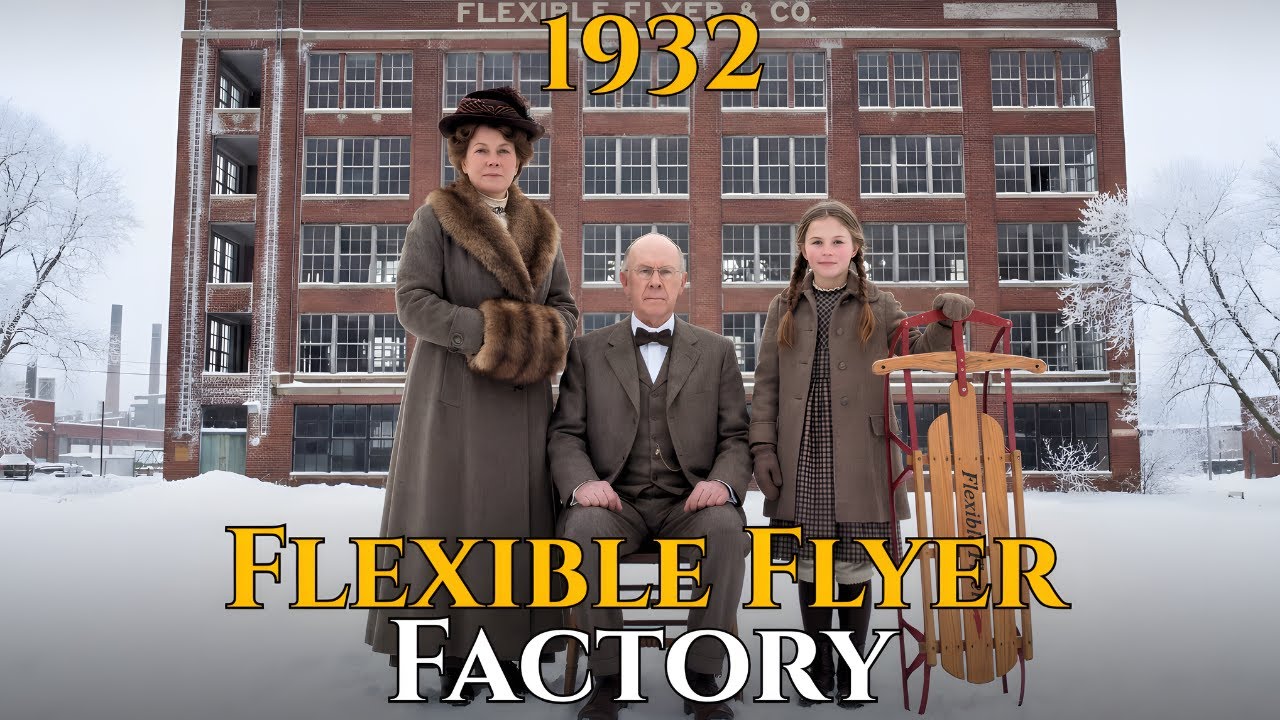
The Flexible Flyer, a seasonal stopgap, had swallowed the farm equipment business. The company eventually migrated across the river to Philadelphia, establishing a factory at Fifth Street and Glenwood Avenue. It was a cathedral of heavy industry that smelled of seasoned white ashwood, sawdust, hot varnish, and tempered steel. Allen, now older with a white Quaker beard, remained a tactile perfectionist, testing prototypes himself on a hill near the factory.
The definitive product was the Model F, a masterpiece of material science. Allen insisted on select white ash, the same wood used for baseball bats, chosen because it could bend without breaking. The runners were high-carbon steel blades, grooved down the center to bite into ice and prevent side slip. The defining feature was the patented steering.
A wooden crossbar floated above the front assembly. Lying prone, gripping the bar, a rider could shift the sled’s geometry, flexing the runners into an arc to carve through turns. The sled was stamped with a red eagle clutching a shield, a mark that looked like a military crest. It told the child this was American hardware, not a plaything.
By the 1940s and 1950s, the Flexible Flyer had entered its golden age. It was the supreme status symbol of the winter hill. There was a strict hierarchy. At the bottom were the children with cardboard boxes, spinning helplessly.
Above them were those with cheap tin saucers that rattled and dented. At the summit were the pilots, the boys and girls with Flexible Flyers, who checked their runners for rust and sometimes applied candle wax to reduce friction. They didn’t sit; they ran, slammed the sled down, and dove onto it belly-first. The sound of a Flexible Flyer at speed was distinct, a low rumble of wood overlaid with the sharp hiss of steel cutting the line.
They could thread the needle between oak trees, and they owned the hill. The company treated the child as a small adult capable of handling risk. Advertising copy did not talk about fun or safety. It used words like speed, control, and victory.
The sled was heavy and dangerous. It bruised shins and cut fingers. This physicality was the point. It taught a generation the laws of physics in the most visceral way, that mass times acceleration equals force, and that if you didn’t plan your turn, you would crash.
The decline did not arrive with a dramatic failure. It arrived in 1968, carried in the briefcases of men who did not live in the snow belt. The SL Allen Company, a family-owned fortress for nearly eighty years, was sold to the Leisure Group, a corporate conglomerate based in Los Angeles. The name was a warning.
Allen had been interested in sport and active engagement, not leisure. The new owners saw only overhead in the aging brick factory and its skilled workforce. They closed the Philadelphia factory, fired the men who knew how to read the grain of wood, and moved production first to Medina, Ohio, then elsewhere, seeking cheaper labor. The deeper betrayal was the shift in materials.
They looked at the rising price of wood and steel and looked at polyethylene. Plastic was cheap, and you could churn out thousands of sleds in the time it took to varnish a hundred wooden ones. The plastic saucer marked the death of the pilot and the birth of the passenger. It was a perfect circle with no front, no back, and no steering.
A child sat in the middle and pushed off, becoming cargo subject to chance, spinning, drifting, and going backwards. The corporate owners then debased the brand itself. The Flexible Flyer name was slapped onto plastic toboggans and foam sliders until it meant nothing more than something you sit on in the snow. Even the remaining wooden sleds suffered.
Cheaper hardwoods replaced the white ash, runners became thinner, rivets were replaced with cheaper fasteners, and the deep varnish was replaced with thin spray-on lacquers that chipped after one season. The safety culture of the 1970s and 1980s accelerated the decline. The original sled was dangerous, and that danger was the teacher. The plastic sled was safe because it was light and soft-edged, but because it was safe, it was disposable.
A plastic sled cracked and was thrown in a landfill. The relationship between child and object was severed. A wooden sled recorded the history of every winter it survived, gaining character with every scratch. The plastic sled recorded nothing but its own cheapness.
The market was flooded with cheap sleds, and big-box store chains wanted stacks of nesting plastic discs, not expensive heavy wooden sleds. The art of the turn was lost, and the hill became a place of random spinning chaos. The demolition of the Philadelphia factory was not a televised event. The wrecking ball swung with the quiet efficiency of urban renewal, and the knowledge inside those walls, the specific temperature to bend an ash runner without snapping it, the exact torque for the steering rivet, evaporated because it lived in the hands of men who were sent home.
The liability culture of the 1980s and 1990s then strangled the sledding hill itself. Municipalities began to see the hills not as recreational assets but as lawsuits waiting to happen. Signs appeared. No sledding.
Use at own risk. Fences went up, and in some towns, trees and hay bales were planted specifically to block the runs. The hill, once a theater of courage, became a prohibited zone. Simultaneously, the rise of home video game consoles offered a devastating alternative to the cold.
A snow day, once a day of frantic mobilization, became a day of stasis, with children inside racing virtual cars where a crash meant nothing more than pressing reset. The Flexible Flyer brand still exists. Reproduction classics made of wood and steel can be found online, but they are nostalgia items for adults, priced at hundreds of dollars to hang on a wall. They are not sold to eight-year-olds.
The warning label on a modern plastic sled tells the story plainly: this product has no steering, do not use on ice, not a life-saving device. The object apologizes for its own existence. The tragic irony is that the safer sleds became, the more dangerous they became. A skilled rider on a wooden sled could steer around a toddler; the plastic saucer is a dumb projectile with no brakes and no rudder, teaching the child that they are helpless against the forces of nature.
Samuel Leeds Allen wanted to give the world a way to fly, to turn the freezing dead months into a playground of velocity. He succeeded for a century. But the quest for convenience and safety clipped the eagle’s wings. The pilots were traded for passengers, and the lesson of the hill was lost: that the world is hard, the ice is fast, and to make it to the bottom in one piece, you have to keep your eyes open and steer.
The factory is gone, the snow falls on empty hills, and the Flexible Flyer, which once carried children toward adulthood, is now just a memory of a machine that demanded skill and rewarded it with the feeling of flight.






