On February 25, 1994, at 2:10 in the afternoon, a 90-year-old man died quietly of natural causes in a room at Nesbitt Memorial Hospital in Kingston, Pennsylvania. There was no drama, no gunfire, no federal agents outside the door. His family kept the funeral arrangements secret. State and federal investigators who had been surveilling this man for forty years showed up at the cemetery anyway, cameras ready, trying to document who came to pay respects.
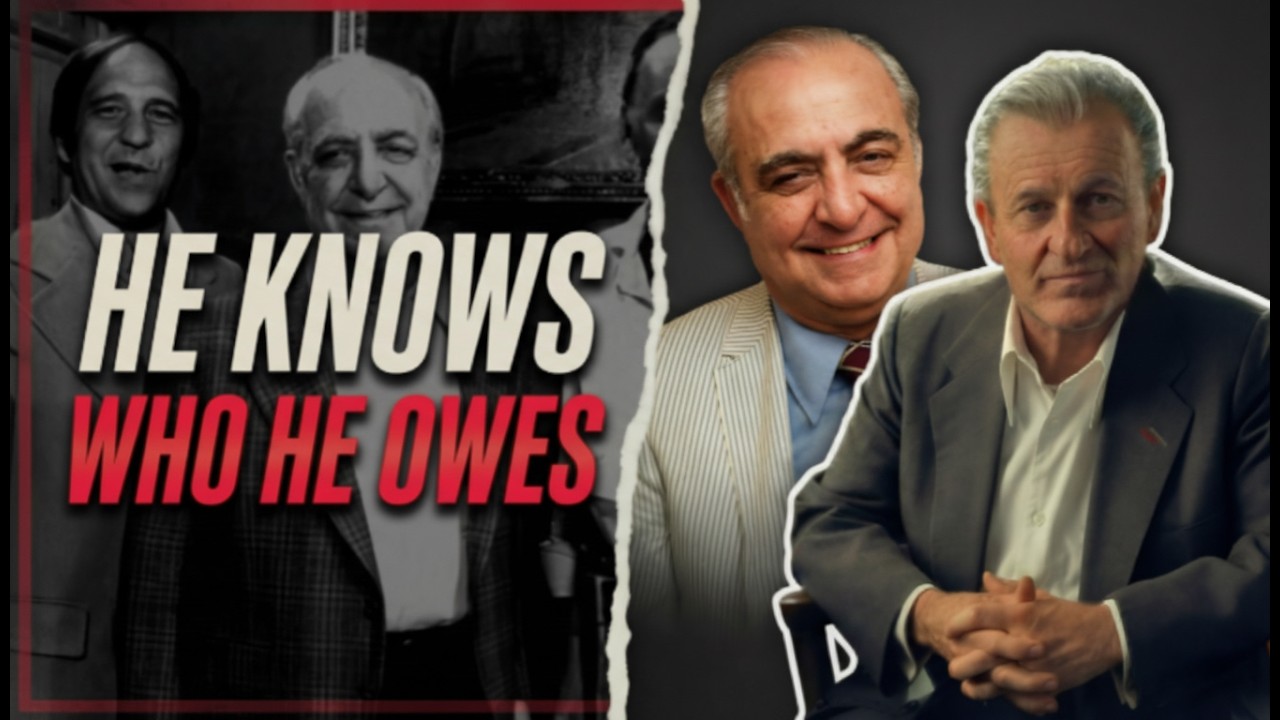
Even in death, he made them work for it. His name was Rosario Alfredo Bufalino. The world knew him as Russell. The FBI knew him as one of the most powerful organized crime figures in American history.
The men who worked for him called him the old man. The people who feared him, which was nearly everyone, called him the don of dons. Joe Pesci played him in The Irishman, a quiet, loyal, almost paternal figure whose central purpose in the story is connecting Frank Sheeran to Jimmy Hoffa. That version is incomplete.
The real Russell Bufalino was not supporting cast. He was the whole story. His power was not about a single hit or a single relationship. It was about thirty years of control so deep and so quiet that even the men who reported to him did not fully understand the architecture of what he had built.
He was born on October 29, 1903, in Montedoro, a hilltop town in the interior of Sicily with a population under two thousand. His father had already emigrated to Pittston, Pennsylvania, working the coal mines, arriving four months before Russell was born. His mother brought the children across the Atlantic through the port of New York in December of that same year. They stayed in Pennsylvania only a few months before Angelo Bufalino died in a mine accident.
The family returned to Sicily. This is where Bufalino’s story already diverges from most mob origin stories. He crossed the Atlantic not once but multiple times as a young child. The family went back to Pennsylvania in 1906.
His mother died in 1910, when he was seven. He went back to Sicily again, taken in by relatives. In 1914, at the age of ten, he returned to the United States for the final time, settling in Pittston before moving to Buffalo around age fourteen. Both parents dead before he was a teenager, raised partly by relatives in Sicily, partly by an older brother in Buffalo, he trusted nothing he could not personally control.
By the time he was a teenager in Buffalo, he was already in the criminal underworld. Buffalo was a Sicilian-American organized crime hub centered around Stefano Magaddino, one of the most powerful bosses in American mob history. Bufalino’s older brother had connections close to Magaddino’s underboss. Young Russell was in the room, watching, learning, building relationships that would serve him for the next seventy years.
His first significant criminal mentor was Joseph Barbara, a bootlegger operating out of Endicott, New York. In the early 1920s, they worked together running bootleg operations. Bufalino married Carolyn Sciandra on August 9, 1928. She came from a Sicilian mafia family.
The marriage tied him into one of the most important organized crime bloodlines in northeastern Pennsylvania. The couple never had children and stayed married until Russell’s death sixty-six years later. In 1940, Bufalino moved to Kingston, Pennsylvania. This was the move that turned him from a mid-level operator into an architect.
Kingston sits at the center of a triangle between Scranton, Wilkes-Barre, and Pittston, the coal and garment industry heartland of Pennsylvania. From this position, he could manage operations across all three cities simultaneously. Barbara named him underboss, and Bufalino immediately understood that the garment industry was the next frontier. He owned at least seven dress factories.
His most documented business was the Penn Drapery and Curtain Company at 161 South Main Street in Pittston, where he operated from an office that served simultaneously as his legitimate business address and his criminal headquarters. He helped place New York mobsters into non-union garment manufacturing operations in Pennsylvania. He controlled the trucking. He controlled the unions.
He controlled who could and could not operate a dress factory in his territory. The garment industry in the 1940s through the 1960s was one of the largest employers in America. The unions that represented those workers controlled one of the most significant pension funds and health benefit programs in the country. Whoever controlled the unions controlled the money.
Bufalino’s garment industry stranglehold gave him direct leverage over every manufacturer, every trucker, and every union official who operated within his reach. The Pennsylvania Crime Commission estimated that at the height of his power, the family’s operations generated revenue across garment manufacturing, coal industry, labor racketeering, illegal gambling, loan sharking, and pornography distribution across Pennsylvania, New Jersey, and New York simultaneously. The family had at most thirty to forty made members at its peak. The revenue it generated was wildly disproportionate to its size.
Bufalino built his empire specifically to be invisible, living in ledgers and union contracts and handshake arrangements between men who never met in public. On November 14, 1957, that invisibility ended briefly and catastrophically. Vito Genovese had spent years maneuvering to take over the most powerful crime family in America. He orchestrated the attempted assassination of Frank Costello.
He arranged the murder of Albert Anastasia in a barber shop at the Park Sheraton Hotel on October 25, 1957. With those obstacles removed, Genovese wanted a national meeting of mob bosses to formally legitimize his new position. He asked Stefano Magaddino of Buffalo to handle the arrangements. Magaddino assigned Northeastern Pennsylvania boss Joseph Barbara and his underboss Russell Bufalino to organize the meeting.
Bufalino handled the logistics, communicating with delegates from across the country, arranging the food, the hotel accommodations, the security. An estimated one hundred mob leaders from the United States, Italy, and Cuba were invited, including Carlo Gambino, Joseph Profaci, Joseph Bonanno, Santo Trafficante, and Carlos Marcello. They met at Barbara’s estate in Apalachin, a town 200 miles northwest of New York City. A state police sergeant named Edgar Croswell, who had been surveilling Joseph Barbara for years, happened to be at a motel in Vestal the night before when he overheard Barbara’s son booking six rooms for what was described as a beverage conference.
Croswell set up surveillance. He watched the cars arrive, expensive vehicles with out-of-state plates from every direction. On the afternoon of November 14th, troopers established a roadblock at the end of McFall Road. What followed was the single most embarrassing day in the history of American organized crime.
Bosses who commanded absolute fear in their cities ran through the woods in expensive suits trying to escape state troopers. John Montana, underboss of the Buffalo family, was found tangled in a barbed wire fence. Vito Genovese, the man who had engineered the gathering as his coronation, was stopped in a car being driven by Russell Bufalino himself. Bufalino told the troopers calmly that he had come to visit his sick friend Barbara.
More than sixty men were apprehended. Twenty were charged with conspiring to obstruct justice. All were convicted in January 1959. All the convictions were overturned on appeal in 1960.
But here is what Apalachin actually did. Before that day, FBI Director J. Edgar Hoover had publicly stated that there was no national organized crime syndicate. The Mafia, he said, did not exist as a national organization.
Thirteen days after Apalachin, Hoover launched the Top Hoodlum Program. The FBI had its list of names, its photographs, its relationships. And at the top of that list, more powerful in the Bureau’s estimation than his small family’s size would suggest, was Russell Bufalino. Apalachin did not weaken him.
It made him essential intelligence. Even with all of that intelligence, the FBI took another twenty-one years to put him in prison. Joseph Barbara died in June 1959. The Commission formally recognized Bufalino as the family boss.
He was fifty-five years old, had been in the criminal underworld for nearly forty years, and had spent every one of those years building connections rather than burning them. His cousin, William Bufalino, was the Teamsters long-time legal counsel, which meant Russell had a direct institutional connection to Jimmy Hoffa and the International Brotherhood of Teamsters pension fund. He sat at the center of a web whose threads ran in every direction. And he pulled none of them loudly.
In 1972, a story emerged that illustrated exactly how his power operated in practice. Singer Al Martino had been cast as Johnny Fontaine in The Godfather, then had the role stripped from him and given to Vic Damone. Martino was Bufalino’s godson. Bufalino did not make a threatening phone call.
He orchestrated the publication of news articles claiming that director Francis Ford Coppola was unaware that producer Albert Ruddy had given Martino the role. The resulting pressure was sufficient. The other actor dropped the role. Martino got it back.
Russell Bufalino solved a problem with newspaper coverage. Then came Frank Sheeran. A truck driver and World War II veteran, Sheeran met Bufalino in 1955 when Bufalino offered to help fix his truck. Bufalino brought him into the network.
Through his cousin William, Sheeran met Jimmy Hoffa. According to Sheeran’s own account, told to attorney and author Charles Brandt in the 2004 book I Heard You Paint Houses, that relationship ultimately led Sheeran to kill Hoffa on July 30, 1975 on Bufalino’s orders. The movie presents this as settled. It is not.
Harvard Law Professor Jack Goldsmith found little to substantiate Sheeran’s confession. Former FBI case agent Robert Garrity stated there was no real indication Sheeran was even present at the location. Author Dan Moldea characterized Sheeran’s story as a deathbed fabrication designed to leave money to his family through a book deal. Sheeran was nearly broke and dying when he gave those interviews.
What is documented and not disputed: Bufalino was deeply connected to the power struggle around Hoffa and the Teamsters pension fund. When Hoffa was pardoned by President Nixon in December 1971, he wanted to return to the Teamsters presidency. The mob had grown comfortable with Hoffa’s replacement, Frank Fitzsimmons, who was far more accommodating about pension fund loans. If Hoffa returned, those loans were at risk.
The FBI confirmed that Sheeran was associated with Bufalino and was known to be in Detroit around the time of Hoffa’s disappearance. A hair matching Hoffa’s DNA profile was found in the car Sheeran and Chuckie O’Brien used that day. None of this proves Sheeran pulled the trigger. All of it confirms that Bufalino was at the center of the decision that ended Hoffa’s life, whoever physically executed it.
The law eventually caught up with him, twice and slowly. In August 1978, at the age of seventy-four, Bufalino was convicted of extorting a mob associate named Jack Napoli, who had failed to pay a $25,000 debt to a jeweler and was in the witness protection program when he testified. Bufalino was sentenced to four years and served almost three. He was released in May 1981.
Within months, he was indicted again, this time for conspiring to have Napoli killed while still in federal custody. In November 1981, he was sentenced to ten years. He was held at the United States Penitentiary at Leavenworth, Kansas. He suffered a stroke in prison in 1987 and was transferred to a federal prison hospital in Springfield, Missouri.
He was paroled in 1989 at the age of eighty-five. He went home to Kingston, to the modest house at 304 Dorrance Street, where he and Carrie had lived for decades. The same house where, according to FBI surveillance logs, he had conducted criminal business for forty years while appearing to be a quiet, mild-mannered retired curtain manufacturer. He lived five more years.
When he died on February 25, 1994, the Wilkes-Barre Times Leader called him the last of Pennsylvania’s old-school mafiosi, the don of dons. His wife, Carrie, survived him by twelve years. His relatives gave no public announcement of the funeral. He is buried at Denison Cemetery in Swoyersville, Pennsylvania.
The Penn Drapery and Curtain Company is long gone. The FBI file on Russell Bufalino runs to over one thousand pages. His family name lives on in a crime family that the Pennsylvania Crime Commission concluded no longer functions independently, its remnants absorbed into the New York families that Bufalino himself helped build and sustain. What The Irishman genuinely gets right is the quietness.
Joe Pesci plays Bufalino as a man who never raises his voice, who makes his most dangerous requests sound like suggestions, who moves through the world with the absolute confidence of someone who has never needed to announce his authority. That is the historically accurate Russell Bufalino.
