They came for her before dawn in the spring of 1898, while she still lay asleep in her own bed. Armed men entered her rooms, took a forty-year-old woman who was neither sick nor confused, and carried her away to be locked inside an asylum for the insane. She was the daughter of the richest king in Europe. When word reached her father that his daughter had been dragged from her bed and committed, he did not send help.
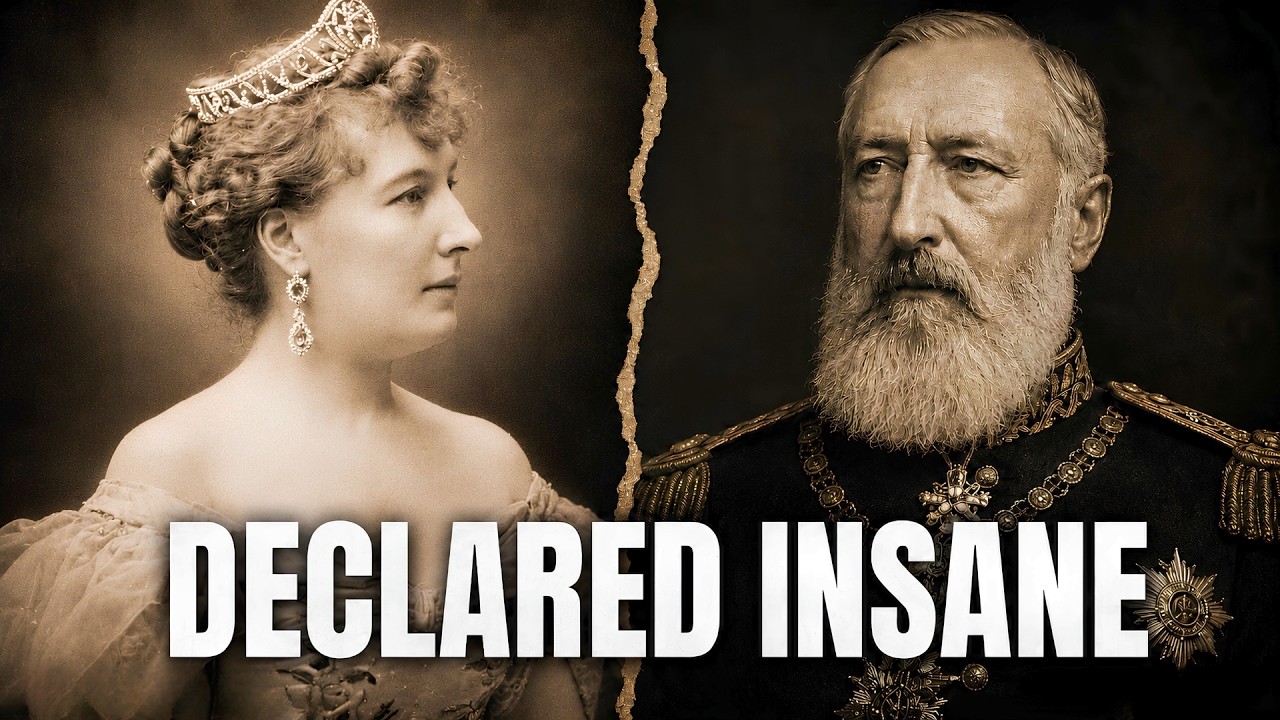
He sent an order: guard her more closely. Louise of Belgium had been born in 1858 into more wealth than almost any woman then alive. Her father, King Leopold II, commanded a private fortune so vast that governments struggled to trace it. His eldest daughter grew up in palaces surrounded by servants and jewels, yet her childhood was cold and correct.
Hard beds, cold morning baths, and rationed hours with her parents measured out like medicine. Leopold believed a royal childhood should be training, not comfort. From the first, there was a flaw in her arrival that no discipline could correct: she was a girl. Belgium followed an unbending rule of succession, and a woman could not inherit the throne.
What the young dynasty needed was a son. A year after Louise’s birth, that son arrived, and the palace exhaled. Louise grew up bright and impossible to satisfy with simple answers. She asked so many questions that the household nicknamed her Madame Pourquoi, Madame Why.
Her father treated her with distance, more as a sovereign to be observed than a parent to be approached. The warmth in her childhood came from her mother, Queen Marie Henriette, and from her little brother, Leopold, the heir, the answer. She adored him with the fierce, uncomplicated love of an older sister. In the winter of 1869, the boy fell into a pond at Laeken.
A chill settled into his chest and became pneumonia. He died on the 22nd of January 1869, at nine years old. Louise was ten. Decades later, she still wrote of it as an open wound, confessing that she had cursed God in her grief and that more than fifty years afterward she still wept for him.
The death broke the shape of the whole family. The king had lost his only son, and his relationship with his three daughters curdled into something colder and more calculating. If he could not have a son to inherit, his daughters became instruments of state, pieces to be married outward to secure alliances. Louise was not quite seventeen when her father found a use for her.
The candidate arrived through negotiation, not affection: Prince Philippe of Saxe-Coburg and Gotha, a wealthy second cousin from the Hungarian branch of the family, thirty-one years old and already twice refused. The king had his reasons. Philippe was rich, connected, and convenient. Nobody appears to have consulted Louise in any meaningful way.
They married on the 4th of February 1875, two weeks shy of her seventeenth birthday. She had been told nothing of what marriage meant. When Philippe left the bridal chamber in the early morning, Louise got up, put on a nightgown, a cloak, and slippers, and fled into the cold glass orangerie on the palace grounds, hiding among the camellia blossoms. A courtier found her among the flowers and brought her back.
Her father did not get out of bed. Her mother comforted her not with rescue but with a lecture, telling her through tears that next time she must be less uncooperative, that this was her duty. When Louise left Belgium for her new life, she was not permitted to bring a single one of her own maids. The marriage produced two children, a son named Léopold Clément in 1878 and a daughter, Dorothée, in 1881.
Philippe was not faithful and not interested in pretending otherwise. Louise endured the arrangement rather than lived it. In the dazzling court of Vienna, she met the Emperor Franz Joseph and formed a private judgment she would keep for decades: at his birth, she said, nature had deprived him of a heart. She did not yet know that this same emperor would one day sign the order that took her freedom.
In May 1895, walking in the Prater, the great park at the heart of Vienna, Louise’s life split cleanly into a before and an after. She was thirty-seven. The man she met was Count Géza Mattachich, a lieutenant in a Croatian regiment of the Austrian army, some nine years younger than she was. She was lost from the moment she saw him.
She made him manager of her horses and soon after of her finances. The affair did not stay quiet, and it did not fade. Word traveled. Her mother grew frantic.
Vienna’s newspapers reached for their most lurid comparisons. And the emperor summoned her to answer for herself. In January 1897, Louise made the choice that would define the rest of her life. She left her husband completely, took her teenage daughter with her, and set off across Europe with Géza.
They lived openly, and everywhere they left a trail of unpaid bills and scandalized talk. Her family closed ranks against her one member at a time. Her father and mother sided flatly with the wronged husband. Her sister Stephanie turned away.
Her daughter, frightened and counseled by the fiancé she would soon marry, went home. Her son, Léopold Clément, blamed her for damaging his prospects and chose his father. One by one, the doors closed. In 1898, Philippe challenged Géza to a duel in Vienna, first with pistols, then with swords.
It was fought on Louise’s fortieth birthday. Philippe lost, injured and humiliated before the whole court. A humiliated prince reached for a weapon more powerful than any blade: he would have the world declare that his wife had lost her mind. There were debts, enormous ones, and attached to them an accusation that Géza had forged signatures on promissory notes, including the name of Louise’s own sister.
Géza was arrested, stripped of his rank, and thrown into a military prison. And Louise was given a choice that was not a choice: return to the husband she had fled or be committed. She chose the asylum. There was no trial.
On the strength of an arranged diagnosis, Louise of Belgium was carried to an asylum at Döbling outside Vienna and placed in a cell. The family insisted she was unstable. Her mother had once cried that Louise was a monster who belonged in a madhouse, and now the family had made those words literally true. But later, independent examinations reached a different conclusion.
A subsequent evaluation found no need for her confinement at all, and a modern psychiatrist who studied the surviving documents concluded that her extravagance and defiance did not amount to a mental illness that could justify locking her away. She was not mad by reason of illness. She was mad by reason of state. She was moved from institution to institution as politics required, eventually to a sanatorium in Saxony where she was harder to reach.
She was given a villa in the grounds and a lady-in-waiting, the gilded trappings of her rank, but the trappings changed nothing. She called it a gilded cage and a tomb. Her father, the richest monarch in Europe, a man who could have secured her release with a word, sent the director of the institution strict instructions that his daughter was to be closely guarded. Let her not go.
Not bring her home. Guard her closely. Then one gray afternoon, during a supervised carriage ride, a boy ran up and threw a folded scrap of paper into her lap. She closed her hand around it and waited until she was alone.
On it was written a single word: hope. On the last night of August 1904, Louise was permitted to travel to Bad Eister, a spa town in Saxony. Géza had spent months preparing. Word had passed to her in fragments carried by a waiter and others willing to take the risk.
First the note that said hope, then a second message brief as a heartbeat: it will be tomorrow. That night she sat up in the dark with her small dog beside her. A night watchman, one of the men meant to keep her, came softly to her door. He was part of the plan.
He led her down through the sleeping house, and there in the darkness Géza was waiting. They slipped out to a waiting carriage and drove through the night toward the border, toward France, toward the first free air she had breathed in six years. Every person who shared her blood had closed the door and walked away. The man in the carriage was the one they had all told her she was forbidden to love, stripped of his rank, branded a forger, locked in prison for four years, and come out the other side with a single purpose: to get her back.
In 1905, a medical examination conducted by the judicial authorities in Paris declared her sane. The following year, her marriage to Philippe was finally dissolved. But freedom was not the same as deliverance. In December 1909, King Leopold II died.
When his three daughters looked at what the wealthiest monarch in Europe had left them, they found nothing. He had moved his fortune out of their reach, into foundations and shell companies, and what remained he left largely to his mistress. He reached out from beyond the grave to make certain the daughter who had defied him would never touch a franc of what should have been hers. Louise and Géza drifted across a Europe sliding toward catastrophe, always a little poorer, always one move ahead of creditors.
Her pension was cut. When the First World War came, the Belgian state seized her property, counting her as an enemy subject. In 1916 came one more blow from the one quarter she might have thought could hurt her no further. Her son, Léopold Clément, the boy who had sided with his father, died after his mistress attacked him in a rage, threw acid in his face, shot him, and then took her own life.
Whatever bitterness had stood between mother and son would never now be resolved. By the early 1920s, Louise and Géza had come to rest in Paris with almost nothing. Géza, the man who had lost his rank and his freedom for her, was dying. He had been loyal for nearly thirty years, and he had never once handed her back to the people who wanted her caged.
When he died in 1923, Louise lost the last person on earth who had chosen her. She outlived him by barely a year. In those final months, she wrote the story of her life, a last argument thrown in the face of everyone who had called her mad and left her to rot. And then she dedicated the book to her father, the great king who had married her off for reasons of state, who had sent instructions to keep her caged, who had reached beyond his grave to make sure she died with nothing.
She gave her life’s testimony to him as a gift. Perhaps she had understood something about herself that she could never escape. She had said it more than once across her life: I was born a king’s daughter. I shall die a king’s daughter.
On the 1st of March 1924, in the German spa town of Wiesbaden, Louise died. Poor, largely alone, her surviving daughter estranged, her name still shadowed by the lie that had been told about her. The oldest child of the richest king in Europe was buried far from the palaces she had been born into. There is a wide, elegant boulevard in Brussels that still carries her name, the Avenue Louise.
Thousands walk it every day without the faintest idea who she was. She was not mad. She was inconvenient.
And in the house of a great king, for a daughter, those two things meant the same.
