The mail carrier saw the mounds first. Seven of them, roughly the length of a grown person, laid out in a neat row behind the cabin. The ground was freshly turned. The cabin door stood open.
Inside, the hearth was cold and every piece of furniture had been arranged in a perfect circle facing the center of the room. He rode back to town at a full gallop. Nobody had noticed the Ketchums were missing. They had been gone for three weeks, and no one had thought to wonder.
The family of seven had vanished from Sink Water Hollow so quietly that the nearest settlement had gone about its business without a second thought. The mail carrier had only ridden out to deliver a parcel. He found a cabin that looked lived-in but empty, and ground that told a story the cabin refused to share. Sheriff Millard Tate gathered eight men and rode out that same afternoon.
When they reached the property, they found something the mail carrier had missed. A Bible sat open on the porch rail, turned to a passage in Ezekiel. The verse had been underlined so many times that the ink had torn clean through the page. What happened next split the community apart for forty years.
The village buried the Ketchums twice. And the second burial had nothing to do with the dead. The Ketchums had arrived in the Ozarks sometime around 1869. Elias Ketchum was a former circuit preacher from eastern Tennessee who had lost his congregation after a doctrinal dispute that no one in the region could quite explain.
His wife, Constance, was the daughter of a tanner. They had five children, the oldest fourteen and the youngest barely walking. Elias bought forty acres of rough timberland in a hollow about nine miles from the nearest settlement. The hollow sat between two ridges and received almost no direct sunlight for most of the winter.
Locals called it Sink Water Hollow because of the way rainwater pooled and disappeared into the limestone beneath the soil. The ground there was different from the surrounding hills—porous, full of gaps and channels that swallowed water whole. Farmers who had tried the land before Elias said their wells would fill overnight and drain by morning. The limestone underneath was riddled with cavities, some of them large enough to walk through.
Most of them unmapped and unexplored. A man named Brevard had attempted to homestead the same forty acres in 1861 and abandoned it within a year. He told people the ground made sounds at night, a low vibration that he felt in his teeth more than heard with his ears. He said it was probably just water moving through rock.
Probably. It was cheap land. Nobody wanted it. Elias paid cash.
For the first two years, the Ketchums did what every new family in the Ozarks did. They cleared trees, built a cabin, planted corn and beans, and raised a small herd of goats because the terrain was too rough for cattle. Constance sold soap and tallow candles at the settlement market. The oldest boy, Harlan, took work splitting rails for neighboring farms.
By all accounts, the family was unremarkable. Quiet. Kept to themselves more than most, but that was not unusual for hollow dwellers. The nearest neighbor, a man named Poke Jessup who lived about two miles east, later told a county recorder that he spoke to Elias Ketchum maybe four times in seven years.
Each conversation was brief. Elias was polite but offered nothing beyond what was asked. The first sign that something had changed came in the autumn of 1873. A woman named Ada Cruz, who ran the dry goods counter at the settlement store, noticed that Constance Ketchum had stopped coming to market.
This was unusual. Constance had been regular as clockwork, arriving every other Saturday morning with her soap and candles. Ada asked around. Nobody had seen Constance in weeks.
Then Harlan stopped showing up for rail work. The farmer who employed him, a man named Doss, rode out to the hollow to check on the family. He found Elias sitting on the porch carving something from a piece of bone. The children were nowhere in sight.
When Doss asked about Harlan, Elias told him the boy was no longer available for outside work. When Doss asked why, Elias said the family had entered a period of preparation. Doss asked what they were preparing for. Elias smiled and said nothing else.
Over the next two years, the Ketchums withdrew almost completely. They stopped attending the seasonal gatherings that served as the hollow community’s only real social events. They stopped trading at the settlement. Jessup reported hearing singing coming from the cabin at odd hours, sometimes at two or three in the morning.
Not hymns he recognized. Something with a rhythm that unsettled him, though he could never articulate exactly why. In the spring of 1875, a circuit judge passing through the region recorded a brief note in his travel diary. He had stopped at Sink Water Hollow to water his horse at the creek and encountered one of the Ketchum children, a girl of about ten.
She was standing barefoot in the creek bed staring at him. He asked her name. She told him. He asked if her parents were home.
She said they were underground. He asked what she meant. She said they were practicing. The judge wrote that the girl’s calm disturbed him more than her words.
He rode on without stopping at the cabin. Sheriff Tate arrived at the Ketchum property with his eight men on an October afternoon in 1876. The cabin was exactly as the mail carrier had described. Furniture arranged in a circle, hearth cold, Bible open on the porch.
But Tate noticed details the carrier had overlooked. Every window in the cabin had been sealed from the inside with a mixture of clay and animal fat. The door had not been forced. It had been removed from its hinges and leaned against the exterior wall.
The air inside carried a smell that two of the men later described independently to the county recorder. Not decay, not rot. Something mineral and sharp, like wet limestone mixed with something burned. One of them said it reminded him of the air inside a root cellar after a lightning strike.
The floor of the cabin, packed earth like most Ozark dwellings of the period, had been dug out. Not randomly. In a pattern. A series of shallow trenches radiated from the center of the room like the spokes of a wheel.
Each trench was about six inches deep and eighteen inches wide. At the center, where all the trenches met, the earth had been excavated to a depth of roughly four feet. Tate described it as a well without water. The men then walked to the mounds behind the cabin.
There were seven. Each roughly six feet long, evenly spaced, aligned north to south. Tate ordered them opened. What they found inside was not what they expected.
The first mound contained nobody. It contained personal belongings. Clothing. A pair of boots.
A wooden comb. A small leather pouch filled with seeds. The second mound was the same. Clothing.
A child’s doll made from corn husks. A tin cup. Each mound corresponded to a family member. Seven mounds, seven sets of possessions.
But no remains. The Ketchums had buried their belongings and disappeared. Tate expanded the search. His men combed the hollow for two days.
They found goat bones scattered in the tree line, picked clean. They found the remnants of a fire pit about three hundred yards from the cabin, deep in the woods, surrounded by a ring of stones that had been deliberately cracked and reassembled. They found marks on the trees, cuts made with a hand axe forming symbols that none of the men recognized. They did not find the Ketchums.
The sheriff filed his report with the county seat. The Ketchum property was classified as abandoned. The land reverted to the county. For about six months, that was the end of it.
Then, in the spring of 1877, a group of children playing near the creek that ran along the eastern edge of the Ketchum property found bones. Human bones. They were scattered across a stretch of creek bed about forty yards long. A femur here, a scapula there, fragments of a skull wedged between two rocks.
The county coroner, such as he was in rural Missouri in 1877, examined what could be collected. He determined that the remains belonged to at least three individuals, possibly more. Two adults and at least one child. The bones showed no signs of violence—no axe marks, no bullet damage, no fractures consistent with blunt force.
They appeared to have been placed in the creek deliberately, then scattered by seasonal flooding. The coroner could not determine cause of death. The bones had been stripped completely clean, with no soft tissue remaining, which suggested they had been exposed to the elements or processed in some manner before being deposited in the water. What troubled the coroner most, according to his written notes, was the condition of the bone surfaces themselves.
They were polished. Not weathered smooth by water, which leaves a matte finish and rounded edges. These bones had a sheen to them, as if they had been handled repeatedly over a long period. Rubbed.
Held. The coroner wrote that the femur in particular had a quality he associated with old ivory, a deep luster that came from sustained contact with human skin. He did not speculate on what this meant. He simply recorded it and moved on to his measurements.
The settlement reacted the way small isolated communities often react to the inexplicable. They turned inward. Stories began to circulate. Some people said the Ketchums had been killed by drifters.
Others said Elias had gone mad and murdered his family. A few whispered that the family had been involved in something darker, that the bone carvings, the singing, the symbols on the trees, and the pattern dug into the cabin floor pointed to practices that had no name in polite company. And then there was a third theory, the one that nobody spoke aloud but everybody seemed to feel. That the Ketchums had done something to themselves.
That whatever Elias meant by preparation had been completed. And that the family had willingly gone into the ground. The bones were gathered and buried in an unmarked plot at the edge of the settlement cemetery without a marker or a service. The plot was not recorded in the cemetery ledger.
It was as close to a non-burial as the community could manage while still putting remains in the earth. That was the first burial. The second burial happened in 1882, and it had nothing to do with bones. A new family moved into the region.
A man named Sykes purchased the old Ketchum land at auction, not knowing its history. He began clearing the property and almost immediately ran into trouble. His mule refused to cross onto the Ketchum plot. Not spooked in the usual way.
The mule would plant its hooves at the property line and not move. Sykes beat the animal and it still would not cross. He finally had to blindfold it and lead it in backward. His well, dug twenty feet from the cabin foundation, produced water that smelled of sulfur.
Within two weeks of moving in, his youngest daughter began sleepwalking. She would walk the same path every night from the cabin door to the location of the old mounds, stand there for several minutes, and then return to bed. She never remembered it in the morning. Sykes tied a bell to her wrist.
It did not work. She walked through the sound as if it belonged to someone else. His wife told the settlement women that the girl’s eyes stayed open the entire time, fixed on something in the tree line that neither parent could see. On the third week, the girl stopped at the mounds and began humming.
Sykes did not recognize the melody. But it matched what Jessup had described hearing from the Ketchum cabin years earlier. Sykes went to the settlement for help. What he received instead was the full story of the Ketchums, and with that story came a demand.
The settlement wanted the Ketchum property erased. Not just abandoned. Erased. A group of men from the community rode out to the property in the early winter of 1882.
They dismantled what remained of the cabin stone by stone, log by log. They burned the timber. They filled in the trenches Elias had dug in the floor. They filled in the mounds.
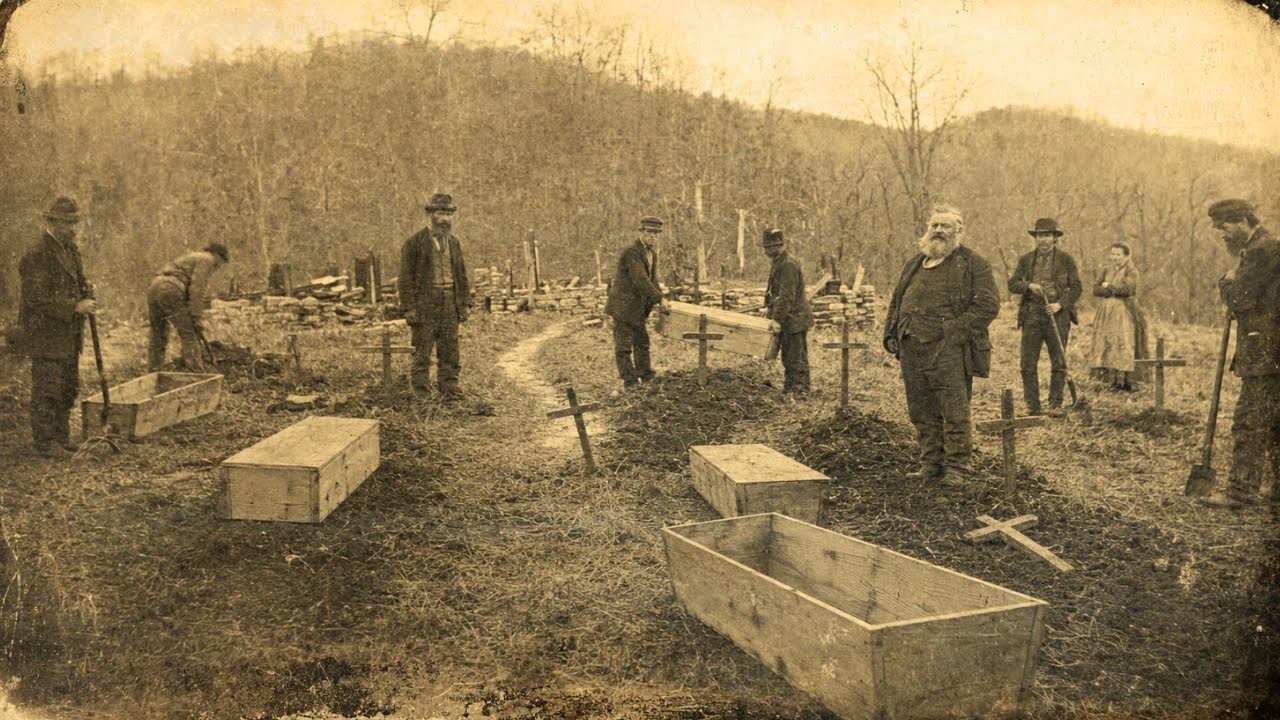
They pulled up the fire pit stones from the woods and broke them into gravel. They cut down the trees bearing the carved symbols and burned those too. And then they did something that the county recorder noted with particular care. They brought seven empty coffins to the site.
Pine boxes built specifically for this purpose. They buried the empty coffins in a row on the property, in the same configuration as the original mounds. Seven coffins. No bodies.
They marked each one with a wooden cross bearing no name. The men worked in silence for most of the day. No one spoke about what they were doing or why. The only conversation Sykes reported was between two younger men who had not been part of the original search party in 1876.
One asked the other if he believed the Ketchums were really dead. The other said it did not matter. What mattered was that the land believed it. When Sykes asked why they were burying empty coffins, the leader of the group, a deacon from the settlement church, told him it was to give the land something proper to hold.
The land had been opened, and it needed to be closed. The first burial had been the Ketchums burying themselves, or whatever version of themselves they believed they were shedding. The second burial was the community burying the idea of the Ketchums. Putting a seal on it.
Giving the hollow permission to forget. Sykes abandoned the property within the year. The land sat empty for another decade. When it was finally resettled in the 1890s, the new owners found the seven crosses still standing.
They pulled them up and used the wood for fence posts. Nobody told them the history. The Ketchum story might have disappeared entirely if not for a folklorist named Emmeline Garth, who traveled through the Ozarks in 1906 collecting oral histories. Garth was a professor’s assistant from the University of Missouri who had spent three summers walking the backroads of the hill country recording songs, recipes, remedies, and the stories that families passed down through generations.
She was methodical. She carried a journal and wrote in a tiny, precise hand that fit roughly four hundred words per page. She dated every entry. She noted the weather, the location, and the physical condition of each person she interviewed.
Her records are considered among the most reliable sources for Ozark folk history from that era. Garth interviewed three people who remembered the Ketchum events firsthand. Their accounts were remarkably consistent on the facts but diverged widely on interpretation. Poke Jessup, by then an old man, told Garth he believed Elias Ketchum had discovered something in the limestone caves beneath the hollow.
Jessup said there were cave openings on the property that went deep, deeper than anyone had mapped. He believed Elias had gone underground and found something that changed him. Something that convinced him that the surface world was temporary and that the real dwelling place was beneath. Ada Cruz, the dry goods woman, told Garth she believed Constance Ketchum was the driving force, not Elias.
She said Constance had always been the sharper of the two, the one who asked questions that made people uncomfortable. Ada believed Constance had developed a theology of her own. Something that required shedding all material possessions and all material identity before a person could pass into whatever she believed came next. The third interview subject, who asked Garth not to record his name, said he believed the Ketchums were simply dead.
Murdered by someone passing through. Their bodies disposed of in the creek. Their belongings buried by the killer to simulate a voluntary departure. He said the symbols, the trenches, and the singing were all details invented after the fact by a community that preferred a ghost story to an unsolved murder.
Garth recorded all three versions. She did not choose between them. In her published collection, which appeared in 1916 under the title *Hollows and Hollows*, she wrote a single editorial note about the Ketchum account. She said the most striking element of the story was not the disappearance itself, but the community’s response to it.
The two burials. The first, of the bones, hurried and unmarked, an attempt to dispose of evidence that the Ketchums had ever existed. The second, of the empty coffins, deliberate and ceremonial, an attempt to replace the real Ketchums with a version that could be controlled. Garth wrote that the second burial was not for the dead.
It was for the living. It was the community telling itself a story about what had happened, a story with a beginning, a middle, and an end, so that the actual story—which had no ending—could be tolerated. The hollow today is privately owned. The cabin foundation is gone, reclaimed by the forest.
The creek still runs along the eastern edge. Local historians have attempted to locate the site of the empty coffin burials but have found nothing. The wooden crosses, repurposed as fence posts, rotted away decades ago. The limestone caves that Jessup mentioned have never been formally surveyed.
There is one final detail from Garth’s field notes that did not make it into her published book. During her interview with Poke Jessup, she asked him whether he had ever gone into the caves himself. Jessup said he had. Once.
In the summer of 1874, before the Ketchums disappeared, he said he walked about two hundred yards into the main opening and came to a chamber where the ceiling was low and the air was warm. On the floor of the chamber, arranged in a circle, he found seven smooth stones. Each stone was roughly the size of a human head. They were not native to the cave.
They had been carried in from somewhere else. Jessup said he picked one up. It was heavier than it should have been. He put it down and left the cave.
He never went back. When Garth asked him why, he said he could not explain it except to say that the stone had felt like it was waiting for something. And he did not want to be there when it arrived. The Ketchums were never found.
The bones in the creek were never identified beyond the coroner’s rough estimate. The symbols on the trees were never documented before they were burned. The passage in Ezekiel that Elias underlined has been debated by local historians for over a century, and no consensus exists on which verse it was, because the Bible itself disappeared from the sheriff’s evidence within a year of being collected. Seven mounds with no bodies.
Seven coffins with no names. A family that buried their old lives in the dirt and walked into a darkness that the community spent the next forty years trying to seal shut. The village buried the Ketchums twice. But the Ketchums may have buried themselves first.
Some stories end with answers. This one does not. It ends with a hollow that swallows water, a family that swallowed itself, and a village that tried twice to put the whole thing in the ground and could not make it stay. The Ozarks are full of hollows like Sink Water.
Quiet places between ridges where the light does not reach, and the limestone holds its secrets in the dark. Most of them have no stories attached. Most of them are just land. But every now and then someone settles in a place like that and discovers that the ground has its own ideas about what belongs above and what belongs below.
And whatever Elias Ketchum was preparing for in that hollow—whether it was madness or revelation or something the Ozark limestone has kept sealed for a hundred and fifty years—the preparation, by every account, was completed.
