The photograph sat on the table between them, and for a long moment no one spoke. The woman who had commissioned it had given a false name, but the photographer’s wife had recognized her at once, and now the truth was out in the open. In the image, the widow stood alone, yet beside her hovered a pale, ghostly shape, unmistakably the figure of her dead husband. The widow was Mary Todd Lincoln, and the specter in the picture was Abraham Lincoln.
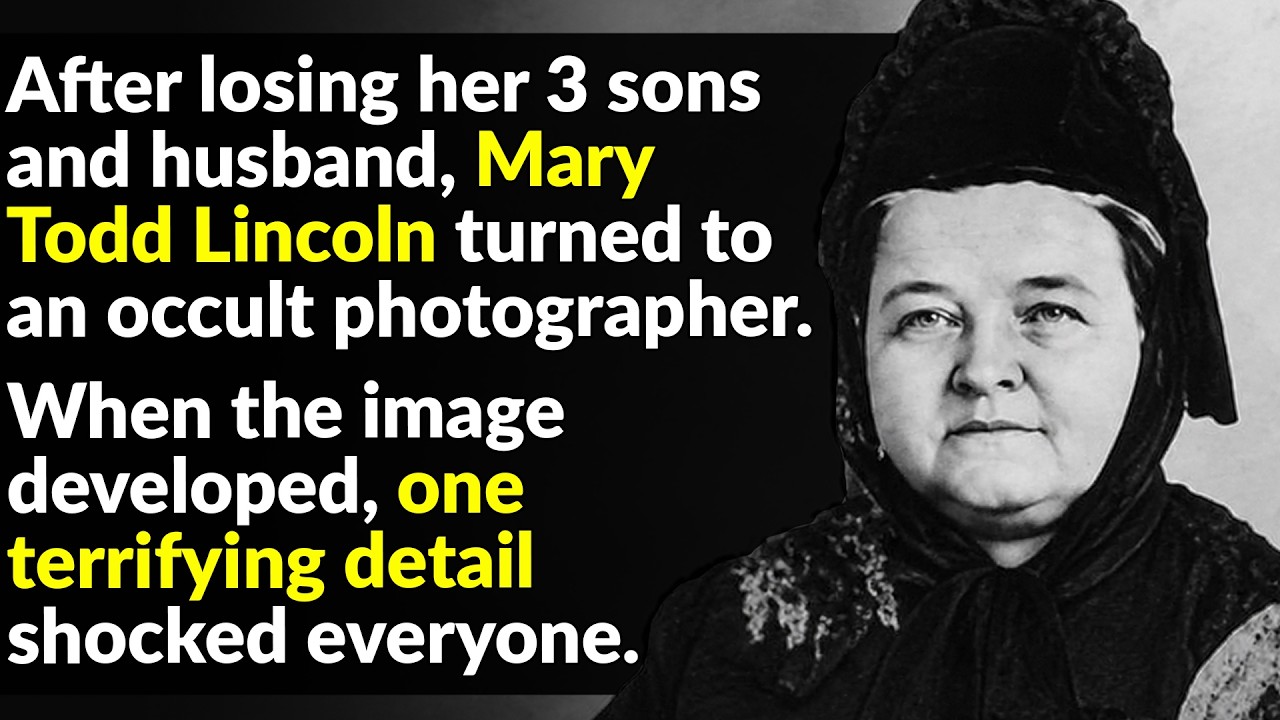
For some, the photograph was proof of her grief. For others, it was simply further evidence that the former First Lady had lost her mind. She had buried a husband and three sons, and in her desperation to reach them she had turned to séances, mediums, and spiritualist photographers. Now, with this image, the public had something tangible to mock and fear.
Many Americans had long since decided that Mary Todd Lincoln was one of the worst First Ladies in the nation’s history, a spendthrift and a meddler who embarrassed her husband at every turn. But there was more to her story than the caricature suggested, and it began decades before she ever set foot in the White House. Mary Ann Todd was born in 1818 in Lexington, Kentucky, the fourth of seven children. Her father, Robert Todd, was a wealthy banker and a slaveholder, and Mary grew up in a fourteen-room mansion with every advantage money could buy.
Her education was that of a young lady of the upper class: she attended Madame Mentelle’s finishing school, studied French until she was fluent, and trained in dance, drama, music, and etiquette. Those who knew her described a sociable, quick-witted girl who shone in company. But tragedy arrived early. When Mary was just six years old, her mother Elizabeth died in childbirth.
Within a year, her father remarried another Elizabeth, known to everyone as Betsy, and the new Mrs. Todd went on to bear nine more children. Mary remained in the mansion, privileged and well cared for, yet the loss of her mother never truly left her. In 1839, at the age of twenty-one, Mary moved to Springfield, Illinois, to live with her older sister Elizabeth, the wife of Congressman Ninian W.
Edwards. Elizabeth acted as Mary’s guardian, and the arrangement soon proved necessary, for Mary drew attention wherever she went. Among the young men who courted her was Stephen A. Douglas, a lawyer and rising politician in the Democratic Party, widely considered one of the most eligible bachelors in the state.
It seemed a promising match. Then one day a man named Abraham Lincoln came to the Edwards house, and everything changed. Mary and Lincoln shared a bond that her other suitors could not offer: both were committed Whigs, the party that would eventually become the Republicans. They began courting, and in time they became engaged.
There was one serious problem. Lincoln was not from Mary’s social class, and her sister Elizabeth and her guardian Congressman Edwards objected to the match so strongly that they forced the engagement to be broken. On January 1, 1841, the relationship ended, a day Lincoln would later call “that fatal first of January. ”
For eighteen months Mary and Lincoln stayed apart, but neither truly moved on.
They found their way back to each other, and this time they kept the courtship secret. Mary and Lincoln planned a private wedding on November 4, 1842, without the knowledge of her sister and brother-in-law. On the very day he was supposed to elope with Mary, Lincoln ran into her guardian on the street. Lincoln was an honest man, and he could not lie to Edwards.
He admitted that he and Mary intended to marry that very day. Edwards was not pleased, but he surprised Lincoln with an offer. Instead of cancelling the wedding, he proposed his own house as the venue. The ceremony went ahead, and Mary Todd became Mary Todd Lincoln.
The bride who had grown up in a fourteen-room mansion moved into a one-room flat above a tavern with her new husband. Soon they had a son, Robert. After a year of living in the cramped flat with a baby, the family of three moved to a small cottage. Lincoln was busy building his reputation as a successful lawyer, and Mary was equally occupied raising their growing family.
In 1848 a second son was born, Edward Baker Lincoln. In 1850 came William, called Willie, and in 1853 the family was completed with Thomas Lincoln, known to everyone as Tad. That same year brought devastation. Four-year-old Eddie died of tuberculosis, and the loss shattered both parents.
Lincoln’s work kept him away from home for long stretches, sometimes for months at a time, leaving Mary alone with the three boys. Already prone to severe headaches and bouts of depression, she now carried the weight of grief and isolation. In 1860, their lives changed beyond recognition. Lincoln, a country lawyer from Illinois, was elected President of the United States.
He won not a single electoral vote from the South, where he was known as an opponent of slavery, and southern states wanted no part of him. For Mary, the situation was painfully awkward: she came from a slaveholding family, and her husband’s position meant separation from her own kin. She chose to stand with him, even at that cost. As First Lady, Mary became the social coordinator of the White House, and she was not equal to every part of the job.
She faced journalists, lawyers, and political rivals, and the pressure showed. The White House was a cauldron of tensions, and Mary struggled to manage it. The Civil War began barely a month after Lincoln took office, and much of her time was spent trying to keep up morale. She visited hospitals, bringing fruit and flowers to wounded soldiers.
She was the first First Lady to come from the West, and most of the people she encountered in Washington were Easterners. They found her rude and called her a pretender, and it must be said that she gave them reason. Mary spent freely, especially on jewelry, shopping on credit at the exclusive Galt and Brother’s. She redecorated nearly every room in the White House, and for the dining room she ordered an expensive new set of china.
Lincoln was furious at the extravagance, especially when he had to ask Congress for appropriations to pay for it. On April 14, 1865, the war was effectively over and the Union had won. That same day, the papers reported that Lincoln and the First Lady would attend a play at Ford’s Theatre. Mary was suffering from one of her headaches and told her husband she would stay home.
Lincoln insisted, and the two of them went together. They sat side by side in the presidential box, holding hands. In the third act there was a scene that never failed to make the audience laugh aloud. As the laughter rose, John Wilkes Booth slipped into the box and fired.
Lincoln was laughing at the moment the bullet struck his head. Mary, frantic, held her husband in his chair so he would not fall to the floor. Lincoln was carried across the street to a house where doctors could tend to him. He slipped into a coma.
Mary was not allowed to stay at his bedside until the following morning. Nearly nine hours after the shooting, Lincoln died. A funeral train carried his body across the country so the nation could mourn. Back at the White House, Mary was surrounded by spiritualists, who filled her head with messages supposedly from her dead husband.
Her son Robert eventually drove them out of the house. Mary was now a widow with only two living sons. She moved to Chicago to be near them, but money never stopped worrying her. Lincoln had left her an estate of roughly $80,000, worth more than a million and a half dollars in today’s money, yet Mary had never learned to manage finances.
She decided that Europe would be better for her and Tad than America. A wealthy American family living in Germany arranged to pay their travel costs and helped them settle there. From Germany, Mary lobbied Congress for more money. Her argument was simple: since the widows of wounded soldiers received pensions, she was entitled to one too.
She had few friends in Congress, yet the measure passed, giving her $3,000 a year. When Europe had lost its appeal, Mary and Tad returned home. Soon after, Tad fell ill. On July 15, 1871, he died.
The cause was disputed, with pneumonia, heart failure, and tuberculosis all proposed, but the result was the same. Mary had now lost her husband and three of her four sons. Only Robert remained. Her behavior around money spiraled out of control.
She spent recklessly on unnecessary things, even as she was haunted by the fear of becoming poor. Then came the infamous photograph of 1872, the one with the ghostly Lincoln at her shoulder, taken by spiritualist photographer William H. Mumler. The image reinforced what many already suspected: Mary Todd Lincoln was unstable.
Tension mounted between Mary and her surviving son. Robert believed his mother was a danger to herself, and he decided she needed to be institutionalized. He knew she would never agree voluntarily, so he arranged a trial in secret. On May 19, 1875, a lawyer named Leonard Swift, who had known both Mary and her husband, took her to court.
She had no idea why she was being brought there. Once inside, she understood. A jury of twelve men and seventeen witnesses testified about her behavior, and the verdict came back: Mary Todd Lincoln was declared insane. She was to be committed to an asylum.
Before she could be taken away, Mary began collecting medicine from several pharmacies, enough to kill herself. A pharmacist caught on to her plan and gave her a placebo instead. She was admitted to Bellevue Place Asylum, but she did not intend to stay. She sent secret letters to her lawyer and his wife, who were also her friends, and to the editor of the Chicago Times.
Suddenly public opinion turned. Many began to see Robert as the villain, and his decision to lock up his mother came under heavy criticism. They pointed out that Robert now controlled her money. The unwanted publicity pushed the asylum’s board to make a surprising decision.
They told Mary she was free. She left without a moment’s delay and went to live with her sister Elizabeth in Springfield. Later she traveled to Europe and settled in France, where her health declined and her money ran short. In 1881 she went to New York City to try to increase her pension.
President Garfield had been assassinated that year, and his family was receiving government support. Congress, despite Mary’s reputation for extravagance, raised her pension and paid her in advance. She spent her remaining years in Springfield with her sister. Eleven years to the day after Tad’s death, Mary fell ill and slipped into a coma.
She died of a stroke the following morning. She was sixty-three years old. Historians have long debated what was actually wrong with her. In The Emancipator’s Wife, Barbara Hambly claimed that Mary used opium throughout her life.
In 2007, Jason Emerson published The Madness of Mary Lincoln, arguing that she suffered from bipolar disorder. Many historians continue to see her as an interfering, disruptive First Lady, while others point to the staggering losses she endured as the true source of her troubles. The photograph with the ghost of Abraham Lincoln remains what it always was: a portrait of a grieving woman, and a question no one has ever fully answered.
