The call came on the night of November 17, 1969. Rudolph Hess, the man who had once stood second only to Adolf Hitler in the Nazi hierarchy, lay near death in the British Military Hospital in Berlin. For twenty-eight years—his son’s entire adult life—Hess had refused to see his family, judging the supervised, tightly restricted conditions of prison visits an affront to his dignity. Now, at the edge of the grave, he relented.
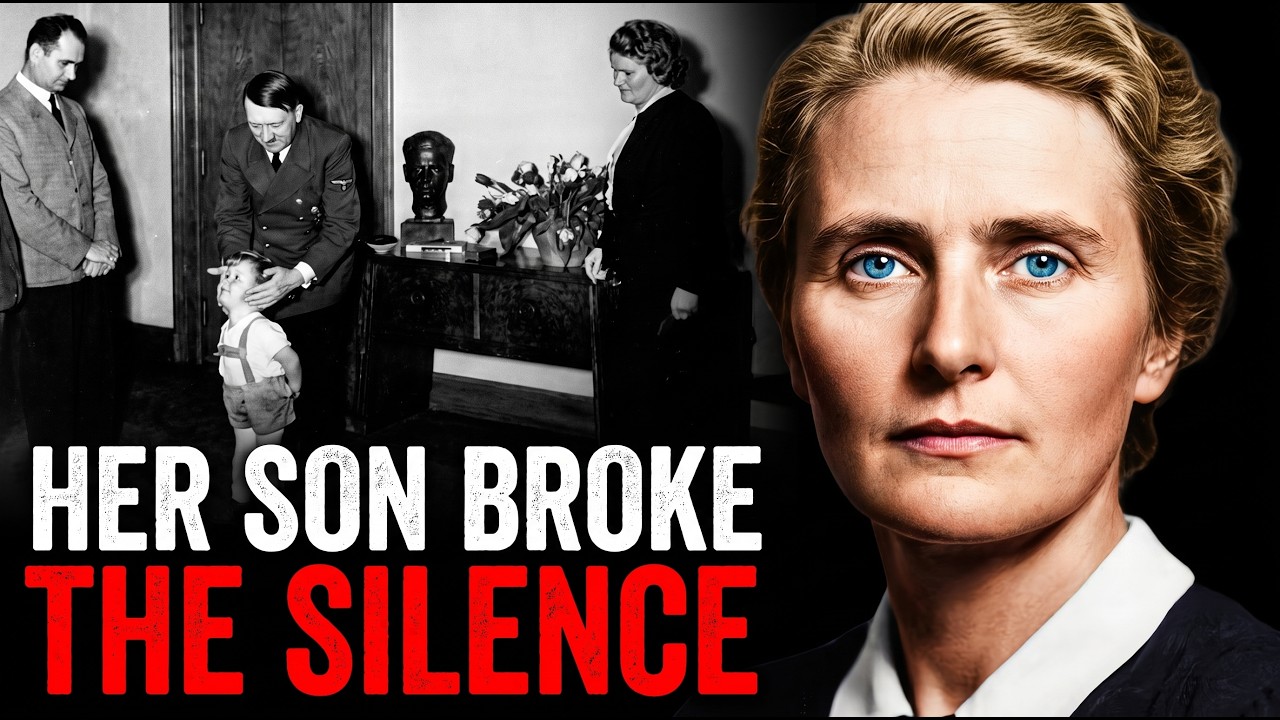
On Christmas Eve of that year, Ilse Hess and her thirty-two-year-old son, Wolf Rüdiger, were permitted into the same room with him for the first time in nearly three decades. It remained, according to the family’s own account, the only occasion on which two visitors were allowed to see the prisoner at once. After that, visits gradually resumed. By Wolf Rüdiger’s own tally, members of the family saw Rudolph Hess a total of 232 times across the remaining eighteen years of his imprisonment—roughly one brief, guarded meeting every four to five weeks.
Each visit lasted at most thirty minutes. A guard remained present and within earshot throughout. For many years, any physical contact between prisoner and visitor was prohibited, and conversations were conducted across a barrier under close observation. The entire sum of physical contact between a father and a son, separated for the whole of that son’s adult life, amounted to a few hundred hours distributed across two decades—an accumulation many ordinary families might exhaust in a single holiday season.
Those 232 visits, and everything that surrounded them, were the end product of a story that had begun nearly seventy years earlier in the cautious optimism of a Munich boarding house, when a young woman named Ilse Pröhl first met a serious, intense former artillery officer freshly returned from four brutal years of combat. Ilse Pröhl was born on the 22nd of June 1900 in Hanover, the daughter of a well-off physician named Friedrich Pröhl and his wife, also named Ilse. The family enjoyed a comfortable, conservative, nationalist upbringing—the kind of household where patriotism was simply assumed rather than debated. That comfort was shattered in May 1917 when Ilse’s father was killed during the First World War, leaving the family without its patriarch in the middle of a national catastrophe that would soon consume all of German society.
Her mother later remarried an artist named Carl Horn, who directed the Bremen Art Museum, but Ilse herself forged her own path. In 1919, in the wake of Bavaria’s decision to permit women to enroll at university, she became one of the first female students admitted to the University of Munich, where she studied economics. It was there, in a shared student hostel in April 1920, that she was introduced to a fellow lodger: Rudolph Hess, the eldest child of a prosperous German import-export merchant, born on the 26th of April 1894 in Alexandria, Egypt. He had spent an idyllic early childhood on the Mediterranean coast before his family relocated back to Germany when he was thirteen.
He had served with distinction in the Seventh Bavarian Field Artillery Regiment during the First World War, earning the Iron Cross, and had later trained as a fighter pilot in the German Imperial Air Force. Like so many demobilized officers who came home in 1918 to a defeated, humiliated, economically shattered Germany, Hess was consumed by resentment and a hunger to find someone or something to blame. In May 1920, just weeks after meeting Ilse, he attended a political rally and heard a fiery young agitator named Adolf Hitler speak for the first time. By his own later account, Hess was instantly and completely captivated.
He would remain devoted to that man, without hesitation or serious reservation, for the rest of his life. What followed was an unusually long courtship for the era, stretching across nearly seven years, largely because Hess had thrown himself so completely into Hitler’s fledgling movement that he had little time or attention left for romance. Ilse joined the Nazi Party herself in 1921, aligning her own political convictions with those of the man she hoped to marry. The early relationship remained largely platonic, hampered by Hess’s near-monastic devotion to the party and to Hitler personally.
In November 1923, Hess took part in the chaotic, doomed Beer Hall Putsch, Hitler’s failed attempt to seize power in Munich. Hess and a group of Sturmabteilung men briefly held several Bavarian government officials hostage before the plot collapsed. Stranded outside the city after his hostages escaped, Hess made a phone call to Ilse, who rode out on a bicycle to help him make his way back into Munich undetected. It was a small, almost cinematic act of loyalty, but it captured something essential about their relationship.
Hess was arrested shortly afterward and sentenced to eighteen months in Landsberg prison—the same facility where Hitler, sentenced alongside him, began dictating the manuscript that would become *Mein Kampf*, with Hess taking down much of the dictation himself. By 1925, with Hess now serving as Hitler’s private secretary, a position that gave him extraordinary influence over who could access the party leader and what mail crossed his desk, Ilse pressed her case for marriage. Hitler himself, who had grown close to both of them, personally urged Hess to finally commit. The wedding took place on the 20th of December 1927 in Munich, with Hitler serving as one of the official witnesses alongside Hess’s mentor, the geopolitical theorist Karl Haushofer.
It was a marriage forged as much in ideology as in affection. For the next decade, as the Nazi Party clawed its way from a fringe movement into total control of the German state, Ilse Hess enjoyed a position of genuine proximity to power. When Hitler became chancellor in January 1933, Hess was elevated to Deputy Führer, the second-ranking figure in the entire Nazi hierarchy, and the couple moved into a substantial villa in Harlaching, an affluent suburb of Munich. Ilse, by several contemporary accounts, was one of the few women in Hitler’s circle who spoke to him with easy familiarity, unafraid to needle him or contradict him in ways that others in his court would never have dared.
Hitler was a frequent visitor to the household, presenting himself within the Hess home as a relaxed, almost avuncular family friend, fond of Ilse’s cooking and evidently comfortable enough to let his guard down in ways he rarely did in more formal settings. The house was staffed, comfortable, and by all surviving accounts a genuinely warm environment for entertaining, with Ilse developing a reputation among the party’s inner circle as a gracious, sharp-witted hostess. For ten years, the marriage produced no children, a source of quiet disappointment given the family-focused propaganda the regime itself promoted. Then, on the 18th of November 1937, Ilse gave birth to a son.
They named him Wolf Rüdiger Hess. The choice of Wolf was no accident—it was Hitler’s own long-favored self-styled nickname, a code name he had used since the earliest days of the movement, and giving it to the boy was widely understood within the party as an unmistakable act of homage. Hitler agreed to serve as the child’s godfather, a rare personal honor that placed the infant Wolf Rüdiger at the very heart of the Nazi elite’s inner social world before he had even opened his eyes. The years immediately following Wolf Rüdiger’s birth were, by the family’s own later recollections, some of the happiest of Ilse Hess’s life.
The family lived comfortably in Munich, insulated by wealth, status, and proximity to the absolute summit of German power. Rudolph Hess doted on his young son in the manner expected of a proud Nazi patriarch. But storm clouds were already gathering, both over Europe and, less visibly, over Rudolph Hess’s own standing within the party. As the 1930s gave way to the opening campaigns of the Second World War, Hess found his influence steadily eroding.
Unlike Hermann Göring, who commanded the Luftwaffe, or Heinrich Himmler, who commanded the SS and the machinery of terror, Hess held no significant military or paramilitary power base of his own. His title of Deputy Führer sounded impressive, but as the war consumed more and more of Hitler’s attention, Hess found himself increasingly sidelined, his once-privileged access to the Führer steadily supplanted by his own ambitious subordinate, Martin Bormann, a ruthless political operator who understood exactly how to make himself indispensable in ways Hess never had. By the beginning of 1941, Hess was a man watching his own relevance evaporate in real time. Historians have long debated what combination of motives drove him toward the extraordinary decision he made that spring: whether it was a genuine, if hopelessly naive, desire to broker a peace between Germany and Britain before the coming invasion of the Soviet Union; whether it was a calculated gamble to win back Hitler’s favor by delivering an unimaginable diplomatic coup; or whether it reflected a mind that had simply come unmoored under the pressure of his own diminishing status.
Whatever the true mixture of motives, the planning was neither impulsive nor sudden. A letter Hess wrote to Ilse dated the 4th of November 1940 makes clear that he had been quietly preparing for months. He cultivated his relationship with the aircraft manufacturer Willy Messerschmitt, secured a specially modified Messerschmitt Bf 110 fighter fitted with extended-range fuel tanks, and studied maps and flight paths in secret. He told almost no one—including, by every credible account, his own wife.
On the afternoon of the 10th of May 1941, Rudolph Hess said goodbye to his family as though it were an ordinary day. He was driven to the Messerschmitt works at Augsburg, climbed into the cockpit of his modified aircraft, and took off at a quarter to six in the evening. He flew a long, looping route north along the Rhine, out over the North Sea, before turning toward Scotland. In a letter he later wrote to Ilse describing the journey, he spoke of a strange, overwhelming loneliness mixed with awe at what he called the fabulous beauty of the evening light over the water.
His destination was Dungavel House, the Scottish estate of the Duke of Hamilton, a British aristocrat whom Hess believed—based on flawed and outdated intelligence supplied by his old mentor Karl Haushofer’s son—might be sympathetic to a negotiated peace and possessed the political influence to broker one. It was, in retrospect, an almost fantastical miscalculation. Hamilton had no such power, and the British government had no intention of negotiating with a regime in the midst of conquering Europe. Hess never reached Dungavel House.
Running low on fuel and unfamiliar with the terrain in the growing darkness, he bailed out over rural Scotland, parachuting into a field near the village of Eaglesham, south of Glasgow. A local plowman named David McLean discovered the burning wreckage of the plane and a disoriented parachutist who introduced himself as Captain Alfred Horn. McLean’s elderly mother—in a scene that has become one of the war’s stranger footnotes—brought the mysterious visitor into her cottage and served him tea by the fireside before the authorities were alerted. It did not take long for British intelligence to piece together who Horn truly was.
Within days, the astonishing truth broke across the world: the Deputy Führer of Nazi Germany, the third-ranking man in Adolf Hitler’s regime behind Hitler himself and Hermann Göring, had flown alone into British custody. The reaction in Berlin was immediate panic. Hitler, according to those present, was thunderstruck when he was informed, furious that his oldest and most loyal lieutenant had acted entirely without his knowledge or authorization. Within hours, the regime’s propaganda machine under Joseph Goebbels began constructing a cover story, informing the German public that Hess had suffered from hallucinations and mental delusions and had flown off in a state of psychological derangement.
Goebbels confided anxiously in his private diary that ordinary Germans were, in his words, rightly asking how such a fool could have risen to become second in line to the Führer. For Ilse Hess, sitting at home in Munich with her three-and-a-half-year-old son, the news arrived as a devastating and bewildering shock. Her husband had told her nothing of his plans. She learned of his fate from the radio and the newspapers, along with the rest of the German public.
Almost overnight, her position within the Nazi hierarchy transformed from privileged insider to object of suspicion and quiet humiliation. She did not have long to process her husband’s disappearance before the practical consequences began arriving at her door. Hess’s title and office were formally dissolved within days of his flight. His authority as Deputy Führer was folded into a newly created Party Chancellery under the control of Martin Bormann—the very man whose rise had shadowed Hess’s own decline.
Ilse found herself almost overnight a political liability rather than a political asset. Rumors swirled through Munich society, some cruel, some merely curious, about what precisely her husband had been thinking and whether she herself had known more than she admitted. She insisted for the rest of her life that she had been given no warning whatsoever, that the letter Hess left for her—delivered only after his flight was already underway—was the first she had heard of his intentions. In this atmosphere of suspicion and social exile, Ilse made the decision to leave the city altogether.
She took her young son and relocated to the family’s secondary residence in Bad Oberdorf, a small spa village nestled in the Allgäu Alps in the Hindelang area of Bavaria, far from the prying eyes and whispered gossip of the capital. It was here, in this quiet mountain village, that young Wolf Rüdiger acquired the nickname that would stick with him for the rest of his life: the locals and family friends began calling him Buz, and the name endured through his childhood, his adolescence, and well into his adult correspondence with intimates. One detail even many amateur historians of the period miss entirely: despite Rudolph Hess’s fall from official grace and the regime’s public insistence that he had been mentally unwell, Hitler personally ensured that Ilse continued to receive a monthly stipend—reportedly around 1,100 Reichsmarks—allowing the family a measure of financial security even as their political standing collapsed. Even Eva Braun, Hitler’s own mistress, is reported to have quietly arranged additional support for Ilse during these years—a small, almost surprising thread of personal loyalty running beneath the public disgrace.
Life in Bad Oberdorf during the war years took on a strange, suspended quality for young Wolf Rüdiger. He was too young to understand the geopolitical earthquake his father’s flight had triggered, too young to grasp that the man whose name he carried had become simultaneously a British prisoner of war, a subject of endless propaganda speculation, and an embarrassment his own government wished would simply disappear from public memory. What he experienced instead was a childhood defined by his mother’s quiet, unwavering insistence that his father was not mad, not a traitor, and would one day return. Ilse Hess never allowed her son to hear a word of doubt about Rudolph Hess’s character or motives.
This unshakable maternal certainty would become the emotional bedrock of Wolf Rüdiger’s entire identity for the rest of his life. Meanwhile, across the English Channel, Rudolph Hess’s circumstances had settled into a strange limbo of their own. Treated formally as a prisoner of war rather than a political prisoner, he was held first at a series of country houses and hospitals, eventually settling at Maintree Court, a military psychiatric facility in Wales, where he remained under guard for the duration of the conflict. British doctors who examined him during this period noted a pattern of erratic behavior, including a suicide attempt in 1941 in which he threw himself over a staircase railing, and recurring bouts of what appeared to be genuine or performed amnesia.
Whether Hess’s psychological symptoms were authentic, a deliberate legal strategy, or some combination of the two would become one of the enduring controversies of his case. As the war ground on toward its catastrophic conclusion for Germany, the Hess family’s relative isolation in the Allgäu countryside likely spared them some of the direct devastation that befell families in the country’s bombed-out cities. But isolation did not mean safety from what was coming. As Allied forces closed in on Germany in the spring of 1945, the entire structure of the Nazi state collapsed within a matter of weeks.
Hitler died by suicide in his Berlin bunker on the 30th of April 1945. Martin Bormann vanished amid the chaos of the capital’s final days, his fate unknown for years afterward. And on the 8th of May 1945, Germany surrendered unconditionally, bringing the Third Reich—and the entire world that had shaped young Wolf Rüdiger’s earliest years—to an abrupt and total end. For a boy who had just turned seven and a half, the collapse of Nazi Germany meant the collapse of the only world he had ever known.
It also meant the beginning of a new and far more dangerous phase for his mother. The Allied occupation authorities, moving swiftly to identify and detain the wives and family members of the senior Nazi leadership who would soon face judgment at Nuremberg, had Ilse Hess squarely in their sights. She was, after all, married to the man who had been the second most powerful figure in the entire regime for eight critical years. Rudolph Hess himself was transferred back to Germany in October 1945 to face justice alongside his former colleagues.
The man who arrived in Nuremberg bore little resemblance to the confident Deputy Führer who had once stood at Hitler’s shoulder reviewing party rallies. Prior to the trial, American psychiatrist Douglas Kelley examined Hess extensively and concluded that while he displayed severe neurotic and hysterical tendencies, he was not legally insane. Kelley offered a memorably blunt assessment: if one considered the street to represent sanity and the sidewalk to represent madness, Hess spent most of his time standing on the curb between the two. Throughout much of the pre-trial period, Hess maintained that he suffered from amnesia and could not recall key events from his years in power—a claim that infuriated prosecutors and fellow defendants alike, several of whom suspected, correctly as it turned out, that the amnesia was at least partly theatrical.
In a dramatic moment during the trial itself, Hess suddenly announced to the stunned courtroom that his memory had in fact returned and that his earlier claims of amnesia had been a deliberate tactic. It did him little practical good. The verdict, when it finally came on the 1st of October 1946, was almost anticlimactic given the years of anticipation that had preceded it. Rudolph Hess was found guilty on charges of crimes against peace and conspiracy to wage aggressive war, though notably acquitted of the war crimes and crimes against humanity charges that sent several of his co-defendants to the gallows.
The tribunal accepted, in effect, that Hess’s flight to Britain in 1941 had removed him from direct involvement in the regime’s escalating atrocities during the war’s final years, even as it held him fully accountable for the earlier crimes of aggression that had launched the conflict in the first place. He was sentenced to life imprisonment, to be served at Spandau Prison in the British sector of occupied Berlin. Unlike Göring, who took his own life with a smuggled cyanide capsule the night before his scheduled execution, or Keitel and Ribbentrop, who were hanged within weeks of the verdict, Rudolph Hess would not die quickly. He would instead spend the next four decades as a prisoner, aging slowly behind Spandau’s walls, while his wife and son eventually grew old waiting for a release that the political realities of the Cold War would make agonizingly difficult to secure.
For young Wolf Rüdiger, not yet nine years old, the life sentence delivered a strange and paradoxical kind of finality. His father would not be executed—a relief beyond measure for a boy who had spent the trial fearing the worst. But neither would his father come home. The family now faced the prospect of an indefinite separation with no clear end point—a limbo that would come to define Wolf Rüdiger’s entire childhood and much of his adult life as well.
What Ilse Hess could not have known as she absorbed the sentence alongside her son in the Allgäu countryside was that her own freedom was about to be curtailed as well, and that young Wolf Rüdiger was about to be separated from both of his parents at once. On the 3rd of June 1947, the occupation authorities came for Ilse Hess. She was arrested along with virtually every other wife of a senior Nazi official who had been convicted or executed at Nuremberg, part of a broader denazification sweep intended to root out any continuing influence the wives of the regime’s leadership might exert over postwar German society. She was transported to the internment camp at Augsburg-Göggingen, one of a network of facilities where Allied authorities held individuals suspected of complicity in or sympathy toward the Nazi state.
For nine-year-old Wolf Rüdiger, the arrest of his mother meant that in the span of less than two years, he had effectively lost both parents to the machinery of postwar justice. He was taken in by an aunt, one of those quiet, unheralded acts of family loyalty that so often go unrecorded in the grand narratives of history but which shape a child’s actual lived experience far more directly than any courtroom verdict. He began attending a local school that same year. Ilse Hess’s internment lasted roughly nine months.
She was released on the 24th of March 1948 and returned to the Allgäu to reclaim her son and begin rebuilding whatever life remained possible for the wife of history’s most famous political prisoner. The Germany she returned to bore little resemblance to the confident, expansionist state that had once employed her husband as its second-in-command. It was a defeated, divided, impoverished country, still years away from the economic recovery that would eventually become known as the *Wirtschaftswunder*—the postwar economic miracle. For a family carrying the Hess name, rebuilding a normal existence presented unique challenges.
Ilse could not simply blend anonymously back into German society. Her surname alone guaranteed scrutiny, whispered recognition, and in some circles a curious mixture of pity and quiet admiration from those who still harbored Nazi sympathies even as public denazification proceeded around them. Rather than retreat entirely from public life, Ilse Hess chose a different path. In 1955, she opened a small pension—a guest house for travelers—in the Allgäu region where she had settled, providing the family with a modest but stable income independent of any government support.
But the guest house business, however practical, was never where her true energies were invested. She had begun writing in 1952, publishing a book titled *England — Nürnberg — Spandau: Ein Schicksal in Briefen*—England, Nuremberg, Spandau: A Fate in Letters—compiling correspondence and reflections from the years of her husband’s captivity, released through the far-right publishing house Druffel Verlag. It was the first of what would become a lifelong project of preserving, defending, and ultimately mythologizing her husband’s legacy—a project her son would inherit and expand upon with even greater intensity in the decades to come. The guest house itself became, in its own quiet way, a gathering point for a particular clientele over the years, drawing visitors who were often as interested in meeting the wife of Rudolph Hess as they were in the Allgäu’s mountain scenery.
Wolf Rüdiger grew into his teenage years within this environment, helping where he could with the family business while absorbing, day by day and guest by guest, the steady drumbeat of visitors who arrived already convinced of his father’s essential innocence and who left, if anything, more convinced still after an afternoon in his mother’s company. By the time he left for his architectural studies in the mid-1950s, he had already spent the better part of a decade absorbing, almost by osmosis, the particular blend of grievance, conviction, and quiet defiance that would come to define the rest of his life. He qualified as a fully credentialed architect in 1961. On paper, this represented the kind of stable, respectable professional path that might have allowed a young man to step outside his father’s overwhelming shadow and build an independent identity.
But the shadow proved impossible to escape, and in truth Wolf Rüdiger showed little interest in escaping it. Even as he built a career designing buildings across Bavaria—colleagues described a meticulous, detail-oriented practitioner—he was simultaneously building something else entirely: a decades-long public campaign to secure his father’s release from Spandau and to rehabilitate the Hess family name in the eyes of history. By the time Wolf Rüdiger reached adulthood in the early 1960s, Spandau Prison had settled into one of the strangest institutional arrangements to emerge from the entire Cold War. The facility—a hulking nineteenth-century red-brick fortress in the British sector of West Berlin—had originally held seven convicted Nazi leaders following the Nuremberg trials, but one by one, through death or the completion of finite sentences, those other prisoners departed.
Constantin von Neurath was released in 1954. Erich Raeder and Walter Funk were freed in 1955 and 1957 respectively on grounds of failing health. Baldur von Schirach and Albert Speer, the two defendants who had received twenty-year sentences, walked free in 1966, having served their full terms. From that point forward, for more than two decades, Rudolph Hess was the prison’s sole remaining inmate—an old man rattling around inside a facility built to hold hundreds, guarded around the clock in rotating monthly shifts by soldiers from all four occupying powers (the United States, Britain, France, and the Soviet Union), at a cost that ran into the millions of dollars annually simply to maintain one aging prisoner behind bars.
This absurd arrangement became the central obsession of Wolf Rüdiger Hess’s life. Three of the four occupying powers—Britain, France, and the United States—were at various points from the 1950s onward willing to consider Hess’s release on humanitarian or compassionate grounds, particularly as he aged and his health visibly deteriorated. The obstacle, consistently and immovably, was the Soviet Union. Soviet representatives on the four-power Spandau governing body repeatedly vetoed any proposal for release, citing both the enormous devastation the German invasion of the USSR had inflicted on Soviet lands and a persistent, politically convenient fear that a freed Hess could become a rallying symbol for a resurgent European neo-Nazi movement.
Every proposal for clemency, medical parole, or compassionate release foundered on this Soviet veto, year after year, decade after decade, regardless of Hess’s advancing age or declining physical condition. For Wolf Rüdiger, this meant a lifetime spent as the public face of a campaign that combined genuine filial devotion with an increasingly politicized crusade that placed him at the center of West Germany’s far-right political ecosystem. He wrote to members of parliament across Western Europe. British Hansard records from House of Commons debates of the 1970s document his direct correspondence with sympathetic members of Parliament, complaining bitterly about restrictions on his father’s legal representation and his access to visitors.
In one such letter quoted directly in a 1976 parliamentary debate, Wolf Rüdiger insisted there was no doubt whatsoever that his father would have expressed regret for the millions killed during the Second World War, if only the prison authorities would permit him to make any public statement at all—a claim later historians and journalists would view with considerable skepticism, given that Rudolph Hess himself, when finally granted the chance to speak at his own trial and in later correspondence, showed remarkably little inclination toward genuine remorse. His visits to his father, when permitted at all, were tightly restricted, brief, and closely supervised—hardly the kind of sustained contact that would allow a grown son to build any real relationship with an aging parent he had barely known as a small child. Wolf Rüdiger would later describe with evident bitterness a lifetime spent essentially advocating for and defending a man he scarcely knew in any personal sense—a stranger bound to him by blood, by name, and by a shared surname that had come to define both of their identities. Despite these extraordinary constraints, Wolf Rüdiger built an ordinary domestic life alongside his extraordinary public crusade.
He married and started a family of his own; remarkably little detailed information about his wife has entered the historical record. The couple would eventually have three children together. Among them was a son, Wolf Andreas Hess, whose birth date fell—to Wolf Rüdiger’s evident and unmistakable satisfaction—on the 20th of April, coinciding precisely with Adolf Hitler’s own birthday. Wolf Andreas would go on to become a computer programmer, one of the very few details about the third generation of the Hess family that has become part of the public record.
Throughout the 1960s and into the 1970s, as Wolf Rüdiger balanced his architectural career with his ceaseless advocacy work, his mother Ilse continued her own parallel campaign from the Allgäu. She maintained an extensive network of correspondents with fellow unrepentant figures from the old regime, including notably Winifred Wagner, the English-born widow of Siegfried Wagner and daughter-in-law of the composer Richard Wagner, herself a lifelong outspoken admirer of Hitler. Ilse also became deeply involved with an organization called Stille Hilfe—Silent Aid—a secretive support network established in 1951 by Princess Helene Elisabeth von Isenburg to provide assistance to arrested, convicted, or fugitive former SS members and their families. Stille Hilfe operated with the explicit purpose of helping former Nazis evade justice, relocate, secure legal representation, or simply survive financially in the postwar decades, and drew persistent criticism for effectively functioning as a support network for unrepentant war criminals and their sympathizers.
By the mid-1970s, Rudolph Hess had become the world’s most famous and most expensive single prisoner. Health scares became increasingly frequent as he aged into his seventies and then his eighties. He suffered from chronic stomach complaints, worsening eyesight that eventually left him nearly blind, and mobility problems that required him to use a cane and eventually a wheelchair. Each health crisis brought renewed calls from Britain, France, and eventually even elements within the American government for a compassionate release on medical grounds.
Each time, the Soviet veto held firm. Hess occupied a single cell in a facility that had once held hundreds of prisoners, tended by a rotating staff of guards, cooks, and medical personnel drawn from all four occupying powers on a strict monthly rotation schedule. He was permitted a small garden plot within the prison walls, where he spent considerable time in his later years cultivating flowers and vegetables. He received a modest allowance for books, wrote extensively, and was permitted supervised visits from his family on a limited and tightly controlled basis.
Documents declassified decades later, in 2009, revealed that British authorities had in fact repeatedly voted in favor of Hess’s release throughout the 1970s and 1980s, understanding all along that the Soviet delegation would block any such measure regardless of how the other three powers voted. This created a peculiar political dynamic in which the Western powers could be seen, at least on paper, supporting Hess’s humanitarian release, safe in the knowledge that the Soviet veto would prevent that support from ever actually being tested in practice. Wolf Rüdiger remained convinced for the rest of his life that the British government’s professed support for release was itself insincere—a calculated performance masking a deeper unwillingness to ever actually let his father go free. Then, in the mid-1980s, the political ground beneath the entire arrangement began unexpectedly to shift.
Mikhail Gorbachev’s rise to the leadership of the Soviet Union in 1985 brought with it the first genuine signs of a thaw in the decades-long Soviet intransigence over Hess’s case. Sensing an opening after so many years of frustration, Wolf Rüdiger intensified his public campaign dramatically. In April 1987, he made a direct and highly publicized appeal to Gorbachev personally, calling on the Soviet leader to finally allow his now ninety-two-year-old father’s release. According to accounts relayed by his family, Hess had told his guards directly that he believed the authorities wanted him to die in prison rather than ever release him.
What Wolf Rüdiger could not have known as he pressed his public appeal in the spring of 1987 was that within a matter of months his father would be dead, and that the circumstances of that death would launch him into the final defining crusade of his own life. On the afternoon of Monday the 17th of August 1987, ninety-three-year-old Rudolph Hess was found unconscious in a small summer house he used within Spandau’s exercise garden, an electrical cord wrapped around his neck, apparently tied to a window latch. He was rushed to the British Military Hospital in Berlin, where efforts to revive him failed. He was pronounced dead later that same day.
According to the official account released by British authorities responsible for guarding him that month, Hess had been left alone for a brief period after his usual guard was called away to take a telephone call—a call that, according to the guard’s own later statement, turned out upon investigation to have no one on the other end of the line. In that narrow window of unsupervised time, the frail, nearly blind ninety-three-year-old man, who required a cane simply to walk and whose hands had grown so weak in recent years that visitors described him struggling even to hold a teacup steady, had apparently climbed onto a chair, secured an electrical extension cord around his neck and to the window latch, and ended his own life. The official ruling was suicide by asphyxiation. For Wolf Rüdiger Hess, the official account collapsed under scrutiny from almost the first moment he heard it.
How, he demanded to know, could a man in his father’s documented physical condition—a man whose hands lacked the strength to grip everyday objects, whose eyesight had deteriorated to the point of near-total blindness, whose mobility required constant assistance—have possibly managed to tie a secure ligature, climb onto unstable furniture, and successfully hang himself without any struggle loud enough to alert nearby guards? Wolf Rüdiger and his father’s longtime legal representative, the attorney Alfred Seidl, moved immediately and jointly to arrange an independent second autopsy, refusing to accept the British military’s own examination as the final word on the cause of death. What followed was the defining crusade of the remaining fourteen years of Wolf Rüdiger Hess’s life. He became convinced, with the same absolute and unshakable certainty that had characterized his mother’s decades of advocacy, that his father had not died by his own hand at all but had been murdered—deliberately silenced by British intelligence operatives to prevent him from ever being released and potentially speaking publicly about sensitive, embarrassing details of British wartime conduct that Hess, in Wolf Rüdiger’s telling, had carried with him since his ill-fated 1941 flight.
The theory held that British authorities, having quietly supported release proposals for years specifically because they knew the Soviet veto would prevent those proposals from ever actually taking effect, suddenly found themselves facing a genuine possibility of release once Gorbachev’s reforms began softening Soviet resistance—and moved to eliminate Hess rather than risk him walking free and speaking his mind after nearly half a century of enforced silence. Wolf Rüdiger pursued the murder theory relentlessly for the rest of his life, publishing his second major book on the subject in 1989, titled *Wer ermordete meinen Vater Rudolf Heß? *—Who Murdered My Father, Rudolf Hess? —laying out in exhaustive detail his case against the official suicide finding.
He had already published his first major work in 1986 as *Mein Vater Rudolf Heß*—My Father Rudolf Hess—an intimate family portrait combining personal recollection with a sustained defense of his father’s actions and character, released through sympathetic nationalist publishing channels rather than mainstream German presses. A third and final major book followed in the mid-1990s, titled *Rudolf Heß: Ich bereue nichts*—Rudolf Hess: I Regret Nothing—a title that left little ambiguity about the interpretation of his father’s legacy that Wolf Rüdiger intended to leave as his own final word. In the immediate aftermath of Rudolph Hess’s death, Wolf Rüdiger and his mother Ilse faced a more urgent problem than any historical dispute over motive and evidence: they needed to bury him. West German authorities, acutely aware of the symbolic danger a Hess grave site could pose, were wary from the outset of any burial arrangement that might create a permanent shrine for neo-Nazi pilgrimage.
The body was kept in a temporary Bavarian resting place for several months following his death before the family eventually secured permission to bury him in the Hess family plot in the small town of Wunsiedel in Upper Franconia, the ancestral home region from which the Hess family had originally hailed before relocating to Egypt generations earlier. On a cold morning in March 1988, roughly seven months after his death, Rudolph Hess was interred in a close family circle, with a local dean presiding over the modest ceremony. His grave bore an inscription that would later become notorious in its own right: *Ich hab’s gewagt*—roughly, “I dared it,” or “I dared to do it”—a phrase Hess himself had reportedly chosen, cementing to the very end his belief that his 1941 flight had been a bold and righteous act rather than the reckless miscalculation history would generally judge it to be. Almost immediately, Wunsiedel became a site of pilgrimage for Germany’s neo-Nazi movement, exactly as Soviet negotiators had warned for decades that a Hess grave site inevitably would.
Beginning within just a few years of the burial and continuing with disturbing regularity every August, coinciding with the anniversary of Hess’s death, hundreds—and in some years thousands—of neo-Nazis, skinheads, and far-right sympathizers from across Germany and neighboring countries descended on the quiet Bavarian town for organized marches, demonstrations, and memorial gatherings at the grave site. The town’s only real connection to Rudolph Hess was ancestral rather than personal: he had never lived there, having spent his childhood in Egypt and his adult life in Munich and Berlin. That thin ancestral thread proved sufficient to transform an obscure market town of a few thousand residents into one of the most closely watched flash points of German domestic security policy for more than two decades. Amid this ongoing controversy, Ilse Hess’s own long life finally drew to its close.
She died on the 7th of September 1995 in Lilienthal in Lower Saxony at the remarkable age of ninety-five. She had outlived her husband by eight years, had watched her son carry forward the advocacy work she herself had begun nearly half a century earlier, and had remained, by every account available to historians, entirely unrepentant about her lifelong devotion to National Socialism right up until her final days. She was buried alongside her husband in the same contested Wunsiedel plot, her name added to a grave that had already become one of the most politically fraught burial sites in modern German history. The 1990s brought Wolf Rüdiger into his own late fifties and early sixties, an era in which his decades of relentless advocacy work showed little sign of slowing.
Germany had by this point undergone a profound and largely successful process of national reckoning with its Nazi past, incorporating Holocaust education deeply into its school curricula, criminalizing Nazi symbols and Holocaust denial through strict legal statutes, and building an entire civic culture explicitly oriented around confronting rather than obscuring the crimes of the Third Reich. Wolf Rüdiger Hess, in this context, occupied an increasingly marginal and anachronistic position—a genuine relic of the regime’s inner circle, still actively campaigning to rehabilitate a legacy that the surrounding society had spent fifty years working systematically to repudiate. Interviews conducted with him in his later years show a man whose convictions had, if anything, hardened rather than softened with time, whose framing of his father as a tragic, principled peace envoy rather than a convicted war criminal remained essentially unchanged from the framing his mother had instilled in him as a small boy in the Allgäu mountains more than half a century earlier. Whether Wolf Rüdiger ever privately grappled with doubt about the cause to which he had devoted his entire adult life, the historical and journalistic record offers remarkably little evidence of any such internal reconsideration.
By the year 2000, Wolf Rüdiger Hess was in his early sixties, still nominally active in the affairs of the Rudolf-Heß-Gesellschaft—the Rudolf Hess Society—an organization dedicated explicitly to preserving and promoting his father’s memory, coordinating legal appeals, and organizing sympathizers across West Germany and beyond. Under this banner, he positioned himself not merely as a private citizen advocating for a family member but as the institutional custodian of an entire historical narrative. On the 24th of October 2001, Wolf Rüdiger Hess suffered a serious health crisis and was taken to a hospital in Munich—the same city where he had been born sixty-three years earlier and where he had first learned, as a small boy of three, that his father had vanished into British custody on a solo flight that would ultimately come to define the entire arc of both of their lives. He died there that same day.
In August 2001, just two months before his death, he had sent a written greeting to the annual gathering of far-right sympathizers assembled at Wunsiedel for the anniversary commemoration of his father’s death. Academic researchers who later studied the nationalist mythologizing of Rudolph Hess’s legacy noted that this message was read aloud to the assembled crowd by Jürgen Rieger, one of Germany’s most prominent and notorious neo-Nazi organizers of the era. It was, in a sense, a fitting final public act—a son’s grief and loyalty expressed through channels that reliably, consistently, and by that point almost inevitably intersected with Germany’s most extreme political fringe. News of his death drew a mixture of muted mainstream coverage and considerably warmer tributes from within the nationalist and revisionist circles he had spent his life moving through.
He left behind a widow and three children. With his passing, the direct first-generation link between the modern world and Adolf Hitler’s own wartime inner circle effectively came to an end. His son, Wolf Andreas Hess—the boy whose birth on Hitler’s own birthday had brought his father such evident satisfaction decades earlier—grew up to pursue a career as a computer programmer, a quiet, almost defiantly unremarkable profession that stood in sharp contrast to the very public, very political lives his father and grandparents had led. Very little else about the third generation of the Hess family has entered the historical record, a silence that appears by every indication to be entirely deliberate.
Historians who have studied the postwar mythologizing of Rudolph Hess describe a process by which the Hess family’s advocacy work, however sincerely motivated by genuine filial love and grief, became gradually absorbed into a much larger nationalist project of reframing key figures of the Third Reich as tragic, misunderstood, even heroic figures rather than as willing architects of catastrophe. The phrase Wolf Rüdiger’s father had chosen for his own gravestone—*Ich hab’s gewagt*, I dared to do it—became something of a rallying cry within Germany’s far-right subculture, precisely because it offered a seductively simple narrative: a lone man of conscience punished for decades by vindictive victors for the crime of having tried, however naively or self-servingly, to bring peace. That this narrative required ignoring or minimizing Rudolph Hess’s eight years of service at the very center of a regime that had already begun implementing its racial policies, had already opened the first concentration camps, and that Hess himself had helped administer through his oversight of civilian sentencing and enemy classification, seemed to trouble neither Ilse nor Wolf Rüdiger in any documented way across more than half a century of combined advocacy. With both Wolf Rüdiger and Ilse Hess dead, the burden of managing the family’s public legacy—and the increasingly unwanted burden of the Wunsiedel grave site itself—fell to a smaller circle of remaining relatives and the dwindling but still active membership of the Rudolf Hess Society.
The annual August pilgrimages had by the early 2000s grown into one of the largest recurring neo-Nazi gatherings anywhere in Europe, drawing thousands of participants in peak years. Every single summer, local residents organized counter-demonstrations. Regional and national politicians faced growing pressure to act. The Evangelical Lutheran Parish Council that owned and administered the cemetery found itself in an increasingly untenable position, forced to weigh its own institutional discomfort at hosting one of the world’s most notorious grave sites against the practical and legal complexities of actually removing a grave that belonged at least nominally to a private family.
The Hess family’s original burial plot lease, like most cemetery plots across Germany, was not permanent but subject to periodic renewal, typically running in extended terms of twenty or twenty-five years before requiring formal reauthorization from the family and the parish. As the lease’s expiration approached in the early 2000s, church officials began signaling clearly and publicly that they had no intention of renewing it. The resolution finally came in the summer of 2011. On the 20th of July 2011—deliberately chosen because it marked the anniversary of the failed 1944 assassination plot against Adolf Hitler—the Evangelical Lutheran Parish Council of Wunsiedel finally acted.
With the lease on the Hess family grave plot expired, no renewal forthcoming, and with the family’s eventual consent secured after prolonged negotiation, the grave was opened under cover of darkness. The remains of both Rudolph Hess and Ilse Hess, who had been buried beside her husband following her own death in 1995, were exhumed. The bodies were cremated, and the ashes were scattered at sea at a location that has never been publicly disclosed, precisely to prevent any possibility of a new pilgrimage site forming around wherever the remains ultimately came to rest. The gravestone itself, bearing Rudolph Hess’s chosen epitaph declaring that he had dared to do it, was removed and destroyed within a matter of hours.
One of the most notorious grave sites in postwar German history simply ceased to exist. The response from Germany’s far-right movement was predictably furious, with various nationalist publications and organizations denouncing the removal as a desecration and a final act of postwar victors’ justice extended even into the grave. But for the town of Wunsiedel itself, the removal was met largely with quiet relief. The mayor at the time spoke of the town finally being freed from an unwanted and unchosen role as a magnet for extremism.
Local shop owners who had grown accustomed to boarding up their windows every August in anticipation of the annual march could, for the first time in over two decades, look forward to a summer without the disruption, the security costs, and the reputational damage the pilgrimage had inflicted year after year. There is one more strand of this family story worth considering, because it reveals something unexpectedly human about how Ilse Hess herself navigated the decades of speculation surrounding her husband. Almost from the earliest years of Rudolph Hess’s imprisonment, a persistent and remarkably durable conspiracy theory circulated claiming that the man held in Spandau was not actually Rudolph Hess at all, but rather an impostor, a doppelgänger substituted in his place. President Franklin D.
Roosevelt reportedly harbored private doubts about the prisoner’s true identity even during the war itself. Decades later, a British Army doctor named Hugh Thomas, who had personally examined the elderly Hess during his time working within Spandau, published a sensational book in the late 1970s arguing forcefully that the prisoner could not possibly be the real Rudolph Hess, pointing to what he described as the absence of a documented chest wound Hess was known to have suffered during his First World War military service, discrepancies in dental records, and the prisoner’s persistent refusal for so many years to permit visits from family members who might otherwise have been positioned to identify him definitively. British government files declassified decades later confirmed that officials had been sufficiently rattled by Thomas’s claims to launch no fewer than four separate internal investigations attempting to conclusively debunk the impostor theory. Wolf Rüdiger Hess himself never fully embraced the doppelgänger theory as central to his own advocacy, focusing his energy instead on the murder allegations surrounding his father’s death.
But the theory persisted regardless in the wider ecosystem of Hess-related conspiracy literature. It fell in the end to Ilse Hess to offer a moment of dry, unexpected levity that this otherwise grim family saga rarely produced. According to family accounts that later entered the historical record, Ilse, visiting her husband in Spandau across the decades of restricted, supervised contact, was known to greet the ongoing impostor speculation with a pointed joke of her own, asking her husband directly—within earshot of the ever-present guards—how the doppelgänger was feeling that day. The doppelgänger theory finally met its definitive scientific end more than three decades after Rudolph Hess’s death and seven years after the destruction of his grave.
In 2018, a team of forensic geneticists led by researchers at the University of Salzburg tracked down a preserved blood sample taken from the Spandau prisoner during a 1982 medical examination—a sample that had improbably survived for decades as a teaching specimen at an American military medical facility before eventually falling into the hands of researchers equipped to run modern DNA analysis. Comparing genetic material from that sample against a living member of the Hess family’s male line, the research team confirmed a match, concluding definitively that the man who had spent forty-six years imprisoned in Spandau, who had died there in 1987, and whose remains had been scattered at sea in 2011, had indeed been the genuine Rudolph Hess all along. That same broader pattern of eventual, if often delayed, historical clarification applies to the central claim that had defined the final fourteen years of Wolf Rüdiger Hess’s own life—his conviction that his father had been murdered rather than having taken his own life. The 2009 declassification of British government files, released more than two decades after Rudolph Hess’s death and eight years after Wolf Rüdiger’s own passing, painted a considerably more mundane picture than the assassination theory he had spent so much energy promoting.
The documents revealed detailed internal British deliberations showing consistent, genuine support among British officials for Hess’s humanitarian release across decades—support that had simply repeatedly been rendered moot by the Soviet veto that Wolf Rüdiger himself had always correctly identified as the primary obstacle to his father’s freedom. Even setting aside the murder theory and the doppelgänger rumors, the underlying question of why Rudolph Hess actually flew to Scotland in the first place remains even today a subject of genuine and unresolved historical debate. The most widely credited explanation among professional historians centers on the influence of Karl Haushofer, Hess’s old university mentor and a leading proponent of the geopolitical theory of *Lebensraum*, and more specifically on Haushofer’s son Albrecht, who maintained prewar social connections to British aristocratic circles, including a documented acquaintance with the Duke of Hamilton. Albrecht Haushofer appears to have suggested, based on outdated and ultimately mistaken information, that Hamilton belonged to a faction of British aristocrats sympathetic to a negotiated peace and possessed the political weight to broker one directly with Churchill’s government.
Hess, increasingly desperate to recover his fading political relevance within the Nazi hierarchy and perhaps genuinely convinced of the coming catastrophe of an invasion of the Soviet Union, seized on this flawed intelligence and built an entire secret mission around it. Alternative theories have proliferated over the decades. British double-agent networks operating in the early 1940s did in fact run various deception operations designed to encourage exactly this kind of miscalculation among the German leadership, feeding carefully constructed false signals suggesting British war-weariness and aristocratic sympathy for peace, and some historians have argued that Hess may have been—whether he realized it or not—lured into his flight by exactly this kind of orchestrated intelligence deception. Other researchers have leaned more heavily on the straightforward psychological explanation favored by wartime American psychiatric evaluators: that Hess, a man with a documented history of hypochondria, occult fascinations, and emotional volatility throughout his adult life, was simply prone to exactly the kind of grandiose, poorly reasoned unilateral action his flight represented, without requiring any elaborate British intelligence conspiracy to explain it.
The Duke of Hamilton himself spent much of the remainder of his own life publicly and repeatedly denying any prior involvement in or foreknowledge of Hess’s plan. What all of these competing theories share, whatever their individual merits, is a fundamental agreement that stands in sharp contrast to the narrative Wolf Rüdiger Hess spent his life constructing: none of the serious historical scholarship on the Hess flight treats it as the clear-eyed, principled peace mission his son insisted it had been. Even historians most sympathetic to the idea that Hess acted from some genuine, if severely misguided, desire to prevent further bloodshed generally characterize the mission as a product of naivety, poor intelligence, and Hess’s own increasingly desperate need to reclaim political relevance, rather than as the courageous act of individual conscience that became the organizing myth of Wolf Rüdiger’s entire adult life. What remains, in the end, is a family story that offers a compressed case study in how devotion, ideology, and inherited conviction can persist, evolve, and eventually dissolve across successive generations.
Rudolph Hess himself was a true believer of the first order—a man who abandoned a comfortable, prosperous life to devote himself entirely to Hitler’s movement from its earliest and most uncertain days, who helped physically write down the words of *Mein Kampf*, and who rose to the very summit of Nazi power before an act of extraordinary, ultimately catastrophic personal miscalculation ended his career and consigned him to history’s judgment. Ilse Hess represents something slightly different: a woman whose own political convictions were genuine and deeply held, but whose public identity after 1941 became almost entirely defined by her role as wife and defender rather than as an independent political actor in her own right. She spent fifty-four years—more than half a century—as either the wife of a Nazi prisoner or the widow of one, and in that span she never once wavered, never once offered even a hint of public reconsideration, choosing instead to channel her considerable energy and intelligence into preserving her husband’s memory and, through organizations like Stille Hilfe, providing quiet material support to a broader community of unrepentant former regime loyalists. And then there is Wolf Rüdiger Hess—a boy who lost meaningful contact with his father before he had even turned four years old, who grew up almost entirely within his mother’s absolute and unbending narrative of paternal innocence and injustice, and who spent the whole of his own adult life, from his twenties until his death at sixty-three, transforming that inherited conviction into an active, public, decades-long campaign that blurred the line between personal grief and political advocacy so completely that neither he nor, in the end, most outside observers could reliably separate the two.
His own most vivid personal memories of his father amounted to little more than a rescue from a garden pond and a bat carried gently to an open window—two small, ordinary moments of parental tenderness that somehow had to bear the entire emotional weight of a lifetime’s devotion. Everything else—the 232 prison visits spread thinly across eighteen years, the parliamentary letters, the three books, the leadership of a society dedicated to his father’s memory, the decades-long murder theory pursued with unwavering conviction right up until his own death—was built not on the foundation of an ordinary father-son relationship but on something far more abstract: an inherited cause, a family myth, a name that came to define virtually everything about who Wolf Rüdiger Hess understood himself to be. Whether one views Wolf Rüdiger Hess primarily as a victim of his own inherited circumstances or as a willing, active participant in a project of historical revisionism that provided real comfort and legitimacy to Europe’s postwar far-right movement—and the honest answer is almost certainly some uncomfortable combination of both—his story stands as a genuinely singular case study in just how far the shadow of the Third Reich’s leadership extended across the decades that followed its collapse, reaching not just through the lives of the men who built and ran that regime, but through the lives of the children and, in some cases, the grandchildren who inherited names, convictions, and burdens they never had any real chance to choose for themselves. Three generations, one extraordinary flight, forty-six years of imprisonment, 232 brief and heavily supervised visits, three books, one contested death, one destroyed grave, and one small boy’s fragmentary memory of being pulled from a garden pond.
That is, in the end, the full shape of what Ilse Hess’s son revealed about family life inside one of the most notorious households to emerge from the Third Reich’s inner circle: a story defined less by the drama of the 1941 flight itself than by the quiet, decades-long human cost of everything that followed it—a family that never stopped believing, and a world that slowly and unevenly moved on without them.
