For nearly three decades after his death, one of the most famous revolutionaries of the twentieth century lay in an unmarked grave that almost no one could find. Che Guevara had been killed in Bolivia in October 1967, and the Bolivian government had buried him in secret, afraid that a known grave would become a shrine for leftists across the globe. For thirty years, his remains vanished from history. Then, in 1997, an international team of forensic scientists and archaeologists unearthed a mass grave near a small Bolivian airstrip.
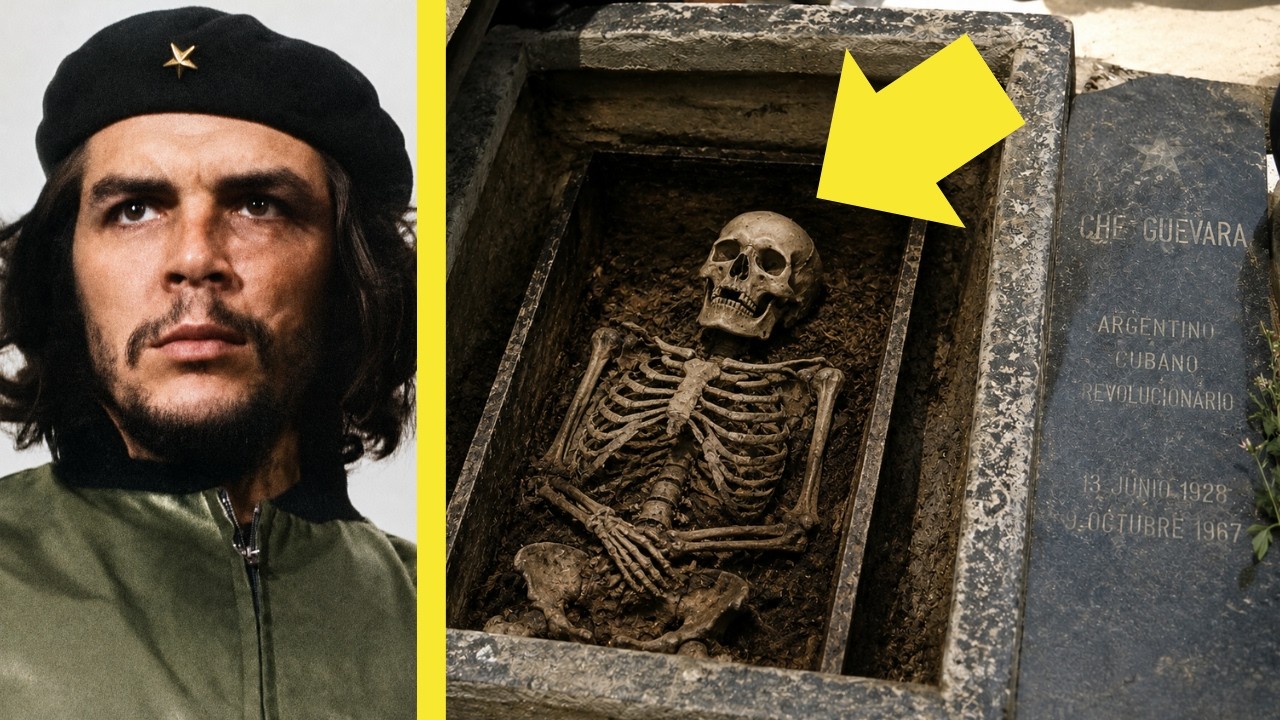
Inside, they found a skeleton without hands. It was the proof they had been searching for. The coffin of Che Guevara was opened, the remains confirmed, and the man who had once helped topple a government was finally sent home to Cuba. Born Ernesto Guevara de la Serna in Argentina in 1928, Guevara trained as a doctor and spent his young adulthood traveling across South America.
Those journeys exposed him to widespread poverty and political instability, and they convinced him that only armed revolution could bring real social change. In the mid-1950s, he met the Cuban revolutionary Fidel Castro in Mexico. Together they planned an insurrection against the Cuban government of Fulgencio Batista. After years of guerrilla warfare, Castro’s forces seized power in January 1959, and Guevara quickly became one of the most powerful figures in the new government.
He served as president of Cuba’s national bank and later as minister of industry. He also oversaw the revolutionary tribunals that sentenced many supporters of the old regime to death. Admirers called it revolutionary justice; critics called it political execution. The debate over his legacy has never ended.
Guevara did not believe the revolution should stop at Cuba’s shores. In 1965 he secretly left the island and tried to support revolutionary movements elsewhere. After a failed campaign in the Congo, he turned his attention to Bolivia. He believed the Andean countryside could become a launching point for communist revolutions across South America.
But the Bolivian campaign ran into problems almost immediately. Guevara struggled to recruit local peasants, many of whom distrusted foreign revolutionaries. The Bolivian army, backed by American advisors trained specifically to hunt guerrillas, tracked his small force relentlessly. By late 1967, Guevara’s group had shrunk to a handful of exhausted fighters.
On October 8, 1967, Guevara was wounded and captured during a battle in the Quebrada del Yuro ravine in southeastern Bolivia. He was taken to the nearby village of La Higuera and held overnight in a small schoolhouse. The next day, after discussions among Bolivian military leaders and government officials, the decision was made to execute him rather than put him on trial. On October 9, Bolivian Sergeant Mario Terán entered the schoolhouse and shot Guevara multiple times.
The official announcement claimed Guevara had died from wounds suffered in battle, but it quickly became known that he had been executed after capture. He was thirty-nine years old. His body was flown by helicopter to the town of Vallegrande. There, soldiers displayed the corpse on a concrete washbasin inside a local hospital.
Journalists, troops, and local residents came to see the body, and the photographs taken during that display were published around the world, becoming some of the most famous images of the century. Many observers noted that Guevara’s appearance resembled traditional artistic depictions of Christ, giving his death a quasi-martyred quality. Before burial, Bolivian authorities amputated both of his hands. The act was not meant to desecrate the corpse but to confirm his identity.
Fingerprint records were needed to prove beyond doubt that the dead man was truly Che Guevara. Once the prints were taken, the hands were preserved separately, and the rest of his body disappeared. For decades, the exact location of his grave remained one of Latin America’s greatest historical mysteries. The Bolivian government kept the burial site deliberately secret.
Officials feared that a known grave would draw communist sympathizers from all over the world and become a permanent site of political pilgrimage. Instead, Guevara and several of his fallen comrades were buried in an unmarked trench near the Vallegrande airstrip. Very few people knew the precise location, and those who did rarely spoke about it. Rumors flourished.
Some claimed his body had been cremated. Others believed it had been secretly moved to another country. Still others suggested it had been buried beneath military buildings or roads to prevent discovery. The ambiguity only added to Guevara’s legendary status.
The breakthrough finally came in the 1990s. A retired Bolivian general named Mario Vargas revealed information suggesting that Guevara had been buried near the old Vallegrande airstrip. His testimony encouraged the Bolivian government to allow a full archaeological investigation. An international team of forensic archaeologists, anthropologists, and other specialists traveled to Bolivia and began excavating.
The search was painstaking. Investigators examined military records, interviewed witnesses, studied old maps, and carefully dug through areas whose features had changed over the years. In June and July of 1997, the team finally discovered a mass grave containing the skeletal remains of several guerrilla fighters. Among them was one skeleton that drew immediate attention.
It was missing both hands. Because Guevara’s hands had been removed after his death, this was strong evidence that the investigators had found the revolutionary leader. The remains were then subjected to a meticulous forensic examination. The coffin and protective containers used during the exhumation had to be opened so specialists could study every part of the skeleton.
The examination was not intended for public display; it was conducted for scientific identification. Specialists compared the skeleton to Guevara’s medical records, photographs, and historical accounts. They examined his height and estimated his age and bone structure. Old injuries matched fractures Guevara had suffered during his life.
The clothing and personal equipment buried alongside the skeleton matched eyewitness descriptions from 1967. Although DNA testing was still developing in the 1990s and was not as comprehensive as modern techniques, the combination of physical evidence convinced investigators that the remains were almost certainly those of Che Guevara. Most historians accept that identification today. Once the forensic investigation was complete, the remains were cleaned, documented carefully, and placed in a new coffin for the long journey back to Cuba.
The transfer required the exhumed remains to be handled with respect before the coffin was permanently sealed. Guevara’s return to Cuba became a major national event. In July 1997, the coffin arrived amid full military ceremony. Huge crowds gathered as ceremonies were held across the island.
Thousands of Cubans lined the streets to watch the procession. State television broadcast the events live, and Fidel Castro delivered speeches praising his former comrade as a model of revolutionary sacrifice. Because only skeletal remains survived after roughly three decades underground, there was no public display of Guevara’s body. Instead, the ceremonies centered on the coffin itself, which symbolized the return of one of Cuba’s most famous revolutionaries.
After the ceremonies, Guevara’s coffin was taken to the Che Guevara Mausoleum, built specifically for this purpose in Santa Clara. The city held deep symbolic significance because it was there, in December 1958, that Guevara had led the decisive battle that helped topple Batista’s government. Inside the mausoleum, Guevara was buried alongside several of the fighters who had died with him during the Bolivian campaign. The site quickly became one of the most visited monuments in Cuba, drawing visitors from around the world.
Some come to honor him as an anti-imperialist hero; others come simply because of his extraordinary place in modern history. Unlike many famous historical figures whose coffins have been reopened for scientific study or archaeological curiosity, there is no credible evidence that Che Guevara’s coffin has been opened again since his reburial in 1997. It remains sealed inside the Santa Clara mausoleum, treated with great respect by the Cuban government. The opening of Che Guevara’s coffin served a purpose entirely different from many other famous exhumations.
It was not done to satisfy public interest, to display his remains, or even to investigate the cause of his death. Historians already knew how he died. Instead, the coffin was opened as part of a precise forensic investigation aimed at solving one of the Cold War’s greatest mysteries. Experts needed to examine the skeleton, confirm its identity, preserve the remains, and prepare them for a proper reburial.
Nearly thirty years after bullets ended Che Guevara’s life in a remote Bolivian village, archaeologists finally answered the question that had puzzled historians for decades: where was he buried? The recovery of his remains turned legend into documented history through archaeology, forensic science, and painstaking investigative work. The mystery of his disappearance was finally closed, allowing one of the twentieth century’s most famous revolutionaries to receive the final rest he had been denied for nearly three decades.
