On the night of March 3, 1924, a train waited at a small station on the edge of Istanbul, away from the main Sirkeci terminal where crowds might gather. The famous Simplon Orient Express hissed steam into the cold spring air. Women carried jewelry boxes. Men lugged hastily packed suitcases.
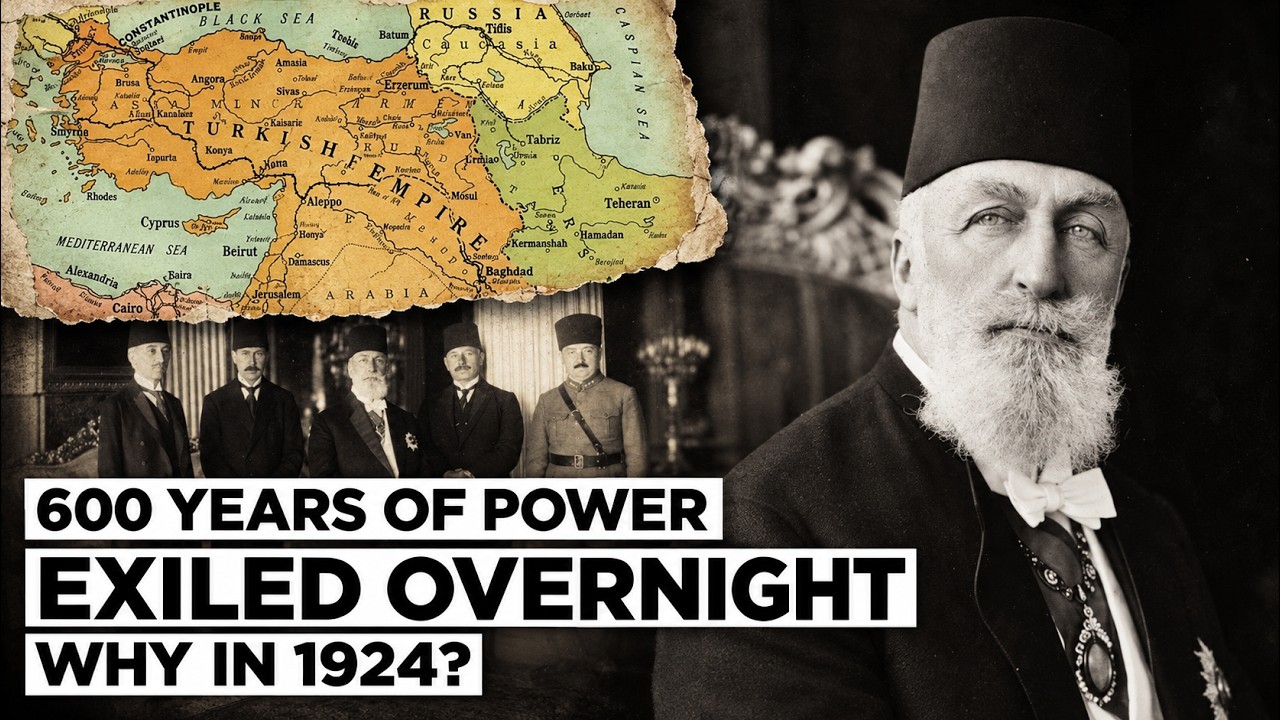
Children did not understand what was happening. These were not ordinary travelers. They were the descendants of a dynasty that had ruled for more than six hundred years. About 157 members of the House of Osman had been given only days to leave Turkey forever.
Their passports were revoked. Their palaces were confiscated. Their names were being struck from official records. Among them was Abdulmejid II, the last caliph of Islam, rushed to that train with two thousand pounds in cash and whatever belongings he could gather in a matter of hours.
He would never see his homeland again. The Ottoman Empire had outlasted the Spanish Empire, the Russian Empire, the French monarchy, and most of the royal houses of Europe. From 1299 to 1922, the dynasty produced thirty-six sultans in unbroken succession. At its peak, it controlled territory across three continents, from Hungary to Yemen, from Algeria to Iraq, ruling an estimated thirty million people.
Yet within a single generation, the entire dynasty was erased from the political map, scattered across Europe as stateless refugees. The story began in 1299 in the small town of Sögüt in northwestern Anatolia. The Seljuk Turks were collapsing. The Byzantine Empire was crumbling.
Amid this chaos, a Turkish warrior named Osman Ghazi, son of tribal leader Ertuğrul, declared his independence and began carving out a small principality through raids on Byzantine lands. He was not thinking of founding an empire. He simply sought survival and expansion. But the name he left behind, Osman, which Europeans rendered as Ottoman, would shape world history for six centuries.
Osman died around 1323 or 1324, just before his son Orhan captured Bursa. The next three generations transformed this small border state into a regional power. Orhan took Bursa and made it the capital. His son Murad I conquered most of the Balkans and openly called himself sultan.
By the late fourteenth century, the Ottomans controlled Anatolia and southeastern Europe. Their first great test came in 1402, when the Central Asian conqueror Timur smashed the Ottoman army at the Battle of Ankara and captured Sultan Bayezid I. For a moment, the entire project seemed finished. The empire dissolved into a brutal civil war among Bayezid’s sons that lasted more than a decade.
Yet the Ottomans survived, reunited, and rebuilt. Then, in 1453, under Sultan Mehmed II, they achieved what no one had done in over a thousand years. They captured Constantinople. The eleven-hundred-year-old capital of the Eastern Roman Empire fell after a fifty-three-day siege.
Mehmed, only twenty-one years old, entered Hagia Sophia and ordered its immediate conversion into a mosque. The city was renamed, resettled, and rebuilt. From that moment, the Ottoman Empire was no longer a regional power but a world power. The sixteenth century was the golden age.
Süleyman the Magnificent ruled from 1520 to 1566, forty-six years. His forces took Belgrade, conquered Rhodes, annexed most of Hungary after the Battle of Mohács in 1526, and besieged Vienna in 1529. To the east, they captured Baghdad. In North Africa, Algeria, Tripoli, and much of modern Libya fell under Ottoman control.
Süleyman also codified the empire’s laws, reformed the tax system, and commissioned architecture on a scale rarely seen. The great architect Mimar Sinan built mosques that still dominate the Istanbul skyline. In 1517, Süleyman’s father Selim I conquered Egypt and defeated the Mamluk Sultanate. According to Ottoman tradition, the last Abbasid caliph, living under Mamluk protection in Cairo, transferred the title of caliph to Selim.
Historians still debate whether this transfer happened exactly as the Ottomans later claimed. But what mattered was that from that moment, Ottoman sultans claimed to be caliphs of all Sunni Muslims worldwide. They were no longer mere emperors. They were, in theory, leaders of the entire Islamic community, from Morocco to Indonesia.
This dual role, political sultan and spiritual caliph, would ultimately lead to the dynasty’s destruction. The long decline began in the late seventeenth century. In 1683, the Ottomans besieged Vienna a second time, but a joint European army led by the Polish king Jan Sobieski crushed them. Over the next sixteen years, they lost Hungary and much of their European territory.
Europe surged ahead technologically, economically, and militarily. The Ottomans missed the Scientific Revolution and the Industrial Revolution. The Janissaries, once an elite shock force, became a corrupt palace guard that staged coups, deposed sultans, and resisted any modernization. Throughout the eighteenth and nineteenth centuries, the empire lost a war nearly every decade.
The Russians pushed them off the northern Black Sea coast. The Greeks won independence in the 1820s. Serbs, Bulgarians, and Romanians broke away one by one. France invaded Algeria in 1830.
Britain occupied Egypt in 1882. By the mid-nineteenth century, European diplomats called the empire the sick man of Europe. Everyone waited silently for its collapse so they could divide the remains. The nineteenth century saw desperate reform attempts.
The Tanzimat reforms, launched in 1839, sought to modernize the army, law, and education. In 1876, Sultan Abdulhamid II issued the empire’s first written constitution. Two years later, he suspended it and ruled as an absolute monarch for three decades. He built railroads, including the famous Hejaz Railway to Mecca and Medina, and modernized the military with German advisors.
But he also oversaw the Hamidian massacres of Armenians in the 1890s, which killed between one hundred thousand and three hundred thousand people. He ran the empire through one of the most extensive secret police networks in the world. In July 1908, a group of military officers known as the Young Turks forced Abdulhamid to restore the constitution. A year later, after a failed counter-coup, they deposed him entirely.
His brother Mehmed V became a figurehead. Real power passed to three officers: Enver Pasha, Talaat Pasha, and Cemal Pasha. By 1913, they effectively controlled the empire. Then came World War I, the point of no return.
In November 1914, the Ottoman Empire entered the war on the side of Germany and Austria-Hungary. It was a catastrophic decision. The Young Turk leadership gambled that a German victory would restore Ottoman greatness. Instead, the empire fell apart.
The British and French invaded from all sides. The Russians pushed into eastern Anatolia. The Arab Revolt, supported by British officers including T. E.
Lawrence, tore away the Arabian Peninsula and the Levant. The war brought terrible suffering, including the Armenian genocide of 1915 and 1916, in which an estimated 1. 5 million Armenians were killed in massacres, forced marches, and deportations. When the Armistice of Mudros was signed on October 30, 1918, the Ottoman army was defeated, the Young Turk leaders fled on a German ship, and the empire teetered on total collapse.
Allied forces occupied Baghdad, Damascus, Jerusalem, and most of the Arab provinces. On November 13, 1918, British, French, and Italian warships sailed into the Bosporus and occupied Istanbul itself. For the first time since 1453, foreign flags flew over Constantinople. In the midst of this catastrophe, a new sultan had taken the throne.
Mehmed VI Vahdeddin became the thirty-sixth sultan on July 4, 1918, as the war was collapsing. He was fifty-seven, intelligent, politically shrewd, and determined to save the state. His strategy was to cooperate with the occupying Allied forces, hoping the empire might survive in some reduced form. In August 1920, his government signed the Treaty of Sèvres, the most humiliating treaty in Ottoman history.
It reduced the empire to a small region in central Anatolia. The straits came under Allied control. The imperial capital itself was placed under international administration. Smyrna was given to Greece.
Independent Armenian and Kurdish states were planned in the east. Had the treaty taken effect, the Ottoman state would have shrunk to a small kingdom around Ankara, and the sultan would have been merely a symbol propped up by British bayonets. But something unexpected happened. Amid the chaos of occupation, a resistance movement formed in the Anatolian heartland, led by a brilliant and ruthless Ottoman general named Mustafa Kemal Pasha.
Kemal was a veteran of the Gallipoli campaign of 1915, where he led the Ottoman defense against British and Anzac landings and became a national hero. He was a militant Turkish nationalist, a believer in modernization, and he had no patience for Allied occupation or the sultan’s willingness to accept it. In May 1919, the same month Greek forces landed at Smyrna, Kemal was officially sent by the Ottoman government to inspect military units in eastern Anatolia. Instead, he used the trip to organize a resistance movement.
On April 23, 1920, he convened a new parliament in Ankara, the Grand National Assembly, which declared itself the only legitimate government of Turkey. The sultan’s government in Istanbul condemned Kemal as a traitor. Mehmed VI even issued a religious ruling calling for his execution. But Kemal had the army and the people.
The Turkish War of Independence raged from 1919 to 1922. Kemal’s forces fought the Greeks in the west, the French in the south, Armenian forces in the east, and various pro-sultan militias. By September 1922, the nationalist army crushed the Greek forces in a sweeping offensive and recaptured Smyrna. The city burned in a devastating fire that killed tens of thousands of Greek and Armenian civilians.
The Allies, exhausted and unwilling to fight for a treaty they could barely enforce, agreed to negotiate. The Armistice of Mudanya took effect on October 15, 1922. The old Treaty of Sèvres was dead. Now Kemal turned his attention to the sultan.
On November 1, 1922, the Grand National Assembly in Ankara voted to abolish the sultanate. The debate was heated. Many deputies were devout Muslims disturbed by the removal of the sultan, especially since he was also the caliph. According to accounts of the session, Kemal stood and delivered a thunderous speech, telling the assembly that sovereignty is seized by force, not granted by religious tradition.
He was said to have warned that some heads might roll if they voted against the measure. They voted for it. The 623-year-old Ottoman monarchy ended not with a battle or revolution, but by a vote in a provincial parliament 450 kilometers from the capital. When news reached Istanbul, Sultan Mehmed VI realized his life was in danger.
He had no army, no allies in the city, no popular support. His government was dissolved. On November 16, 1922, he wrote to the British general occupying Istanbul, Sir Charles Harington, asking for protection: Since my life is in danger in Istanbul, I take refuge with the British government and request my transfer as soon as possible from Istanbul to another place. The next morning, before dawn, Mehmed VI slipped out of Yildiz Palace.
General Harington personally escorted the last Ottoman sultan to the harbor, where the British battleship HMS Malaya waited. Mehmed brought only his personal belongings, no jewels, no state treasures, nothing that could be considered looting of national property. By dawn, the sultan was already at sea. The House of Osman had ruled Turkey for 623 years.
Now it ruled nothing. Two days later, on November 19, 1922, the Grand National Assembly made a strange decision. It abolished the sultanate but kept the caliphate. It elected Mehmed’s cousin, Abdulmejid Efendi, as the new caliph of Islam.
But the caliph now had no political power whatsoever. He was a purely religious symbol, residing in Istanbul but subordinate to the republican government in Ankara. It was a bizarre compromise, half monarchy and half not, and it was never going to last. Abdulmejid II was, in many ways, a strange choice.
He was fifty-four, highly educated, a trained painter whose works had been exhibited in Paris. He spoke fluent French and considered France his second home. He was fascinated by classical music, Western literature, and European art. Politically, he was completely naive.
From the moment he took office, he began acting as though he were a real caliph with actual authority. He wore ornate ceremonial robes. He wrote letters to foreign Muslim leaders. He received Islamic delegations from India, Egypt, and across the Muslim world.
He attended Friday prayers at Hagia Sophia and the Fatih Mosque with grand ceremony. All of this infuriated Mustafa Kemal, who had explicitly told him not to interfere in political affairs. Abdulmejid ignored the warnings. Meanwhile, Kemal consolidated his power at astonishing speed.
The Treaty of Lausanne, signed on July 24, 1923, replaced the hated Treaty of Sèvres and granted full international recognition to the new Turkish state. On October 29, 1923, Kemal declared the Republic of Turkey and was elected its first president. The old imperial order was officially over. The question of the caliphate grew more urgent.
Two prominent Indian Muslim leaders, the Aga Khan and Syed Ameer Ali, sent an open letter to the Turkish prime minister urging him to preserve the caliphate as a symbol of Islamic unity. The letter was leaked to the Turkish press and portrayed as foreign interference in Turkey’s internal affairs. Kemal seized on the issue, delivering fiery speeches denouncing the caliphate as an institution contrary to the will of the people, a nightmare weighing on the Turkish nation. On March 3, 1924, the Grand National Assembly passed three laws that changed Turkey forever.
The first abolished the Ministry of Religious Law and Pious Foundations. The second established a unified secular education system. The third, Law Number 431, abolished the caliphate itself and ordered the exile of all members of the Ottoman dynasty from Turkish territory. Chaos swept Istanbul when the news arrived.
Abdulmejid II was at Dolmabahçe Palace when a delegation of officials came to inform him of the law. His first reaction was defiance. He reportedly said he would not go under any circumstances. But he had no choice.
The governor of Istanbul, backed by police and soldiers, told him he had to leave within hours. He was given two thousand pounds in cash and told to pack. Late on the night of March 3, and into the early hours of March 4, he was led out of the palace with his family. They were not taken to the main Sirkeci station, where crowds might gather and incidents might occur, but to a smaller station at Çatalca on the city’s outskirts.
There, they boarded the Orient Express bound for Switzerland. When Swiss border guards stopped the train at noon on March 7, 1924, the last caliph of Islam, the direct descendant of Osman I, became a stateless refugee. The rest of the dynasty followed over the next few days. All told, roughly 157 people were expelled.
Princes, princesses, wives, children, elderly uncles and aunts, all of them. They were given three days to sell their property. Many sold everything at rock-bottom prices to Istanbul merchants who exploited the situation. The law also provided for state confiscation of any real estate registered in the sultans’ names.
The palaces, villas, country estates, and farms all became property of the new republic. The dynasty was stripped not only of its throne but of nearly all its material possessions within Turkey. The night of March 6, 1924, was when most of them boarded the train. The writer Ayşe Osmanoğlu, herself of dynastic lineage, described how her ancestors said they left their souls in Istanbul that cold spring night when they boarded the Simplon Orient Express and crossed the Turkish-Bulgarian border.
These were people raised in palaces along the Bosporus, served by thousands of staff, who had never in their lives needed to think about money, passports, train tickets, or the cost of a hotel room. Overnight, they became stateless exiles with nothing but what they could carry in a few suitcases. The government issued them travel documents valid for only one year. When those expired in 1925, the dynasty had to rely on the goodwill of foreign governments to issue any kind of travel permit.
France was especially hospitable, which is why many Ottoman princes and princesses settled on the French Riviera. Abdulmejid II first stayed in a Swiss hotel, then moved to Nice in October 1924, where he bought a nineteenth-century villa called Villa Carabasiel. He lived there for most of the remaining twenty years of his life, painting, listening to chamber music played by his wives and household ladies, writing his memoirs, and trying desperately to arrange politically advantageous marriages for his children. His grandest project was marrying his daughter Dürrüşehvar into one of the great Muslim royal families of the East.
In 1937, after years of complex negotiations involving messengers traveling between France, Persia, Iraq, Egypt, and India, Dürrüşehvar married Azam Jah, the crown prince of the Nizam of Hyderabad. In the same ceremony, her cousin Nilüfer married Azam Jah’s brother. The Nizam, believed to be one of the richest men in the world, quietly supported the exiled caliph financially. Without that support, Abdulmejid would have spent his days in abject poverty.
Other family members scattered across the Mediterranean and beyond. Some settled in Beirut, others in Cairo, others in Damascus. A few reached London, Berlin, or New York. Many of the princes had been trained as Ottoman military officers, a career they could never practice again.
Children born in exile grew up with French, Egyptian, Lebanese, and Syrian passports. Many never learned Turkish fluently. The second generation lost most of their connection to a homeland their parents still mourned every day. By the 1930s and 1940s, the Ottoman dynasty had shrunk to a scattered network of impoverished aristocrats living on the charity of other Muslim rulers, on the slow sale of family jewels, and increasingly on their own modest incomes from ordinary jobs in European cities.
Some became music teachers. Some became translators. One prince ended up working as a mechanic in Paris. Abdulmejid II died in Paris on August 23, 1944, at the age of seventy-six.
The city was still under German occupation, complicating his burial. His body remained in Paris for ten years because Turkey refused to allow his return to Istanbul. He was finally buried in Medina, Saudi Arabia, in 1954. He never saw his homeland again.
The exile lasted for decades after his death. For twenty-eight years, there was no legal way for any family member to return. Then, on June 16, 1952, the Turkish parliament amended Law 431 to allow women of the ruling family to return. The change came partly in response to pressure from Egypt and other Islamic countries, and partly as recognition that women posed no political threat.
Some princesses began visiting Istanbul in the following years, often quietly, frequently weeping on the ferry crossing the Bosporus as they saw their birthplace for the first time in nearly three decades. The men had to wait another twenty-two years. Male descendants were only allowed to return home under a general amnesty law of May 15, 1974. By that time, the first generation of exiles was almost entirely dead.
The abolition of the caliphate had enormous repercussions across the Islamic world. For centuries, Muslims from Morocco to Indonesia had looked to the Ottoman sultan-caliph as the symbolic head of the global Islamic community. When Kemal abolished the office in 1924, shock rippled through the Muslim world. In India, there had been an active Caliphate movement, led by Muslim leaders with support from Mahatma Gandhi.
Overnight, that movement collapsed. In Arabia, Sharif Hussein declared himself caliph on March 11, 1924, just eight days after the Ottoman abolition. His caliphate lasted only six months before the Saudis invaded the Hijaz and exiled him. A Caliphate conference in Cairo in 1926 ended in deadlock.
Nobody could agree on who should hold the title or how a new caliph should be chosen. The vacuum left by the fall of the Ottoman caliphate, it can be argued, has never been filled. For the winners in this story, the picture is clearer. Mustafa Kemal, who took the name Atatürk in 1934, meaning Father of the Turks, continued transforming Turkey into a modern secular state at a pace that still astonishes historians.
He abolished the Islamic court system. He replaced the Arabic script with a modified Latin alphabet in 1928, meaning Turks lost, within a single generation, the ability to read any document written in their country before that date. He closed the Sufi lodges in 1925. He banned the fez and discouraged the wearing of the veil.
He gave women the right to vote in national elections in 1934, before many European countries. He built an entirely new national identity from scratch, consciously cutting most ties with the Ottoman and Islamic past. He died on November 10, 1938, and remains the central figure of modern Turkish identity. The Ottoman dynasty itself continues to this day.
It is currently headed by Harun Osman, born in 1932, who became head of the family in January 2021 after the death of his cousin Dündar Osmanoğlu. He is a grandson of Sultan Abdulmejid I. The family today numbers hundreds of members scattered across Turkey, Europe, the Middle East, and the United States. Some became businessmen or academics.
A few wrote published memoirs. Most live ordinary lives, their famous surname merely a historical curiosity. In 2006, family members gathered at Dolmabahçe Palace, the very palace from which Abdulmejid II had been expelled eighty-two years earlier, in a reunion. There was no attempt to reclaim anything, no political demand, just a visit by descendants to the home their ancestors had been forced to leave in the middle of the night.
In recent years, there have been modest legal victories. In 2025, after a fifteen-year legal battle, a court in Istanbul recognized seventy-one people as legal heirs of Sultan Abdulhamid II. The ruling rested on a specific legal technicality: Abdulhamid died in 1918, six years before the 1924 exile law. His heirs proved the law could not be applied retroactively to a dead man, and his property had passed to his descendants under the legal system before 1924.
The ruling opened a small crack in the wall that has prevented the family from recovering inherited property for a century. It remains to be seen whether it will lead to any real restoration of palaces or lands. The story of the Ottoman dynasty is a reminder of how quickly even the most deeply rooted systems can collapse. For 623 years, no one could imagine Turkey without a sultan.
All those titles, father of the nation, protector of Islam, commander of the faithful, shadow of God on earth, were thrown onto the ash heap of history in just sixteen months, between November 1922 and March 1924. The dynasty that had recaptured Constantinople from the Byzantines, challenged the Habsburgs at the gates of Vienna, ruled more than thirty million people, and given the Islamic world its most enduring political institution for nearly half a millennium, scattered overnight. The great palaces became museums. The imperial treasury passed to the Turkish state.
The vast network of pious foundations that had funded Ottoman civilization for centuries came under state control. The family crushed between these two answers, the men and women who boarded the Orient Express from Sirkeci and Çatalca in the first week of March 1924, were the human cost of that transition. They paid the price for the birth of the republic. The men and women who boarded that train on the night of March 6, 1924, had grown up believing their family had ruled since before Columbus sailed to the Americas.
By the next morning, they were just passengers on a train heading somewhere they had never been, carrying travel documents that would expire in a year. That story, more than any battle, treaty, or revolution, is the true end of the Ottoman Empire.
