For eighteen years, deputies from the Riverside County Sheriff’s Department knocked on Gary Fenwick’s door sixty times. He was an elderly man who lived alone, and neighbors occasionally worried about him. A polite figure in his late sixties, he kept to himself, tended his property, and waved from the driveway. Each time, the deputies stood on the porch of the house on Morse Canyon Road and spoke to him through the screen door or in the yard.
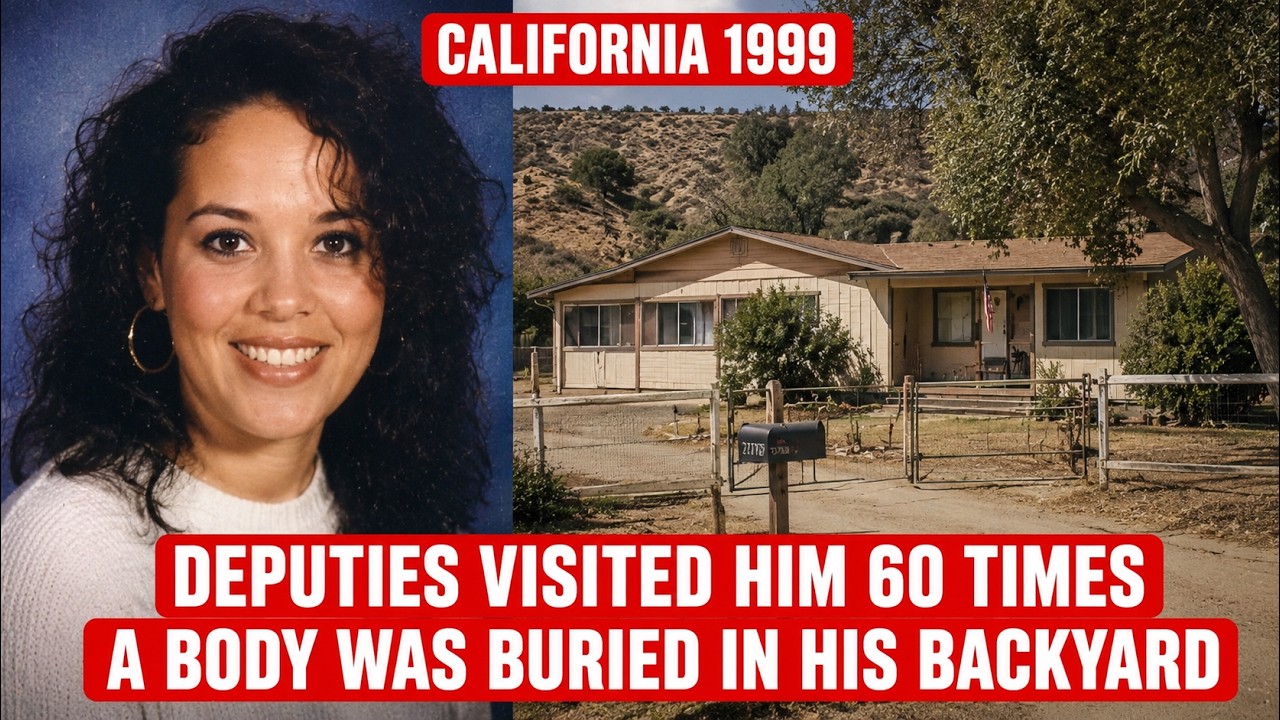
They checked on him in summer heat and winter cold. They wrote in their logs that the resident was fine, no concerns, no action required. They had no idea that for most of those eighteen years, a woman was buried on that property. Her name was Deborah Ruiz.
She was thirty-four years old, a mother of two, and on a September evening in 1999 she drove to Gary Fenwick’s house to collect money he owed her from a landscaping job. She never came home. Nobody connected those welfare checks to a missing woman for nearly two decades. But a property tax lien, a county assessor’s notice, and one retired detective who still carried her file in the back of his truck changed everything in 2017.
The Inland Empire in 1999 was a place of relentless expansion. Subdivisions went up faster than the roads to serve them. Orange groves that had defined the region for a century were being pulled out by their roots to make way for cul-de-sacs, big box stores, and commuter corridors that fed workers into Los Angeles each morning and returned them each night. On the edges of that growth, in the unincorporated land east of Moreno Valley where the desert started to reassert itself, there were still stretches of road where you could go a long way between neighbors.
Morse Canyon Road was one of those roads. Deborah Ruiz had grown up in the valley of Perris, the youngest of five children in a family that had been in the Inland Empire since her grandparents arrived from Michoacán in the 1950s. She worked as a bookkeeper for a landscaping company called Desert Verde Landscaping, handling accounts receivable, invoices, and payment tracking, chasing down clients who fell behind. Her boss described her as the person who kept the business running, the one who remembered every outstanding invoice and every excuse a client had ever given for not paying one.
She raised her two children, a son aged nine and a daughter aged six, largely on her own, though her family was close and her mother helped three evenings a week. Every Friday night, without exception, she made tamales with whatever filling her children requested, and they ate at the kitchen table together without the television on. She kept a small green accounts ledger in her car at all times. Every outstanding payment was written in it by hand in her careful block print, with the client’s name, the amount owed, and the date the invoice had been sent.
She updated it every Monday morning. It was how she made sure nobody got away with not paying. In August 1999, Desert Verde Landscaping completed a landscaping job at a property on Morse Canyon Road. The client’s name was Gary Fenwick.
The invoice was for $940. It had not been paid in thirty days, then sixty. By September, it appeared in Deborah’s ledger as overdue, flagged, requiring follow-up. On the evening of September 17th, she told her mother she was driving out to collect the money personally.
She had done this before with difficult clients. She expected to be home by nine. She kissed her children good night before she left. Her daughter was already in pajamas.
Her son was doing homework at the kitchen table. She never came home. Deborah’s mother called the Riverside County Sheriff’s Department at 11:45 that night. At first, the deputies did not treat the call with the urgency Teresa Ruiz felt it deserved.
Deborah was a thirty-four-year-old adult woman. She had told her mother she was going to collect a payment from a client. Adults, the deputies explained, sometimes changed their plans. They logged the report and said to call back in the morning if she still had not returned.
By morning, she had not. The lead investigator assigned to the case was Detective Ramon Villanueva, a thirty-six-year-old, twelve-year veteran of the department who had worked financial crimes and major crimes in roughly equal measure. He was methodical and kept his case notes in a spiral-bound notebook rather than a ring binder. Ring binders, he said, made you think you could rearrange the story.
Spiral notebooks kept things in order and kept you honest. He had Deborah’s ledger within forty-eight hours. The last entry was for Gary Fenwick, Morse Canyon Road, dated September 15th. Amount $940.
Overdue. Villanueva drove to Morse Canyon Road on September 19th, two days after Deborah disappeared. Gary Fenwick answered the door. He was sixty-seven years old, gray-haired, unhurried.
He invited Villanueva inside without hesitation. Yes, Deborah Ruiz had come by a couple of evenings ago. He had paid her cash, which he preferred for transactions like that. She had counted it, thanked him, and left.
He had no idea she was missing. He seemed, by every visible measure, genuinely concerned. He offered coffee. Villanueva accepted, walked the exterior of the property as Fenwick spoke, noted the layout, noted the man’s manner, and left with nothing he could use.
Fenwick’s account could not be disproved. No neighbors had seen Deborah’s car arrive or leave. Her white 1994 Honda Civic had not been located. Fenwick had no prior criminal record.
He did not become defensive or evasive. He asked Villanueva twice whether there was anything he could do to help. He was interviewed again in December 1999 and again in March 2000. Each time cooperative, each time consistent, each time exactly the same story in exactly the same order.
Deborah’s former partner, the father of her children, had a documented alibi and was eliminated within the first month. A dispute with a commercial client from earlier in the year was examined and cleared. Her phone records showed nothing unusual. Her bank accounts showed zero activity after September 17th.
No cash withdrawals, no card transactions, nothing. People who are alive move money. Deborah Ruiz had not moved any money in three months. Villanueva made three more visits to Morse Canyon Road in 2000.
He spoke to the nearest neighbors, a couple three properties down who had been there since 1993. They described Fenwick as quiet, private, reliable, always kept the place up. There was nothing to arrest him on. There was nothing to search the property for.
In 1999 in Riverside County, without physical evidence or a witness, the threshold for a search warrant on private property was not met. By mid-2000, the active investigation had been formally scaled back to review status. Deborah Ruiz was classified as a missing person, presumed at risk. Her children were being raised by their grandmother on Perris Avenue.
Her name was entered into a database. She had disappeared, and the man who knew where she was had offered the investigating detective a cup of coffee. The years moved in the particular way that years move around an unresolved absence. Deborah’s mother, Teresa, kept her daughter’s room exactly as it was.
She took in her grandchildren permanently in 2001 and raised them through their school years. Every year on September 17th, she lit a candle at the kitchen table in the morning and left it burning all day. On Morse Canyon Road, Gary Fenwick continued his life. He maintained his property.
He observed his neighbors. When county deputies knocked on his door for welfare checks, the first one came in early 2000, requested by a neighbor who had noticed his car sitting in the same spot for four days. He answered calmly, thanked them for checking, and offered no reason for concern. The checks continued at irregular intervals over the years.
A new neighbor, a stretch of unusual silence, a different deputy each time, working from a log that noted the address, the date, the outcome. Resident present, appears well, no concerns. Page after page, year after year. Detective Ramon Villanueva retired from the department in 2009.
Before he went, he wrote a summary memo for each of his unresolved cases and attached it to the front of the file. Deborah Ruiz’s memo was two pages long. At the bottom, he added a note in his own handwriting. Last known contact, Fenwick G.
, Morse Canyon Road. Story never fully checked. Revisit if property ever changes hands or owner dies. He kept a photocopy of that memo in a folder in the back of his truck.
He drove that truck for the next eight years. In the spring of 2017, the Riverside County Assessor’s Office sent Gary Fenwick a notice of property tax delinquency. Fenwick had fallen behind on payments, not dramatically, but enough that the county filed a lien. The lien was a public record.
It triggered automatically a flag in the county’s record system for properties with delinquency notices against owners over the age of seventy. A county social worker made a home visit in April. Fenwick answered the door. He was eighty-five now, visibly older, moving slowly.
He said he was fine, that he had been meaning to sort out the taxes. The social worker made a note. She also noticed that the property, always neat when deputies had checked on it, looked different, overgrown in places. A section of fencing along the rear of the lot had come down.
She filed a report. The report, as a matter of routine, was cross-referenced with active welfare records for the address. A clerical supervisor in the county office noticed that the address on Morse Canyon Road appeared not only in the current welfare file, but also through an old cross-reference flag that Ramon Villanueva had placed on the address before he retired. She forwarded the flag to the sheriff’s cold case unit.
The detective who picked it up was Sergeant Lisa Dominguez, who had been working cold cases for six years after a decade in homicide. She pulled the Ruiz file on a Tuesday morning, read Villanueva’s two-page memo, read the handwritten note at the bottom, and immediately called the retired detective. Villanueva answered on the second ring. He had been waiting, without knowing it, for eighteen years.
The Ruiz case, Dominguez said. Fenwick, he said before she could say anything else. The property. It was always the property.
Within seventy-two hours, Dominguez secured a search warrant for the Morse Canyon Road address. On a Thursday morning in late April 2017, a forensic excavation team began working the rear section of the property behind the fallen fence line. They found Deborah Ruiz on the second day. She was identified by dental records within forty-eight hours.
The medical examiner determined the cause of death as blunt force trauma. The remains had been buried at a depth consistent with intentional concealment. Several personal effects were recovered with her, including, in fragmentary condition, the cover of a small green ledger book. Gary Fenwick was arrested at a care facility in Hemet on May 3rd, 2017.
He had moved there eight months earlier when managing the property had become too physically difficult for a man of eighty-five. He had sold the property in 2016. He was in the common room reading a newspaper when the detectives arrived. He did not resist.
He did not ask questions. He stood when they asked him to stand, walked when they asked him to walk, and was placed in the vehicle without incident. The trial in Riverside County Superior Court began in March 2018. The defense argued that the physical evidence was circumstantial, that the presence of remains on a property sold by the defendant did not establish beyond reasonable doubt that he had caused the death.
The prosecution presented four categories of evidence. First, the forensic evidence itself: the manner of burial, the depth, and the recovery of personal effects alongside the remains, including the green ledger cover. Medical examiners testified that the burial was not accidental and not recent. Second, Deborah’s ledger entry preserved in the original case file since 1999.
Fenwick, $940, overdue, the last outstanding account in her book. Third, Villanueva’s testimony. He took the stand and walked the jury precisely through eighteen years of suspicion he had not been able to prove. He was sixty-two years old and spoke without notes.
Fourth, a recorded phone call. In the days following his arrest, Fenwick had used the care facility’s phone to call a distant cousin. The call was recorded as a matter of routine. In it, speaking in a voice that was tired and flat, he said they were always going to find her eventually.
I just didn’t think it would be me who was still alive when they did. The courtroom was silent when the recording finished. He was convicted of first-degree murder on November 14th, 2018. He was sentenced to twenty-five years to life.
He was eighty-six years old at sentencing. He will die in custody. Outside the courthouse, Deborah’s daughter, now thirty-two years old, the same age her mother had been when she drove to Morse Canyon Road, read a statement she had written herself in longhand on a single sheet of paper. My mother kept a ledger so nobody could get away with not paying what they owed, she said.
In the end, that ledger was part of what found her. She folded the paper and did not add anything else. Gary Fenwick had lived on Morse Canyon Road for eighteen years with Deborah Ruiz buried behind his fence line. He had answered sixty welfare checks.
He had offered coffee to the detective investigating her disappearance. What undid him was not a witness, not a confession, not a forensic breakthrough. What undid him was a property tax bill he did not pay, a clerical cross-reference flag that a retiring detective had planted in a database eight years earlier, and a county supervisor who noticed that two records from two different departments pointed at the same address. Bureaucracy found what investigation could not reach.
Deborah Ruiz was thirty-four years old. She drove to Morse Canyon Road on a September evening with a name in her ledger and an outstanding invoice, because she believed that people who owed money should pay it and that nobody should get to pretend otherwise. She had kissed her children good night before she left. Her daughter was in pajamas.
Her son was doing homework. She had every right to come home. Her small green ledger book, the careful block print, the Monday morning ritual, is the image that stays. She kept it so nobody could disappear a debt.
She could not have known that it would one day help make sure she herself could not be disappeared entirely. Teresa Ruiz lit the candle on September 17th, 2017. She lit it on September 17th, 2018 after the conviction. She has lit it every year since.
It burns all day as it always has. The photograph on the living room wall has not changed. Deborah is still laughing, her hand still raised.






