In 1956, the first fully enclosed, climate-controlled shopping mall in the United States opened in Edina, Minnesota. Southdale Center was the creation of Victor Gruen, a Viennese architect who had fled the Nazis in 1938 with almost nothing. Gruen was no suburban capitalist. He was a Jewish socialist and avant-garde designer who performed satirical cabaret at night.
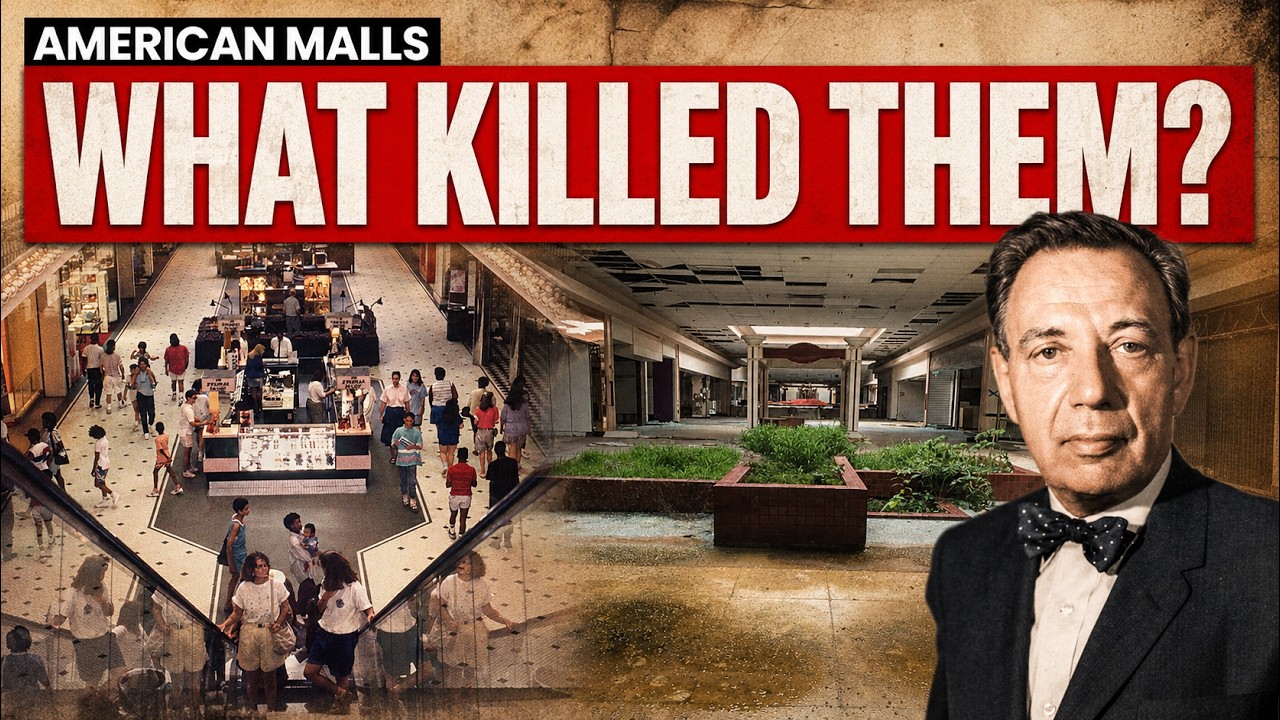
But when he looked at the new American suburbs, he saw a profound emptiness: communities without centers, neighborhoods without gathering places, families isolated in homes with nowhere to meet or simply exist together. His vision was not a shopping center but an enclosed community hub, a place that combined stores with gardens, art, medical facilities, and public squares, replicating the vibrant street life of his beloved Vienna in the middle of the American landscape. Southdale was enormous for its time: 800,000 square feet of retail space, 72 stores, 5,000 parking spots, and two anchor department stores placed at opposite ends to pull foot traffic past every smaller shop between them. A central garden court was flooded with natural light, filled with trees, sculptures, and birdcages.
The temperature was kept at a constant 75 degrees, a miracle in a region with brutal winters. And Gruen had secretly engineered something even more powerful than climate control. His layout was deliberately disorienting. Curved corridors, shifting sightlines, lighting, music, and spatial design all combined to create a pleasant confusion, a dreamlike state in which shoppers forgot what they came for and began wandering and buying things they never planned to purchase.
Consumer psychology weaponized through architecture. It worked devastatingly well. Life magazine called Southdale the splashiest shopping center in the country, and developers from coast to coast rushed to copy it. Over the next two decades, the American mall multiplied faster than anything before it.
By the mid-1970s, more than a thousand enclosed malls dotted the country, and they all followed the same formula. Two or three massive department stores, called anchor tenants, sat at opposite ends of a long corridor lined with specialty shops. A food court sat near the center, joined by a movie theater, an arcade, fountains, and acres of free parking. In suburbs that had no downtown, no main street, and no public park, the mall became all of those things.
It was where you got your ears pierced, had your first date, applied for your first job, and went on Christmas Eve. For a long time, it worked beautifully for developers, retailers, and the tens of millions of families who organized their weekends around it. But through the 1970s and 1980s, the mall did not just grow. It metastasized.
Developers realized malls were profit machines. They bought cheap land on the suburban fringe, built the mall, and watched the surrounding area explode with new housing and commercial development. Property values soared. Anchor tenants signed long leases.
Smaller retailers paid premium rent for the foot traffic the anchors generated. Everyone got rich. By 1986, America had roughly 25,000 retail malls and shopping centers, and Americans spent an average of 12 hours per month inside them. The country had accumulated nearly 24 square feet of retail space per person.
Britain had about five. Germany had two. Japan had less than two. America built ten to twenty times more retail space per person than any other developed nation, and no one stopped to ask if that made sense.
The model was cannibalizing itself. Each new mall required cheap land further out on the suburban fringe, so developers built them farther and farther from the city. New housing surrounded each new mall, families drifted away from older neighborhoods, and as soon as an even bigger, flashier mall was built on even cheaper land, the cycle repeated. The original mall lost its customer base, property values fell, retailers left, and the old mall deteriorated.
Every new mall built was a ticking clock for the one before it. But through the 1980s and 1990s, none of that mattered because the money still flowed and the culture still hummed. Fast Times at Ridgemont High celebrated mall culture in 1982. Tiffany toured malls across the country for her 1987 hit single.
The Mall of America opened in Minnesota in 1992, a 5. 6 million square foot cathedral of consumption with an indoor amusement park, an aquarium, and over 500 stores. Beneath the surface, the foundation was already cracking. The entire economic model of the American mall rested on the anchor tenant.
The department stores, names like Sears, J. C. Penney, Macy’s, Nordstrom, and Lord & Taylor, were the gravitational center of the operation. They drew the foot traffic and paid for the advertising, and in return they paid far lower rents than smaller tenants, sometimes almost nothing at all.
This arrangement worked only as long as the anchors stayed healthy, and starting in the late 1990s and accelerating through the 2000s, the American department store began to die. The most dramatic fall was Sears. At its peak, it was one of the ten most valuable companies in America, a retailer so dominant that its catalog sold everything from socks to prefabricated houses. At its height, Sears operated roughly 3,500 stores.
By 2025, fewer than ten remained. It filed for bankruptcy in October 2018. J. C.
Penney followed, closing around 200 stores during its 2020 bankruptcy. Macy’s announced plans to shutter 150 stores by 2026. Lord & Taylor closed entirely. Bon-Ton, a chain with 250 locations, liquidated in 2018.
In just 24 months during 2017 and 2018, more than 600 anchor store locations went dark across America. The damage to malls was catastrophic. When an anchor closes, foot traffic drops 20 to 25 percent almost immediately. But the real devastation came from co-tenancy clauses in smaller tenants’ leases.
These clauses allowed smaller stores to renegotiate rent downward or break their leases entirely if a major anchor left. So when Sears closed, it was not just Sears that disappeared. The shoe store next to it started paying less rent. The boutique on the second floor triggered its exit clause.
The pretzel stand lost half its customers. The whole ecosystem collapsed inward, like a building losing its load-bearing walls. And that is exactly what happened across hundreds of American malls throughout the 2010s. The single biggest external force accelerating the demise was the rise of e-commerce.
In 1994, Jeff Bezos founded a small online bookstore in his garage in Bellevue, Washington, called Amazon. Within a decade, it expanded into electronics, clothing, household goods, and eventually everything. By 2017, Amazon alone was generating more than 50 percent of all retail sales growth in the United States, more than every mall, department store, and main street shop combined. Between 2015 and 2025, in-store shopping in New York City declined by 77 percent while online orders surged by over 100 percent.
Chicago and San Francisco both saw 70 percent drops in physical retail visits. Major brands shifted online: Nike reported 26 percent of revenue through digital channels, Gap 35 percent, Sephora a quarter of its business. E-commerce did not just compete with physical stores. It undermined the very reason people went to malls.
The mall’s original value proposition was convenience, everything under one roof without driving from store to store in the rain. When everything could be found on a screen and delivered to the door the next day, the convenience argument evaporated overnight. Then came March 2020. The COVID-19 pandemic forced malls across America to close for weeks, sometimes months.
Foot traffic vanished. A record 12,000 stores closed in 2020 alone. J. C.
Penney, J. Crew, Neiman Marcus, and Brooks Brothers all filed for bankruptcy. And the pandemic permanently changed habits. Shoppers who discovered they could get everything delivered during lockdown never came back.
Even by 2024, mall foot traffic remained 35 percent below pre-pandemic levels. But e-commerce and the pandemic were accelerants, not the root cause. The root cause was structural and had been building for decades. America was grotesquely overbuilt in retail.
Twenty-four square feet of retail space per person was eight times more than Spain, nine times more than Italy, eleven times more than Germany, and roughly 400 times more than India. Americans did not need that much shopping space, but developers kept building because the tax code incentivized commercial real estate. Buildings could be depreciated to reduce tax liability. Cheap debt was available.
Property could be flipped. Success was measured not by whether the country needed another mall but by whether someone would finance it. For decades, someone always would. The result was a retail arms race.
Cities and suburbs offered tax breaks and infrastructure subsidies to lure developers. But when three malls were built within 20 miles of each other, competing for the same shoppers, the math stopped working. The pie did not get bigger. It just got sliced thinner.
Not all malls are dying equally. The industry has bifurcated into two completely different worlds. On one end are class A malls, premium properties in wealthy, high-traffic locations like South Coast Plaza in California, the Galleria in Houston, and Tysons Corner Center in Virginia. These have occupancy rates around 95 percent and have seen an average 12 percent increase in foot traffic since the pandemic, reinventing themselves as luxury destinations where people dine, see art, and attend events.
On the other end are class B, C, and D malls in smaller cities and declining suburbs. An estimated 31 percent of all American malls fall into this lower tier, and these are dying in real time. Many are already what the industry calls zombie malls, technically still open but functionally dead, with vacancy rates 248 percent higher than the retail average. The average vacant mall sells at 43 percent below its original acquisition price.
A dead shopping mall sitting on 50 acres of prime suburban land near a highway interchange, with existing infrastructure and massive parking lots, is a redevelopment goldmine. Nearly half of all mall redevelopments are mixed-use projects combining retail, residential, and commercial space. About 31 percent of vacant malls are reborn with new retail tenants. Nine percent become warehouses, seven percent residential housing, five percent delivery and distribution centers, often serving the very e-commerce companies that helped kill the mall.
About four percent become community colleges, medical facilities, or civic spaces. Landmark Mall in Alexandria, Virginia, closed in 2017 and is now being redeveloped into a $2 billion mixed-use community with 4,400 apartments, a hospital, parks, and retail space. Amazon itself partnered with Simon Property Group to convert former Sears and J. C.
Penney spaces into fulfillment centers. The company that did more than any other to destroy the American mall is now moving into the buildings it killed. Victor Gruen lived long enough to see what his creation became, and he hated it. By the 1970s, he had publicly disowned the suburban shopping mall, calling it a bastardization of his original vision.
He had dreamed of a community center that happened to include shops. America built a consumption machine that happened to have air conditioning. Gruen moved back to Vienna in 1968 and spent the last decade of his life advocating for walkable, mixed-use urban neighborhoods, the exact opposite of what American malls had become. He died in 1980, just as the mall entered its most bloated, most culturally dominant phase.
He never saw the collapse, but the collapse was inevitable, built into every assumption the mall depended on: that suburbs would grow forever, that department stores would always anchor the model, that Americans would always prefer driving to a climate-controlled box, that more retail space could be built indefinitely without saturating the market. Every one of those assumptions shattered. The dead malls are a monument to an era when America believed bigger was always better, that growth could go on forever, and that a building full of stores could serve as the heart of a community. The strong malls that reinvent themselves as mixed-use hubs will survive.
The mall of the future, if it exists at all, will not be a shopping center. It will be a community center that happens to have some stores, which is exactly what Victor Gruen wanted in the first place.
