The hunter was not looking for anything in particular. He was simply walking through the woods near an old burned-out building on the edge of a trailer park in Allenstown, New Hampshire, in November 1985, when a glint of rust caught his eye. Half-hidden among the underbrush sat a 55-gallon steel drum. It was sealed tight, placed there deliberately, and then abandoned.
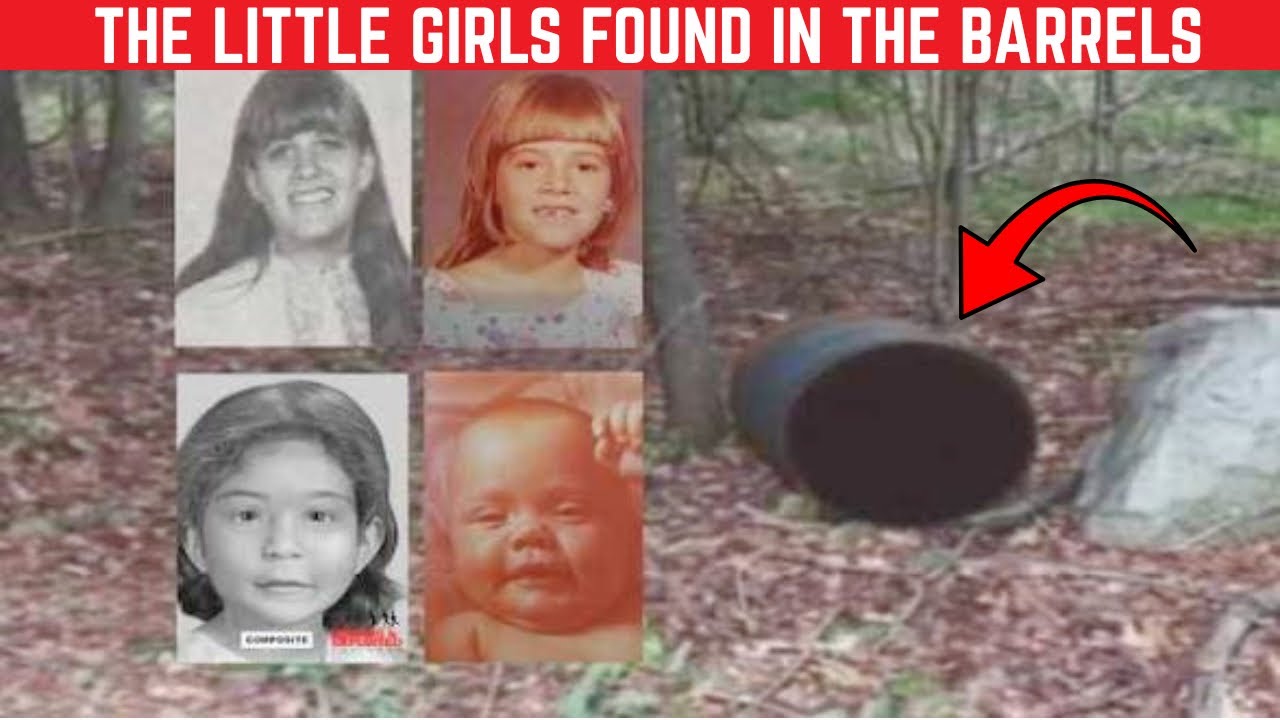
Inside that drum, he found the bodies of a woman and a young girl. Both had been beaten to death. They had no identification, no names, and no one had reported them missing. The barrel had been there long enough that the best forensic estimates placed their deaths somewhere in the late 1970s or early 1980s, meaning the pair had lain inside that corroding steel for at least five years before anyone stumbled upon them.
The victim was a white woman estimated to be between 23 and 27 years old, and the girl was between 6 and 10. No fingerprints matched any file on record. No missing persons report matched their descriptions. No dental records pointed anywhere.
New Hampshire State Police and the Attorney General’s office mounted a painstaking investigation. Sketch artists’ renderings were distributed across New England. Dental records were compared against every available database. Flyers went out to police departments, hospitals, and dental clinics from New Hampshire down to Massachusetts.
Nothing. No one came forward. No one recognized either of them. The case went cold and stayed that way for fifteen years.
In May 2000, a state police investigator returned to Bear Brook State Park and walked the original crime scene, trudging over ground that investigators, journalists, and search teams had already crossed dozens of times. About 90 meters from the first barrel, in the same dense underbrush, he found a second barrel. It was not buried. It had simply been set there among the bushes, rusted and partially covered with leaves.
It had been there the whole time, hidden in plain sight. Inside were two more girls, younger than the first. One was a toddler, estimated to be between one and four years old. The other was older, bigger than the toddler but younger than the girl from the first barrel.
The investigators gave her a working name: the Middle Child. Four victims. Two barrels. All killed the same way.
All completely unidentified. A crime scene that had remained incomplete not for days, not for months, but for fifteen years. The case had become a quadruple murder. And the investigators had almost nothing to work with.
No suspect, no starting point, no families to call, no neighborhoods to comb, no friends to interview. When CODIS, the FBI’s national DNA database, launched in the late 1990s, it gave investigators a new tool. Every time DNA from a convicted offender was entered into the system, it was automatically compared against unsolved case files. But there was a problem.
The remains had been decomposing for two decades. The DNA profiles extracted from the victims were partial, degraded, and limited. Every time investigators ran a comparison against the database, there was no match. The Attorney General’s cold case unit kept repeating the checks every few years as CODIS grew.
Every time, the answer was the same. Nothing. More than twenty years passed. The dead remained nameless, without justice, without even a grave marker anyone could visit.
In November 1981, in Manchester, New Hampshire, a 24-year-old woman named Denise Beaudin told her family she was leaving town with a man she had been living with. His name, as far as anyone knew, was Bob Evans. The couple shared an apartment on Marrimack Street in the west part of the city. Denise left, and no one ever heard from her again.
Her family reported her missing to the Manchester Police. But Evans, whoever he really was, kept Denise’s six-month-old daughter. He told the child her mother was dead. He named her Lisa.
Then he moved, from Arizona to Texas to northern California, a new state every year or two, new schools, new family surnames. He never stayed anywhere long enough for anyone to get to know him. In 1986, he stopped at a mobile home park in Scotts Valley, California, a small town in the Santa Cruz Mountains south of San Jose. He told the park owners he would be right back.
He left the girl there. She was six years old. He never returned. A couple at the park took the girl in and later adopted her through the Santa Cruz County court.
She grew up in the San Francisco Bay Area, never knowing her real name, never knowing who her mother was, never knowing what had happened to either of them. In 2002, in Richmond, California, a 45-year-old chemist named Eunsoon Jun disappeared. Her husband, Larry Vanner, reported her missing to the Richmond Police Department. Weeks later, during a follow-up interview at the police station, Vanner confessed.
Jun’s body was found buried under cat litter in the basement of their home on Belmont Drive. He was charged with first-degree murder, convicted in 2003 in Martinez, California, and sentenced to life in prison with the possibility of parole after fifteen years. Then investigators ran his fingerprints, and everything became more complicated. Larry Vanner.
Bob Evans. Curtis Kimball. Gordon Jenson. Four names, one set of fingerprints.
One man who had spent his adult life drifting across the country under stolen identities, assuming the names of dead and missing people. Employment records and utility bills placed him in southern New Hampshire in the early 1980s, right in the window when investigators believed the four Bear Brook victims had been killed. He had worked odd jobs and rented rooms in towns surrounding Bear Brook State Park: Allenstown, Hooksett, Manchester. In January 2017, New Hampshire authorities announced that he was the prime suspect in the four murders and the disappearance of Denise Beaudin.
But there was a twist. He had already been dead for seven years. He died on December 28, 2010, in a California prison hospital, at the age of 67. He was buried under the name Larry Vanner in a prison cemetery.
No one had known his real name, not the prison administration, not his neighbors, not even his wives. In 2015, Barbara Rae-Venter, a genetic genealogist, received a call from the New Hampshire Attorney General’s office and the FBI. She was a retired patent attorney with a doctorate in biology who had turned to forensic genealogy as a second career. The question put to her seemed simple at first: who was this man really?
Rae-Venter uploaded a DNA sample taken from the suspect’s remains to GEDmatch, a public genealogy database where people share their results to find family connections. The concept behind genetic genealogy was remarkable. Even if the suspect had never taken a DNA test himself, perhaps one of his distant cousins had. If she could find those relatives, she could build a family tree and trace it back to him.
The technique was brand new in 2015. This case became one of the first times it was used in a real criminal investigation, before it became famous in the Golden State Killer case. Rae-Venter found distant cousins in the database and began building the family tree from there, working backwards through birth certificates, marriage records, census data, and death notices in Colorado and neighboring states. The work took months.
The tree eventually pointed to one man, born in Denver in 1943. He had joined the Navy at eighteen in 1961 and served six years as an electrician on ships in the Pacific, receiving an honorable discharge in 1967. He married in Colorado Springs and had four children. In 1975, he was arrested for aggravated assault after burning one of his children with cigarettes.
His wife took the children and fled the state. Then he abandoned his real name and never used it again. Every identity he assumed from that point on was stolen. Dead men, missing men, a different name for each state, a different face for each life he took.
His real name was Terry Peder Rasmussen. Rae-Venter’s work also confirmed something else. The girl he had left at the mobile home park in Scotts Valley was not his biological daughter. DNA analysis showed her family traced back to Manchester, New Hampshire.
Her name was Dawn Beaudin. Her mother was Denise, the woman who had left the Manchester apartment with Rasmussen in 1981 and was never seen again. Dawn had built an entire life in California believing her mother was dead and that the man who abandoned her at age six was her real father. When investigators knocked on her door with the DNA results and the truth, the man responsible had been dead for years, buried under a name that was not his.
With Rasmussen finally identified, investigators returned to the barrels. DNA extracted from the victims, through multiple rounds of difficult testing on decades-old remains, underwent genetic genealogy analysis. Meanwhile, a librarian in Stratham, New Hampshire, named Rebecca Heath had been working the case in her spare time, unpaid. After her shifts at the Wiggin Memorial Library ended, she would go home and spend her evenings searching genealogy databases, genealogy forums, and missing persons forums.
She was looking for anyone who might be looking for them. In October 2018, after months of fruitless searching, Heath found a post on a genealogy forum. A woman in California was looking for a missing family member named Sarah McWaters, born in 1977. Her age lined up with the birth and death dates.
Heath’s independent forensic genealogy research reached the same conclusion within a few weeks. In June 2019, New Hampshire Attorney General Gordon MacDonald stood before a crowd and read four names aloud for the first time. Thirty-four years after the first barrel was found, family members of the victims sat in the front row. The woman found in the first barrel was Marlyse Elizabeth Honeychurch, born in 1954 in Fairfield, Connecticut.
She had settled in La Puente, California, a city east of Los Angeles in the San Gabriel Valley. She was 24 years old. The girl found with her was her daughter, Marie Elizabeth Vaughn, born in December 1971, about six years old when she died. The youngest girl in the second barrel was Marlyse’s daughter, Sarah Lynn McWaters, born in December 1977, between one and three years old.
The three girls were last seen on Thanksgiving 1978, when Marlyse left her apartment in La Puente with a man her family had never met, someone she had met through mutual acquaintances. Her family called and wrote letters after the holiday, but she never replied. They had no address for her, and no way to reach her for four decades. They never knew what happened to her or her daughters.
They never knew they had been murdered. Three of the four victims now had names. The Middle Child remained unidentified. DNA testing confirmed she was not the biological daughter of Marlyse Honeychurch but another child from another family.
No missing persons report anywhere in the country matched her. January 2024. The New Hampshire State Police Cold Case Unit partnered with DNA Doe Project, a volunteer organization founded in 2017 that uses genetic genealogy to identify unidentified remains. For the Bear Brook case, they assembled a team of more than forty volunteer genealogists, experts, and researchers experienced in DNA analysis.
The laboratory work alone was a formidable challenge. Remains stored in steel for decades had degraded through bacteria, moisture, and chemical decomposition. The Center for Human Identification at the University of North Texas conducted multiple rounds of extraction, but traditional methods failed. Eventually, a modified protocol produced a partial, degraded profile, not perfect, but workable.
The team uploaded it to genealogy databases and a distant kinship match emerged. They expanded the search, verifying each branch through birth certificates, death records, obituaries, and court files in Texas, California, Colorado, and the Pacific Northwest. Over more than a year of painstaking work, they assembled a family tree of roughly 25,000 people across multiple generations. In June 2025, the tree led them to a family in East Texas.
The link traced back to a woman named Pepper Reed, born in 1952 in Orange County, Texas. Reed had been in a relationship with Rasmussen in California in the mid-1970s. Her family last saw her around Christmas 1975, when she visited them in Orange, Texas, near the Louisiana border in the southeastern corner of the state. She was pregnant at the time, and her family knew it.
They did not know who the father was or where she was going after the holidays. They assumed she had decided to break ties and move on. A birth certificate from Orange County, California, confirmed the birth of a girl in 1976. The father’s name listed on the certificate was Terry Peder Rasmussen, the real name of the man who had lived three decades under stolen identities.
The child’s name, recorded on the death certificate, was Rae Rasmussen. DNA from the Middle Child was compared against a sample from one of Rasmussen’s known biological relatives, and it matched. A Y-chromosome DNA test, using samples from Rasmussen’s 2010 autopsy, confirmed his paternity. Rae Rasmussen was between two and four years old when her father killed her.
He placed her in a steel drum in the woods of Allenstown, New Hampshire, next to Marlyse Honeychurch and Marie Vaughn, two people to whom she had no connection at all, and left her there. She stayed in that barrel for roughly forty years before anyone knew her name. On September 5, 2025, in Concord, New Hampshire, Senior Assistant Attorney General Benjamin Agati stepped to the podium at the Attorney General’s office and announced the identification of the fourth and final victim of the Bear Brook murders. He spoke her name aloud: Rae Rasmussen.
Investigator Christopher Elfving, who had worked the case for years, said they never forgot her, and they never stopped looking. Forty years after a hunter stumbled upon a rusted barrel in the New Hampshire woods, all four victims finally had names. Terry Peder Rasmussen’s confirmed victims numbered five: Marlyse Honeychurch, Marie Vaughn, Sarah McWaters, and Rae Rasmussen in New Hampshire, and Eunsoon Jun in Richmond, California. Denise Beaudin and Pepper Reed were presumed dead.
Investigators believed the true number was higher. He had lived in at least six states under at least four stolen identities over three decades. He never confessed to the Bear Brook murders. He never told anyone where he had buried Pepper Reed or Denise Beaudin.
He took that secret with him to his grave. Pepper Reed has been missing for roughly fifty years. Her family in East Texas has been waiting since the mid-1970s. At the September 2025 press conference, a victim-witness specialist read a statement from Pepper’s family: “Pepper is very loved and we miss her every day.
Although we did not get the chance to meet Rae, she is equally precious to us. ” No remains have ever been found. It took forty genealogists, a family tree of 25,000 names, a librarian working alone after her shifts, a retired patent attorney who learned an entirely new science, and investigators who refused for four decades to leave four people unnamed in the dark.
That refusal is the whole story.
