On August 8, 1944, in a wheat field beside the Caen road in Normandy, seventeen minutes before one in the afternoon, SS tank commander Michael Wittmann stood in his Tiger tank, number 007, leading seven Tigers across open ground toward Allied lines. He was thirty years old and the most famous tank commander in the world. Eight weeks earlier, at the crossroads town of Villers-Bocage, he had taken a single Tiger down a road crowded with British tanks and destroyed roughly fourteen armored vehicles in about fifteen minutes. German radio broadcast his name every night for a week.
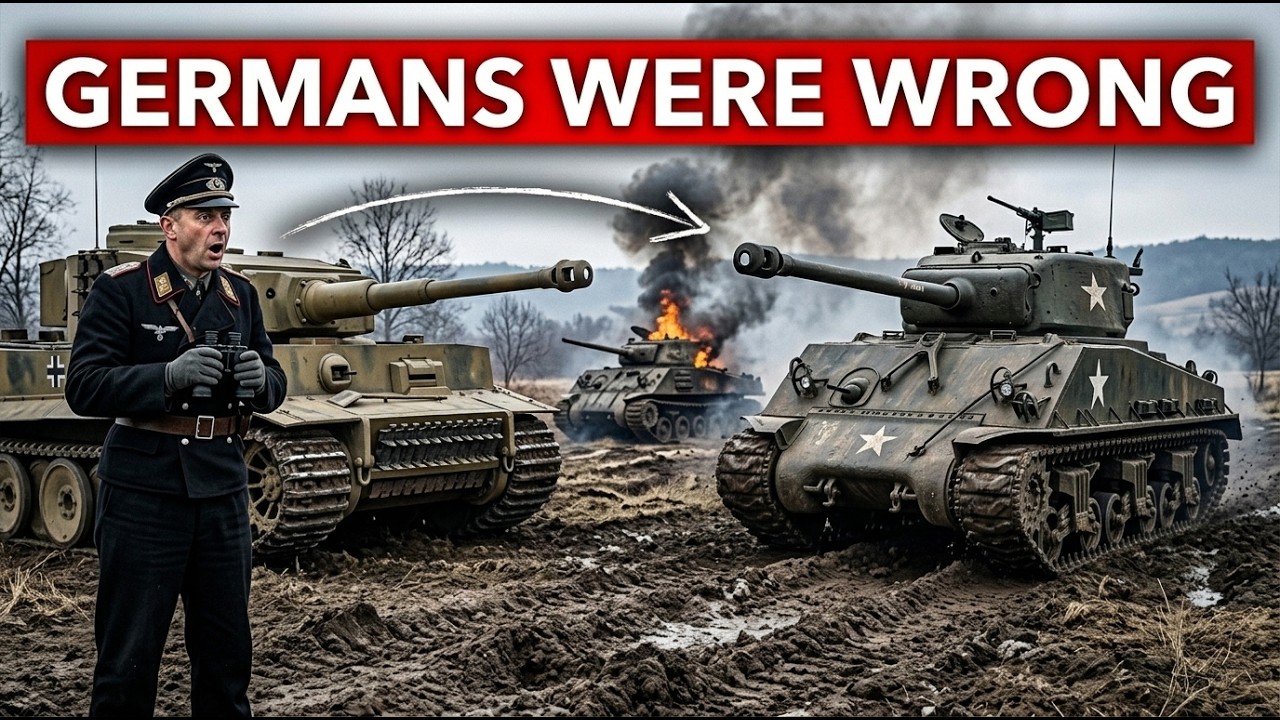
Goebbels’s newsreels repeated the Villers-Bocage story so often that it became dull. In a summer when the world was collapsing around Germany, a nation hungry for heroes was given one in a tanker’s uniform, and it had no intention of letting him go. He wore the Knight’s Cross with Oak Leaves and Swords. He had shaken Hitler’s hand.
He had been offered a safe training post and refused it. Wittmann had built his legend on one constant fact of the Second World War: Allied tanks burned. His gunners had watched it happen more than a hundred times. The German soldiers’ name for the American M4 Sherman reflected everything the Wehrmacht believed about it.
They called it the “Tommy Cooker,” a recycled joke from the small trench stove British soldiers had carried in the First World War. Allied crews, with the black humor of men who had no other choice, had their own version. They called it the “Ronson,” after the cigarette lighter: a tank that lights, a tank that cooks its crew. That was the reputation.
By the summer of 1944, that reputation had hardened from a joke into fixed doctrine: the Sherman was prey. What Wittmann did not know, standing in his cupola in the wheat field, was that a Sherman was hidden roughly eight hundred yards to his right, in an orchard behind a hedgerow. In the gunner’s seat sat a twenty-one-year-old former shoe factory worker from the English town of Rushden, named Joe Ekins. Gunner Ekins had never fired at an enemy tank in his life.
His tank was a Firefly, a Sherman hull fitted by the British with a 17-pounder gun, the only weapon tank crews really feared in Normandy, concealed in broad daylight inside the hull they had spent two years despising. Over the next twelve minutes, Ekins fired about five rounds. Three Tigers were destroyed. Tiger 007 was one of them.
It was hit, penetrated, and then destroyed by the explosion of its own ammunition. The blast was violent enough to tear the eleven-ton turret from the hull and throw it into the wheat field. The greatest tank ace of the war did not burn a single enemy that day. On the last morning of Michael Wittmann’s life, the stove was German.
This is a story about the most ridiculed weapon of the Second World War. Roughly 49,234 Shermans were built, more than all the Tigers, Panthers, and Panzer IVs combined. They were made in eleven American factories, shipped to every front on earth, and crewed by men from nine Allied nations. For eighty years, the verdict on the Sherman has been the German verdict: cheap, weak, flammable, a death trap saved only by its numbers.
Some of those accusations are true. That is what makes the story worth telling, because in the middle of the war, the United States did something no other combatant did. It put its tank on the dissecting table, read the autopsy reports, accepted every finding, and fixed everything without stopping the production line. The result was the M4A3E8, which its crews called the “Easy Eight.
” It reached the front in the winter of 1944. It was still destroying tanks three decades later, and it made everyone who had ever said “Tommy Cooker” regret it. The nickname was born in the North African desert in 1942, where Afrika Korps gunners watched the first American-built tanks come under enemy fire and revived the old trench stove joke from Normandy. Two years later, the joke had statistics behind it.
In the summer of 1944, when a Sherman’s armor was penetrated, the tank caught fire in roughly 60 to 80 percent of cases. Not smoke, not slow burning, but full combustion, with propellant fires capable of filling the fighting compartment in seconds. Crews spoke of the thirty-second rule. Whatever you were going to do after being hit, you had that long to do it.
Men drilled on escape hatches the way an aircrew drilled on ditching in water. Hands searched for hatch handles in the dark because the difference between a burned hand and a dead man was one jammed latch. Replacement crews knew the reputation before they knew the tank. Nineteen-year-old gunners arrived at night, were assigned to a hull no one mentioned the previous crew of, and learned the traverse wheel by touch before breakfast.
Veteran sergeants taught them two skills before anything else: how to fire first and how to get out. The gun was the second charge in the indictment. The Sherman’s 75mm was accurate, fast-firing, and reliable. Against a German Panther, it was nearly useless.
At two hundred yards, Sherman gunners watched their rounds hit the Panther’s sloped flanks and skip into the sky like burning matches. The Panther’s long 75 could destroy a Sherman from the front at a thousand yards and beyond, ranges at which Sherman gunners could not respond at all. In the hedgerow country, where every low lane was a killing ground, that disparity was paid for in tank losses. The British, who used Shermans early and longest, paid the same price on a larger scale.
In three days of Operation Goodwood in July 1944, British armored divisions lost hundreds of tanks on the plain east of Caen, a rate of destruction no armored force in history had endured, and they kept fighting. The third factor was the shape of the tank. The Sherman stood about ten feet high, a prominent target above hedgerows and skylines. Its tracks were narrow, and in autumn mud it sank where the wide-tracked Tiger walked.
In American lines that year, tank crews repeated a phrase that never left the literature: “The Germans had cats, and cats hunt. ” Fear preceded the facts. By autumn, American crews were reporting Tigers in sectors where no Tiger battalion had ever operated. The legend was doing what legends do, magnifying the enemy and condemning the machine.
Put it all together, and German contempt looks less like arrogance and more like observation. The United States lost roughly 4,500 Shermans in Northwest Europe. There were weeks in Normandy when armored battalions were rebuilt twice. Over the entire campaign, the 3rd Armored Division lost more than 500 percent of its authorized strength in tanks.
Every tank it owned was destroyed and replaced five times. A young lieutenant from the 3rd Armored Division named Belton Cooper spent that summer with a maintenance battalion indexing the wreckage that came back on tank transporters: hulls, stowage, interiors burned down to bare steel. Decades later, he wrote a book about it called “Death Traps. ” Half a century after that, the book became a bestseller and cemented the Sherman’s reputation for an entire generation of readers.
Here is the odd detail that turns the indictment into an investigation. Everything above is true. Every number, every deflected shell, every burned crew. The Germans measured all of it precisely, and almost all of their conclusions were wrong.
The distance between those two sentences is the story of the Easy Eight. And it does not begin with a general or a tank designer. It begins with men in lab coats crawling among burned-out tank hulls in the summer of Normandy, asking a question no one had seriously asked before: why exactly does a Sherman burn? Everyone already knew the answer.
That was the problem. The answer was so obvious that no one checked it. The Sherman ran on gasoline. Gasoline is flammable.
Therefore the Sherman burned. Soldiers believed it. Journalists repeated it. Eighty years later, most documentaries still do.
The operational research teams, British and American, sent to study battle damage the way coroners study bodies, were not soldiers, and that was their strength. They were physicists, actuaries, and engineers in borrowed combat clothing, men who made their living counting things. They crawled among the hulls one by one with tape measures and clipboards, mapping every penetration, where the round entered, what it crossed, what it ignited. When the hit maps were printed over the stowage diagrams, there was no room for doubt.
The fires were not what everyone thought. They were not fuel fires. They were ammunition fires. The Sherman stored its main gun rounds in raised side bins, on racks above the tracks, where a hit was most likely to land.
A penetration scattered white-hot fragments across those bins. The propellant in the cartridges ignited, and the tank was destroyed. The low fuel tanks in the rear were seldom responsible for anything. The gasoline theory failed twice, because the Tiger ran on gasoline, and so did the Panther and the Panzer IV.
Every German tank in the war burned the same fuel the Sherman burned in its Maybach engines. German tanks stored their ammunition the same way the Sherman did. There were even diesel Shermans, the M4A2s sent to the Marines and the Soviet Union, and when their ammunition racks were hit, they burned at nearly the same rate as their gasoline counterparts. The most common fact about the Sherman was not a fact at all but a fabricated rumor.
Engineers moved the ammunition from the sides to the very bottom of the hull, inside armored bins immersed in a mixture of water and glycerin. They called it “wet stowage. ” If a round penetrated now, it hit the liquid before it hit the propellant. The results were not an improvement; they were a transformation.
Penetrated Shermans with wet stowage burned in roughly 10 to 15 percent of cases. The number had been 80. The chances of a crewman dying by fire dropped by more than four to one because of plumbing. The Sherman of 1942 had been shaped by a reality no German designer ever had to think about for an hour: the ocean.
Every American tank had to fit on a factory crane, a railcar, a Liberty ship’s hold, a dock, a landing craft, and a floating bridge three thousand miles from where it was built. Every inch of width and every ton of weight was taxed at every step. German tanks moved from factory to front on rails. American tanks crossed the ocean or they were useless.
Shipping calculations were brutal. A design ten tons heavier would have meant thousands fewer tanks delivered to France. The Sherman’s size was not cowardice; it was marine engineering. The Sherman had also been designed around a doctrine written before America fought a single battle against a German Panzer: enemy tanks were the business of specialized tank destroyers.
The Sherman’s job was to exploit holes in the army behind the tanks: infantry, guns, trucks, buildings, the infrastructure of an army. For the war it actually fought, even the mocked gun was half right. More than nine out of ten rounds fired by Shermans in Europe were aimed at non-tank targets: machine gun posts, trucks, buildings, infantry, fortifications. Against those targets, the short 75mm high-explosive round was effective, in fact better than the 76mm that replaced it.
When the new gun was first offered in Normandy, some veteran units were reluctant to take it, not from ignorance but because the 75mm was what kept the infantry alive. The gun was not weak; doctrine was pointing it at the other 90 percent of the war. That doctrine was the real error. But doctrine is written, not welded.
And in the middle of the war, unlike welded armor, doctrine could be reversed. Between 1943 and 1944, without stopping the production lines, the Sherman was rebuilt piece by piece. The ammunition rack burned, so the ammunition moved. The gun was inadequate, so a new 76mm, longer and faster, with tungsten-core ammunition capable of hurting tanks at combat ranges, replaced it.
The engine became a Ford GAA, 500 horsepower, machined from aluminum, one of the best tank engines of the war. A new suspension called HVSS with wide 23-inch tracks cut the tank’s ground pressure by about a quarter. Now the Sherman went through the mud that had swallowed its predecessors, through snow, into places where the Panther itself had become cautious. There was even an assault version, the M4A3E2, called the “Jumbo,” with seven inches of frontal armor, designed to advance on German artillery lines and take hits.
Crews competed fiercely to get one. The experimental designation for the final version was E8. Crews did one test drive on the new suspension, which smoothed out the ride that had exhausted them in earlier Shermans, and did what soldiers always do with any designation. E8 became “Easy Eight.
” The army did not choose that name. The soldiers chose it, and soldiers do not give affectionate names to death traps. Germany was aware of the Panther’s own flaws. The final drive, the gearbox that actually moved the tank, was fragile, and it stayed fragile from Kursk to Berlin because stopping the production line to fix it was a luxury an exhausted industry could not afford.
America diagnosed its tank, redesigned its ammunition stowage, its gun, its engine, its suspension, and did not stop production for a single month. The crews of summer 1944 paid for everything that followed, and most of their names survive only in morning reports and on stones. In September 1944, at Arracourt, France, morning fog covered the tank country east of Nancy. Out of that fog came Germany’s newest tanks: fresh Panther brigades sent to blunt Patton’s advance.
On paper, it was a slaughter waiting to happen. Panthers against the Shermans of the 4th Armored Division, most still carrying the old short 75. The fog closed the range to a few hundred yards. At that distance, the advantage changed hands.
In the morning of the first day, one American tank destroyer platoon under Lieutenant Edwin Leiper met the edge of a Panther brigade near Bezange-la-Grande and destroyed seven tanks in short order, some from under two hundred yards, some from behind. The German crews were green, some trained only weeks. The American crews were veterans who had survived a summer, led by men like Lieutenant Colonel Creighton Abrams of the 37th Tank Battalion, using the ground like practiced hunters. They fired, fell back, shifted positions, flanked, and fired again.
When the fog lifted after ten days, the German brigades had lost more than a hundred armored vehicles against a fraction of that in American tanks. Arracourt was the largest American tank battle of the war to that point, and the Germans had lost it despite fielding what most considered the best tank in the field. German generals recorded in the secretly monitored Trent Park conversations could not explain it. They judged American tanks unremarkable.
What they could not account for was that the tanks were always there, always fueled, always in good order, with six more in the morning. One general said fighting the Americans was like fighting a machine that repairs itself overnight. He thought he was describing an illusion. He was describing the maintenance battalions.
Then came December and the snow. When the German offensive crashed into the Ardennes, Patton’s Third Army turned 90 degrees north in 48 hours. With the 4th Armored Division driving toward the besieged town of Bastogne, the first M4A3E8s in Europe went to the front, so newly issued that some crews learned the new suspension during the approach march. It was the coldest European winter in decades.
Abrams led the spearhead in a new Easy Eight he called Thunderbolt VII. On December 26, 1944, the lead tanks of Abrams’s force, commanded by Lieutenant Charles Boggess in the lead in Cobra King, a Jumbo Sherman, broke through the German ring in the fading dusk. Boggess passed a line of foxholes, stopped, and called out. An engineering officer of the 101st Airborne climbed up out of the snow, shook his hand, and said the men were glad to see him.
The siege was over. Cobra King was lost after the war, found again six decades later, rusty on a German military base, identified by its serial number, restored, and displayed in a museum today. The war ended, and the judgment seemed final. But the Easy Eights had two more decades ahead.
In June 1950, North Korean forces rolled south behind Soviet T-34/85s. In the first weeks, no American unit in the country could stop them. Then the Easy Eights arrived, pulled from storage and occupation duty. In a series of battles through late summer and autumn 1950, the more experienced, better-aimed, faster-firing American crews decisively outfought the T-34s.
Even when offered the larger M26 Pershing, many American crews chose to keep their Shermans. In the Korean hills, the Pershing handled like a weak heart in a heavy body, while the Easy Eights kept moving. Post-war American statistics showed crews destroyed North Korean tanks at a ratio of more than three to one. Israel bought surplus Shermans, rebuilt them, and in 1967 and 1973 used them to destroy T-54s, T-55s, and even T-62s.
A tank built in the early 1940s was destroying tanks designed twenty years after the Wehrmacht ceased to exist. So judge each point according to the evidence. Tank against tank at a thousand yards in an open field, the Panther or Tiger was superior. That is not a fair contest against the Sherman.
But war is not a duel. The Germans asked which tank wins the field. The Americans asked which tank wins the year. They are different questions, and only one of them was the war.
The flaws in the legend do not survive scrutiny. The Ronson joke relies on a slogan the company never used during the war. The famous five-to-one ratio appears in no American field manual or wartime document; it was the consolation of the defeated, adopted by the entertained. German heavy tanks were rare.
Fewer than 1,400 Tigers were ever built. Most American tank crews never saw one. They called every German tank a Tiger the way people call every shark a great white. Most Shermans lost in Europe were not killed by legendary tanks but by towed anti-tank guns and the disposable Panzerfaust in the hands of an infantryman in a ditch.
Belton Cooper told the truth about what he saw. His summer was real and terrible. But a maintenance officer sees every wreck and none of the fleet. The broader record shows the other half.
Over the entire Northwest Europe campaign, about 500 American armored division tank crewmen were killed in action. That is a terrible number, but also fewer than the infantry could lose in one bad month. After wet stowage, losing a tank usually meant four or five men surviving. By the brutal statistical standards of 1944, inside a late-model Sherman was one of the safest places a combat soldier could sit in Europe.
The tank the legend called a death trap was statistically a survival machine that could be replaced, and that replaceability fed survival in a loop the Germans never had. An American crew that lost its tank got another from the depot and kept its experience. A German crew that lost one of the 1,346 Tigers often ceased to exist as a crew entirely. America recycled its veterans.
Germany drained them. And the man in the wheat field? For sixty years, historians have argued over who fired the shot that killed Michael Wittmann. The dispute has never been fully settled.
But no serious account denies the single fact this story needs: the gun was mounted on a Sherman. The ace who built his legend by burning Allied tanks was killed by one of them. His own ammunition finished what the shot began. His turret ended in the wheat field.
Joe Ekins was pulled from his Firefly the same day after it was hit, finished the war with another crew, went home, and spent the next forty years in the shoe trade in Rushden. He rarely spoke about those twelve minutes. For most of his life, he did not know which kill historians would credit to him. When they found him an old man and told him, he showed little interest and no self-regard at all.
He died in 2012. Wittmann’s grave was lost for nearly forty years. His crew’s remains were found in 1983 during roadwork beside the field where the turret had separated, and reinterred in the German cemetery at La Cambe, where the most famous tank commander of the war now lies under a simple dark marker visited daily by strangers. The gunner credited with stopping him made shoes and told almost no one.
The Wehrmacht built weapons to win battles. America built systems to win wars. And the system, unlike the masterpiece, grows stronger every time it is hit. The Tiger was built to win the battle it was fighting.
The Sherman was built to win the war it was fighting: to cross the ocean, to run every morning, to forgive its crew, to be repaired by farm boys, to be replaced before the enemy finished celebrating, to keep standing while every masterpiece it burned rusted in a museum or a ditch. Germany called it a stove, and the name stayed in circulation as long as the record stayed closed. When the counting was done in Normandy, in the Ardennes, in Korea, and on the Golan, the last tank still standing was the one that had only asked to be counted.
