Niki Lauda lay trapped inside his burning Ferrari at the Nürburgring for nearly a minute, his face and lungs scorched so badly that a priest was summoned to administer last rites. He was 27 years old, locked in a bitter championship fight with British rival James Hunt, and the world assumed his career, and possibly his life, was over. Six weeks later, wounds still raw and bandages visible beneath his helmet, Lauda climbed back into a Formula 1 car and finished fourth at the Italian Grand Prix. Asked why he returned so soon, he said simply that he had to prove to himself he could do it.
That defiance defined the man long before the crash and long after it. Born in Vienna in 1949 into a wealthy industrial family, Lauda was expected to take over the family business. Instead, he took out a bank loan to fund his racing ambitions, ignoring relatives who called him an idiot. The gamble paid off.
By 1974 he was driving for Ferrari, and a year later he won his first Formula 1 world championship, ending the team’s long drought and earning the nickname “the Computer” for his calm, precise, almost mechanical driving style. The 1976 season turned him into a legend. His fiery crash at the Nürburgring nearly killed him, but his astonishing comeback defined his career. He lost that year’s championship to Hunt by a single point, then reclaimed the title in 1977.
After briefly stepping away from the sport, he returned in the 1980s with McLaren and won his third and final championship in 1984, beating teammate Alain Prost by just half a point, still the closest margin in Formula 1 history. Lauda never limited himself to racing. He built an aviation empire, founding Lauda Air in 1979 and later Niki Airlines. But that world brought its own tragedy.
In 1991, Lauda Air Flight 004 crashed in Thailand, killing all 223 people on board. Instead of retreating, Lauda personally investigated the accident and took on Boeing until the manufacturer admitted a design fault. His blunt insistence on the truth became as much a part of his reputation as his driving. He was never afraid of controversy.
During the rain-soaked 1976 Japanese Grand Prix, Lauda withdrew from the race, saying the conditions were too dangerous. Critics accused him of cowardice, but he did not care. His life, he insisted, was worth more than a title. Later, in retirement, he mocked modern drivers as “crybabies” compared to his generation.
Even after he stopped racing, Lauda shaped the sport from the inside. As non-executive chairman of Mercedes, he pushed to sign Lewis Hamilton, a decision that produced one of the most dominant dynasties in Formula 1 history. Hamilton later said that without Lauda, he would not have been there, that Lauda believed in him when others doubted. Lauda’s impact extended to pop culture as well, with the 2013 film Rush dramatizing his rivalry with Hunt.
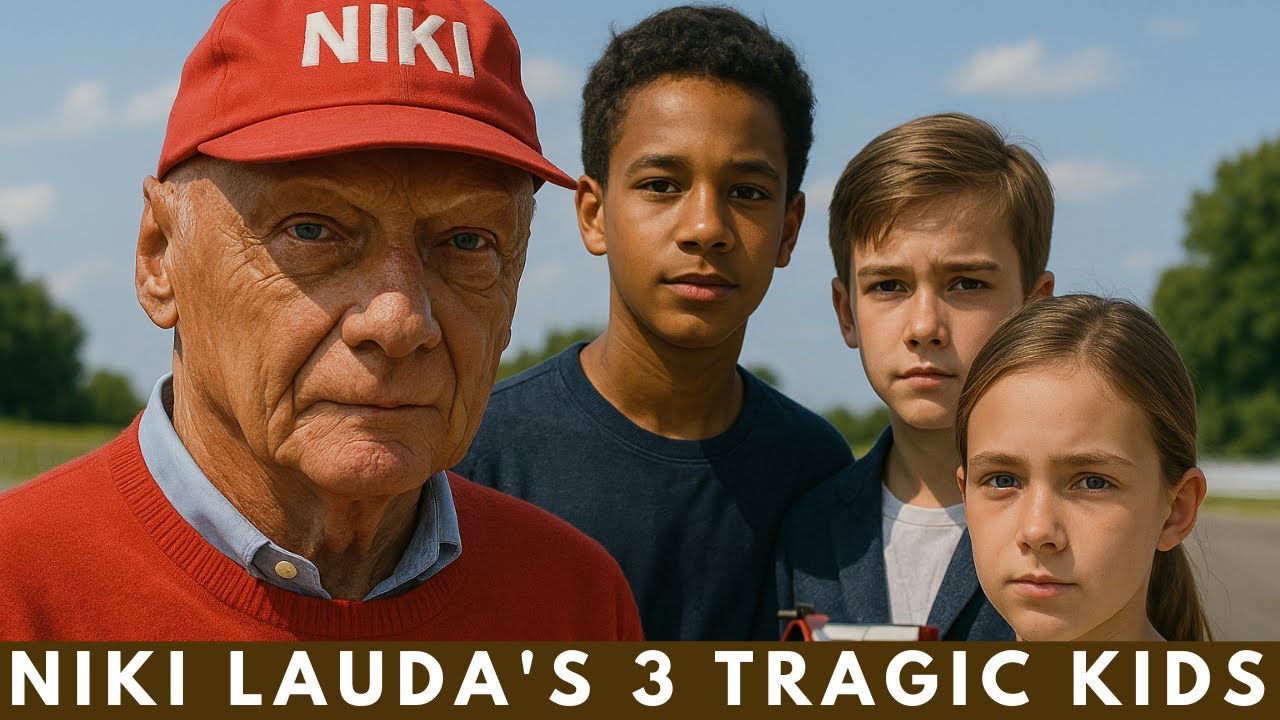
Lauda praised its accuracy, joking that it was 80 percent true and the other 20 percent was better than reality. But the public image of the fearless champion, the sharp-tongued executive, the relentless survivor, was only part of the story. At home, Lauda was a father of five, and his children grew up in the shadow of both triumph and trouble. His first family began amid the heights of his Ferrari fame.
In the mid-1970s, he met Marlene Knaus, a glamorous former model and a fixture in Viennese high society. They married in 1976, the same year as his Nürburgring crash, and together they had two sons: Lucas, born in 1979, and Mathias, born in 1981. The marriage had its turbulence. In 1982, while still married, Lauda fathered a third son, Christoph, from an affair.
For years Christoph remained out of the public eye, and Lauda later admitted with characteristic honesty that he had not been a full father to him, a regret he carried for the rest of his life. Nikki and Marlene divorced in 1991 after 15 years together, though she remained a respected figure in his life. His second great love story began in an unlikely place: onboard one of his own airplanes. In 2005, Lauda met Birgit Wetzinger, a flight attendant 29 years younger than him, while flying with his airline.
Their bond became extraordinary that same year when Lauda’s health collapsed due to kidney failure and Birgit donated one of her own kidneys to save his life. Lauda joked that she had not only given him love but a spare part. They married in 2008, and in 2009, when Lauda was 60 years old, Birgit gave birth to twins, Mia and Max. Friends noticed that with Birgit and the twins, Lauda seemed calmer, more reflective, almost softened compared to the fiery, uncompromising man the public knew.
His five children followed very different paths. Lucas, the eldest, chose a quiet, private life, managing his younger brother’s career and acting as the steady anchor of the family. Mathias inherited his father’s love of speed. He climbed the racing ladder through Formula 3000, GP2, and the DTM touring car series, and in 2017 achieved his proudest moment, winning the World Endurance Championship in the LMGTE class with Aston Martin.
Mathias remembered his father not as the global icon the world saw, but simply as papa, his hero and role model. When Lauda was home, which was not often, he made those moments count, waking the boys early to cook a big breakfast together and talking to them honestly about life, never sugarcoating anything. His philosophy as a father matched his philosophy as a racer: blunt, practical, honest. Christoph, the son born from his affair, carried a more complicated legacy.
He lived away from the media spotlight, his relationship with his father shaped by absence and regret. Lauda acknowledged him legally and included him in his will. When Lauda died, Christoph quietly attended the funeral, though he was not part of the family’s public statements, a reminder of the hidden chapters behind the legend. Mia and Max, the twins, experienced a different father entirely.
Raised in Vienna, they attended international schools and enjoyed a normal childhood away from media attention. Max occasionally tried go-karting, but Birgit insisted the children not be pressured into racing. For them, Lauda was simply dad, an older father, sometimes tired and often busy, but deeply grateful for a second chance at family life. Lauda died in May 2019.
His death set off a bitter dispute over an estate estimated in the hundreds of millions, drawn from his Formula 1 career, airline ventures, and investments. Reports suggested that Birgit sought around 20 million euros through the family foundation, while Lucas and Mathias defended their shares, and Christoph’s legal recognition in the will added another layer of tension. The Austrian press called it Lauda’s final race, fought not on asphalt but in courtrooms and boardrooms. Yet the controversies did not overshadow how the world remembered him.
On May 29, 2019, Vienna held a funeral befitting a national icon. His coffin, draped in flowers and topped with his red racing helmet, lay inside St. Stephen’s Cathedral, Austria’s most famous church. Thousands of fans lined the streets as Lewis Hamilton, Sebastian Vettel, Alain Prost, and Toto Wolff joined dignitaries and former presidents in the pews.
After the grand ceremony, the burial was private. Birgit, the twins, his older sons, and even Christoph stood together at the graveside in Vienna, a rare gesture of unity from a family that had often been fractured. His legacy lives across Austria in streets, memorials, and exhibitions. In Formula 1, Mercedes dedicated its 2019 Constructors’ Championship to him, and Hamilton spoke tearfully of the man who had been his mentor and friend.
His sharp philosophy still resonates in sporting and business circles alike: from success you learn nothing, from failure you learn everything; my life is worth more than a title. He was a man of contradictions, a calculating computer behind the wheel who was fiercely human when he tore off his bandages and returned to the cockpit, a businessman who built airlines but confronted Boeing after tragedy, a sharp-tongued executive who shaped modern Formula 1, and a flawed, sometimes distant, yet fiercely honest father of five. He lies now in Viennese soil, but the lesson he left behind endures: that failure teaches more than success, that life is worth more than titles, and that courage is not the absence of fear, but the will to move forward anyway.
