On the morning of November 22, 1963, the woman in the back of the presidential limousine wore pink. The suit, a vivid raspberry wool with a navy collar and matching navy buttons, was the most photographed garment in American political history, though the cameras would not capture it the way she intended that afternoon. She had worn it before, at least six times, including on a state visit to London and during the Maharaja of Jaipur’s tour of Washington. The President had asked her specifically to wear it in Texas because he liked it so much.
By the end of that day, the suit would be soaked in his blood, and she would refuse to take it off for the next twenty hours, telling the aides who urged her to change, “Let them see what they did. ”
The most famous thing Jacqueline Kennedy ever bought is now locked in an acid-free container in a windowless room at the National Archives in Maryland, unfolded, shielded from light, never cleaned since the moment it came off her body the morning after the assassination. Caroline Kennedy signed a deed in 2003 transferring legal ownership to the archives, with the request that the suit not be shown to the public for at least one hundred years from that date, meaning nothing before 2103. The note that accompanied the garment when it first arrived, sometime before July 1964, was written on the personal stationery of Janet Auchincloss, Jackie’s mother.
It read simply: “Jackie’s suit in bag, worn November 22nd, 1963. ”
But almost everything the public believed about that pink suit, and about the woman who wore it, was a carefully managed illusion. The suit was not actually a Chanel, though it was universally described as one. It was a line-for-line copy, an authorized knockoff, assembled in New York by a Park Avenue salon called Chez Ninon, using wool, buttons, trim, and design specifications shipped directly from Chanel in Paris.
The arrangement existed for one reason: political survival. When John F. Kennedy launched his presidential campaign in 1960, Jackie’s love of French couture became a liability. She had studied in Paris in 1949, and she adored Givenchy, Chanel, Balenciaga, and Dior.
But as the wife of a candidate depending on the votes of American workers and manufacturers, wearing French-made clothes was a problem. She was publicly criticized for un-American fashion choices. Joseph Kennedy Sr. , her father-in-law, a former Hollywood figure who understood the power of image better than almost anyone, made clear that this had to change.
Chez Ninon, owned by Nona Park and Sophie Shonnard, had a special arrangement with several French houses, including Chanel, to recreate garments in New York using original materials, producing dresses that looked identical to the Paris originals and cost roughly the same. The only difference was the address on the label. The pink suit Jackie wore to Dallas came from Chanel’s 1961 autumn-winter collection, made this way, a political workaround that let the first lady wear French fashion without appearing to buy French fashion. This careful choreography of appearance extended to the very beginning of her marriage.
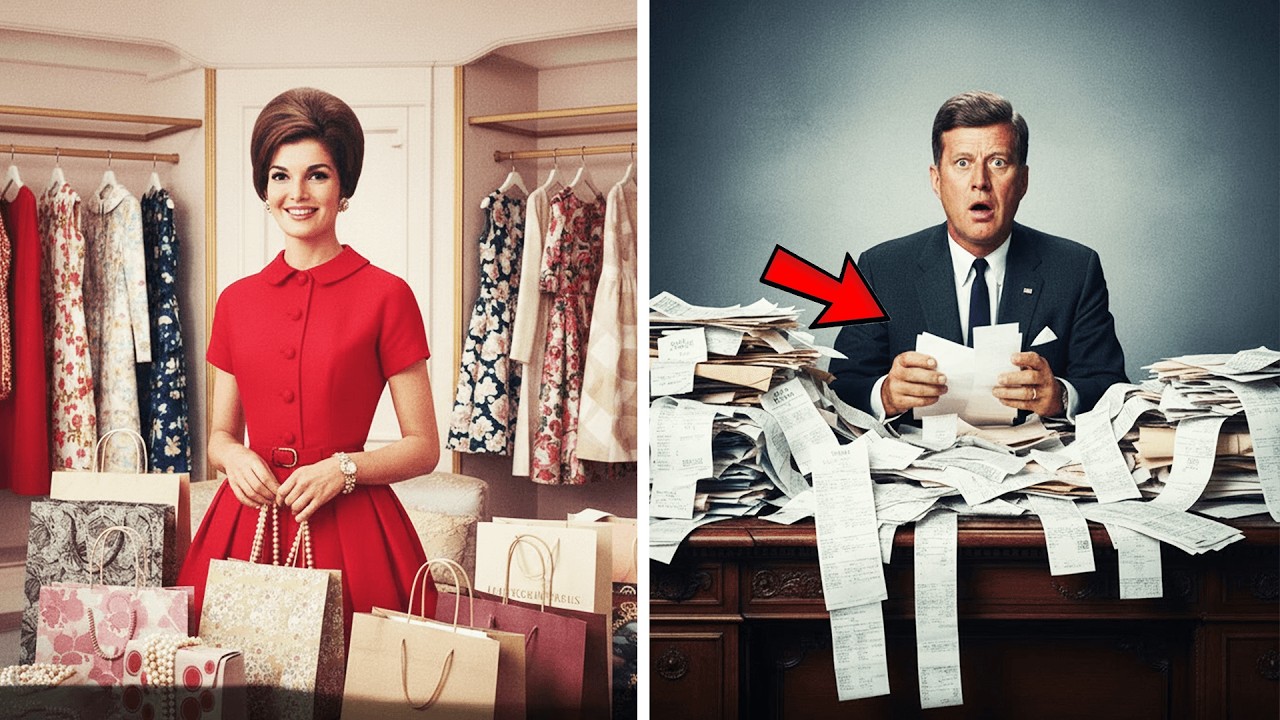
From the earliest days, John F. Kennedy had one recurring complaint about his wife: the money she spent on clothes. It was not a small complaint, and it was not occasional. Mary Gallagher, who served as Jackie’s personal secretary during and after the White House years and later published a memoir, described the tension over shopping bills as a regular feature of their private life.
During JFK’s Senate years, Jackie spent roughly $30,000 a year on clothing, a figure reported by the New York Times that caused a minor public embarrassment in the 1960 presidential campaign. When a reporter asked about it, Jackie made a remark her own circle acknowledged was not her finest public relations moment: she could not possibly have spent that much, she said, unless she wore sable underwear. It was witty, but it confirmed the impression of lavish spending rather than denying it. Once she moved into the White House, the spending increased dramatically.
Biographers documented her wardrobe bill for 1962 alone at over $150,000. To put that in context, JFK’s annual salary as president was $100,000. His wife spent fifty thousand dollars more than he earned, in a single year, on clothes. He was not pleased.
Gallagher described multiple occasions when JFK called her directly, asking her to gather Jackie’s bills so he could confront her. He raised the issue, argued about it, and watched as Jackie kept spending. She had grown up surrounded by wealth and the expectation that her appearance would be maintained to the highest possible standard, and no amount of presidential frustration was going to change the way she had been raised. The tension was never resolved.
It was simply managed. Part of the management involved hiding the true scale of the spending. A collection of receipts from Saks Fifth Avenue, dated April 1961, auctioned through University Archives in Westport, Connecticut, documented purchases of dresses, a navy dot suit, a red coat, two black evening dresses, and a white evening dress. Every item was billed not to Mrs.
John F. Kennedy but to Mrs. Fred Drake, the wife of a Harper’s Bazaar editor. A handwritten note from Mary Gallagher, on White House memo paper, listed the stores where Jackie had shopped and included the notation: “For Mrs.
K, ordered in my name. ” The receipts and note were addressed to Thomas Walsh, the Kennedy family financial adviser, care of Joseph P. Kennedy. Dispensing the charges across multiple names made the total harder to see at a glance—and, presumably, harder for an angry husband to confront her with a specific number.
Gallagher’s memoir described a broader pattern of deliberately obscured bookkeeping. This was not carelessness. Jackie understood exactly what the numbers looked like, and she took deliberate steps to manage how much of the picture was visible at any time. Her methods were meticulous even when no one was watching.
During the White House years, her primary point of contact for accessories was a woman named Marita O’Connor, who worked in the millinery department at Bergdorf Goodman on Fifth Avenue. O’Connor functioned as Jackie’s personal shopper, and they communicated through handwritten letters that have since become collector’s items. Seventeen of those letters were auctioned through John McInnis Auctioneers in Massachusetts in November 2013, drawing attention from fashion historians and Kennedy collectors alike. The letters revealed the extraordinary precision with which Jackie approached her own image.
She did not simply ask for nice hats. She wrote detailed instructions, included sketches, tore pictures from magazines, and attached fabric swatches from the outfits Oleg Cassini was making for her, sending them to O’Connor so accessories could match exactly. One of the most quoted letters contained a shoe request so specific it read like an engineering specification. She needed a pair of alligator shoes, size 10A, with a medium heel, a slender pointed toe “but not exaggerated,” and she did not want what she called “tricky vamp business.
” She specified that she usually purchased Italian shoes at a shop called Eugenia of Florence, so O’Connor would know the style she meant. She described what she wanted as elegant and timeless, and she added that the shoes absolutely had to be ready in time for Inauguration Day. O’Connor would need to rush. The letters also revealed a more personal side.
In one note, Jackie wrote about hats with obvious frustration: “Oh dear, it was so pleasant when I did not have to wear hats. They willize me and I still feel absurd in them. ” In another letter, she declared that hats were the most important thing she needed O’Connor’s help with—a complete reversal delivered without acknowledging she had just said the opposite. She knew what she needed, even when she was not happy about needing it.
When a pair of shoes O’Connor sent did not meet her standards, she returned them with a note explaining precisely what was wrong: “They have that vamp, which I do not like. ” No ambiguity, no softening of the critique. During those years, Jackie wrote in detail to Cassini as well. Many of the letters are preserved at the John F.
Kennedy Presidential Library in Boston. She was not a passive client. She was an active collaborator who communicated in writing with great specificity and held her designer to strict standards. One of the most frequently quoted lines came from a letter she wrote on December 13, 1960, before she had even moved into the White House: “Just make sure no one has exactly the same dress I do.
I want all mine to be original and no fat little women hopping around in the same dress. ” Her clothes were to be exclusive. If Cassini sold similar designs to other clients, she would not wear them. In the same correspondence, she explained her reasoning.
She wrote that she refused to have JFK’s administration “plagued by fashion stories of a sensational nature. ” She did not want to be the Marie Antoinette of the 1960s—a reference that reflected genuine awareness that her spending and taste for luxury could become a political liability if not managed correctly. She asked Cassini to help her be glamorous without being controversial, sophisticated enough to represent America on the world stage, restrained enough not to give her critics ammunition. She told him she wanted clothes like those Audrey Hepburn wore, with simplicity and a certain sportiness combined with sophistication.
She sent him a photograph of Hepburn wearing a yellow sari-inspired gown designed by Givenchy and asked him to create his own interpretation. The resulting dress became one of the most photographed of her first lady years. The collaboration almost did not happen at all. When the search for an American designer began in earnest, Jackie was in the hospital, having just given birth to John Jr.
by cesarean section. She had relied for years on French designers, particularly Givenchy, and she was now required by political necessity to wear made-in-America clothing. The problem was that she had no deep familiarity with American designers and needed to find one quickly. Joseph Kennedy Sr.
placed an urgent call to Oleg Cassini, a Russian-born, American-naturalized designer who had built his career in Hollywood and New York, who had dressed some of the biggest stars in entertainment, and who had a long personal friendship with the Kennedys. Cassini was forty-seven. He came to the hospital and found Jackie in bed, surrounded by sketches sent over by fashion columnist Diana Vreeland from a variety of American designers. None of them were quite right.
Cassini looked at the sketches, looked at Jackie, and proposed a different approach entirely. He told her he was not going to design clothes for her as a politician’s wife. He was going to dress her as though she were the star of a major film, because that was what the role of first lady actually demanded. He visualized her as an American queen.
She needed a scenario, a consistent visual identity that would read clearly from a distance in photographs and on television: clean lines, strong colors, simple silhouettes, nothing that would compete with her face. Jackie was persuaded. She appointed Cassini as her exclusive couturier for the White House years, giving him the title “Secretary of Style. ” Over the next three years, he designed more than three hundred outfits for her, producing what fashion historians call the Jackie Look, a term coined almost immediately as the style was copied by women across the country and around the world.
Film costume designer Edith Head, one of the most celebrated figures in the history of Hollywood fashion, described the Jackie Look as the single biggest fashion influence in history. The transition was not entirely clean—according to Vanity Fair, Jackie’s sister Lee Radziwill smuggled Givenchy dresses into the White House for her during the Kennedy years—but the official record was Cassini, all-American, for all one thousand days. Cassini later described the collaboration as unlike anything he had experienced with any other client. He had dressed Hollywood stars, socialites, and international figures of every kind.
None came close to Jackie Kennedy in the thought and intention they brought to their own image. He told an interviewer that all he could remember about those years were nerves, and Jackie on the phone saying, “Hurry, hurry, Oleg. I’ve got nothing to wear. ”
The gap between what Jackie said about her spending and what she actually spent was one of the most consistent and well-documented features of her public and private life.
When the New York Times reported in 1960 that she spent $30,000 a year on her wardrobe, she responded with the sable underwear quip, which was widely quoted but satisfied nobody who had been doing the arithmetic. The actual figure for her White House years was substantially higher. Some accounts place the total for 1962 at approximately $40,000, though historians have disputed that as understated; the documented bill exceeded $150,000. A social secretary letter sent to Women’s Wear Daily on Jackie’s behalf in January 1961 made public commitments that her clothes would be designed and made in America and that she would be seen wearing the same outfit more than once.
The first promise was kept. The last promise was never kept. Multiple biographers and people who knew her wardrobe described Jackie as someone who never wore the same outfit twice, a habit entirely inconsistent with the stated promise of restraint. Her response to scrutiny was to get better at managing information rather than reducing spending.
She charged purchases under other names. She communicated with her personal shopper through handwritten letters outside official channels. She maintained the public narrative of a responsible first lady wearing American designs and avoiding extravagance while the actual bills told a different story. She understood very clearly that the appearance of something and the reality of it were separate things, and she put considerable effort into managing both simultaneously.
Some of the management was mechanical. Kathy McKeon, who worked as Jackie’s personal assistant and lived with the family in their Fifth Avenue apartment from 1964 to 1977, was responsible among other things for maintaining Jackie’s wardrobe, which meant she had an intimate familiarity with the closet that very few people could claim. Through that familiarity, McKeon noticed something unusual about every single pair of shoes Jackie owned. Every pair, without exception, had a quarter-inch lift affixed to one heel.
The lift was small enough that it was not visible unless you were looking for it, and most people who interacted with Jackie had no reason to examine the soles of her shoes closely. But once you knew it was there, it was hard to miss. McKeon described the discovery in her memoir, Jackie’s Girl: My Life with the Kennedy Family, published in 2017. The lift compensated for the fact that one of Jackie’s legs was slightly shorter than the other—a minor asymmetry, fairly common, that most people manage without special accommodation.
Jackie managed it with characteristic thoroughness. If every pair of shoes she owned needed a quarter-inch lift on one heel, then every pair she owned was going to have one, whether a formal evening pump, a casual flat, or a practical walking shoe. McKeon described the closet itself with undisguised amazement. She had never seen anything like it.
The walk-in closet was jammed with clothing arranged by color. The shoe collection was extraordinary: London Look boots, pumps in every color, spotless sneakers for morning jogs around the reservoir, all sharing the same small secret built into the sole. Jackie never publicly mentioned the lift. It was not the kind of detail she would have wanted widely known.
The public image of the first lady was one of effortless grace and perfect proportion. The reality was that the perfection was maintained through exactly the kind of careful, visible preparation she brought to everything she did. The shoes looked right because she made sure they would look right. That was always the point.
Before she ever became first lady, she had learned that even the most beautiful thing could be destroyed and had to be remade in secrecy. On September 12, 1953, Jacqueline Lee Bouvier married Senator John F. Kennedy in Newport, Rhode Island. Approximately one thousand guests attended; crowds estimated at two thousand filled the street outside the church.
Photographs of Jackie in her ivory silk taffeta gown appeared in newspapers and magazines across the country. The dress was widely admired and became one of the most iconic wedding gowns in American history. Almost nobody knew it was not the original dress. The original had been destroyed ten days before the ceremony.
The one she walked down the aisle in was a complete recreation, built from scratch in a matter of days by a woman named Ann Lowe and her team, working around the clock at their own expense, without ever telling the bride. Lowe was an African American fashion designer who had been making gowns for the wealthiest families in America since the 1920s. The Saturday Evening Post described her as society’s best-kept secret. She had spent eight weeks making Jackie’s wedding gown and ten bridesmaid’s dresses when a pipe burst in her workroom and flooded the space.
The water destroyed everything: the original gown, which required fifty yards of ivory silk taffeta and had been constructed using a specialized sewing technique that created a three-dimensional effect of ruffles and concentric circles, was gone. So were the bridesmaid’s dresses. Lowe did not call the Kennedys. She did not ask for compensation, additional time, or any acknowledgment of what had happened.
She called her team together, ordered replacement materials, and started over. The recreation was completed in approximately ten days, with Lowe and her assistants working through the night on multiple occasions. The additional cost of materials and labor came entirely out of Lowe’s own pocket—a loss estimated at $2,200, a significant sum for a small fashion business in 1953. Lowe received no public credit.
The wedding was exhaustively documented in the press, with detailed descriptions of the food, the guest list, the number of tiers on the wedding cake, and the fabric and silhouette of the gown. The designer’s name appeared nowhere. It was not until after JFK’s assassination in 1963 that Lowe began to receive any public acknowledgment for creating one of the most famous wedding dresses in American history. Many historians now believe the anonymous benefactor who paid off Lowe’s tax debt to the IRS in 1962, allowing her to continue working when she would otherwise have been forced to close, was Jacqueline Kennedy.
That has never been officially confirmed. When Jacqueline Kennedy married Greek shipping magnate Aristotle Onassis in October 1968, the financial arrangement that accompanied the marriage gave her access to a level of resources she had never had before, not even during the White House years. Onassis was one of the wealthiest men in the world, and Jackie, by every account of those closest to her, made the most of it immediately. According to The Fabulous Bouvier Sisters, a biography of Jackie and her sister Lee Radziwill, Jackie spent $1,250,000 on clothing in the first year of her marriage—in today’s currency, roughly nine million dollars in a single year.
The spending reflected both her genuine love of fashion and a degree of freedom she had not experienced before. During the Kennedy years she had been subject to political constraints. During the years after the assassination, she had been genuinely constrained by finances, relying on income from Kennedy family trust funds and a government pension that, however generous by ordinary standards, was nowhere near enough to support the lifestyle she was accustomed to. Marrying Onassis resolved that constraint definitively.
Onassis responded to the spending by establishing a monthly allowance: $30,000 per month in the early years, worth roughly $260,000 today. It sounds generous until you do the arithmetic. $30,000 a month over twelve months is $360,000 a year—less than a third of what she had spent in the first year. She was exceeding the allowance constantly.
Onassis eventually reduced it from $30,000 to $20,000 per month. The reduction did not significantly change Jackie’s behavior. She simply found other ways to supplement what she had, including reselling her designer gowns to a consignment shop and pocketing the cash behind her second husband’s back. Jackie Kennedy spent her entire public life managing the story of what she wore, how much it cost, and what it meant.
She wrote detailed letters to personal shoppers and sent back shoes that were not right. She charged her bills under other people’s names. She sold her couture dresses in secret and pocketed the money. She wore a political workaround to a presidential motorcade and refused to take it off for the next twenty hours.
At the end of it all, the most famous thing she ever bought sits in a sealed vault in Maryland, unavailable to anyone until a date more than seventy-five years away. The shopping habits were not small or incidental. They were, in their way, as carefully managed and as historically significant as everything else she ever did.
