The soft hiss came out of the dashboard sometime after midnight, somewhere between Flagstaff and Albuquerque. If you drove for a living, or if your father did, you knew what that little chrome knob meant. It meant there was another voice out there in the dark, a stranger who had just crested a hill you were about to climb, and who could tell you what was waiting on the other side before you ever got there. The CB radio did not disappear overnight.
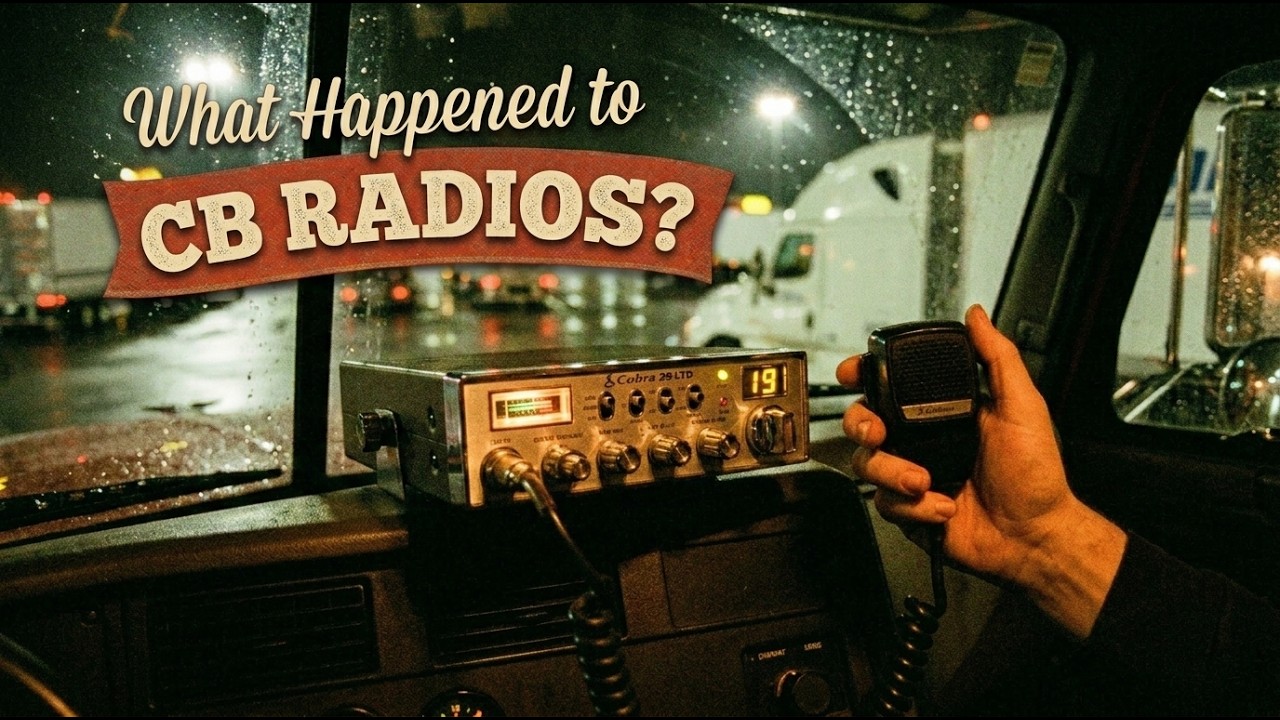
It sat in the cab of every long-haul rig from Bakersfield to Baltimore. It sat in kitchens, on a shelf above the toaster, so a mother could call her husband in from the shop. It sat on the shelves at Radio Shack, at Sears, at Western Auto beside the hardware. Then one day it was gone.
Not banned, not broken. Gone the way most things go, quietly, slowly, while nobody was paying attention. Most people never even noticed the moment it left. Here is what almost nobody tells you.
The CB radio did not disappear. We just stopped listening to strangers. A large percentage of professional drivers still reach for that microphone every single shift to this day, not out of nostalgia but because it works. When the phone shows no bars on a mountain pass, that little four-watt box is still the only voice you have.
The story of how it got there, how twenty million people built a nationwide network out of anonymity, and how most of them walked away from it, begins in 1973. That year the oil embargo hit. Gas stations had lines around the block. Some owners simply put plywood over the pumps and walked away.
Then Washington did something that changed the American highway for good: it dropped the national speed limit to fifty-five miles per hour. For ordinary drivers, fifty-five was an annoyance. For a long-haul trucker, it was a pay cut. Drivers were paid by the mile, not by the hour.
Every minute stuck behind a sedan doing fifty-four was money walking out of their wallets. They needed to know two things, and they needed to know them fast. Where is the fuel, and where is the bear? A fuel stop in 1973 was not like pulling off at a modern travel center with forty diesel lanes and a fast-food restaurant inside.
It was a two-pump station outside some town nobody had heard of, and the plywood was already going up over pump number one. If a driver wasted an hour detouring to a station that had run dry, he just kissed fifty dollars of his paycheck goodbye. And if he got caught doing sixty-five to make up the time, the ticket ate the rest. The CB radio was not a luxury.
It was payroll. The system was simple. You pressed a button on the side of the microphone, push to talk. You spoke.
You let go, and somewhere out there on the same frequency, a driver you had never met answered. There was nothing between you and that voice. No app, no login, no profile picture. Just a knob, a microphone, and whoever happened to be listening.
Which station still had diesel? Which exit had a state trooper sitting in the median? Where was the backup four miles ahead of the hill? The CB answered all of it, and it moved information faster than any newspaper, faster than any phone call, faster than anything short of a helicopter.
By 1974, truckers were organizing highway-wide blockades from the cabs of their rigs. No meetings, no flyers. Just a voice on channel nineteen saying, “We’re shutting her down at exit 212. Get the word out.
” And the word got out. There was no list of contacts, no group chat. You just talked, and the people who needed to hear you heard you. That was the whole system.
You could still picture what it looked like. A Peterbilt with a six-foot whip antenna bolted to the mirror pulling into a truck stop outside Little Rock. The driver climbs down, stretches his back, and the first thing he asks in the coffee shop is not about the weather. It is, “Anybody been through the hill country tonight?
” and “Is 40 West still moving? ” Three men sitting at the counter who have never met him turn around and answer. That was the culture. The radio was the nervous system that made it work.
In 1976, a song called “Convoy” hit number one. Not on the country chart, on the pop chart. A song about truckers talking to each other on CB radio was beating out the Eagles and Elton John on the radio in the dentist’s waiting room. A year later, Smokey and the Bandit came out, and Burt Reynolds turned the CB into the coolest thing on four wheels.
The economics were just as straightforward. A CB unit cost less than a dishwasher. You could walk into Radio Shack with about forty dollars and walk out with a transceiver, on the air that same afternoon. Radio Shack’s profits doubled between 1975 and 1977, almost entirely from CB gear.
At the peak, an estimated twenty million units were in use. This was not a niche hobby. It was a national network. Suburban families started picking handles.
That was the name for the fake identity you used on the air. Dad was Big Red. Mom was Sunshine. The kid in the back seat was Little Dipper.
You did not give your real name on the CB because you could not. The whole channel was listening, and the whole channel were strangers. Decades before the internet, America was already online. Twenty million people.
Anonymous aliases. Real-time conversation. A shared public space where strangers talked to strangers. They developed slang, inside jokes, a code of conduct, all of it without being told to.
The FCC did not write the rulebook. The drivers did. The FCC could not even keep up with the growth. In 1977, it had to expand the service from twenty-three channels to forty because the original frequencies had simply become too crowded.
A hobby so big the federal government had to build more lanes on the highway to hold it. You could walk through a Kmart parking lot in the summer of 1977 and see it. Half the cars had antennas sticking up off the trunk lids. Teenagers saved their paper route money to buy base stations for their bedrooms.
Widows in Florida used them to call their neighbors across the mobile home park. A retired schoolteacher in Ohio could key up a microphone and talk to a dairy farmer in Wisconsin she had never met, and nobody thought that was strange. That was just Tuesday. And the slang.
Bear in the air meant a sheriff’s helicopter. Four-wheeler meant a regular car. 10-4 meant yes, got it, I hear you. Breaker 1-9 meant, “I’d like to say something on channel nineteen if you’ll let me in.
” These phrases are in cartoons now, in country songs, in the mouths of people who have never touched a microphone in their lives. That is how deep it sank into the culture. It seeped. If it was that big, how did it collapse so fast?
Three things killed it, and none of them was the telephone. Not yet. The first was the noise. By 1978, channel nineteen was no longer a community.
It was a war zone. Drunks screaming obscenities at each other. Trolls blocking channels on purpose just to ruin somebody’s drive. Kids in basements running illegal amplifiers, five hundred watts, a thousand watts, loud enough to drown out a trucker three states away with pure electronic squeal.
The unwritten code of conduct, the thing that made the whole system work, snapped. Once it was gone, it was gone for good. The second was the enforcement collapse. The FCC was supposed to police the airwaves, and it could not.
The system was too big. They would shut one amplifier down and ten more would come online the same week. In April of 1983, the FCC officially stopped requiring a license to operate a CB. On paper that sounded like freedom.
In reality it was the federal government quietly admitting it had given up. The cops had left the party. The third thing, finally, was the mobile phone. But it did not kill the CB.
It just showed up at the funeral. At first the phone was a toy for businessmen. Then it was in every minivan. Then it was in every pocket.
And something changed that nobody had words for at the time. People stopped broadcasting into a shared space with strangers. They started talking only to a private contact list, people they already knew, people whose names they already had. Something was gained.
Something was lost. Most folks did not notice which was which until it was far too late. The CBs themselves were not thrown out. They were forgotten.
The unit under the dash of a father’s Ford F-150 stayed exactly where he installed it in 1978, because pulling it out was more trouble than it was worth. It sat there for twenty years, wires still connected, knob still turning, antenna still mounted, quietly waiting for somebody to turn it back on. Garage shelves across America were lined with them, tucked between the WD-40 and the Christmas lights. An entire generation of hardware, paid for and ready to go, gathering dust while the phone in everybody’s pocket got louder and louder.
Now the story turns, and this is the part the obituary writers got wrong. The CB never actually died. It just went back underground, back to the people who needed it in the first place. Industry surveys suggest a majority of professional drivers still keep one in the cab.
In one recent survey, the overwhelming majority of drivers said their CB is what keeps them safe. Not their phone, not their GPS. The radio. There is a reason.
Cell towers do not cover the country the way most people think. There are black holes, mountain passes in Colorado, long stretches of Wyoming, parts of the Appalachians where the phone shows full bars right up until the exact moment you need it. In those places, a four-watt CB with a good antenna can reach for miles, farther than any phone signal. It is the only thing that will tell you there is black ice on the bridge or a jackknifed trailer around the next blind curve.
And in September of 2021, something happened that almost nobody outside the industry caught. The FCC approved FM mode on CB radios for the first time in the history of the service. For sixty years it had been AM only, with all the static, squeal, and noise that came with it. Now, for the first time, a driver could flip a switch and get clean, clear audio, the kind you have been hearing on your car stereo since childhood.
The new dual-mode units, the Cobra 29 LX FM and the ones coming behind it, are quietly modernizing a technology everybody wrote off two decades ago. The global CB market was valued at $193 million in 2024 and is on track to hit $237 million by 2032. That is not a dying business. That is a business that finished its pop culture tour and went back to work.
There is a younger crowd quietly discovering it, too. Off-roaders running trails in Moab, Jeep clubs crossing the Rubicon, hunters working fifty miles deep into the Oregon backcountry where no cell tower will ever go. They looked at their phones, they looked at their apps, and they realized the same thing the truckers never forgot. When the signal drops, the radio does not care.
It just keeps working. There is no password, no subscription, no monthly bill. You turn the knob, you hear a voice, and the voice is real. So what happened to CB radios?
The honest answer is the same thing that happened to a lot of the best parts of the twentieth century. It stopped being popular, so the rest of us stopped paying attention. But the people who actually needed it, the ones hauling your groceries, your furniture, the gas for your car, never put the microphone down. And it was never really about the radio.
It was about the unwritten obligation. A stranger three miles ahead of you on a road you had never driven, looking out for you for no reason other than he would want somebody to do the same for him. Your GPS does not know you. Your phone does not know you.
The algorithm does not know you. A driver on channel nineteen at two in the morning does not know you either. But he will still key the mic and tell you the bridge is out. We have GPS now.
We have smartphones. In almost every practical sense, what the CB did we do better, and somehow ended up more alone. If you ever rode shotgun on a long haul, if you remember the crackle of that signal or the strange comfort of a stranger’s voice coming through the dash at two in the morning, you remember something that was once completely ordinary. And that is exactly what made it matter.
You do not notice a change when it is happening. You notice it later, when the thing that replaced it is so familiar you can barely remember what came before. The CB radio was ordinary once, completely, unremarkably ordinary. And an entire country was talking to itself, out loud, in the dark, to people it did not know.
We will not build a thing like that again, not on purpose.
