Down on her knees on the bedroom floor, September 1918, Elellanena Roosevelt unpacked her husband’s suitcase while he lay upstairs, sick with the illness he had carried home from the war in Europe. At the bottom of the case, tied together, were letters in a handwriting she knew, because it belonged to the young woman she herself had hired to organize her own home. In the next few days, she would be offered a choice that most tellings call endurance. She would make a different kind of choice.
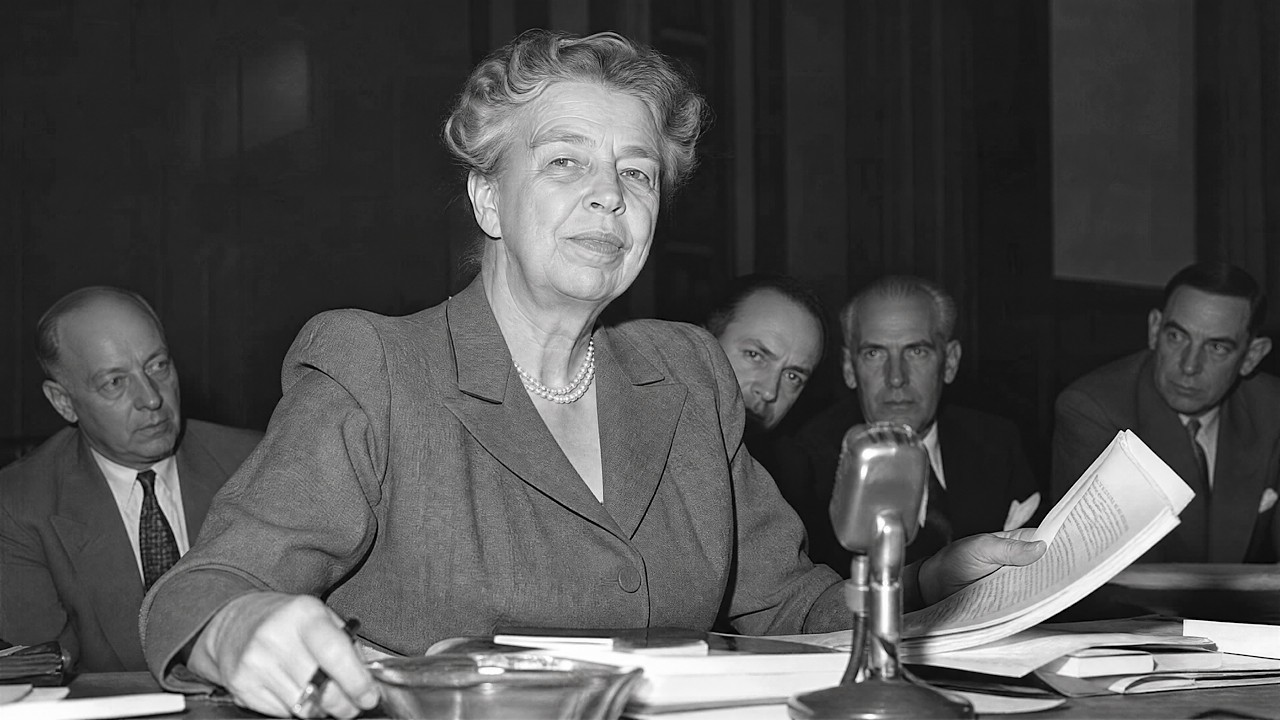
She would stay on terms of her own, and spend the next twenty-seven years turning the worst morning of her life into the most powerful public life any American woman of her century would build. The woman who would break Elellanena Roosevelt’s marriage did not force her way into the house. Elellanena opened the door and paid her to come in. Lucy Paige Mercer was born on the 26th of April 1891 into a Maryland family that had once been socially prominent and had since lost its money.
She had the manners of the class she was born into and none of the security. She had to work. And so in 1914, when Elellanena found herself drowning in the social correspondence of a rising political family, she hired Lucy Mercer as her social secretary, three mornings a week, to bring order to the letters and the invitations and the calling cards that governed life in official Washington. Lucy was by every account the opposite of a schemer.
She was gentle, warm, discreet, and strikingly lovely, with an ease and a softness that people remembered for the rest of their lives. She fit into the Roosevelt household so naturally that the children adored her. She was not a stranger who invaded. She was a trusted presence who belonged.
The betrayal, when it came, would not come from outside Elellanena’s world. It would come from the very center of it, from a woman she had chosen, trusted, and paid. By this time, Franklin’s star was rising fast. In 1913 he had been made assistant secretary of the Navy, a serious post for a man not yet past his early thirties, and the family had moved to Washington.
The First World War soon filled the capital with urgency, uniforms, and long working hours. Franklin thrived in it. He was charming, ambitious, and constantly surrounded by people who found him irresistible. And among the people who found him irresistible was the graceful young woman his own wife had brought into the house.
Historians who have studied the surviving record place the beginning of the romance around 1916. That summer, as she did most summers, Elellanena took the children to the family’s retreat at Campobello, the island off the coast of Maine, to escape the Washington heat. Franklin stayed behind to work. The pattern repeated across the war years.
The wife and children went north to the cool of the island. The husband remained in the hot, humming capital, and Lucy Mercer remained there too. In 1917, when the United States entered the war, Lucy enlisted in the Navy and was assigned, of all the offices in Washington, to Franklin’s own. They continued to see one another, and in a city that watched everything, the sight of the assistant secretary of the Navy driving out into the countryside around Washington with his wife’s beautiful secretary began to draw quiet, knowing talk.
The arithmetic of it from Elellanena’s side was brutal. She had hired the woman. She had trusted the woman with her home, her calendar, and her children. She had gone north each summer to do the hard, unglamorous work of raising a family, precisely so that her husband’s career could rise.
And in the space her absence opened, her husband and her secretary had grown close. The wife’s devotion had built the very conditions of her betrayal. Whether she suspected anything in those years is not clear from the record, and she never said. Elellanena Roosevelt was a woman who had learned as a child to look away from pain, to keep the surface calm, to endure rather than confront.
It is entirely possible that some part of her sensed the truth long before she let herself know it. It is equally possible that she trusted her husband and her friend completely and never let the suspicion form. In September of 1918, Elellanena unpacked a case of her sick husband’s belongings and found the proof she had never let herself look for. Franklin had gone to Europe that summer to inspect naval facilities near the front.
On the voyage home he fell dangerously ill with what was called pneumonia and influenza in the great epidemic then sweeping the world, and he was carried off the ship on a stretcher when it reached New York. Elellanena did what a wife of her time did without thinking. She took charge of the sick room, and she began to unpack the luggage of the man she had married. And there, among his things, she found a packet of letters tied together, written to her husband in the familiar hand of Lucy Mercer.
There was no ambiguity in them, and no room to look away. Years later, she described the feeling of that moment in words that never lost their edge, words her biographer would draw from her own correspondence. The bottom, she said, dropped out of her own particular world. What happened in the days that followed is the most famous scene in the Roosevelt marriage, and it is also the part of the story that must be told with the most care, because almost none of it exists in a document.
By the account the Roosevelt children gave many years later, an account their mother’s biographers have generally accepted, Elellanena confronted Franklin and offered him his freedom. She told him, so the family remembered it, that she would give him a divorce, if that was what he truly wanted. This was an extraordinary offer for a woman of her position in that era, when divorce meant scandal and ruin. It was not the act of a passive victim.
It was the act of a woman refusing to hold a man who loved someone else. The reasons the marriage survived are where legend and record part ways. It is said that Franklin’s mother Sarah intervened and threatened to cut her son off from the family money if he left his wife and children for Lucy Mercer. That specific threat, the money held over the marriage like a blade, comes down to us most sharply from a single source, a memoir published in 1973 by the couple’s son Elliott, a book the historian Geoffrey Ward called crude and mean-spirited, and one that Elliott’s own brother and sister felt compelled to publicly disown.
The threat may well be true. Sarah certainly opposed divorce, and she certainly held the purse. But it should be spoken of as what it is: a family recollection set down decades later, not a line anyone recorded at the time. The letters that started it all were later destroyed.
Elellanena never described the scene in print. The one thing that is certain is the outcome. Franklin agreed to end the affair. He promised never to see Lucy Mercer again.
Lucy, a devout Catholic who would not in any case have married a divorced man with children, withdrew. The marriage was preserved in form, but the marriage as a romance was over, and both of them seemed to have known it. One of the Roosevelt sons would later describe what remained between his parents as an armed truce, a partnership that endured to the end without ever again becoming a love. From the autumn of 1918, Eleanor and Franklin would be allies, colleagues, and eventually one of the most effective political teams in American history.
They would not again be husband and wife in the way she had once believed. A woman had just learned that the single relationship on which she had built her entire sense of worth was hollow. She could have collapsed into it. She had every reason and every excuse to disappear into bitterness and become a footnote to a great man’s life.
She would not be a woman things were done to. Slowly, deliberately, she began to turn the ruin into a foundation. If she could no longer be Franklin’s beloved, she would become something he had never needed her to be, and could not give her: a person in her own right, with work of her own and a name of her own. The age around her offered a wife only one respectable path: to look away entirely, to say nothing, to save the marriage by pretending the wound did not exist.
Elellanena took a harder road. She named the thing. She offered the freedom. And then she stayed on terms of her own.
For the first thirteen years of her marriage, Elellanena Roosevelt had never once slept in a home that her mother-in-law did not own. Every roof over her head had belonged to Sara. Every wall had been chosen, furnished, and staffed by another woman. That fact, more than any single cruelty, was the true shape of her captivity, because a woman who owns no space of her own is always, in the end, a guest in her own life.
The change when it came was small and quiet and made of stone, and it changed everything. In the middle of the 1920s, on a stretch of the Hyde Park estate a couple of miles from the great house where Sara reigned, Elellanena and a small circle of close women friends built a retreat of their own. It sat beside a stream the family called Val-Kill, and the name attached itself to the place. It began as a simple fieldstone cottage and grew into a modest compound, a house plain enough to feel like a rebuke to the grandeur of Springwood up the road.
Franklin, who liked the idea of his wife having somewhere to go, helped arrange the land. But the life inside the cottage was hers, and for the first time in her married years, no one could walk through a connecting door to reach her. At Val-Kill, she could set her own table, keep her own hours, and fill her own rooms with the people she chose. Her friends there were women of independent lives and independent minds, teachers, organizers, and professionals.
Among them, the anxious, deferential wife of the East 65th Street townhouse slowly disappeared. In her place stood a warmer, freer, more confident woman, who laughed easily and worked hard and belonged at last somewhere. She would call Val-Kill the only home that was ever truly her own, and she meant it as more than a remark about property. She meant that everywhere else she had been living inside someone else’s decision.
On East 65th Street, Sara had joined two houses with communicating doors so that she was never more than a room away. At Val-Kill, Eleanor had put two miles of Hyde Park field and wood between herself and that door. One home had been designed to keep her watched. The other she designed to keep herself free.
But a house is not the same as independence, and she knew it. Sarah still held the money. Franklin still held the name. A cottage could give her privacy.
But privacy is not power. To become truly free of the people who had run her life, she would need something no Roosevelt had ever expected her to want, and no woman of her class was supposed to need. She would need money of her own. A woman who owns nothing can be kept.
And Elellanena Roosevelt had spent her whole marriage being kept, until she decided to earn. This was the most quietly radical thing she ever did, and it is the part of her story that almost every telling leaves out. The world remembers Elellanena Roosevelt as a conscience, a saint, a tireless doer of good. It rarely remembers that she was also, by the middle of her life, a working professional who made real money by her own labor, and that this money was the hinge on which her freedom turned.
The first venture grew straight out of Val-Kill. In the middle of the 1920s, she and her friends founded a furniture works on the estate, a small factory that employed local men to build fine reproductions of early American furniture, an experiment meant to give farm families a craft and a wage through the hard rural years. Elellanena helped run it and helped fund it. For the first time, she was part owner of a going concern, a maker of things that sold.
Then came the teaching, which she loved more than almost anything else she did. She bought a financial interest in a private girls’ school in New York City called Todhunter, and she did not merely lend it her famous name. She stood in front of the classroom herself and taught several days a week in history, in government, in current events, driving down from Hyde Park to do it. She took her students to see courts, tenements, and markets so that the daughters of the comfortable would understand the city they lived in.
She was good at it, and she said more than once that if the presidency had never taken her away, teaching is the work she would have kept for the rest of her life. The lectures came next, and here the money grew serious. Elellanena turned professional on the lecture circuit, standing before paying audiences across the country and speaking for a fee. And in 1935 she began the work that carried her voice furthest of all: a daily newspaper column called My Day, syndicated to papers across the nation six days a week, which she would keep writing for more than a quarter of a century, almost to the end of her life.
She broadcast on national radio under commercial sponsorship. Piece by piece, she assembled the income of a genuinely independent woman. The woman who at thirty-four had not owned a stick of furniture was, by the height of the 1930s, earning sums from her writing, her lectures, and her broadcasts that by several accounts rivaled, and in some years may have exceeded, the salary of the president of the United States himself, which stood at $75,000 a year. She gave a great deal of it away to causes she chose and to people in need, on her own authority, asking no one’s permission.
She had begun her marriage unable to buy a train ticket without accounting for it. She ended the decade able to fund a cause with the stroke of her own pen. There was something close to scandal in it for a woman of her rank. Women of Elellanena’s class were expected to give their time to good works, to sit on charity boards and lend their names, and never to take a wage for anything.
To be paid was to admit you needed the money, and a lady was supposed to need nothing. Elellanena crossed that line deliberately and without apology. She let the Todhunter classroom put her to work for a salary. She let lecture agents book her for fees.
She let a syndicate pay her by the word. While her husband learned to stand again after the illness that took his legs, Elellanena learned something more dangerous: how to build a base of her own. In August of 1921, at the family retreat on Campobello, Franklin Roosevelt was struck by the paralytic illness long called polio that would cost him the use of his legs for the rest of his life. It was a catastrophe, and it was also for Elellanena the accidental beginning of her public career.
In the long years of his convalescence, someone had to keep the Roosevelt name alive in Democratic politics so that Franklin would have something to return to. That someone became his wife. Through the 1920s, she threw herself into the organized political life of women, a world that had opened up only recently after women won the vote in 1920. She worked with the League of Women Voters.
She joined the Women’s Trade Union League, standing with working women in a way no woman of her social position was expected to. She became a leading figure in the women’s division of the New York State Democratic Committee. She learned to run meetings, edit newsletters, raise money, and turn out voters. What she was really doing, though she may not have named it so at the time, was building a machine.
The network of politically active women she gathered around her in those years was loyal to Elellanena Roosevelt personally, not merely to her husband. When Franklin finally returned to public life, winning the governorship of New York in 1928, he did not simply bring a wife along. He inherited an entire political organization of women that his wife had built while he was learning to walk again, and it was one of the most effective in the state. The paralysis reshaped the marriage into something new and formidable.
Franklin could no longer move freely through the world, could no longer easily climb stairs or work a room on his feet. Elellanena became his legs and his eyes. She traveled where he could not, saw what he could not see, and reported back to him with a bluntness few others dared. He in turn taught her the hard craft of politics, how to count votes, how to read a room, how to wait.
Out of the wreckage of the romance that had ended in 1918, the two of them assembled a working partnership of genuine power. When Elellanena Roosevelt reached the White House in 1933, she did something no first lady had ever done. She barred the men. Within days of the inauguration, she began holding her own press conferences, regular meetings with reporters run by the first lady in her own right, on the issues she chose, and she admitted to them only women.
No male reporter was allowed in the room. It looked at first like a courtesy, a gesture toward the female press. It was in fact a calculated act of power. In the depths of the Great Depression, newspapers were cutting staff, and women reporters were the first to go.
By creating a source of national news that only women could cover, Elellanena forced every paper that wanted the first lady’s words to keep a woman on the payroll to get them. With a single rule, she turned her own celebrity into job security for women across American journalism. She traveled constantly, tens of thousands of miles a year, going into the places the paralyzed president could not reach. She went down into coal mines to see how miners worked.
She walked through relief camps, tenements, and sharecroppers’ cabins. She went into the segregated South and sat deliberately on the wrong side of the aisle. Wherever she went, she looked, listened, and carried what she saw straight back into the White House, into the ear of the man who could act on it. Inside the administration, Elellanena Roosevelt was a relentless advocate for the people her husband’s politics often could not afford to champion openly.
She pressed him on civil rights for Black Americans at a time when he depended on the votes of segregationist Southern Democrats and moved with extreme caution. She pressed him on the rights of workers and the plight of the poor. She pressed him, as war came to Europe, to open America’s doors wider to refugees fleeing persecution. She did not always win.
Often the president chose the cautious path over his wife’s conscience. But she made herself the voice in the room that would not let the hardest questions be ignored. No first lady before her had been loved so fiercely by strangers, and none had been hated so openly by so many. She had made herself a public figure with real positions, and a public figure with real positions makes real enemies.
She was mocked in newspapers and in the halls of Congress. She was caricatured as a meddling, homely busybody who could not keep to her proper place. Her looks were jeered at. Her endless traveling was turned into a national joke.
The deepest hatred came from the causes she chose. When the Daughters of the American Revolution refused to let the great Black contralto Marian Anderson sing in their concert hall in Washington, Elellanena resigned from the organization in public protest, a stand that outraged conservatives and thrilled millions of others. She was photographed sitting deliberately among Black delegates in the segregated South. To the defenders of the old racial order, she was a traitor to her class and her color, and they said so viciously.
As war spread across Europe, and refugees, many of them Jewish, sought escape from Nazi persecution, Eleanor pressed her husband to open America’s doors, and the isolationists who wanted the country to stay walled off and uninvolved detested her for it. She was attacked as a warmonger and a foreign meddler by some and as a dangerous radical by others. And through all of it, she carried a private grief the public knew nothing about. The marriage that the country held up as a model partnership was, behind its doors, the armed truce it had been since 1918.
Elellanena and Franklin worked together, respected each other, and needed each other. But the warmth between them had never come back. He kept his own circle of devoted companions who made him laugh and eased his days, a circle his earnest, driving wife was not part of. She kept hers.
They were two allied leaders sharing an enterprise, and beneath the enterprise ran a loneliness she rarely let anyone see. The person Elellanena Roosevelt may have loved most in the White House years did not sleep in the family quarters by right of blood or marriage. Her name was Lorena Hickok, and almost everyone called her Hick. She was one of the best-known women in American journalism, a hard-driving reporter for the Associated Press who had climbed out of a brutal, impoverished childhood in the Midwest to become one of the top wire service correspondents in the country.
When the Associated Press assigned her to cover the wife of the Democratic nominee during the presidential campaign of 1932, the two women fell into a closeness that would change both their lives. It grew fast and it grew deep. In the long hours of trains and hotels and waiting rooms, the guarded first lady in waiting and the tough reporter found in each other something each had been missing. By the time Franklin took office, Lorena Hickok was so completely in Elellanena’s confidence, and so deeply and openly devoted to her, that she could no longer pretend to report on her at arm’s length.
In the middle of 1933, she did something almost unheard of for a woman at the top of her profession. She resigned from the Associated Press because she knew she could no longer write about Elellanena Roosevelt with a reporter’s honesty. She gave up the career she had clawed her way to rather than compromise it or give up the woman. For years afterward, Hickok lived for long stretches inside the White House itself, in a small room just steps from the first lady’s own.
The two women exchanged an extraordinary volume of letters whenever they were apart, and the letters survive. There are around 3,300 of them, more than 2,000 from Eleanor to Hick and around 1,000 from Hick to Eleanor. Their language is open, tender, and physically affectionate. Elellanena wrote of longing to hold her and of kissing her photograph.
What those letters mean is a question historians have argued over for decades, and honesty requires holding it open rather than closing it. Some scholars read the correspondence as clear evidence of a romantic and physical love affair. Others read it in the context of an age when passionate, even ardent language between close women friends was common, and did not always carry the meaning a modern reader assumes. The plain truth is that the evidence allows both readings and settles neither, and no one living can say for certain what passed between the two women in private.
Elellanena Roosevelt kept her deepest feelings to herself all her life, and she took whatever the full truth was to her grave. Two things, though, are beyond dispute. The first is that the emotional center of Elellanena Roosevelt’s life in the years of her greatest public power lay outside her marriage. The second is that she had built on her own a private world of love and loyalty and belonging that Franklin was no part of, just as he had built one she was no part of.
The armed truce of 1918 had produced two separate lives running side by side beneath one famous roof. Hickok understood the cost of loving a woman who belonged in the end to the whole world. She once wrote that she was trying to teach herself not to expect too much, that Eleanor could never be hers alone. But she also kept every letter.
And at the end of her life, she made a decision that would let the world finally see what had passed between them. She arranged that the correspondence be sealed and opened only ten years after her death. Lorena Hickok died on the 1st of May 1968. The letters were opened in 1978, and a private woman’s most guarded relationship became at last a public argument.
The affair Elellanena believed she had ended in 1918 had never truly ended, and her own daughter was helping to hide it. Franklin Roosevelt had promised in the crisis of that autumn never to see Lucy Mercer again. He had not kept the promise, though he had kept the secret. Lucy had married a wealthy older widower named Winthrop Rutherford in 1920 and become a stepmother and then a mother, living a quiet life far from Washington.
But the tie between her and Franklin had never fully broken. He had arranged for her to be present, discreetly, at his first inauguration as president in 1933. Across the years, at careful intervals, they had stayed in touch. The great secret of 1918 had gone underground, but it had gone on living.
In 1944, Lucy’s husband, Winthrop Rutherford, died, and Lucy Mercer Rutherford was a widow. Franklin Roosevelt by then was a dying man carrying the whole weight of a world war, exhausted, gray, and failing, though the country did not yet know how badly. In those last hard months, he wanted the comfort of the woman he had loved as a young man, and he found a way to have it. Quietly and with great care, meetings were arranged between the president and Lucy Rutherford.
And the person who arranged many of them was his and Elellanena’s own daughter, Anna. Anna Roosevelt loved her mother. But she also loved her father. And she saw a sick, lonely, overburdened man who found ease in one particular woman’s company.
And she chose to give him that ease in his final months. She acted as the keeper of the meetings, seeing to it that Lucy could come to the White House and later to Warm Springs when Elellanena was away. And she did it all without telling her mother. The daughter became the guardian of the very secret that had broken her mother’s heart a quarter century before.
On the 12th of April 1945, Franklin Roosevelt died in a small Georgia cottage, and the woman beside him was not his wife. He had gone to Warm Springs, the place in the Georgia hills where he had long sought relief for his paralyzed legs, worn down to almost nothing by twelve years in office and a world war. Elellanena was in Washington, carrying on with the endless public duties that filled her days. And Lucy Mercer Rutherford, the woman from the letters in the suitcase, was at Warm Springs with him, her visit arranged once again with the help of his daughter Anna, and unknown to his wife.
That afternoon, sitting in the cottage, the president put a hand to his head, said that he had a terrific pain, and collapsed. Within hours, he was dead. The news reached Elellanena in Washington, and she did what the moment demanded, absorbing the shock, summoning her strength, preparing to become the widow of a president before a watching world. But in the hours that followed, a second blow landed on top of the first.
She learned that Lucy Rutherford had been with Franklin at Warm Springs when he died. She learned that this was not the only such visit, and she learned that her own daughter had helped to arrange them in her own homes, behind her back. In the same terrible day, Elellanena Roosevelt lost her husband, and discovered that the wound of 1918 had never truly closed, that the woman she thought long gone had been there at the very end, and that the deception had reached into her own family. Whatever she felt in that hour, she mostly kept to herself, as she had kept so much across her life.
She did what had to be done. She traveled to Warm Springs to bring her husband’s body home. She stood through the funeral train’s long journey north through the crowds that lined the tracks, weeping for the man who had led them through depression and war. She buried Franklin Roosevelt in the Rose Garden at Hyde Park on the estate his mother had ruled, and she stood at the graveside as the widow of the thirty-second president of the United States.
The family closed ranks around the secret, and it held for a long time. The fact that Lucy Rutherford had been present at Warm Springs was kept from the public for more than twenty years, until a writer named Jonathan Daniels made it public in 1966. Only then did the country learn that the great romance at the top of American life had carried all along a hidden second story. For Elellanena, though, there had been no waiting.
She had known the truth from the day he died. She had absorbed it in silence, folded it into everything else she carried, and walked forward. She could have broken with her daughter and torn the grieving family apart in front of a watching nation. She did not.
She could have let the bitterness of the discovery show, could have turned the funeral of a president into a settling of private scores. She did not do that either. She absorbed the second wound the way she had absorbed the first, in silence, and she carried on with the enormous public duties that a president’s death demanded of his widow. She received the condolences of the world.
She comforted a mourning country. She kept the family’s oldest secret still, for the sake of the children and the memory of the man. At sixty years old, she was a widow. The husband was gone.
The role of first lady was gone with him. By every rule of her age, her public life was over. A woman of sixty who had just buried the man who wronged her was expected to retire into memory, and Elellanena Roosevelt declined. Within months of Franklin’s death, the new president, Harry Truman, asked her to serve as a delegate of the United States to the first General Assembly of the newly created United Nations.
It was an extraordinary appointment. She had never held elected office. She had no formal diplomatic training. She was a widow of sixty-one being sent to represent her country at the founding of the great postwar attempt to build a lasting peace.
Some of the men around Truman thought of it as a gesture, a graceful way to honor the widow of a beloved leader with a ceremonial seat. They badly misjudged the woman they were sending. Elellanena went to that first assembly, held in London at the start of 1946, and she went to work with the same relentless seriousness she had brought to every committee room and church basement of the 1920s. She read every document.
She mastered every brief. She sat through the long procedural battles that bored or exhausted the other delegates. And she outlasted them. Assigned to the committee handling humanitarian, social, and cultural questions, the work many assumed was the soft and secondary corner of the new organization, she took hold of it and made it the ground on which one of the century’s great documents would be built.
Some of the American delegation had privately doubted whether the president’s widow belonged among the diplomats and statesmen. Then they watched her work. She outread them, outlasted them, and outmaneuvered them in the committee room, mastering the briefs they found tedious and holding her ground against opponents far more experienced in the arts of diplomacy. By the end of that first session, the men who had questioned whether she should be there were admitting, some of them openly, that she had been among the most effective members of the delegation.
When the United Nations created a commission to draft an international statement of human rights, Elellanena Roosevelt was elected its chair. It was one of the most difficult assignments imaginable. She had to forge a single declaration of the fundamental rights of every human being out of a room full of governments that agreed on almost nothing. The United States and the Soviet Union, the great colonial powers and the nations chafing under them, the Western democracies and the communist bloc, each with its own idea of what a right was and who deserved one.
Holding that room together was less like writing a document than like conducting a war by other means. This was the dawn of the Cold War, and the great divide between the American-led West and the Soviet-led East ran straight through her commission. The two sides could not even agree on what a human right fundamentally was, one bloc emphasizing political and civil liberties, the other the rights of labor and material security, and each suspected the other of trying to turn the document into propaganda. Again and again, the whole enterprise threatened to collapse into deadlock or walk out altogether.
Elellanena did it with a mixture of iron patience and quiet command that astonished the diplomats around her. She ran the meetings with a firm hand, kept the exhausted delegates at the table long into the night, and drove the work forward when it threatened to collapse into deadlock. She had no army, no vote in any legislature, no formal power beyond the gavel in her hand and the force of her own preparation and will. She scheduled the sessions, drove the pace, and kept the delegates working long past the point of exhaustion, on the theory that a tired room was a room more willing to agree.
Over two years of grinding negotiation, she shepherded the Universal Declaration of Human Rights from an idea into a finished text, article by contested article, refusing to let the great powers grind it into meaninglessness or abandon it altogether. On the 10th of December 1948, the United Nations General Assembly adopted the Universal Declaration of Human Rights. It set down for the first time in history a common standard of dignity and freedom for every person on earth, whatever their nation, race, sex, or creed. When it passed, the delegates rose and gave Elellanena Roosevelt a standing ovation, a rare and pointed tribute to the woman who, more than any other single person, had willed the document into being.
The world understood what it was seeing, and it gave her a new name for it. She had been the longest-serving first lady in the nation’s history. Now, in the years after, she was known across the globe as the First Lady of the World, a private citizen who commanded more moral authority than most heads of state, sought out for her counsel, her endorsement, and her presence until nearly the end of her life. The power she held in those years was entirely her own.
No husband had granted it. No husband’s death could take it. Elellanena Roosevelt died in New York City on the 7th of November 1962 at the age of seventy-eight, and the world she left was not the one she had entered. She was mourned as one of the most admired human beings of the century, and the tributes that poured in for her had almost nothing to do with the fact that she had once been the wife of a president.
At Hyde Park, the plain fieldstone cottage at Val-Kill, the one home that was ever truly her own, is preserved as the Eleanor Roosevelt National Historic Site, the only such site in the country dedicated to a first lady. The Universal Declaration of Human Rights she drove into being still stands as the founding document of the modern human rights system, invoked by the oppressed and the imprisoned in every corner of the earth. And the office she rebuilt, the idea that the wife of a president could be a public figure with her own voice, her own causes, and her own power, became the template that every first lady after her has had to reckon with. She changed what the role could be, and it never changed back.
Consider the two images that bracket her life. A wife on her knees on a bedroom floor in 1918, holding proof that the one relationship she had staked her whole self on was hollow. And a stateswoman in a great hall in 1948, rising to a standing ovation from the assembled nations of the earth for authoring the rights of all humankind. The same woman, twenty-seven years, and a whole world between them.
She had been given every reason to disappear, and she had answered by building the most consequential public life any American woman of her century would lead. She would not be a woman things were done to. The bottom had dropped out of her particular world on a September morning in 1918. She spent the next twenty-seven years building a new world for herself, and then for everyone.
And it began with a suitcase, a packet of letters, and a woman on the floor who decided that this would not be the end of her, but the beginning.
