The horses were gone by sunrise. Not stolen, not spooked, just gone, released one by one sometime after midnight, their gates left swinging in the wind as if no one cared whether anyone noticed. The storehouse doors hung open too, the shelves bare, the dust not yet settled. In the fire pit behind the smokehouse, the overseer’s ledgers—the records that tracked every human being on the property like cattle in a stockyard—had been reduced to ash.
And forty-one people were simply not there anymore. No screaming, no struggle, no blood on the ground. Just absence. A silence so total that when the plantation owner, Elias Witmore, stepped onto his porch that October morning in 1837, he said later that the quiet itself felt like a verdict.
By noon, patrols were riding in every direction. By nightfall, rewards were posted in three counties. And by the following week, when investigators finally sat down with what little evidence remained—a torn page of handwriting practice hidden beneath a floorboard, a map traced in charcoal on the back of a feed sack, a pattern of movements that could only have been planned for months—they arrived at a name that made every grown man in that room go still. Charlotte Reed.
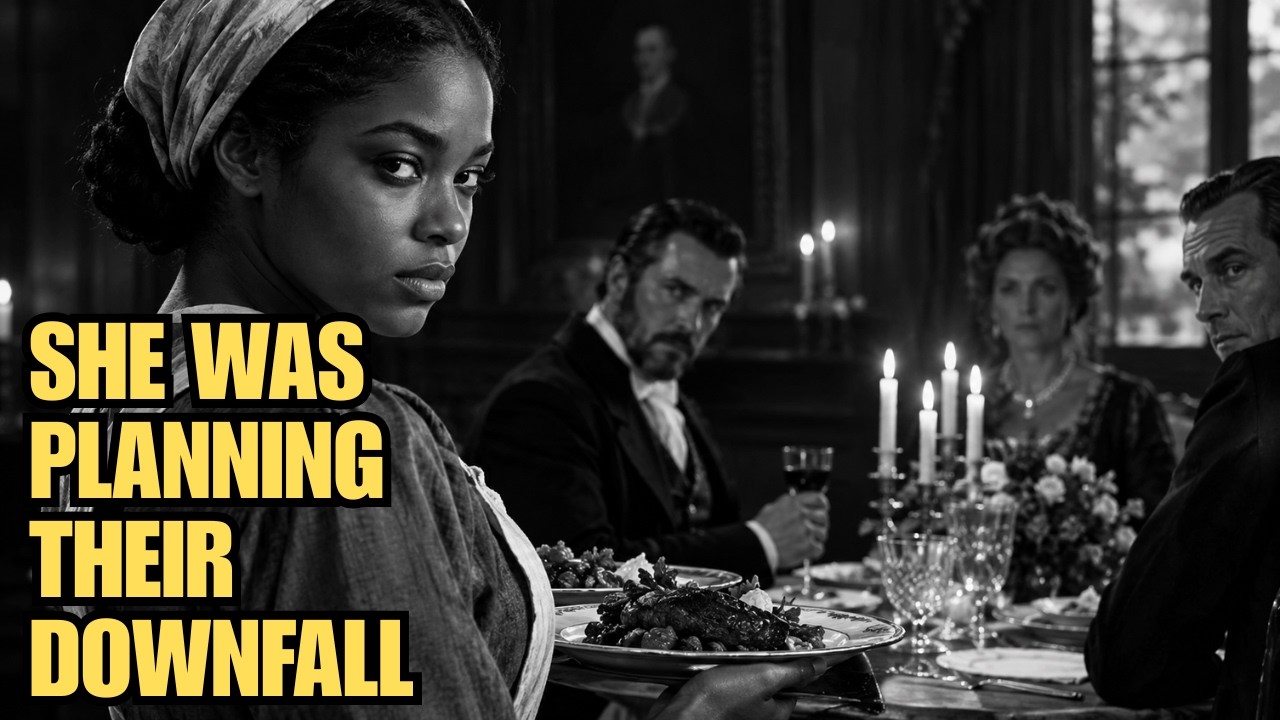
The woman they called the most beautiful enslaved woman in three counties. The woman plantation owners toasted at their dinner tables like she was a prize horse. The woman everyone assumed was too soft, too quiet, too broken to be anything more than what she appeared to be. They were wrong.
And by the time they understood how wrong, it was already too late. Kentucky, 1837. The Witmore plantation sat on nearly two thousand acres of tobacco land, one of the largest holdings in the county, and Elias Witmore liked to remind his neighbors of that fact whenever the opportunity arose. He was a man who measured his worth in acreage and bodies.
Among the two hundred and six enslaved people who lived and worked and suffered on his land, there was one whose name traveled further than the rest. Charlotte Reed was twenty-three that autumn, though she carried herself with a stillness that made men forget her age entirely. She had been born on the Witmore land, the daughter of a woman named Dena, who had died when Charlotte was eleven—coughing blood into a rag in the corner of a cabin that never once saw a doctor. Charlotte remembered her mother’s hands more than her face by then.
Rough hands, quick hands, hands that had taught her to sew a hem so fine it looked machine-stitched, a full two decades before such machines existed on any real scale in the South. It was those hands, and the quiet grace behind them, that first drew attention. By sixteen, Charlotte was being loaned out to neighboring plantations for their finest social occasions—to serve at dinner tables, to stand near the piano while guests admired the room, to be, in the ugly language of the era, on display. Witmore understood, even if he never said it plainly, that Charlotte’s beauty was an asset.
Visiting planters spoke of her the way men speak of a prized animal or a piece of fine furniture: admiringly, possessively, and always with the unspoken assumption that whatever lived behind her eyes was simple, pliant, grateful for the attention. She had learned early—earlier than most children ever should have to learn anything—exactly what kind of attention her appearance drew, and exactly how dangerous that attention could be if she let it define her instead of the other way around. By thirteen, she had already watched two older girls on neighboring plantations sold away, or worse, simply because a visiting planter had taken too keen an interest in them. She understood in a way no child should have to understand that beauty in her position was not a gift.
It was a spotlight. And a spotlight could either expose you—or, if you learned to control it, hide everything standing just outside its edge. Charlotte chose to make it hide her. She practiced alone at first: the particular blankness that made powerful men comfortable, a softening of the eyes, a slight downward tilt of the chin, a stillness in her hands that read as diffidence rather than what it actually was—patience.
She practiced answering questions with just enough warmth to satisfy and just little enough substance to reveal nothing. By the time she was seventeen, planters who had known her for years would have sworn under oath, if asked, that Charlotte Reed had never had an original thought in her life beyond pleasing whoever stood in front of her. Here’s what nobody told those men. Charlotte had been listening to every single word they said since she was twelve years old.
While they toasted her beauty over glasses of Madeira wine, she was memorizing the layout of their properties. While they murmured that she was the calmest girl on any of these plantations, she was cataloging their patrol schedules, their debts, their arguments about tobacco prices, their careless talk of which roads the slave catchers preferred and which they avoided. Men speak freely in front of a woman they’ve already decided doesn’t matter. That mistake—that one fatal mistake repeated by dozens of wealthy men across three counties for nearly a decade—would come back to destroy them.
But before Charlotte could become the architect of the largest single escape Kentucky had seen in a generation, she first had to become something no one thought was possible. She had to learn to read. And that secret alone, if discovered, would have gotten her killed. In 1837, teaching an enslaved person to read was against the law in Kentucky.
The state had passed increasingly severe anti-literacy statutes in the years following Nat Turner’s rebellion in Virginia six years earlier. Witmore, like most planters, treated literacy among the enslaved as a kind of contagion—something to be stamped out the moment it was found, with punishment severe enough to discourage anyone else from catching it. Charlotte knew this better than anyone, and she learned anyway. It began almost by accident.
When Charlotte was fourteen, she had been assigned to help in the Witmore main house, dusting shelves and polishing silver under the eye of the housekeeper, an older enslaved woman named Patience, who had worked the house for over thirty years. Patience had a peculiar habit. When the family was out and the house was empty, she would sometimes sit near the study window with a torn scrap of newspaper, moving her lips silently over the words. Charlotte asked her once what she was doing.
“Learning what they don’t want us to know,” Patience had said. And then, after a long silence, she had beckoned Charlotte closer and pointed to the first letter on the page. “That there is an A. Sounds like the start of ‘apple.
‘ Sit down, girl. Quiet now. ”
It took years. It happened in stolen minutes—five here, ten there, always with a lookout posted, always with a story ready in case anyone asked what they were doing.
Patience taught Charlotte the alphabet first, then simple words, then painstakingly how letters combined into meaning. When Patience died of a fever in 1834, Charlotte was nineteen and could read almost anything she got her hands on. Which, given her position, turned out to be quite a lot. Because here is the second thing nobody understood about Charlotte Reed.
Her beauty didn’t just distract men from her intelligence. It gave her access. She was invited into rooms other enslaved people never entered. She stood near desks covered in correspondence while wealthy men discussed business matters they assumed she couldn’t comprehend even if she overheard them.
She dusted studies lined with maps of the county, of the state, of the roads leading north. She served drinks to men who spread newspapers across dinner tables and left them behind unthinking. When the meal was cleared, Charlotte read every single one. She learned about railroad expansion routes still under construction.
She learned which rivers could be crossed on foot during the dry season and which required a boat. She learned the names of sympathetic free Black communities in Ohio and Indiana, mentioned in passing by planters complaining about troublesome free Negroes who harbored runaways. She learned patrol rotation schedules from careless conversations about hunting parties and slave patrols sharing the same roads on alternating nights. And she began, slowly, deliberately, to write it all down.
But here’s the part most people get wrong when they imagine stories like this one. They imagine one dramatic night of decision—a single moment where an enslaved woman decides to run. That is not what happened on the Witmore plantation. What happened took four years.
By 1835, Charlotte was no longer just gathering information. She was organizing. It began with a man named Isaiah, a blacksmith on a neighboring plantation whom Charlotte had met during one of her loan-out visits. Isaiah was trusted by his owner in a way few enslaved men were—given relative freedom to travel between plantations for repair work, permitted to move through the county with a pass that named him as a skilled tradesman on legitimate business.
Isaiah had been quietly helping people disappear for two years before he ever met Charlotte, guiding small groups north in twos and threes, using his travel pass as cover. What Isaiah lacked was information. He knew the roads he had personally walked. He didn’t know the patrol schedules of six different plantations, the debts and rivalries between planters that could be exploited, or which overseers could be bribed and which would shoot first and report later.
Charlotte had all of that. And more than that, she had something Isaiah didn’t: access to the extended network of enslaved women across multiple plantations who moved between kitchens and nurseries in ways that made them functionally invisible to the men who ran the county. Here’s what nobody told those planters. The women serving their tea, minding their children, washing their linens—they talked to each other constantly in yards and kitchens and washhouses across property lines the planters imagined as solid barriers.
Women exchanged information the way water finds every crack in a dam. A conversation overheard at breakfast on one plantation could reach a woman on another plantation by dinner, and by the following morning it had traveled ten miles further. Charlotte understood this network instinctively because she had been part of it her whole life without ever thinking of it as a weapon. Now she began to see it exactly that way.
She started small—a whispered question to a woman she trusted at a neighboring plantation. Had anyone in her quarters ever tried to run? What happened? Which direction?
How far did they get before they were caught? And why? Slowly, carefully, over months, Charlotte built a map—not on paper, not yet, but in her own memory first—of every failed escape attempt within a thirty-mile radius over the past decade. She learned that most people who ran were caught within the first three days, usually because they moved at night without knowing the terrain, or because they followed roads that patrols specifically watched, or because they had no destination beyond “north”—a direction, not a plan.
Charlotte decided her people would not make those mistakes. She began quietly, and without ever naming what she was doing, to interview survivors. A man on a neighboring plantation who had run twice and been caught twice told her, in a hushed conversation held while shelling peas on a porch step, that patrols favored the main road because it was easiest to ride, and that anyone with sense should treat the main road as the one place they must never set foot. An older woman, decades removed from her own failed attempt as a girl, told Charlotte about a particular stretch of swamp that patrol dogs refused to enter because the mud swallowed their scent trail whole.
A boy no older than thirteen, who had watched his own uncle dragged back in chains, remembered with startling precision which of the county’s slave catchers preferred whiskey to watchfulness, and which nights of the week those men could reliably be found too drunk to ride. Charlotte gathered every fragment like this, the way a seamstress gathers scraps of fabric—useless alone, but woven together into something whole. She cross-referenced what she heard from the enslaved community against what she overheard from planters themselves, testing one account against another, discarding rumor, keeping only what corroborated. By the end of 1835, she had assembled, entirely inside her own memory, a working intelligence picture of patrol behavior across two counties that no single enslaved person—and very likely no single slaveholder—possessed in its entirety.
She had also learned something else, something that would shape every decision she made from that point forward. Information was only as valuable as the discipline used to protect it. A network was not a strength. It was a liability wearing the costume of a strength, because every person who knew something was a person who could, under threat or torture or simple fear, reveal it.
So Charlotte built her network the way a fortress is built in concentric rings. Each ring trusted with only what it needed to know, no more. The outer ring knew nothing beyond their own small role—a woman asked to leave a particular door unlatched on a particular night was never told why, never told what would happen, never told who else was involved. The middle ring—group leaders like Isaiah, trusted with entire routes and small teams of travelers—knew their own piece of the puzzle in detail but not the full shape of the operations surrounding them.
Only Charlotte herself held the complete picture: every route, every signal, every contingency, every name. It was an enormous, isolating burden to carry alone. But it was also, she understood with a clarity beyond her years, the only way to ensure that no single betrayal, no single beating, no single moment of fear could bring the entire structure crashing down. Building the plan was the easy part.
Keeping it hidden from everyone who wanted her dead for it—that was the war she fought every single day for four years. Charlotte was never alone in a way that felt safe. She was watched constantly, not out of suspicion, but out of the particular scrutiny reserved for enslaved women considered beautiful. Witmore’s wife, a sharp-eyed woman named Constance, kept close tabs on Charlotte’s movements, partly out of a casual cruelty common to plantation mistresses, and partly—though she likely never admitted it even to herself—out of something closer to jealousy.
Visiting planters requested Charlotte by name for social events with unsettling frequency. Overseers watched her the way men watch something they’ve been told not to touch but cannot stop looking at anyway. Every single one of these forms of attention was dangerous, and Charlotte turned every single one of them into camouflage. She learned to let men underestimate her completely.
When planters spoke around her, she kept her eyes down and her expression soft, cultivating a reputation for gentle, uncomplicated agreeableness that made grown men comfortable saying things in front of her they would never have said in front of an enslaved man they considered a threat. When Constance Witmore questioned her about where she’d been or who she’d spoken to, Charlotte answered with such calm, unbothered honesty about the mundane parts of her day that the deeper truth simply never came under suspicion. She was performing, every single hour of every single day, a version of herself designed entirely to be underestimated. And it worked, because the alternative—a Black woman in 1837 Kentucky who was seen as intelligent, watchful, and quietly powerful—was not a woman who had been allowed to live freely, let alone move as she needed to move.
Charlotte’s softness was not a weakness. It was armor, deliberately worn, precision-fitted to the exact shape of what her enemies expected to see. By 1836, her network had grown to include trusted contacts on five plantations across two counties. She had a system of signals: a specific way a quilt was hung on a fence line, a particular song sung at a particular volume during fieldwork, a certain arrangement of stones near a well.
Information moved without a single word being spoken aloud where it might be overheard. She had built an intelligence network, and she had done it while everyone around her believed she was simply the prettiest girl on the Witmore plantation. No operation of that size survives four years without near disaster. Charlotte had at least three moments where everything could have collapsed—where a single wrong word, a single moment of bad luck, could have ended not just her plan, but her life and the lives of everyone connected to her.
The first came in the spring of 1836. A young enslaved boy named Toby, no older than ten, was caught by an overseer with a scrap of paper in his pocket. On it was a crude drawing—a version of the charcoal map Charlotte had begun teaching select trusted members of her network to memorize and reproduce, simplified enough for a child to carry without understanding what it truly represented. The overseer, a cruel man named Gentry, beat the boy for having notions above his station and demanded to know where he’d gotten the drawing.
Toby, terrified, said only that he’d found it. Gentry didn’t believe him, but he had no way to prove otherwise. After three days of increasing punishment, he moved on to easier targets, assuming the boy had simply copied something he glimpsed and didn’t understand. Charlotte heard about the incident within hours through her network.
She did not sleep that night. She spent it instead reworking every single method of communication she’d built, adding new layers of deniability, ensuring that from that point forward, nothing that could be construed as a map would ever exist on paper in a form a child could be caught carrying. Everything moved to memory alone, reinforced through repetition, tested constantly for accuracy. In the days that followed, Charlotte moved through the plantation as though nothing had happened.
But inside her chest, something had shifted permanently. She began holding small, quiet gatherings—never more than three people at once, never in the same location twice, always framed as something innocent: a mending circle, a prayer meeting, a shared task assigned by the overseer himself. In these gatherings, she taught her most trusted contacts a system of memory she had developed specifically because paper could be found and children could be caught holding it. She taught them to memorize routes the way a person memorizes a hymn—through repetition, through rhythm, through association.
A bend in a creek became a line in a song. A fallen oak became a verse. A fork in the road became a chorus repeated three times, once for each possible direction, so that even a person who had never seen the terrain with their own eyes could recite their way through it in the pitch dark. “You carry it here,” she told them once, touching two fingers gently to her own temple.
“Not here. ” She touched her palm. “Hands get searched. Pockets get searched.
Nobody can search what’s sitting inside your head unless you let them. ”
It was a method that would, months later, save every single person in her network from the fate that nearly befell young Toby. The second close call came just months before the escape, in the summer of 1837. A planter named Josiah Cobb—a frequent guest at Witmore’s table and a man notoriously indiscreet after his third glass of brandy—began speaking too openly at a dinner where Charlotte was serving.
He complained loudly about “uppity” slaves who thought they were clever, specifically referencing a blacksmith on a neighboring property whom Cobb suspected, without proof, of helping people disappear. He was talking about Isaiah. Charlotte, standing near the sideboard with a decanter in her hand, kept her face perfectly composed as her entire chest went cold. Cobb had no evidence—only suspicion, and the kind of vague, half-formed accusation men make when they’ve had too much to drink and want to sound important.
But suspicion in that world could be enough to get a man killed on nothing more than a planter’s whim. That night, Charlotte broke every rule of caution she had built for herself. She sent an urgent message through her network—three separate relays, each one carrying only a fragment so that no single person could betray the whole—warning Isaiah to disappear from public view for several weeks and to destroy anything on his property that could connect him to the network. Isaiah listened.
Cobb’s suspicion faded without evidence to sustain it, the way idle accusations from drunk men often did in that world. And by autumn, the danger had passed. But Charlotte understood more clearly than ever exactly how thin the margin was between success and catastrophe. One careless sentence from one drunk man had nearly ended everything four years in the making.
The third close call was the one that almost destroyed her personally. And it’s the one she never spoke of afterward, not even to the people closest to her in the network. In the summer of 1837, a wealthy planter from a neighboring county—a widower named Augustus Hail—became fixated on Charlotte during one of her loan-out visits. Hail was forty-six years old, powerful, and accustomed to acquiring anything he wanted.
He approached Witmore directly with an offer to purchase Charlotte outright at a price nearly triple her market value, making his intentions—which had nothing to do with fieldwork or domestic service—unmistakable to everyone involved. Witmore, who valued Charlotte precisely because of the prestige and social currency her presence brought him, initially refused. But Hail was persistent and wealthy, and the kind of man who did not accept refusal gracefully. He began making repeated visits to the Witmore estate, always finding reasons to be near Charlotte, always pressing Witmore harder each time.
For Charlotte, this was not merely an insult. It was an existential threat to everything she had built. If Witmore sold her to Hail, she would be removed entirely from a network she had spent four years constructing—cut off from every contact, every signal system, every relationship that made the coming escape possible. Worse, Hail’s estate lay in a different direction entirely, further from the escape route she had spent years mapping.
Everything would collapse. She had exactly one tool available to her in that moment—the same tool that had built her network in the first place. The performance. The careful, calculated management of how powerful men perceived her.
Charlotte began deliberately to make herself less appealing to Hail. Not through open defiance, which would have brought punishment down on her immediately, but through a thousand small, deniable choices. She let her responses to his attention grow slightly duller, slightly less engaged. She complained quietly—and only when it would reach Constance Witmore’s ears—of headaches and fatigue whenever Hail’s visits were announced, cultivating an impression of frailty that ran counter to everything Hail found desirable.
She made herself, through careful and exhausting performance sustained over weeks, simply less interesting to a man who wanted a prize, not a burden. It worked, but barely, and not without cost. Hail’s interest cooled by late summer, redirected toward an enslaved woman on another plantation whose story, tragically, history does not preserve. Witmore, relieved to avoid losing what he saw as a valuable asset without gaining anything in return, quietly ended the negotiations.
Charlotte had saved her network. But those weeks had taught her something that hardened her resolve beyond anything that came before. The system she lived under could take everything from her—her network, her freedom, her body, her future—on nothing more than the whim of a man with money. There would be no waiting for the perfect moment.
There would be no more delays for further preparation. It was time. By September of 1837, Charlotte had spent four years building toward a single night. Now, with the threat of Hail still fresh in her memory, and autumn approaching—the season when tobacco harvest slowed and plantation attention turned briefly elsewhere—she made the decision that would change everything.
The escape would happen at the new moon in late October, when the nights would be darkest. What Charlotte designed was extraordinary in its complexity: a coordinated multi-plantation escape involving forty-one people moving simultaneously across five separate properties, timed to exploit every weakness in the regional patrol system she had spent four years cataloging. The plan had three pillars. First, disruption.
On the night of the escape, key infrastructure across the Witmore plantation would be sabotaged simultaneously—not destroyed in a way that would immediately signal deliberate rebellion, but disrupted just enough to delay any organized pursuit. Horses would be released from their stalls under cover of darkness, scattering across the property and forcing anyone attempting pursuit to first recover their own mounts. Storehouse supplies—food in particular, that would otherwise sustain a rapid, well-equipped pursuit—would be quietly removed in the hours before dawn. And critically, the plantation’s records, the ledgers documenting the names, descriptions, and estimated locations of every enslaved person on the property, would be destroyed, burned in a fire pit behind the smokehouse.
The destruction of the ledgers was timed to look, in the chaos of the following morning, like an accident or an act of opportunistic vandalism rather than a calculated strike against the very system of identification that made recapture possible. Without accurate records, Witmore and his allies would struggle even to know precisely who had left, let alone create the detailed descriptions typically circulated to slave catchers and posted as rewards. Second, dispersal. Rather than a single large group moving together—an approach that history had taught Charlotte was almost always caught, since a group of forty-one people leaves an unmistakable trail and moves at the pace of its slowest member—Charlotte organized the escape into eight smaller groups, each with a designated route, a designated leader familiar with that specific terrain, and a designated rendezvous point deep enough into the countryside that patrols would have exhausted their most obvious search radius by the time the groups converged.
Isaiah led the largest group, using his travel pass as cover for the initial hours, escorting the most vulnerable—several young children and two elderly women who could not travel quickly—along a route that used the cover of a legitimate blacksmith supply run before diverting into the deep woods after nightfall on the second day. Each of the remaining seven group leaders had been chosen by Charlotte over the preceding year with the same care she applied to every other element of the plan. She selected people whose ordinary duties gave them plausible reasons to be moving through the countryside at odd hours: a woman who traded eggs and preserves between properties; a young man permitted to fish a stretch of river that happened to run within a mile of the rendezvous; an older man trusted to carry messages between plantations on behalf of his owner, who had no idea the messages he delivered often carried, folded inside them, information meant for entirely different eyes. Charlotte drilled each leader individually in stolen sessions spread across months, walking them through their route not once but dozens of times, questioning them on details until their answers came without hesitation, even when startled awake in the middle of the night and asked to recite their path.
She built contingencies into every route: a secondary crossing point if the primary one flooded, a fallback rendezvous if the main one was compromised, a signal that meant “abort and scatter” if any group encountered a threat too severe to continue. “You are not memorizing a road,” she told one young woman preparing to lead a group of six through unfamiliar terrain. “You are memorizing a promise. Every person walking behind you is trusting that promise with their life.
Don’t you dare let fear make you forget a single turn. ”
Third, and most dangerous of all, misdirection. Charlotte understood that the moment the escape was discovered, patrols would fan out toward the most obvious destination: north, toward Ohio, toward the routes most commonly associated with escape in that era. So she built deliberately a false trail.
Two volunteers—free Black men from a sympathetic community Charlotte had identified through years of careful listening—agreed to travel openly north for the first several days, moving conspicuously, stopping at inns and crossroads where they would be seen and remembered, drawing patrol attention in a direction the actual escaping groups would not take. The real routes moved differently. Several groups traveled initially southeast toward the river country, where Charlotte had learned through years of overheard conversation that a network of free Black watermen operated small boats along the waterways, willing—for the right circumstances—to carry passengers northward by river, bypassing the overland patrol roads entirely. It was a plan built not on hope, but on four years of stolen information, patient observation, and an intelligence-gathering operation so thorough that Charlotte Reed, by the autumn of 1837, likely understood the movement patterns of regional slave patrols better than most of the patrolmen themselves.
But a plan this complex required something Charlotte had never before attempted. She would have to disappear, too. And unlike everyone else in her network, she would have to do it while Elias Witmore’s entire household watched her more closely than anyone else on the property. The night chosen was October 23rd, 1837—a moonless Monday, chosen deliberately because it fell two days after a large social gathering at a neighboring estate, an event Charlotte knew from years of pattern-tracking would leave overseers and patrol volunteers exhausted, hungover, and less vigilant than on any other night of the month.
The evening began, to any observer, exactly like any other. Charlotte served dinner in the main house as she had a thousand times before, her demeanor calm, her movements unhurried. Constance Witmore later recalled in testimony given to investigators the following week that Charlotte had seemed, if anything, unusually pleasant that evening, humming softly as she cleared the table—a detail that, in hindsight, chilled the household to their core. What Constance did not know was that the humming was itself a signal.
A specific melody, sung at a specific pace, that told every member of the network within earshot across the property that tonight was the night. By eleven o’clock, the main house had gone dark and quiet. Witmore, satisfied with his brandy and his evening, had retired. Constance had followed shortly after.
The household slept. At midnight, the first movements began. In the horse stalls, two young men Charlotte had recruited months earlier—brothers named Amos and Elijah, both trusted with stable work and therefore able to move near the horses without arousing suspicion even at odd hours—quietly opened every gate. The horses, disoriented by the darkness and unfamiliar freedom, scattered slowly at first, then, spooked by an owl’s cry, broke into a run across the open fields, disappearing into the treeline.
Simultaneously, in the storehouse, three women who worked in food preparation—women who had access to the storehouse keys as part of their daily duties, and whose presence there even at night would raise no immediate alarm if discovered—began quietly removing dried goods, salted meat, and anything else that could sustain a rapid pursuit. What they took, they distributed immediately among the escaping groups. What they couldn’t take, they scattered or spoiled in ways designed to look, the following morning, like the work of raccoons or opportunistic theft rather than deliberate sabotage. And in the small office off the main hall, where Witmore kept his ledgers, receipts, and correspondence, Charlotte herself moved through the darkness.
She knew better than anyone alive—having cleaned that room a thousand times, having read every document in it during a thousand stolen moments over four years—exactly what to take. She gathered the ledgers: the physical record of who belonged to Elias Witmore, their ages, their descriptions, their market values. She carried them out to the fire pit behind the smokehouse, where Isaiah’s younger brother—a boy of fifteen named Caleb, sworn to secrecy and trusted with the single most dangerous task of the night—waited with a lantern. Caleb held the lantern low, shielding its light with a scrap of burlap so that only the faintest glow escaped, just enough for Charlotte to see the pages as she fed them into the flame one by one.
She did not rush. Four years of discipline would not abandon her now, not in the final minutes, not when a single ember drifting the wrong direction could set the smokehouse itself alight and turn a quiet act of sabotage into a blaze that woke the entire property. Page by page she watched the names burn. Names of people who had died in those fields before she was born.
Names of children sold away to settle a debt. Her own name, appearing again and again across a decade of entries—each one a number, a value, a line item in another man’s ledger of wealth. She felt no triumph watching it burn, only a kind of grim, exhausted relief—the feeling of a door closing on a room she never wanted to enter again. The fire took nearly twenty minutes to consume everything, the pages curling and blackening in the dark, the smoke thin enough to vanish into the night sky, unnoticed from the main house.
When the last page had folded into ash, Caleb kicked dirt over the pit’s edges, scattering the remains so that even a careful search the next morning would find only what looked like old refuse, burned by no one in particular for no reason anyone could name. Charlotte did not linger. She pressed her palm briefly against Caleb’s shoulder—the closest thing to an embrace either of them could risk in that moment—and turned toward the treeline, where the first wave of her network already waited in the dark, silent, watching for her signal. She gave it: a low, two-note whistle mimicking the call of a nightjar, a sound so ordinary to anyone half-asleep in the main house that it would never register as anything but the woods being the woods.
One by one, shapes detached themselves from the darkness and began to move. But the night was not over, and the most dangerous moment of the entire plan was still ahead of her. Charlotte’s own escape route was, by design, the most exposed of all eight groups. As the architect of the entire operation, she had insisted on personally overseeing the movement of the largest and most vulnerable group—the one containing the young children, the elderly, and those least able to move quickly or defend themselves if discovered.
It was, by any rational calculation, the riskiest possible assignment she could have given herself. Every person in her network who understood the full scope of the plan later testified, through the oral histories preserved by their descendants, that they had begged her to take an easier route. She refused. She would not ask anyone to walk a path she wasn’t willing to walk herself.
And she would not leave the most vulnerable members of her community without the person who understood the terrain, the patrol schedules, and the contingencies better than anyone alive. The group moved southeast through the darkness, following a route Charlotte had memorized down to individual trees and creek crossings—information gathered over years from overheard conversations, from careful questioning of enslaved men who worked timber and surveying jobs on neighboring properties, from her own limited but precious opportunities to observe terrain during loan-out visits to other plantations. They moved in near-total silence, communicating through a system of hand signals Charlotte had developed and drilled into her network over the preceding months. Children were carried by the strongest members of the group in rotating shifts.
The elderly were supported, half-carried when necessary, never left behind, never left to slow the pace in a way that would endanger everyone. By the second night, they reached the first checkpoint: a hidden clearing near a creek bed where a sympathetic free Black farmer—a man Charlotte had identified and cautiously approached over the preceding year—had agreed to leave food and water hidden beneath a specific fallen log. The supplies were there, exactly as promised. A small but critical confirmation that Charlotte’s years of careful relationship-building had held.
But it was on the third night that the operation faced its gravest threat. A patrol, larger and more determined than Charlotte had anticipated—likely mobilized once Witmore’s household discovered the scale of what had happened—crossed paths with the edge of Charlotte’s group near a river crossing roughly fifteen miles from the plantation. A dog’s bark cut through the darkness. Torchlight flickered through the trees.
For a moment, four years of careful planning hung on a single decision. Charlotte did not run. Running, she knew from everything she had learned, was almost always fatal. It confirmed guilt.
It drew pursuit. It separated groups and left the slowest members exposed. Instead, she signaled for absolute stillness, pressing the group down into a low ravine choked with underbrush, covering the youngest children’s mouths gently with her own hands to prevent even a whimper of fear from escaping into the night air. The patrol passed within thirty yards.
Charlotte later told her own children, decades afterward, that she had counted her own heartbeats to keep from screaming, that she had felt in that moment the full weight of every life in that ravine resting on her ability to stay perfectly, impossibly still. The dog, confused by scent trails deliberately muddied earlier by Charlotte’s group crossing and recrossing the shallow creek several times, finally lost the trail. The patrol moved on, their torchlight fading into the darkness upstream. Charlotte’s group did not move again for nearly two hours, waiting until every trace of the patrol had vanished before continuing their journey toward the river.
They would face two more close calls before reaching the river rendezvous point six days later. But the closest call of all wasn’t a patrol, a dog, or a river crossing. It was exhaustion. And the moment Charlotte herself very nearly didn’t make it.
By the fifth night, Charlotte had not slept more than two hours at a stretch in over a week. She had spent four years building this plan in her mind and in stolen moments, and now she was living it in her body—carrying children, supporting the elderly, staying awake through every watch, because she trusted no one else’s vigilance more than her own, driven by a responsibility she had chosen and could not now set down. On the fifth night, crossing a swollen creek made treacherous by recent rains, Charlotte’s strength finally gave out. She stumbled, went under briefly in water far colder and swifter than the group had anticipated, and for several terrifying seconds—those closest to her later recalled—they believed they had lost her entirely.
She was pulled from the water by Amos, one of the young men who had released the horses days earlier and who had since become one of Charlotte’s most trusted lieutenants on the journey. He caught her wrist first, then her arm, dragging her against the current with a strength born entirely of panic, hauling her onto the muddy bank as the rest of the group froze in stunned silence around them, afraid even to whisper for fear of what sound might carry across the water. She was unconscious for several minutes, water draining from her mouth in weak coughs even as Amos pressed rhythmically against her chest, the way he had once seen a riverman revive a drowned boy years earlier, praying under his breath with every motion. The group—down now to perhaps a dozen of the original forty-one, the rest having peeled off toward their own designated rendezvous points along separate routes days earlier—stood in the darkness, not knowing whether the woman who had built their entire escape from nothing was going to survive the very journey she had planned so carefully for everyone else.
She woke coughing river water, disoriented, and immediately—according to the accounts passed down through her family for generations—asked only one question. How far had they drifted from the road? They had drifted almost nothing. Perhaps forty yards downstream.
Easily correctable. Charlotte, still soaked and shivering, insisted on continuing that same night rather than resting, afraid that any delay would push their arrival at the river rendezvous past the window the waterman network had agreed to hold open for them. It was, by every account preserved through her descendants, the single closest she came to losing everything. Not to a patrol, not to a slave catcher, not to Witmore’s men—but to the simple, brutal physical toll of what she had asked of her own body across four years of secrecy and six days of near-continuous movement.
She did not rest. She got up, and she kept walking. There was one more test on the sixth night that very nearly undid everything Charlotte had built, and it came not from a patrol or a slave catcher, but from an ordinary act of human suspicion. Approaching a crossroads roughly ten miles inland from the river rendezvous point, Charlotte’s group needed to pass near an isolated farmhouse belonging to a small landowner unaffiliated with any of the larger plantations she had studied for years.
He was an unknown quantity—not part of her intelligence picture, not accounted for in any of the routes she had memorized. A blind spot in a plan built otherwise on near-total information. A dog began barking from the farmhouse porch as the group attempted to skirt the property’s edge under cover of a thin, cold rain. A lantern flared to life in a window.
A man’s voice called out into the darkness, demanding to know who was there. Charlotte, thinking faster than she had ever needed to think in four years of careful, patient planning, stepped forward alone into the edge of the lantern light, leaving the rest of her group hidden in the treeline behind her. She had spent years learning how to be underestimated, how to be read by powerful men as harmless, soft, unthreatening. In that single moment, facing a stranger with a lantern and a shotgun somewhere near at hand, she used every ounce of that hard-won skill.
She told him, in a voice pitched to sound frightened and apologetic rather than desperate, that she was a free woman traveling with her ailing mother and young nieces to reach family near the river before the weather turned, that they had lost their way in the rain, that she was terribly sorry to have disturbed him. It was a lie built entirely out of four years of studying exactly how such men expected a woman to sound—exactly what details would soothe suspicion rather than sharpen it. The farmer, unable to see clearly into the dark treeline where thirty-odd people held their breath, and unwilling to venture out into the cold rain over what appeared to be a single frightened traveler, grumbled something about foolish notions of night travel and told her to be on her way before she caught her death. Charlotte thanked him, apologized once more, and walked calmly back into the darkness.
Every measured step a monument to the discipline that had carried her through four years of exactly this kind of impossible calculation, made in seconds with no room for error. They did not stop moving again until they were three miles clear of the farmhouse. On the seventh day after leaving the Witmore plantation, Charlotte’s group reached the agreed rendezvous point along the Ohio River: a hidden inlet known to a small network of free Black watermen who had, for years, quietly ferried escaping enslaved people northward along river routes that bypassed the overland patrols entirely. The boats were waiting—low wooden hulls barely visible against the gray water, their occupants standing so still along the treeline that Charlotte’s exhausted group nearly walked past them before a soft, familiar whistle stopped them cold.
The same nightjar call Charlotte had used to launch the escape a week earlier, passed along and taught to the watermen months in advance as a mark of trust. A man stepped forward from the shadows—older, weathered by decades on the water—and looked at the ragged, salt- and mud-covered group standing before him. Children asleep on the shoulders of the adults carrying them. The elderly leaning on makeshift walking sticks cut from fallen branches days earlier.
Every single face carrying the particular hollowed exhaustion of people who had not truly rested in a week. “You’re later than we planned for,” he said quietly. “We’re alive,” Charlotte answered. And something in her voice—steady even after everything, even soaked to the bone from the river crossing three nights earlier, even having buried nothing but carried everything—made the old waterman nod once, sharply, and turn to help the first child into the nearest boat.
It was here, at the water’s edge, in the gray light of an October dawn, that Charlotte’s group finally reunited with several of the other seven groups that had scattered from the Witmore plantation a week earlier. Isaiah’s group had arrived two days prior, having successfully used his travel pass to cover their initial movement before diverting into the countryside. The two decoy volunteers, who had drawn patrol attention northward, had successfully vanished into a free Black community in Ohio—their misdirection having worked exactly as Charlotte had designed it, drawing the bulk of the regional search effort in entirely the wrong direction. Of the forty-one people who had left the Witmore plantation and its neighboring properties that October night, thirty-eight reached the river safely.
Three had been separated during the crossing of a different river and were, according to the fragmentary records that survive, never definitively accounted for in the oral histories passed down. A loss Charlotte reportedly carried with her for the rest of her life—understanding, with the particular clarity of someone who had planned every detail she could control, that some things remain beyond even the most careful planning. The watermen’s boats carried the group northward along the river over the following two weeks, moving at night, sheltering in hidden coves and sympathetic communities by day, following a route that had been used by escaping enslaved people for years before Charlotte ever arrived and would continue to be used for years after. By late November of 1837, Charlotte Reed and the majority of the network she had spent four years building reached Pennsylvania.
Free soil, in the language of the era. Though freedom in the North came with its own complications, dangers, and limitations that history does not allow us to romanticize away. The Fugitive Slave Act of 1793 still technically permitted slave catchers to pursue escaped people even into free states, and life for Charlotte and those who traveled with her remained precarious, watchful, incomplete—in the way freedom so often was for those who had escaped bondage in that era. But she had done it.
She and thirty-seven others had walked out of Kentucky in the dead of night, leaving behind a plantation in chaos, a slaveholder’s records reduced to ash, and a mystery that would take investigators weeks to even partially unravel. Back on the Witmore plantation, the reckoning was just beginning. The morning after the escape, Elias Witmore stood on his porch surveying a plantation that had, overnight, been quietly and methodically dismantled from inside. Forty-one people gone.
Horses scattered across the county, taking days to fully recover. Storehouses emptied or spoiled. And most devastating of all, from Witmore’s perspective, his ledgers—the entire documented record of his human property—reduced to ash behind the smokehouse. Without those records, Witmore could not even produce accurate descriptions for the reward notices he desperately wanted to circulate.
He was forced to rely on memory, on the recollections of his overseers and household staff, producing descriptions that were, according to surviving newspaper archives from the period, notably vague and occasionally contradictory. A direct consequence of the very sabotage Charlotte had orchestrated that night. Investigators hired by Witmore and several of the neighboring planters whose properties had also lost enslaved people in the coordinated escape spent nearly two weeks attempting to reconstruct what had happened. They interviewed remaining enslaved people on the properties involved, though naturally, information within the community was carefully and deliberately withheld, protected by the same networks of trust and communication Charlotte had spent years cultivating.
The lead investigator, a hired tracker named Silas Burke with a reputation for recovering runaways across three states, later admitted in a letter to a colleague—a fragment of which survives in a regional historical archive—that he had never encountered a case where the physical evidence had been so thoroughly and deliberately erased. No ledgers to establish who was missing. No maps to establish where they had gone. No single informant among the remaining enslaved population willing—or perhaps even able—to provide a coherent account of the planning behind what had happened.
Burke’s early theory, consistent with the assumptions of his era, was that the escape must have been organized by a man—likely one of the enslaved blacksmiths or skilled tradesmen, with the freedom of movement necessary to coordinate such an effort across multiple properties. He spent the first several days of his investigation questioning every enslaved man on the Witmore plantation and its neighbors with any history of travel privileges, growing increasingly frustrated as each line of inquiry produced nothing. It was Constance Witmore who first raised Charlotte’s name to investigators. Not out of any concrete suspicion at first, but out of the particular uneasy feeling that had been building in her for days.
She recalled, when questioned, small details that had never seemed significant before: Charlotte’s uncanny calm during moments of household tension, her habit of lingering near the study when she believed no one was watching, a handful of afternoons over the preceding months when Charlotte had requested leave to visit a neighboring plantation for reasons that, in hindsight, seemed thinner than Constance had allowed herself to notice at the time. It was ironically a piece of evidence Charlotte herself had never intended to leave behind that finally pointed investigators toward her name. Beneath a loose floorboard in the small cabin Charlotte had occupied—searched thoroughly only after the initial, more obvious search of the property turned up nothing—investigators discovered a torn scrap of paper containing handwriting practice. The alphabet, copied out in a careful, practiced hand, alongside several words that appeared to reference directions and distances.
It was old—likely years old by the time it was found—a remnant from her earliest days of secretly learning to read and write that she had simply forgotten to destroy, amid the meticulous planning of everything else. That single scrap of paper was enough. Combined with Constance Witmore’s recollection of Charlotte’s unusually calm demeanor on the night of the escape, and the household’s growing realization of just how frequently Charlotte had moved through spaces where sensitive information was discussed, investigators arrived at a conclusion that stunned the entire region. The woman celebrated across three counties for her beauty and her gentle, uncomplicated nature had, in fact, been the architect of the largest coordinated escape the area had seen in years.
The reaction, when the truth spread, was not what anyone expected. News of Charlotte Reed’s role in the escape spread through Kentucky’s planter class with a speed and intensity that surprised even Witmore himself. It was not merely the scale of the escape that unsettled the region’s slaveholders—coordinated escapes, while uncommon, were not entirely unheard of. It was the method.
For four years, Charlotte Reed had moved through their homes, served their dinners, stood near their private conversations, and been trusted, admired, even desired by some of the wealthiest and most powerful men in the region. All while quietly building an intelligence network sophisticated enough to orchestrate a simultaneous multi-plantation escape that had left them collectively humiliated and exposed. Planters who had once spoken of Charlotte’s beauty at their dinner tables now spoke of her with something closer to dread. If a woman they had considered soft, gentle, and entirely without guile could accomplish what Charlotte accomplished, what did that mean about every other enslaved person they had similarly dismissed as harmless?
What conversations had they carelessly conducted in front of people they assumed could not understand, could not act, could not ever pose a genuine threat to the system that held them? The fear that spread through the region’s plantation society in the weeks following the escape was, in its own dark way, a kind of confirmation of everything Charlotte had believed about the vulnerability hidden inside the system of slavery itself. A system that depended at every level on convincing enslaved people that resistance was impossible—while simultaneously depending on the constant casual presence of those same “harmless” people in every private space where power was discussed and decisions were made. At a gathering of neighboring planters held just weeks after the escape—ostensibly a harvest celebration, though surviving letters suggest the true purpose was damage control and mutual reassurance—Josiah Cobb, the same indiscreet guest whose careless talk had nearly exposed Isaiah months earlier, reportedly stood and demanded to know how a woman “no cleverer than a house cat” could have humiliated an entire county’s worth of grown men.
No one at the table, according to the account preserved in a descendant’s later retelling, had an answer that didn’t indict themselves. Augustus Hail, the widower who had once tried to purchase Charlotte outright, is said to have gone pale upon hearing the news—understanding, with sudden, horrified clarity, just how close he had come to placing the very woman responsible for the county’s greatest security failure inside his own household, trusted with access to his own private affairs. In the weeks that followed, several neighboring plantations quietly and abruptly changed their practices: restricting enslaved domestic workers from serving at dinners where business was discussed, removing study rooms and correspondence from areas where household staff might overhear. And in at least two documented cases, selling away enslaved women specifically because their owners had grown suddenly and irrationally suspicious of any composure or grace that had once been considered a virtue.
The very qualities that had made Charlotte valuable—her calm, her intelligence, her quiet grace—became, almost overnight, qualities other slaveholders viewed with fresh and paranoid suspicion in the enslaved women they still held. It was, in its own bitter way, a kind of victory Charlotte likely never learned about and could not have intended. The system that had used her beauty as a tool of control had turned that same tool into a source of anxiety for the very men who once wielded it. A crack in their confidence that no amount of increased surveillance could ever fully repair.
Witmore, humiliated before his peers and financially damaged by the loss of forty-one enslaved workers—representing a substantial portion of his labor force and market wealth—reportedly never fully recovered his standing among the region’s planter elite. Several newspaper accounts from the period, preserved in regional archives, reference the Witmore incident for years afterward as a cautionary tale. Though notably, the surviving accounts tend to frame the lesson not as an indictment of slavery itself, but as a warning about the supposed dangers of enslaved people gaining literacy. A framing that ignores the far deeper truth.
Charlotte’s story reveals that the system’s greatest vulnerability was never literacy alone. It was the arrogance of those who assumed intelligence and resistance could never coexist with grace, beauty, and quiet composure. The historical record on what became of Charlotte Reed after reaching Pennsylvania grows thinner, as it does for so many formerly enslaved people whose lives, once free, were rarely documented with the same obsessive detail slaveholders had applied to them in bondage. What survives comes primarily through oral histories passed down within the descendant community, supplemented by fragmentary references in abolitionist correspondence and Underground Railroad records from the period.
According to these accounts, Charlotte settled initially in Philadelphia, within a free Black community that included several people connected to the broader network of river watermen and Underground Railroad conductors who had helped her group complete their journey north. She reportedly continued in the years that followed to assist in coordinating the movement of other escaping enslaved people, using the skills—the careful observation, the network-building, the patient accumulation of information—that had defined her years of secret planning on the Witmore plantation. She is said to have married Isaiah, the blacksmith whose early efforts to guide small groups north had first connected him with Charlotte’s growing intelligence network, and to have raised a family in freedom—though always with the vigilance and caution that remained necessary for formerly enslaved people living under the continued threat of the Fugitive Slave Act. She reportedly never spoke publicly, in any recorded or surviving account, about the full details of how the 1837 escape had been planned.
A silence her descendants believe was deliberate—both to protect those still living under slavery in Kentucky who might have been implicated by association, and out of the same instinct for careful, quiet strategy that had defined every choice she made during her years on the Witmore plantation. Descendant accounts describe Charlotte in her later years as a woman who kept two lives folded carefully inside her, much as she had during her years of secret planning. To her neighbors in Philadelphia, she was known simply as a devoted mother and a skilled seamstress, running a small dressmaking business out of her home that by the 1850s had earned a modest but loyal clientele among the city’s free Black community. To her own children, she was something else entirely.
A woman who insisted long after any of them could remember why that every child in the household learned to read before they learned almost anything else. Who taught them, without ever fully explaining the reason, how to memorize a route through unfamiliar streets by landmark and rhythm rather than by written direction. Who grew quietly, fiercely alert whenever a stranger asked too many questions about where the family had come from. One account, passed down through her granddaughter and recorded decades later by a local historical society interviewing elderly members of Philadelphia’s Black community, described Charlotte sitting her children down on the anniversary of a date she never named directly and telling them only this: that freedom was never given, only taken, and that the people who took it rarely looked like what the world expected freedom-takers to look like.
She told them to remember that the softest voice in the room is sometimes the one that should worry you most. Whether she meant this as a warning, or quietly as a kind of pride in herself, the account does not say. She reportedly lived to see the end of slavery itself, dying sometime in the 1870s according to fragmentary family records, having outlived Isaiah by several years and having watched her children and grandchildren grow up in a country that had finally, formally abolished the system she had spent four years of her own youth quietly, brilliantly dismantling—one plantation at a time. What she left behind was not a written memoir, not a public testimony, not a name inscribed in the history books that record the era’s most famous abolitionists and Underground Railroad conductors.
What she left behind was a family. And within that family, a story passed down mother to daughter, generation to generation, of a woman once called beautiful by men who never once suspected the mind working quietly behind her calm, composed smile. Charlotte Reed was never what they thought she was. She was not a prize to be admired at a dinner table.
She was not a symbol of contented servitude, proof as slaveholders so often insisted that the enslaved were satisfied with their condition. She was a strategist, an intelligence-gatherer, a network-builder, and—when the moment finally came—the architect of freedom for thirty-eight human beings who might otherwise have lived and died in bondage. Her story, drawn from the fragments of history and oral tradition that survive, honors the countless real people whose acts of resistance were never recorded, never celebrated, and often deliberately erased. Resistance to slavery took infinite forms.
Many of them quiet, patient, and hidden in plain sight. Not every act of resistance looked like rebellion. Some of it looked exactly like a beautiful, gentle young woman clearing dinner plates while the most powerful men in the county spoke freely of things they should have kept silent. They called her beautiful.
They should have called her dangerous. And in the end, they were forced to call her both.
