In a federal courtroom in Bowling Green, Kentucky, a man in his sixties stood to face the charge that had haunted this community for three decades. Robert Scott Froberg pleaded guilty to kidnapping resulting in death—the abduction and murder of seven-year-old Morgan Violi, a little girl snatched from a parking lot on a hot summer afternoon in 1996, whose fate remained a tormenting mystery for thirty years. Prosecutors described in careful detail how Morgan had fought for her life. Some of her family members sat in the room, weeping as they listened.
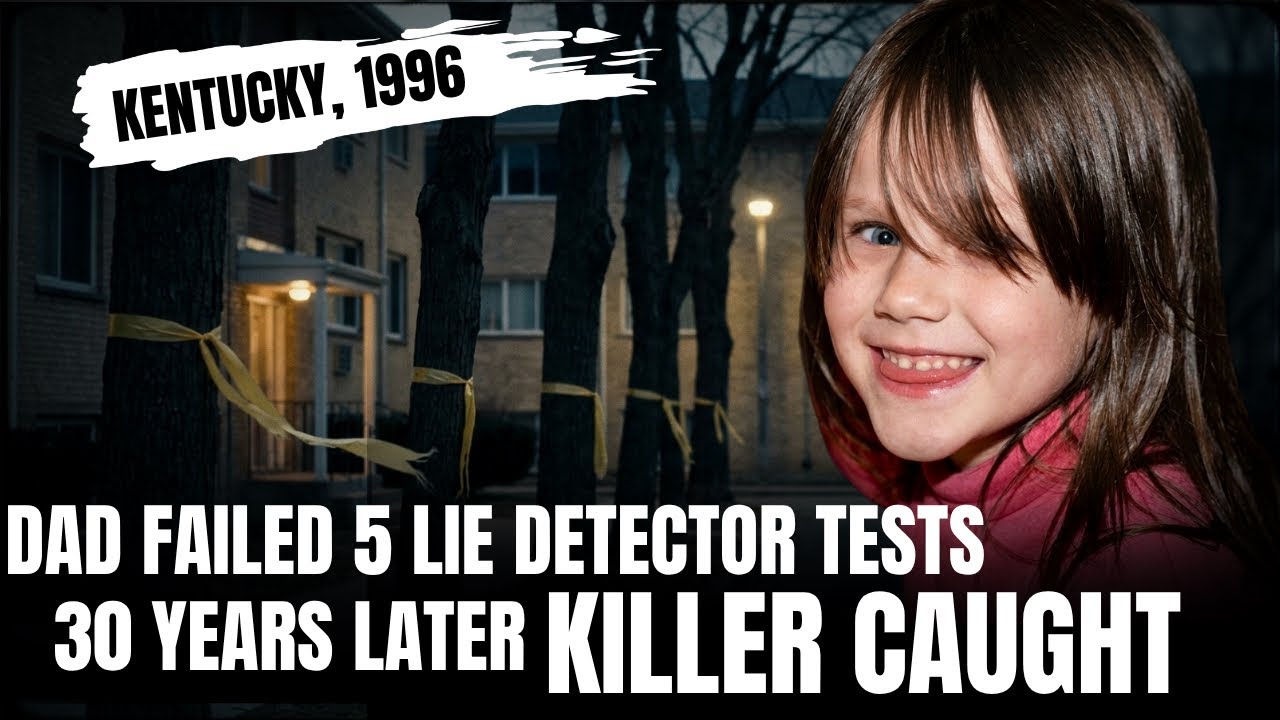
The case had begun on a Wednesday, July 24th, 1996, when Morgan was outside playing at the Colony Apartments in Bowling Green, Kentucky. She was in the parking lot with a group of friends, enjoying the warm weather the way any child would during summer break. Nobody around her had any idea that within minutes her life would end, and that it would take three decades for the full, horrifying truth to come out. At around 12:30 in the afternoon, a van rolled into the apartment parking lot.
It was maroon or burgundy, depending on who you asked—an old Chevrolet from the late 1970s or early 1980s, maybe with a bit of gold trim and a Kentucky license plate. The van had been noticed before. A teenager in the area later said she believed she had seen it sitting around the complex for a day or two before this moment. But on that day, it was not sitting still.
The driver, a white man in his twenties who looked like he had not shaved in several days, climbed out and lunged at one of the children playing near Morgan, a six-year-old girl. For a horrifying second, it looked like he had her. But the girl twisted free of his grip and bolted, screaming, weaving between the apartment buildings. The man did not chase her.
Instead, he turned to the next closest child. That child was Morgan. He grabbed her, hoisted her into the passenger seat of the van, then climbed over her small body into the driver’s seat. Seconds later, tires screeched and the van sped out of the apartment complex with a little girl inside it.
Nobody who witnessed it could do a single thing to stop it. Within minutes, police were on their way, but the man and his van had already vanished. What made this even more terrifying was where the apartment complex sat, just a short distance from Interstate 65. If the driver merged onto that highway, he could be in another state before anyone even organized a proper search.
Witnesses gave police a description: collar-length brown hair, a white T-shirt, blue jeans, unshaven. Some witnesses even believed there might have been a second person riding in the van, though this detail would later prove to be one of many false threads investigators would have to chase down. A composite sketch of the suspect was drawn up and released to the public almost immediately, and calls began pouring into the police department. Dozens of tips came in that very first day.
None of them led anywhere. By nightfall, this was no longer just a local matter. The Bowling Green Police Department, the Warren County Sheriff’s Department, Kentucky State Police, and the FBI had all joined the search. More than 200 ongoing felony investigations were put on hold so that every available officer could hunt for Morgan.
Search dogs were brought in. Every red, maroon, and brown van in the area was pulled over and checked. None of them matched. Morgan’s parents, Glenn and Stacy Violi, were in the middle of a divorce, but that afternoon none of that mattered anymore.
They needed their daughter back. In a cruel twist, just hours before Morgan was taken, the two of them had been in court finalizing custody arrangements. Stacy had been granted custody of Morgan and her two older sisters. Glenn had missed the hearing because he was working a construction job that morning, but both parents said the custody terms had already been agreed upon peacefully and there was no ongoing conflict between them.
That timing turned out to be devastating for Glenn. To investigators, the timing alone was enough to raise suspicion. A father loses a custody battle and just hours later his daughter disappears. It was the kind of coincidence that made detectives take a very hard look at him.
Glenn was asked to take a polygraph test, and according to what he told reporters at the time, he failed it. He agreed to take another one and failed that too. Over the following weeks, he says he was tested again and again, and by his own count, he failed five separate polygraph examinations administered by investigators. Hoping to clear his name once and for all, he went out and hired his own independent polygraph expert, paying for the test himself.
That test came back the same way as all the others: failed. Investigators would never say publicly whether he was officially considered a suspect, but Glenn said privately he was told they believed he had something to do with his daughter’s disappearance, and that they urged him more than once to confess. He always denied any involvement and said that if confessing would somehow bring Morgan home safely, he would gladly spend the rest of his life in prison to make that happen. He also pushed back on the idea that the FBI was behind the pressure, saying that when he asked them directly, they told him they had nothing on him at all.
Stacy stood by Glenn throughout all of it, pointing out something simple but important. The man in the van had tried to grab another little girl first. If this were somehow connected to Glenn and the custody dispute, why would the kidnapper have gone after the wrong child initially? Outside their apartment, neighbors hung yellow ribbons, left stuffed animals, and put up a banner for Morgan.
Stacy, referring to her three daughters as her three angels, told reporters she was simply taking each day as it came, trying not to dwell on the darker possibilities she knew were out there, but never losing her belief that her daughter would be found alive and brought home. Before all this happened, Morgan had just been an ordinary little girl living an ordinary summer. She had recently finished first grade at Warren Elementary School, where she was known for talking a little too much in class, but getting along with just about everyone. The year before, she had been the only student in her entire grade brave enough to perform in the school talent show, doing a gymnastics routine in front of the whole audience.
She loved riding her pink dirt bike around the apartment complex and looked up to her two older sisters. Her father would later describe her as sassy beyond her years, the kind of kid who acted like she was fifteen instead of seven. And he clung to the hope that maybe that same stubborn, grown-up attitude would somehow help her survive whatever was happening to her. While all this played out, more and more people gathered to help.
Flyers with Morgan’s photograph and the composite sketch were handed out at motels, rest stops, toy stores, and restaurants across the region. On the Thursday after Morgan vanished, a $5,000 reward was announced for information leading to an arrest. By Saturday, that reward had climbed to $11,500, and by early August it stood at $20,000. On the Thursday night after she disappeared, more than 400 neighbors and strangers alike gathered in the parking lot where Morgan had been snatched, holding candles, praying together for her safe return, even as the FBI released an updated sketch of the man they were hunting.
The story spread nationally. On the Saturday night after Morgan disappeared, her case was featured on America’s Most Wanted. Tips flooded in from that broadcast too, and none of them led investigators any closer to finding her. There were strange moments along the way.
One night, Glenn was standing outside talking with friends when a man in a different van, this one blue, pulled up, pointed a gun at him, said he didn’t have time to deal with him, then drove off. To this day, it’s unclear if that had anything to do with Morgan’s case at all, but at the time, every strange encounter felt like it could be the break investigators needed. A week after the abduction, detectives went back to the apartment complex and started knocking on doors all over again, hoping something had been missed. A young boy told them something they hadn’t heard before, though police wouldn’t reveal exactly what it was.
Investigators also spent that first week compiling every single van matching the description that was registered anywhere in Kentucky, then reached out to neighboring states to widen the list even further, checking each vehicle one by one. By early September, with Morgan missing for more than six weeks, billboards carrying her photograph had gone up, not just across Kentucky, but also in Georgia, Indiana, North Carolina, South Carolina, Tennessee, and West Virginia. More tips came in—over a thousand of them eventually—claiming sightings of Morgan in Arkansas, Georgia, New York, Ohio, Pennsylvania, Tennessee, and Texas. Every single one turned out to be nothing.
Her father told reporters at the time that it felt like things got a little bit worse with each passing day, and that he expected to be arrested at any moment, even though he had done nothing wrong. Then came October 20th, 1996, almost three months after Morgan disappeared. A woman was walking on her own property in Robertson County, Tennessee, in a wooded area near the town of White House, roughly forty miles from Bowling Green. What she found in a ravine would end the search, but not in the way anyone had hoped.
Skeletal remains. Small. A child’s. She called the police immediately, and word quickly reached investigators in Kentucky.
Everyone feared the worst, but nobody could say for certain yet who this was. That confirmation would take time. The remains had been exposed to the elements for what looked like three or four months, meaning whoever this child was, she had likely been there since shortly after Morgan vanished. It was the discovery of a small item near the bones that gave investigators their first real clue: a yellow hair clasp, the very same kind Morgan had been wearing on the day she disappeared.
DNA testing eventually confirmed what everyone already feared in their hearts. This was Morgan. The little girl who had been playing in a parking lot on a summer afternoon was gone, and had been gone for months while her parents held onto hope. Because of how long the remains had been exposed outdoors, doctors could not determine exactly how she died just from studying the bones.
What they could determine was that her body had been left unclothed in that wooded ravine. Near the site, witnesses recalled seeing two vans parked about 100 feet away on July 25th, 1996, the very day after Morgan was taken. One matched the maroon van already being searched for. The other was a white van believed to be an older Ford, possibly from 1979 or earlier, with an unusual slotted trailer door style window on the passenger side.
That van had reportedly sat there for about four hours. Investigators released a sketch of it, hoping someone would recognize it. Nobody ever did. A tiny fiber recovered from Morgan’s hair would later prove to be one of the most important clues in the entire case.
It was tested and found to match the seat fabric inside the maroon van, tying her directly to the vehicle that had carried her away from her home. But a fiber alone could not tell investigators who was driving that van. That answer was still thirty years away. Morgan’s funeral was held on November 15th, 1996 at Eastwood Baptist Church in Bowling Green.
More than 500 people came to say goodbye to a little girl most of them had never even met but whose disappearance and death had gripped the entire community for months. Her classmates took down the yellow ribbons they had tied up around town while hoping for her safe return and replaced them with purple ribbons, Morgan’s favorite color. Her small casket, painted purple, was surrounded with pink flowers and photographs of her smiling face. Mourners were asked not to grieve but to celebrate the short life she had lived.
The investigation did not stop there. In March 1997, police revealed something they had been sitting on for months. The maroon van had actually been found just two days after Morgan disappeared, abandoned at a truck stop near Nashville, Tennessee. It had been stolen from a home in Dayton, Ohio the day before Morgan was taken.
Investigators had kept this quiet while they ran forensic tests, not wanting to tip off whoever was responsible. Police released an updated sketch of the suspect and continued asking the public for help. The reward stayed at $20,000 for years. On the first anniversary of Morgan’s death, detectives admitted they had a handful of potential suspects but nowhere near enough evidence to charge anyone.
One of those potential suspects made headlines that November. A man named Redaman, already facing an attempted rape charge in a different case, was noted by a Jefferson District Judge to resemble the composite sketch of Morgan’s kidnapper closely enough that his bond was set at $1 million. Redaman denied any connection to Morgan’s case, and his lawyer insisted he had never even been to Bowling Green and wouldn’t know how to find it. In time, this lead, like so many others, went nowhere.
Years passed. The reward grew, eventually reaching $67,000 by 2001, as investigators became convinced that somebody out there knew who had done this and simply hadn’t come forward. But no matter how high the reward climbed, nobody talked. Stacy Violi continued speaking to reporters as the years dragged on, saying that the day her daughter was taken was the day she lost her faith in humanity.
She said she never imagined there was someone capable of that kind of evil. By the time Morgan had been gone for a decade, then two decades, the case had gone cold in every sense of the word. In 2022, Stacy admitted she was simply waiting, still hoping that one day, somehow, somebody would be arrested. Then, in February 2026, nearly thirty years after Morgan disappeared, everything changed.
Forensic science had advanced enormously since 1996. Techniques that could not extract usable DNA from tiny samples decades ago were now standard practice. Investigators sent a strand of hair, recovered from inside that stolen van all those years ago, back to the lab for testing. This time, the results came back with a name attached.
The DNA profile was entered into CODIS, the national criminal DNA database, and it matched a man named Robert Scott Froberg. To understand how a stolen van in Ohio ended up connected to a man in an Alabama prison, you have to go back to the beginning of 1996 and follow Froberg’s own trail of crime. Because by the time he crossed paths with Morgan Violi, he was already a man on the run twice over. At the time of Morgan’s abduction, Froberg was serving a lengthy sentence for armed robbery in the Alabama Department of Corrections, but he wasn’t actually behind bars when Morgan disappeared.
On April 3rd, 1996, he escaped from custody. From Alabama, he made his way to Mount Carmel, Pennsylvania. While hiding out there, Froberg approached a seven-year-old boy who was playing near a treehouse. The child later spoke to his parents, who contacted the police.
Officers went looking for Froberg, and when they confronted him, he tried to run, but he was caught, arrested, and thrown into a Pennsylvania jail. His freedom, however, did not last long there either. On July 16th, 1996, Froberg escaped from that jail as well, using nothing more than a cable and a rain spout to climb his way out. From there, he made his way to Dayton, Ohio, close to where his own parents lived.
About a week after his jailbreak, he stole a maroon van from a street near his parents’ home. This was the same van that would soon be used to snatch a little girl off a Kentucky sidewalk. Froberg’s plan, at least as he would later explain it, was to head south toward Huntsville, Alabama, where he intended to hide out with a man he had befriended while previously incarcerated, a male nurse. But on July 24th, 1996, while driving south on Interstate 65, Froberg took an exit into Bowling Green, Kentucky, reportedly looking to buy drugs.
That decision led him straight to the Colony Apartments, where he spotted a group of children playing outside, including seven-year-old Morgan. According to what Froberg would eventually admit, he first grabbed for another little girl, but she got away from him. He then grabbed Morgan, forced her into the back of the stolen van, and got back onto I-65, continuing south. He drove until he crossed into Tennessee, exiting the interstate near the town of White House.
What happened next was something Morgan’s family had waited thirty agonizing years to learn, and it was every bit as horrifying as they feared. Investigators say Morgan did not go quietly. She fought. She screamed.
She resisted with everything a seven-year-old girl had in her, but Froberg climbed into the back of the van where she was, covered her mouth and nose with his own hands, and did not stop until she could no longer breathe. He then carried her small body into the woods near White House, Tennessee, and left her there. Fearing that her clothing might carry DNA evidence connecting him to her, he took it with him when he left, which is part of the reason her remains were found unclothed months later. After killing Morgan, Froberg did not stay in Tennessee.
He continued south to Huntsville, Alabama, where he stayed with the male nurse he had planned to hide with all along, remaining there for about a week. Eventually, he made his way back north to Pennsylvania. On August 21st, 1996, less than a month after he murdered Morgan Violi, Froberg was arrested again—this time for fleeing the Alabama prison system. He was sent back into custody, where he remained on charges of robbery and escape for the next three decades.
The entire time investigators searched desperately for Morgan’s killer, the man responsible was sitting in an Alabama prison cell, his name never once connected to the case. When detectives finally traveled to Montgomery, Alabama, to confront Froberg with the new DNA evidence in early 2026, he admitted to everything. He walked investigators through the entire sequence of events, from stealing the van to abducting Morgan to what he did to her in those Tennessee woods. On February 26th, 2026, a federal criminal complaint and arrest warrant were filed against him in the US District Court for the Western District of Kentucky, charging him with kidnapping resulting in death.
The lead federal prosecutor on the case put it plainly at the press conference announcing the charges: it was hard to imagine a crime more evil than the abduction and murder of a seven-year-old child. He said this single act had devastated Morgan’s family and had haunted an entire community for thirty years, leaving parents to wonder whether the stranger who took their neighbor’s daughter might one day come back for their own child. Investigators who had worked the case across multiple generations of law enforcement attended the announcement, including the current Bowling Green police chief. Some of Morgan’s own family sat in the room, some of them reportedly weeping as prosecutors described in careful detail exactly how their little girl had fought for her life.
For thirty years, parents in Bowling Green had lived with an unspoken fear every time their children played outside, wondering if the man who took Morgan was still out there somewhere, watching, waiting to take another child. Officials said they hoped this arrest would finally put that fear to rest. Froberg, now in his sixties, was formally moved into federal custody in Kentucky to await trial. On July 22nd, 2026, just two days before the thirtieth anniversary of Morgan’s abduction, he stood in federal court and pleaded guilty to kidnapping resulting in death.
Under the terms of his plea agreement, he is expected to receive a life sentence. And because there is no parole in the federal system, that means he will spend the rest of his life behind bars. His formal sentencing has been scheduled for November 2nd, 2026, in Bowling Green, in the very community where he tore a family apart three decades ago. For Morgan’s family, this outcome brings a strange, complicated kind of closure.
Her father spent years believing people in his own town suspected him of killing his daughter, all while the real killer sat safely in a prison cell hundreds of miles away, never once named as a suspect. Her mother spent decades saying there was nothing on earth that could ever make up for what was taken from her. Her sisters grew up, grew older, had families of their own, all while carrying the memory of a little girl who never got the chance to do any of that herself. Morgan loved to sing and dance.
She dreamed of growing up to become a veterinarian one day. She was, by every account, a fighter right up to her final moments.
