The veil dropped the moment the last reporter left the suite. Theodosia Goodman—known to the world, and to the millions who would soon worship her image, as Theda Bara—leapt off the couch where she had been posing like a living idol. The silks and veils came off. She rushed to the window, gasping for air.
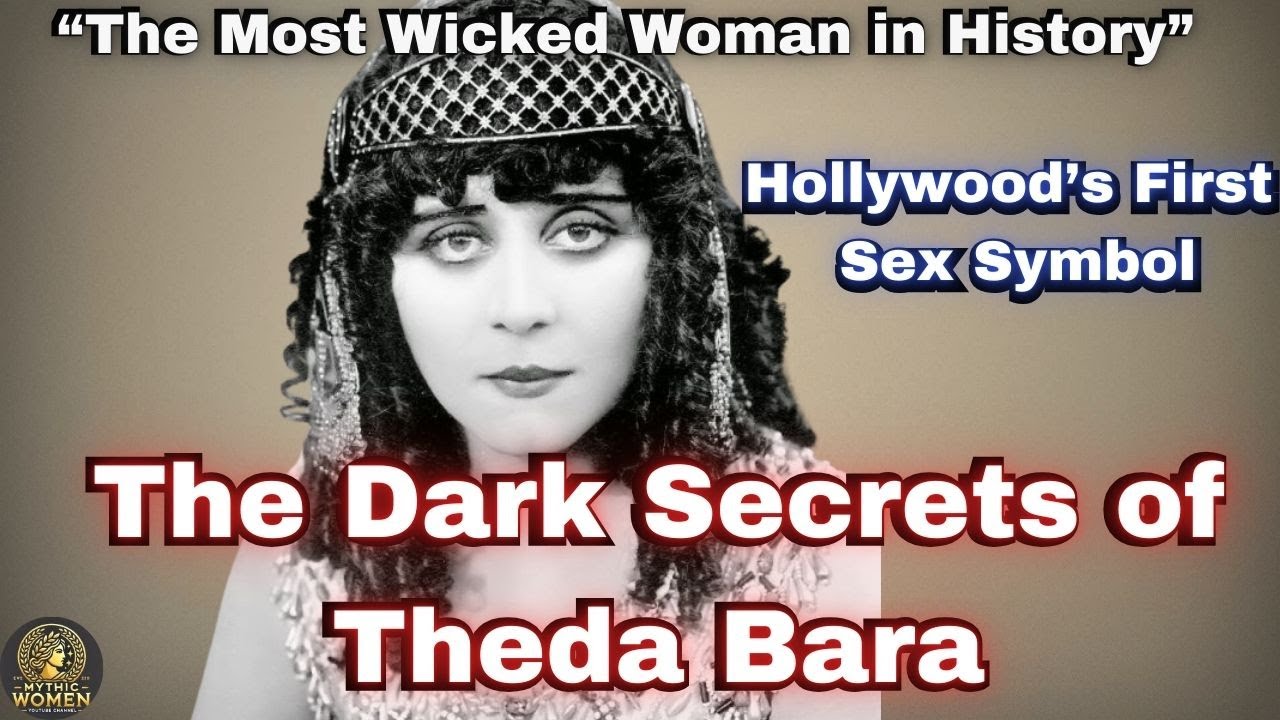
“Give me some air,” she demanded, and her accent, that mysterious, exotic accent she had laid on thick for the press, was suddenly gone. The journalists had arrived hours earlier, gathering eagerly in her hotel suite for the unveiling of Hollywood’s newest sensation. Fox Studios had promised them a story as dramatic as the movies themselves. And they had delivered.
The tale they spun was intoxicating: born in the enigmatic shadows of the Sphinx in Egypt, daughter of an Italian sculptor and a French actress, raised in a humble tent amidst the mystique of the desert. Schooled in the arts, she had moved to Paris, taken the stage by storm, and become a sensation across Europe. When the storm clouds of war gathered over the continent, director William Powell had whisked her away, sneaking her aboard the last ship bound for America. Then, as the reporters watched, a heavy velvet curtain was drawn back.
There she lay, draped in exotic silks and veils, upon a chaise—the living embodiment of Oriental allure. Her voice, veiled like her face, resonated with an accent as mysterious as her origins. “The Press claims I possess the most wicked face of any woman,” she murmured, low and beguiling. “They say my hair is like Medusa’s serpent locks, that my eyes have the cruel cunning of Borgia, my mouth the scheming smile of Delilah, and my hands like the talons of Circe or the blood-soaked grip of Elizabeth Báthory.
And then they ask of my soul—if it reflects my face. ”
The press was enthralled. The tale spread across magazines like wildfire, painting a portrait of Theda Bara as the ultimate seductress, the wickedest woman in the world. But one journalist lingered.
Luella Parsons, a gossip columnist with close ties to the studio, watched as the performance ended. And in that moment, Theda Bara—one of the earliest illusions ever crafted by Hollywood, a manufactured fantasy designed to captivate the masses—dropped the act. Her name. Her life.
Her very essence had been spun from the studio’s imagination. A carefully curated story of an American girl transformed into a mythical figure of mystery and seduction. The truth was far less fantastical. She was born Theodosia Goodman around 1885 in Cincinnati, Ohio, to a Polish Jewish father and a Swiss mother.
Her name was inspired by Aaron Burr’s ill-fated daughter, who had vanished at sea in 1812—a fitting touch of mystery for a girl destined to become Hollywood’s most elusive enchantress. But Theodosia’s early life was rather ordinary. A voracious reader with a streak of mischief, she was known to cause trouble. On one occasion, after damaging a screen door, her exasperated parents built a small cage in the backyard to contain her antics—an extreme measure, but perhaps not so unusual for the strict sensibilities of nineteenth-century parenting.
Contrary to her later myth, Theodosia had never set foot in Egypt, nor had she ever traveled abroad. The acting bug bit her early. She dropped out of the University of Cincinnati and, like so many other aspiring actors, headed to the bright lights of New York City, dreaming of a career on the theater circuit. It was a time when movies were gaining popularity, yet production remained centered on the East Coast.
Hollywood as we know it had yet to rise from the Californian desert. Her first break came in a play aptly titled *The Devil*. But success did not come easily. For a decade she struggled, landing only minor roles and barely scraping by.
When she first arrived, her curvaceous figure was ideal for the Victorian stage. But times were changing. By 1908, the slim, almost ethereal look was in vogue, thanks in large part to dance sensation Irene Castle. Suddenly, a frail frame, boyish bobbed hair, and a delicate demeanor became the standard of beauty.
Theda’s voluptuous curves and haunting deep-set eyes were no longer in style. At twenty-five, she found herself out of step with the new ideals. By twenty-nine, she was still far from stardom, having secured only bit parts and fleeting roles. But 1914 brought a stroke of luck in the form of director Frank Powell.
When he met Theda, she cleverly shaved a few years off her age, claiming to be twenty-four instead of twenty-nine, and padded her resume with fictional credits. Powell decided to give her a small role in *The Stain*, a modest production meant to gauge her screen presence. Impressed by her unique look and on-screen charisma, Powell took her along when he moved to Fox Studios, where her career would soon take a dramatic turn. To understand this moment, it’s essential to consider the broader context.
In the early 1900s, Europe led the way in cinematic innovation, while America lagged behind, producing cheap, disposable films that often ran for just a few days before being melted down for reuse. But with Europe consumed by the Great War, the United States found an opportunity to build its own film industry. By the time Theda met Powell, Hollywood was evolving rapidly. The first fan magazines had begun to emerge—*Photoplay* launched in 1911, and by 1914 it had shifted focus to Hollywood stars, regardless of whether the stories were true.
In this burgeoning era of stardom, audiences craved stories as much as they did films, and Theda, still an unknown, was a perfect canvas for the studio’s most outlandish fantasies. For Fox Studios, she was a godsend: a mysterious beauty who could embody the ultimate femme fatale without demanding a star’s salary. Meanwhile, other silent-era actors were already becoming household names, and with fame came a demand for higher pay. But Theda, with her dark eyes and exotic appeal, was an affordable gamble—ideal for a studio looking to captivate audiences with scandalous tales of forbidden love, deceit, and danger.
The star-making machinery of Hollywood was still in its infancy, but already it was clear that the truth mattered less than the story. And no one embodied that better than Theda Bara. Though creating false personas for actors became commonplace in the Hollywood studio era, in 1916 this was entirely new territory. Even giving a star a distinct personality was revolutionary—just a few years earlier, actors weren’t even credited by name.
The invention of Theda Bara, both on and off screen, marked a turning point in the art of cinematic mythmaking. Her breakthrough role came in *A Fool There Was*, a film adapted from a play based on Rudyard Kipling’s poem “The Vampire. ” At the time, the concept of a vampire went beyond Bram Stoker’s blood-sucking creation. In the 1910s and 1920s, a vamp referred to a femme fatale—an enigmatic, dangerously seductive woman who lured men to their doom, then moved on to the next unsuspecting victim.
Theda was the perfect embodiment of this new archetype. Fox Studios quickly recognized her potential and signed her to a five-year contract offering one hundred dollars a week, a considerable sum for an unknown actress. They suggested she adopt the surname Baringer, shortened to Bara, adding an exotic twist to her new identity. And thus Theda Bara was born—a name that sounded as mysterious as the character she was about to play.
In silent cinema, the emphasis was on close-ups, with actors conveying emotion purely through expressions. Theda excelled in this medium. Silent film actresses had to endure thick, heavy makeup: yellow pancake foundation, blackened eyes, and dark brown lips. Unlike today, stars were responsible for buying and applying their own makeup.
It was a grueling, unforgiving process, but Theda adapted with surprising resilience. *A Fool There Was* broke new ground with its unapologetically dark ending. Theda’s vamp character ruthlessly ensnares the male protagonist, destroys his life, and leaves him a broken man. It was a radical departure from the cheerful resolutions audiences were used to.
And yet, behind the scenes, Theda was a far cry from the man-eater she portrayed. Despite her wicked on-screen persona, she was deeply scandalized when the script required her to wear a bathing suit—a daring move for a woman in 1915. Filming was further complicated by crowds of nearly two thousand spectators who gathered to watch, drawn by curiosity and controversy. Theda felt deeply embarrassed, describing herself as a lost soul beneath the layers of stage makeup necessary to make her features visible on film.
And with that film, the myth of Theda Bara, the Arabian woman of mystery, was born. The studio orchestrated an elaborate campaign, complete with haunting publicity photos and staged interviews. Magazines were flooded with images of Theda draped in veils, her dark eyes hinting at forbidden secrets. At the press conference, she had solidified her image as a seductive enigma, leaning into her role during interviews and maintaining a beguiling, tragic air.
“Some night,” she mused darkly to the press, “when I face old age and my mirrored image shows wrinkles, I will end my life. Gas or poison, I should think. ” It was a line worthy of the character she portrayed—dramatic, haunting, and perfectly crafted to captivate an audience hungry for scandal. *A Fool There Was* became one of the most profitable films of 1915, turning Theda Bara into Hollywood’s first overnight star.
Fox Studios, keen to maintain the success, continued to cast her as the vamp in a string of sultry roles: *Sin*, *Destruction*, and *Gold* in *The Woman*. She was alternately a home-wrecker, a fallen artist’s model, or an ill-fated seductress dragging men into ruin. Occasionally she managed to sneak into more serious fare, such as *Carmen* in 1915, but these roles were rare and never far from her vamp persona. Fox spared no effort in amplifying Bara’s mystique.
They claimed her co-star in one film was a live python, while a phrenologist conveniently proclaimed that her muscular system was “serpent-like. ” Press releases dubbed her “the wickedest woman in the world,” calling her name an anagram for “Arab death. ” They even asserted that she was the reincarnation of Delilah and Lucrezia Borgia. When she starred as Cleopatra, Theda declared with theatrical fervor: “I felt the blood of the Ptolemies coursing through my veins.
I am Cleopatra. ” Bara’s fame reached such heights that even Nikola Tesla quipped about sending her image to Mars. Yet beneath the glittering veneer, she grew weary of her typecasting. Fox occasionally placated her with roles as a good girl, but these films were deliberately under-promoted, keeping her in line.
Theda once lamented: “The studio is a factory. We manufacture pictures the way they make sausages, one after the other. ” Attempts to break free from her vamp persona, such as a ghostly Juliet returning to Romeo in *Romeo and Juliet*, failed to resonate with audiences. Despite her reputation, Theda led a quiet, elegant life offscreen.
With her earnings, she purchased a spacious apartment on Manhattan’s Upper West Side, where she lived with her mother, brother, and sister. Fox, however, maintained a separate exotic hotel room filled with veils, occult artifacts, and incense for press interviews. Here, Theda recited her scripted stories, further fueling the illusion of her dangerous allure. While studios later scrambled to cover up scandals involving stars like Fatty Arbuckle and Olive Thomas, Fox tried to suppress Theda’s reality: a scandal-free existence marked by nights spent reading rather than attending parties, and no romances with famous figures.
During her five years of stardom, she dated no celebrities—a stark contrast to her sinful on-screen persona. Her career flourished in a unique era of cinema, just before censorship became centralized. Films faced decency boards in each state, each with its own standards, making it possible to present Bara’s daring roles in some regions while others banned them. To avoid outright bans, studios would sometimes add an ending revealing that her sinful deeds had all been a dream—a clever strategy that kept audiences intrigued while satisfying censors.
As Bara’s films incited public outrage and moral condemnation, Fox began releasing her real biography to appease audiences, revealing the truth of her Cincinnati upbringing. Yet there was a feminist angle to Theda’s vamp persona. In an early studio-scripted interview, she claimed: “I am a feminist. For every woman like me, there are ten men who take everything from a woman and give nothing in return.
V stands for vampire, and it stands for vengeance, too. The vampire I play is the vengeance of my sex upon its exploiters. ”
By 1917, Theda was at the peak of her fame, rivaling Mary Pickford, Douglas Fairbanks, and Charlie Chaplin. She signed a four-thousand-dollar-a-week contract with Fox and moved to Los Angeles to film *Cleopatra*.
It became the biggest box-office hit of 1917, further cementing Theda Bara as Hollywood’s reigning star. Yet even amid this triumph, the reviews were mixed. Critics, sharp-tongued and unforgiving, fixated on her physique, deeming it unfit for the fabled queen she portrayed. Bara, undeterred by the jabs, kept her gaze fixed forward.
In August 1918, she released *Salomé*, which found some success despite the looming Spanish Flu pandemic, which soon gripped the nation and decimated movie attendance. Her next film, *The She-Devil*, opened the day before the Armistice, but it was completely overshadowed by the end of the war. Newspapers barely reviewed it. Soon, Bara’s career was plagued by a series of flops.
She began arriving late on set, negotiating her contract to start at one in the afternoon, and eventually lost the will to act altogether. In early 1919, desperate to escape her vamp persona, Theda announced she would strike until she could find a good, non-vamp script. She believed she had found her salvation in *Kathleen Mavourneen*, where she would play a quaint little Irish girl. The film brought her more than just a role—it brought her love.
She fell for director Charles Brabin, whom she would later marry. Buoyed by this new beginning, Theda demanded a salary increase to five thousand dollars a week. When Fox declined, she refused to renew her contract, certain that her performance would open doors elsewhere. However, *Kathleen Mavourneen* turned out to be her most controversial project.
It drew the ire of Irish American groups, who protested its portrayal of the Irish and condemned the casting of a Jewish actress in the lead role. The film’s screenings sparked riots. Theda received death threats, and the studio pulled it from theaters. It was a devastating blow, one from which Bara’s career never recovered.
By 1920, Theda was without a studio contract. Hollywood had moved on. Flappers like Clara Bow and Louise Brooks were the new feminine ideal. At thirty-five, Bara was considered too old and too typecast to fit the new mold.
Desperate for a comeback, she ventured to Broadway in *The Blue Flame*. Audiences flocked not to admire but to mock, laughing aloud at her performance. But Bara, ever shrewd, had negotiated a share of the profits, making the play financially lucrative despite its scornful reception. In 1921, after marrying Brabin, Theda retreated from the limelight at his urging.
She would attempt only one more film, *The Unchastened Woman* in 1925, which failed to revive her career. From then on, she settled into a quiet, mostly content retirement, living with Brabin until her death from cancer in 1955. By the 1950s, silent films had become Hollywood’s forgotten past, often treated as laughable relics. Bara’s legacy, once formidable, was reduced to caricature.
Her *Cleopatra* even became a punchline. In an episode of *I Love Lucy*, Lucy wants to become an actress and gushes about seeing *Cleopatra* twelve times, only for Ethel to sarcastically remark that she must mean the one with Theda Bara—a nod to how history had rewritten her once mighty name as a relic of campy melodrama. Tragedy struck her legacy in 1937 when a fire at Fox Studios destroyed the master prints of nearly all her films. A second fire in New York later consumed the few remaining reels of *Salomé* and *Cleopatra*.
Today, most of her work is lost, leaving only a few surviving films, scattered clips, and hundreds of haunting still photographs that serve as her enduring memory. With the advent of the internet, Bara’s fame has seen a revival. Her striking images—eyes rimmed with heavy coal, lips darkened to dangerous allure—resonate anew, captivating a digital age fascinated by vintage Hollywood glamour and its mysterious stars. Her films may have turned to ash, but the photographs, coupled with her mythic backstory, continue to spark curiosity and admiration.
Bara remains a figure caught between memory and forgetfulness, a spectral symbol of cinema’s infancy—a time when stars were born not just on screen but also in the carefully woven tales that surrounded them. She remains a paradox, at once forgotten and eternal, an echo of Hollywood’s earliest dreams. Her legend whispers of a time when the lines between reality and illusion blurred effortlessly, when stars were both manufactured and mythologized. As a symbol of what the industry can create, immortalize, and ultimately abandon, Bara’s name lingers like the final frames of a lost film.
Her allure undiminished, her spirit haunting the silent spaces between history and myth. In the words of her character: “To be good is to be forgotten. I’m going to be bad so I’ll always be remembered.
”
