The shot came from a small, unassuming revolver that no one in the street would have looked at twice. Charles Guiteau raised it in the Washington railway station, aimed at President James A. Garfield, and fired. The weapon was a British Bulldog, a compact pocket pistol produced in quantity by American manufacturers like Forehand & Wadsworth.
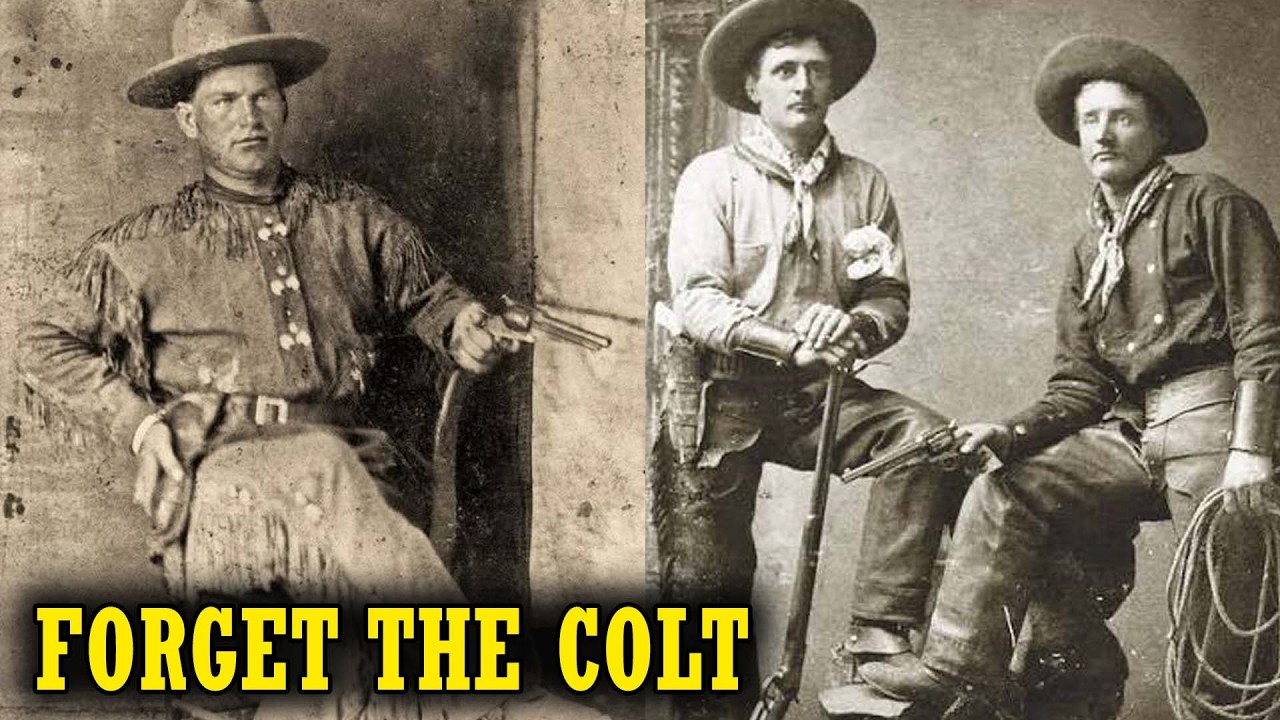
The bullet did not kill the president outright, but the wound festered, and months later Garfield died from complications. The gun that ended a presidency was not the long-barreled Colt that Hollywood loves to put on screen. It was one of a whole class of forgotten weapons that actually armed the Old West. For anyone who learned the frontier from the movies of the fifties and sixties, the story usually looks simple: the Colt Peacemaker settled the West.
It is an appealing legend. The Colt had a distinctive profile, an iconic silhouette, and that sharp mechanical click as the hammer was drawn back. But stepping off a train into a bustling town like Deadwood or Tombstone in the late 1870s would have revealed something different, a remarkable variety of sidearms carried by everyone from lawmen to gamblers to outlaws. Some of them were every bit as deadly as the famous Colt, and a few were far more ingenious.
Among those who cared about engineering and reliability, one name stood out: Merwin Hulbert. The Merwin Hulbert Army revolver was no ordinary sidearm. It was a display of late nineteenth-century craftsmanship. Where others built sturdy, simple tools, Merwin Hulbert built what amounted to a fine watch.
Produced by Hopkins & Allen in Connecticut under Merwin and Hulbert patents, the gun was machined so precisely that its moving parts created a genuine suction effect inside the frame. Its hallmark was a selective ejection system. Reloading a traditional Colt meant cocking the hammer to half-cock, opening the loading gate, and punching out each empty cartridge one by one with the rod, a slow process when time mattered. Merwin Hulbert took a different approach.
Working a small lock in front of the trigger guard let the shooter rotate the barrel a quarter turn and pull the front forward, opening the revolver like a folding mechanism. Because of the tight tolerances, the expanded empty cartridges dropped out on their own while unfired rounds stayed put. The shooter could then close the barrel, reload the empty chambers, and be ready far faster than any Colt user. The gun was built for stopping power too.
It was chambered mainly for its own . 44 Merwin Hulbert cartridge or the famous . 44 Russian, both heavy, slow lead bullets pushed by substantial black powder charges. With a smooth factory trigger and a solid frame that absorbed recoil well, it earned a reputation for being both accurate and powerful.
Historical evidence backs that reputation. Gunsmith advertisements from the era and shipping records, including listings in papers like the Rocky Mountain News, regularly priced Merwin Hulberts above their competitors. Frontier figures known to own or carry them included Pat Garrett, John Wesley Hardin, Bob Dalton, Sam Bass, Texas Ranger Frank Hamer, and others. It was known as the weapon of the demanding owner, favored by men who appreciated craftsmanship as much as function.
So why did Hollywood largely forget this piece of frontier history? The answer has more to do with film production than with the gun itself. Prop departments need firearms that are simple and reliable when firing blanks. The same ultra-precise mechanism with tight tolerances that made the Merwin Hulbert exceptional in the 1880s made it troublesome on set.
Blanks leave heavy, dirty residue, and in a mechanism built with almost no clearance, that fouling could quickly jam the rotation. Furthermore, surviving original Merwin Hulberts are rare and valuable collector pieces, making the wear of filming a poor financial risk. Hollywood chose practicality over historical accuracy, leaving one of the most advanced revolvers of its era out of the popular imagination. There was another silhouette that stood out in the smoke of the Wilderness or at Gettysburg, and it did not belong to Union cavalry.
It was not made in a New England factory. It was a large, imported piece of artillery nicknamed the grapeshot revolver. That was the LeMat, arguably the most impressive and unconventional handgun in American combat. While Westerns tend to romanticize the formal one-on-one duel between two standard revolvers, the LeMat was designed for an entirely different purpose: overwhelming firepower at close range.
Dr. Jean Alexandre LeMat, a French-born physician settled in New Orleans, patented the design in 1856. He went into partnership with a relative of his wife, Pierre Gustave Toutant Beauregard, who later became one of the Confederacy’s foremost generals. Once war broke out, Beauregard used his influence to secure production contracts in Paris and London, and completed pistols were shipped through the Union naval blockade to Confederate ports like Charleston and Wilmington.
Mechanically, the LeMat was astonishing. Fully loaded, it weighed more than four pounds, heavy compared to conventional revolvers of the time. Its defining feature was its double-barrel design. Where most contemporary revolvers carried five or six shots, the LeMat cylinder held nine rounds of .
42 or . 36 caliber arranged around a central axis. That axis pin proved to be the true innovation. Instead of leaving it as a simple mechanical rod, LeMat hollowed it out to become a second, smoothbore barrel, roughly 16 to 18 gauge, mounted beneath the main barrel and loaded with buckshot separately.
Switching between firing modes required no extra steps and no second weapon. The hammer had a pivoting head that the shooter could flip down with a flick of the thumb, directing the blow to the cap of the lower barrel to release a wide spray of shot instead of a single bullet. Use of the weapon is well documented. Confederate cavalry commander J.
E. B. Stuart carried one through most of the war, including the battle at Yellow Tavern where he received his mortal wound, and General Braxton Bragg favored it as well. Estimates of how many guns entered Confederate service vary by source, generally ranging from about 1,500 to nearly 3,000 pieces produced in total.
After the war, many surviving pistols made their way west with former soldiers. Hollywood rarely shows this unusual sidearm, partly for visual storytelling and partly for practical prop concerns. The LeMat does not fit the sleek, symmetrical image of the quick draw in classic Westerns. It is front-heavy, somewhat bulbous, and features an old-fashioned loading lever assembly that looks unfamiliar on screen.
A four-pound gun simply does not clear the holster with the same cinematic speed as a Colt. There is also a production safety issue. The LeMat was originally a cap-and-ball weapon, and converting an original or replica to safely fire modern blanks, nine revolver shots plus one shotgun blast from a completely separate barrel, requires specialized gunsmithing that most production companies are not interested in. Firing large-caliber blanks at close range also raises crew safety concerns.
Rather than deal with these complications, productions largely excluded this unusual dual-purpose sidearm, despite its real and documented role in Civil War history. Anyone who has watched a classic Hollywood Western knows the ritual. Two men face each other in a dusty street, hands hovering near their holsters, and when the moment comes, the hero draws his Colt and thumbs the hammer back before firing. That thumbing motion, cocking the hammer manually before each shot, is known as single action, and decades of Westerns cemented the idea that it represented the height of firearms technology of the era.
But for a cavalryman in the middle of a fast, chaotic engagement where every fraction of a second counted, relying on the thumb to recock the hammer every time was a real disadvantage. That was where the Starr Model 1858 double-action revolver came in, a gun that offered rapid, repeated fire to Americans far earlier than is widely recognized. Designed by Eben Townsend Starr of New York and patented in the late 1850s, the gun sharply broke with the design conventions of its time. In an era when Samuel Colt’s single-action revolvers dominated the civilian and military markets, Starr built something meant for rapid close-quarters use.
It was a sturdy . 44 caliber cap-and-ball revolver with an unusually sophisticated internal mechanism. Instead of a conventional single trigger, Starr used a large forward blade inside a massive trigger guard that acted as a cocking lever. Pulling that lever rotated the cylinder and drew the hammer back.
At the rear of the trigger space sat a second, smaller trigger. Continuing to pull the main lever all the way back would activate that smaller trigger, dropping the hammer and firing the round. In practice, the shooter never needed to thumb the hammer at all. Simply pulling the trigger repeatedly was enough to empty all six chambers in a few seconds, a genuinely rapid rate of fire for the period.
Starr also added flexibility. A small switch on the back of the trigger blade let the shooter disable the self-cocking feature and use the gun in traditional single-action mode when accuracy mattered more than speed. Historical records show the U. S.
government paid serious attention to this revolver. During the Civil War, the Union Army’s Ordnance Department needed cavalry sidearms suited to the speed of mounted engagements. Government purchase records indicate the army bought between 20,000 and 23,000 Starr double-action revolvers, making Starr the third largest supplier of pistols to Union forces after Colt and Remington. After the war, large numbers of surplus Starrs entered the civilian market and made their way west with settlers, scouts, and early lawmen.
So why was this early rapid-fire design ignored in Western films? Mostly a matter of storytelling choices rather than the gun’s actual competence. Filmmakers rely on rhythm and suspense, and the slow, deliberate click of a hammer being drawn back builds tension in a way that suits the genre. A gunfight settled immediately by rapid trigger pulls does not create the same dramatic buildup.
And to modern audiences, the speed might read as a twentieth-century double-action revolver rather than a nineteenth-century frontier weapon, spoiling the visual character directors want. There is also a practical, mechanical reason. The Starr’s cocking-and-firing system was complex and required precise timing even when new. The Model 1863 that replaced it during the war essentially abandoned the double-action feature in favor of a simpler, more rugged single-action design.
That same delicate mechanism makes it difficult for modern gunsmiths to reliably maintain surviving originals or replicas when firing blanks on set. As a result, the revolver that gave Civil War cavalry a real edge in firing speed stayed largely off screen, despite being a documented, widely issued sidearm of its time. Picture a classic Hollywood saloon scene, a tense poker game in a haze of cigar smoke, a cheat exposed, and suddenly a long-barreled Colt Peacemaker is drawn from a low hip holster and slammed on the table. It is a striking visual, but it does not reflect how frontier self-defense actually worked.
In the cramped, crowded spaces of booming town saloons, carrying a large combat revolver was awkward. It caught on clothing, could not be concealed, and took time to get into action. Gamblers, undercover lawmen, and others who needed protection in tight places usually preferred something smaller and easier to hide. In the early 1870s, that meant the Colt Cloverleaf House pistol.
Introduced by Colt’s Manufacturing Company in 1871, this compact revolver was a major departure from the heavy military arms that built the company’s reputation. Designed by Charles Brinckerhoff Richards and William Mason, the same two engineers who would design the Single Action Army only a few years later, it was built with one goal in mind: a practical, concealable defensive tool for close-quarters use. What made the Cloverleaf distinctive was its cylinder. Pocket pistols of the era tended to be either weak single-shot derringers or larger revolvers with thick cylinders that were hard to conceal.
Colt’s solution was a compact four-shot cylinder with recessed chamber walls, which from the front looked like a four-leaf clover, giving the gun its nickname. That slim cylinder, combined with a short barrel of 1. 5 or 3 inches depending on the model and a smooth bird’s-head grip, allowed the pistol to be slipped neatly into a vest pocket, a boot, or a sleeve. It was chambered for .
41 rimfire, a caliber significantly larger and more powerful than the . 22 or . 32 typical of pocket pistols at the time, giving it more stopping power than its small size suggested. The military never adopted the gun, but historical records indicate it was a substantial commercial success in the civilian market, especially among people who wanted a compact self-defense option.
The weapon is perhaps best known today for its association with a famous real-life incident. Financier James “Jubilee Jim” Fisk was killed with one of these pistols in 1872 by Edward Stokes during a personal dispute, an event that sometimes led to the pistol being called the “Jim Fisk” model. Hollywood rarely shows this pocket pistol, largely because of visual storytelling conventions. Westerns rely heavily on a strong, larger-than-life aesthetic, and a long-barreled Colt worn low on the hip instantly signals authority and toughness on screen.
By comparison, a four-shot pocket pistol does not carry the same visual weight, even though its ammunition was genuinely potent for its size. There is also a practical acquisition issue. Original Colt Cloverleafs are relatively rare today. Only a few thousand were produced during their five-year manufacturing run from 1871 to 1876, making surviving pieces valuable to collectors and difficult for prop departments to obtain or safely modify to fire blanks.
As a result, this historically significant compact revolver, Colt’s first solid-frame metallic cartridge design, remained outside the Western film tradition despite its real role in frontier self-defense and at least one well-documented historical event. Walk into a frontier gunsmith’s shop in a city like St. Louis or Kansas City in the early 1860s, and beyond the familiar shapes of Colts and Remingtons, you would eventually notice something stranger. A weapon that looked more like industrial machinery than a traditional sidearm.
That was the Savage Navy Model 1861. At a time when most people imagine frontier revolvers as simple single-trigger designs, this heavy, unusual gun represented an attempt to solve two real problems of the muzzle-loading era: slow reloading and the danger of chain fire, when multiple chambers ignite at once. Made by the Savage Revolving Firearms Company of Middletown, Connecticut, under patents held by Henry S. North and Edward Savage, the Model 1861 took a genuinely different approach to how the shooter’s hand worked the gun.
Its most distinctive feature was a large heart-shaped trigger guard housing two separate triggers stacked vertically. The lower trigger was not a trigger at all in the traditional sense. It was a ring-shaped lever meant for the middle finger. The upper trigger, operated by the index finger, was responsible for the actual firing.
This two-trigger setup gave the shooter a real practical advantage. Instead of using the thumb to cock the hammer, a movement that could disturb the grip while on horseback or in an emergency, the shooter pulled the lower ring lever with the middle finger. That single motion cocked the hammer and rotated the cylinder to the next chamber. The index finger then pressed the upper trigger to fire.
With practice, one could fire all six . 36 caliber rounds quickly, one-handed, without changing grip, a design approaching double-action years before double-action revolvers were common. The Savage Navy’s other standout feature was how it handled gas pressure. Ordinary cap-and-ball revolvers lost some power through the gap between cylinder and barrel, a gap often blamed for chain fires.
The Savage Navy addressed this with a cylinder that moved forward when the ring lever was pulled, seating snugly against the barrel to form a tighter seal, improving velocity compared to other revolvers of the era. Historical purchase records confirm the government took the design seriously. U. S.
Ordnance records show the federal government contracted for about 12,000 of these pistols starting in late 1861, with total production reaching around 20,000 units when civilian and other sales were added. The guns served in many Union cavalry units, including regiments from Wisconsin and Kansas, and some ended up in Confederate hands. Why did this unusual weapon disappear from Western films? Much of it comes down to visual storytelling style.
Audiences expect a familiar silhouette, a sleek single-trigger Colt sliding smoothly from a leather holster. The Savage Navy’s double-trigger design and bulky frame look unfamiliar in comparison, more like something out of a steampunk movie than a Western. There is also a practical maintenance problem. The forward-sliding cylinder mechanism depends on precise internal timing, and the heavy residue from modern blanks can quickly foul those moving parts.
Savage Revolving Firearms went out of production shortly after the war, having lost its military contracts to simpler, more durable designs from Colt and Remington. Original pieces and working copies are rare today, making their use in film production impractical and risky. As a result, one of the most mechanically innovative revolvers of the Civil War era faded from public memory, despite real service and a genuine step toward the double-action revolvers that came later. Hollywood Westerns love a particular dramatic style.
The hero empties his single-action Colt, takes cover, and begins the slow process of reloading. Open a small gate, use the rod to push out each empty casing, feed fresh rounds one at a time while tension builds. It makes for great cinema, but it ignores important historical realities. By the mid-1870s, people who depended on their sidearm for survival were not loading one round at a time if they could avoid it.
Instead, many carried the Smith & Wesson Model 3 Schofield. This large revolver first appeared as the Model 3 in 1869-70 and already represented real progress in revolver mechanics. But it was the set of modifications made by Major George W. Schofield of the U.
S. 10th Cavalry, patented in the mid-1870s, that made it a frontier favorite. Schofield, who served with the Buffalo Soldiers on the southwestern plains, recognized that handling a standard revolver while on horseback was difficult at best. He redesigned the Model 3’s latch, moving it from the barrel to the frame, allowing a rider to operate the gun more easily with one hand.
What set the Schofield apart mechanically was its top-break design with automatic ejection. Unlike a solid-frame Colt, the Schofield opened on a hinge at the lower front of the frame. Pulling the latch just forward of the hammer allowed the shooter to swing the barrel and cylinder assembly downward. With the gun open, a spring-loaded star extractor in the center of the cylinder rose and kicked out all six empty casings at once, emptying the cylinder in a single motion.
That left all six chambers open and ready. Instead of feeding cartridges individually, the shooter could load six fresh rounds together, snap the gun closed, and be ready to fire again in under thirty seconds, roughly half the time it typically took to fully reload a Colt Peacemaker. The Schofield was designed to work with the . 45 Schofield cartridge, slightly shorter than the .
45 Colt and developed specifically to function reliably with the top-break mechanism. With a balanced 7-inch barrel and a smooth trigger, the revolver earned a strong reputation among shooters of the era for accuracy, although its ammunition was somewhat less powerful than standard . 45 Colt. Historical records support this reputation.
The army purchased between 8,000 and 8,300 Schofields by 1879, issuing them to cavalry regiments including the 4th, 9th, and 10th, the latter two being Buffalo Soldier units. Its reputation was further boosted by use from famous figures on both sides of the law. Jesse and Frank James, Wyatt and Virgil Earp, John Wesley Hardin, Pat Garrett, and lawman Bill Tilman were all reported to have carried this revolver at some point, along with Theodore Roosevelt. So does Hollywood usually prefer the Colt over this faster-loading revolver?
Much of it comes down to how filmmakers build suspense. In movies, speed works against drama. If a character can reload in seconds, the tension of whether they will finish in time disappears. The slower, more visible reloading process of the Colt gives directors room to build that suspense.
Furthermore, classic top-break revolvers can be demanding on set. The star extractor mechanism and its spring are sensitive to the heavy fouling from modern blanks, which can cause malfunctions after repeated takes. That is another reason prop departments often rely on the simpler, more tolerant Colt. As a result, the design that actually allowed faster reloading, and saw real frontier and military service, remained in the background of Westerns, overshadowed by the familiar look of the Colt Peacemaker.
Play any classic Hollywood Western and you will see the same familiar image. A lawman rests his hand on a single-action Colt while walking down a sunny street. For generations, films presented the Colt as the undisputed sidearm of the frontier. Real history tells a more diverse story.
Pioneers, lawmen, and outlaws facing harsh conditions in the Southwest and northern territories often wanted something designed for durability above all else, a revolver that could survive a fall from a horse, bad weather, or rough handling. For many, that gun was the Remington Model 1875. Introduced by E. Remington & Sons of Ilion, New York, the Model 1875, also known as the “Improved Army” or “Frontier Army,” was designed to compete directly with Colt for both civilian and government buyers.
Remington already had a strong reputation from the Civil War era, when its . 44 caliber New Model Army revolver gained popularity among Union soldiers for its ruggedness. With the Model 1875, the company moved into the new era of metallic cartridge revolvers. At first glance, the Model 1875 looked similar to the Colt Peacemaker, but a closer look revealed a genuine structural difference.
Along the underside of the barrel ran a solid, distinctive piece of steel extending toward the ejector rod housing. This was not just decoration; it braced the entire front of the gun. On a Colt, the ejector rod housing was a separate, thinner piece held by a single screw, which could loosen or bend under hard use. Remington built the housing directly into the frame, giving the front of the weapon greater structural integrity.
The Model 1875 also retained Remington’s familiar solid-frame design with a fully enclosed top strap, which withstood pressure from heavy black powder cartridges well. The revolver was offered in several powerful calibers, including . 44 Remington, . 44-40 Winchester, and later .
45 Colt. The . 44-40 caliber in particular gave frontier users a practical advantage. It used the same ammunition as the widespread Winchester Model 1873 rifle, allowing a person to carry one type of cartridge for both weapons instead of two different kinds.
Historical records show the Model 1875 saw actual frontier use, though in modest numbers compared to Colts. The U. S. Department of the Interior purchased 639 nickel-plated units in 1883 for use by Indian police forces on western reservations, and the Mexican government bought roughly 1,000 more.
Perhaps the most famous association is with outlaw Frank James, who carried a Model 1875 and, when he surrendered to the Missouri governor in 1882, described it as the strongest and most accurate pistol ever made. Why does this powerful revolver appear so rarely in Westerns while the Colt achieved legendary screen status? Much of the explanation is practical rather than dramatic. During the studio era of the 1930s and 1940s, prop companies bought large quantities of inexpensive surplus Colts because they were far more abundant than surviving Remingtons.
Since the two guns look nearly identical from a distance, it was easier and cheaper for productions to rely on the Colt rather than seek out and maintain rarer Remington models. Over time, this practical choice became a kind of unspoken convention. Filmmakers grew accustomed to the Colt image, and few bothered to educate audiences about the visual differences in the Remington’s unique design under the barrel. As a result, one of the most durable and historically significant sidearms of the frontier era remained largely absent from the screen, despite being a real and respected tool for the people who actually carried it.
The tension in a classic Hollywood Western gunfight rests on a simple unspoken rule understood by characters and audiences alike. A revolver holds six shots, and once they are spent, its owner is at a serious disadvantage. Counting an opponent’s shots was an essential survival skill in that world. But in the late 1850s and 1860s, a few people carried a pocket revolver designed specifically to defy those expectations.
From the outside it looked and handled like an ordinary pocket pistol, but it held a hidden reserve of firepower that most opponents never expected. That was the Walch pocket revolver. John Walch of New York patented it in 1859, and the design addressed a common frustration with early personal defense weapons: limited capacity. At a time when pocket pistols were typically small single-shot derringers or five-shot miniatures, Walch set out to build something that could fire far more rounds before needing a reload.
What made this possible without making the gun bulky was an unusual method called superimposed loading. Whereas a standard revolver carried one charge per chamber, the chambers of the Walch cylinder were bored deeply enough to hold two complete loads of powder and ball stacked one behind the other in the same chamber. Firing this safely required a rather complex mechanism. Two hammers and two triggers arranged side by side.
The front bullet in each chamber sealed the charge behind it, preventing the rear charge from igniting prematurely. Pulling the first trigger dropped a hammer that struck a percussion cap, sending a spark through a channel to ignite only the front charge. The shooter could then pull the second trigger to fire the remaining charge from the exact same chamber. Working through the five chambers, or six in some versions, in this way allowed a small pocket revolver to fire up to 10 or 12 shots depending on the model.
Chambered for . 31 or . 36 caliber, the Walch was not built for long-range power, but it offered a real advantage at very close distances, a reserve capacity an opponent might not expect. Historical accounts of actual field use of the Walch are scarce, and it should be regarded primarily as an innovative engineering concept rather than a widely proven combat weapon.
Historical records show the Walch was made in only small numbers. Roughly 200 of the larger 12-shot . 36 caliber Navy models were produced, and about 3,000 of the smaller 10-shot . 31 caliber pocket models, made by New Haven Arms, the same company that would later produce the Henry rifle.
Notably, the Walch order caused serious financial distress for New Haven Arms after the contracting party failed to pay for the completed pistols, leaving thousands of dollars tied up in unsold weapons. Why was this unusual design excluded from Western films? Largely because modern storytelling favors what audiences already understand. The concept of superimposed loading, two charges crammed into one chamber fired by separate hammers, is not something a general audience can grasp instantly, and explaining it on screen would interrupt the pace of an action sequence.
There is also a practical concern with prop firearms. Modern blanks rely on precisely controlled gas pressure, and designing a safe double-load system that does not risk igniting both charges at once is a genuine engineering challenge that most productions simply avoid. Combined with how rare and fragile surviving Walch pistols are today, the design has remained almost entirely outside popular media. As a result, one of the most innovative, if commercially unsuccessful, firearm designs of the pre-Civil War era remains largely unknown outside collector and historian circles.
When people imagine lawmen and outlaws of the Old West, they usually picture them carrying entirely American-made revolvers. Colt, Remington, Smith & Wesson. But that image misses an important detail. Texas Rangers patrolling the borderlands in the 1850s and 1860s, and other frontier figures who valued raw stopping power, sometimes looked overseas for their sidearms.
Among the imported options, one heavy British revolver earned a real reputation on the American frontier: the Tranter. Designed by William Tranter of Birmingham, England, and patented in the early 1850s, it was considered a first-class combat weapon throughout the British Empire. Tranter had manufactured and licensed thousands of Adams’ patented revolvers before developing his own improvements, aiming to combine speed of fire with genuinely large calibers, larger than American manufacturers typically offered. Mechanically, the early Tranter stood out with its double-trigger design.
A lower trigger protruded below the main trigger guard, intended for operation by the middle finger. Pulling that lower trigger rotated the cylinder and cocked the internal hammer. For a slow, deliberate shot, the shooter could then release the lower trigger and squeeze the upper trigger gently with the index finger to fire in a precise single-action mode. Alternatively, squeezing both triggers together fired the gun in a faster double-action style.
Later Tranter models simplified this to a single-trigger double-action mechanism similar to the contemporary Beaumont-Adams, but retained the same solid-frame construction, noticeably more durable than the open-top frames common in Colt revolvers of the era. Tranter also offered his revolvers in genuinely large calibers by American standards, including . 442, . 500, and even .
577 variants, far larger than the . 36 or . 44 typical of American military sidearms of the time. These larger bullets, backed by heavy black powder charges, provided massive stopping power at close range.
The historical record confirms the Tranter found real use in America, especially during the Civil War. With virtually no domestic arms manufacturing capacity, the Confederacy relied heavily on imported weapons, and Tranter had an existing commercial arrangement with the New Orleans firm Hyde & Goodrich, later continued by Griswold & Company, to distribute his revolvers. Thousands were shipped from Birmingham to the South, and the gun gained popularity among Confederate officers, including cavalry commander J. E.
B. Stuart. It was not, however, a standard Confederate government issue weapon. It arrived through private and commercial import channels rather than official contracts.
Why does this prestigious British import rarely appear in Westerns? Part of the explanation may lie in the strong pull of a familiar, homegrown American narrative in Western films, a story built almost entirely around domestic gunsmiths. Acknowledging that imported European designs played a real role complicates that simple storyline. There are also practical prop considerations.
Tranter revolvers were made to British caliber standards that do not match common American ammunition, and obtaining an original nineteenth-century piece in . 442 or . 500 or safely modifying one to fire modern loads requires a specialized, expensive gunsmith. Surviving originals are collector’s items today, making their use in film production impractical.
As a result, an important and well-documented part of frontier arms history, used by Confederate forces and not fitting neatly into American mythology of the West, remained largely absent from popular films. When people imagine the classic Old West confrontation, they usually picture vast desert terrain and long cavalry revolvers drawn from low hip holsters. That image misses a large part of frontier reality. By the 1870s and 1880s, booming Western cities like San Francisco, Denver, and Tombstone had grown into crowded urban spaces where saloons, alleys, and gambling halls converged.
In those tight spaces, a long combat revolver was often impractical, slow to draw, and impossible to conceal. For everyday self-defense in such environments, many turned to something smaller: the British Bulldog, produced in large numbers by American companies like Forehand & Wadsworth. Originally designed by Philip Webley & Son of Birmingham, England, in 1872, the British Bulldog quickly became a worldwide phenomenon. American gunsmiths noticed the demand for compact, powerful self-defense revolvers, and companies like Forehand & Wadsworth of Worcester, Massachusetts, began producing their own versions during the late 1870s and 1880s.
Despite its small size, the Bulldog was solidly built. It featured a solid-frame design, a short 2. 5-inch barrel, and a distinctive curved bird’s-head grip that seated firmly in the hand. It was loaded through a side gate and used a simple ejector mechanism to remove empty casings.
What made the Bulldog notable was how much power it packed into such a small package. It was often chambered in . 44 Bulldog, a wide, slow-moving lead bullet backed by a stout black powder charge, far more effective than the common small . 22 pocket pistols of the time.
Historical sources confirm the Bulldog was extremely popular on the American frontier. Hardware catalogs of the era, including Montgomery Ward listings from the 1880s, show these compact revolvers sold in large numbers, often outselling the more expensive Colt Peacemaker among ordinary shopkeepers, miners, and travelers. The design is also linked to a notorious moment in American history. In 1881, Charles Guiteau used a .
442 caliber Bulldog, a Belgian-made version according to historical records, to shoot President James A. Garfield, who died months later from complications of his wounds. Why does this one-time ubiquitous revolver appear so rarely in Westerns? Much of it comes down to the visual style Hollywood built around the genre.
Westerns tend to favor towering characters in distinctive clothing and long coats carrying long-barreled revolvers, an image that became the genre’s accepted visual symbol. A short pocket revolver does not fit that picture. To modern audiences, it might seem more like something from a modern crime drama than a frontier-era film. There is also a practical reason.
Original nineteenth-century Forehand & Wadsworth Bulldogs are relatively rare today, and their old black powder cartridges make it difficult and expensive to safely convert an original piece for modern blanks on set. The Colt Peacemaker may dominate the legend, but the real Old West was armed with a far stranger and more innovative arsenal. Weapons that fired 10 rounds from a five-chamber cylinder, revolvers with a hidden shotgun built into the cylinder pin, and pocket pistols powerful enough to end a presidency. Hollywood chose one stereotype and stuck with it for a century, but the frontier itself was a proving ground for clever, sometimes bizarre engineering that never made it to the screen.
The real West was wilder and more mechanically inventive than the movies ever showed.
