The winter of 1898 found Thomas Garrett among the dead. That was how it felt, anyway, as the town clerk of Harper’s Ferry worked his way through the municipal archives, organizing birth records that reached back to 1867. The stone building overlooking the confluence of the Potomac and Shenandoah rivers had stood since 1851, and its basement vault held the town’s memory in leather-bound volumes and metal filing cabinets, perpetually chill and smelling of mildew and old paper. Garrett knew those stacks the way he knew his own home.
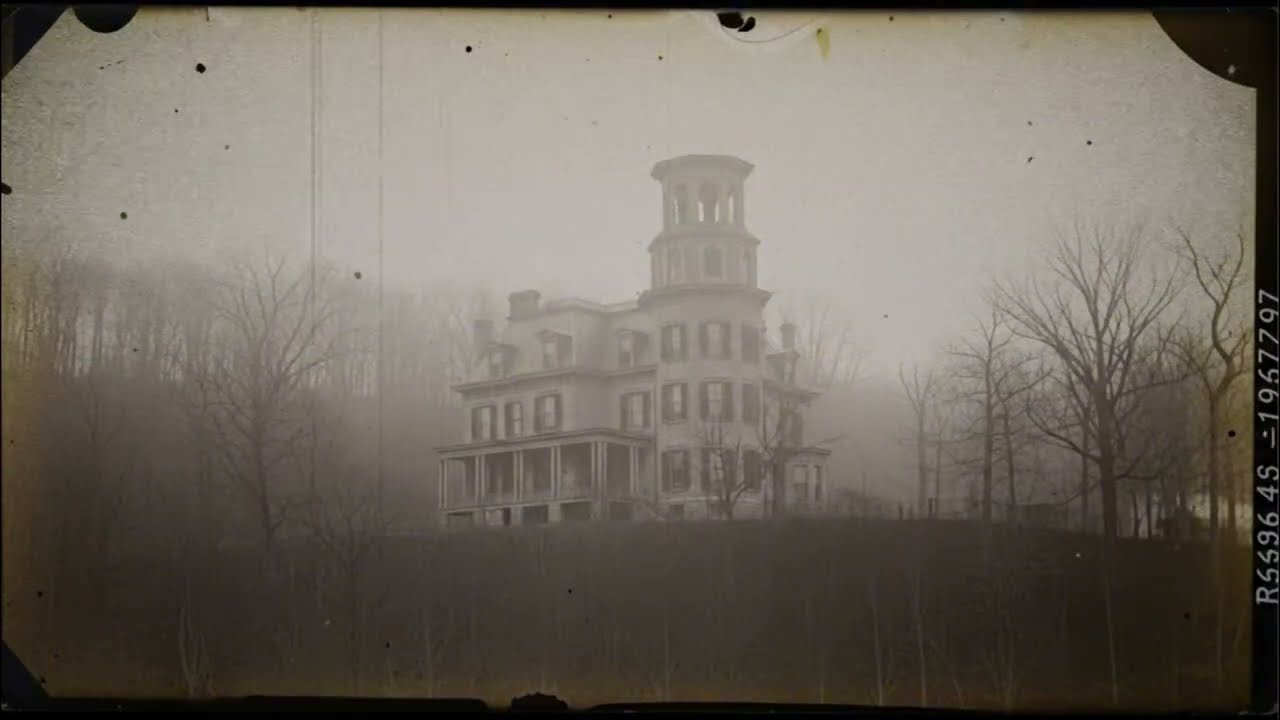
He had lived in Harper’s Ferry his entire life, knew every family name, every building, every patch of land. So when he found the Blackwoods, he knew at once that something was profoundly wrong. The first record was a property deed for a large house on Lancaster Hill, dated May 1867. Three stories tall, with a distinctive octagonal tower, set on six acres of woodland.
The deed bore the signature of James Blackwood, a notary seal, and the witnesses’ signatures of known town officials. It even included an architectural sketch of the proposed structure, drawn with professional precision. Lancaster Hill existed, a steep wooded slope north of town, but no such house had ever stood there. Garrett had hunted those slopes as a boy and walked them as a man.
The hillside was densely forested, with no clearing large enough for a substantial structure. He mentioned his discovery to Edward Harrison, the elderly postmaster who had served the town since before the Civil War. Harrison’s face remained blank. “Never heard of them,” he said firmly.
“And I’ve delivered mail to every household in this town for forty years. ”
In the days that followed, Garrett found more. Tax payments from the Blackwoods spanning twenty years. Baptismal records.
Correspondence between James Blackwood and the town council regarding road improvements. Records of regular coal and grocery deliveries. The documents were interspersed throughout the archives, filed alongside records of actual residents, each appearing authentic, with consistent handwriting across years, appropriate aging, official stamps and signatures. A receipt book from Stalaker’s general store showed monthly purchases by Ellaner Blackwood, flour, sugar, coffee, fabric, in the handwriting of Timothy Stalaker, who had run the store until his death in 1888.
When Garrett asked Timothy’s son, who now managed the business, about the Blackwood account, the younger Stalaker checked his ledgers and found no mention of the family. During evening hours, after the municipal building had emptied, Garrett sometimes heard footsteps on the wooden floors above when the building should have been vacant. Once he distinctly heard a drawer open and close in the record room adjacent to his office, but found the room locked as he had left it. The night watchman, Frank Miller, claimed to have seen no one entering or leaving during his shifts, though he added hesitantly, “There have been nights I could swear I heard conversations from the records room when no one was there.
Men’s and women’s voices talking low like they didn’t want to be overheard. ”
Garrett began cross-referencing the Blackwood records with other town documents. The more he searched, the more the family seemed woven into the historical fabric of Harper’s Ferry. Ellaner Blackwood appeared in the minutes of the Lady’s Aid Society.
James was listed as a contributor to the reconstruction of St. Peter’s Catholic Church after the Civil War. Their name appeared in the ledger of Strider’s Pharmacy, with purchases of medicines for ailments ranging from common colds to more concerning conditions. According to town council minutes from September 1872, James Blackwood had spoken passionately against a proposed ordinance restricting hunting on the outskirts of town.
The minutes recorded his words in detail, noting that several council members had been persuaded by his arguments. The ordinance was voted down, seven to two. Yet when Garrett interviewed William Chambers, who had served on the council during that period and was still living, Chambers had no recollection of any Blackwood addressing the council. “I remember that vote,” Chambers said, frowning.
“It was a contentious issue, but it was Marcus Wilton who spoke against the ordinance, the tanner who lived by the lower bridge. No Blackwood involved. You must be misreading the minutes. ” But the minutes clearly named James Blackwood as the speaker, with no mention of Marcus Wilton.
A photograph of the town council from 1875 showed eleven men posed on the steps of the municipal building. The caption on the back named James Blackwood seated second from left, but the man in that position was unmistakably Samuel Davis, the town banker, recognizable by his distinctive mutton chop whiskers and prominent forehead. Garrett compared the photo to others from the same period, confirming Davis’s identity beyond doubt. The records showed interactions between the Blackwoods and real historical figures, conversations, transactions, shared community events, yet none of these real people had left any personal records or journal entries mentioning the family.
It was as if the Blackwoods existed only in official documentation, leaving no impression on human memory. Three weeks into his investigation, Garrett made his most disturbing discovery. In the medical records of Dr. Samuel Wilkins, town physician from 1860 to 1888, he found detailed notes about treating the Blackwood family.
On March 10, 1873, Wilkins had supposedly treated James Blackwood for a severe laceration to the left forearm requiring fifteen stitches. On July 2, 1876, he attended Ellaner for what he diagnosed as nervous exhaustion following a family bereavement. There were numerous other entries, mundane medical matters spanning decades. But one entry from December 1878 stood out: “Visited Blackwood residence upon urgent summons.
Found no evidence of reported conditions. House appeared unoccupied despite lights visible from road. Left without providing treatment. Will not return.
”
It was the first suggestion that someone else had noticed something wrong. Garrett searched for further entries from Wilkins regarding the Blackwoods and found none. It was as if after that December night, the doctor had refused to acknowledge their existence, even as other town records continued to document their presence. More curious still, in the doctor’s personal expense ledger, discovered in a separate file, Wilkins had twice in January 1879 paid substantial sums to a researcher at the Maryland Historical Society in Baltimore.
The purpose was not specified, but the timing suggested it might relate to his experience at the Blackwood house. A third payment, larger than the previous two combined, was made in March to someone identified only as “EP — consultation regarding documentary anomalies. ”
The strangest aspect of the records was their abrupt end. All mentions of the Blackwoods ceased after September 15, 1887.
No death certificates, no property sales, no departures noted in travel registers. Just a sudden absence where there had been meticulous documentation. The last record was a payment for property tax, filed precisely and on time, as all their previous payments had been, giving no indication that it would be their final interaction with the town’s bureaucracy. By February, Garrett was spending more time in the archives than at home.
His wife remarked on his distraction, the dark circles under his eyes, his tendency to stare at empty corners of rooms as if seeing something beyond the wallpaper and wood. He began having dreams about the family, vivid visions of elegant Ellaner in her fine dresses, of stern James with his neat beard and watchful eyes. In these dreams they never spoke to him directly, but seemed always to be having conversations just out of his hearing. He would wake with a profound sense of loss, as if he had known these people intimately but had somehow forgotten them.
“You’ve always been so methodical, Thomas,” Sarah said one evening, as he sat distracted at dinner. “I’ve never known you to be so consumed by something. These people, this family, they’re not worth your health. ”
“But that’s just it,” he replied.
“They’re not people, not real ones. They’re fabrications—elaborate, detailed fabrications that exist only in town records. Don’t you see how impossible that is? Who created them and why?
And how did they manage to insert this fictional family into decades of official documentation? ”
Sarah reached across the table to touch his hand. “Perhaps there’s a simple explanation. Records get misplaced.
Names get confused. Mistakes happen in documentation all the time. ”
“Not like this,” he insisted. “Not with this level of consistency and detail.
And not just in one type of record, but in every kind of official document the town produced over two decades. This was deliberate, Sarah. Someone wanted this family to exist in the town’s memory, even if they never existed in reality. ”
One evening, as a snowstorm howled outside, Garrett was examining an 1870 map of Harper’s Ferry when he noticed something odd.
There, clearly marked on Lancaster Hill, was the outline of a large structure with an octagonal tower. The map was official, created by the county surveyor and approved by the town council. Garrett had reviewed town maps dozens of times throughout his career and had never seen this building depicted before. He pulled other maps from the archives.
An 1865 survey showed the hill undeveloped. An 1872 property map featured the Blackwood house prominently. An 1880 county map again showed the distinctive structure. Then an 1890 map, created after the Blackwoods had disappeared from town records, showed Lancaster Hill once again empty and forested.
The implications were clear and disturbing. Whatever force had inserted the Blackwood family into written records had also altered official maps to support their existence. Then, when the family vanished from documentation, subsequent maps were either created without the house or altered to remove it. The next morning, despite the deep snow, Garrett hiked up Lancaster Hill.
The slope was steep, the forest dense with oak and pine. No path led to where the house should have been, and the untouched snow showed no signs of other visitors. After nearly an hour of difficult climbing, he reached the approximate location indicated on the map. What he found was a clearing roughly the size a large house and grounds would occupy.
The trees surrounding it were mature, at least thirty years old, but the clearing itself was conspicuously empty of large vegetation. At the center, barely visible under the snow, was what appeared to be a foundation—stone blocks arranged in a pattern that could indeed support a structure with an octagonal projection. As Garrett stood in that quiet clearing, with only the distant murmur of the town below and the occasional fall of snow from burdened branches, he felt a profound sense of wrongness. The air itself seemed denser here, resistant to his presence.
The light seemed dimmer, though the winter sun shone brightly overhead. He walked the perimeter of the foundation, noting dimensions that matched precisely the property deed. Near what would have been the rear of the house, he found a depression suggesting a cellar or root storage. He cleared away snow to reveal a set of stone steps leading down into darkness.
Garrett hesitated. The rational part of his mind insisted that investigating an abandoned foundation alone in winter was dangerous, but the same drive that had led him to spend weeks poring over inexplicable records pushed him forward. Using a small lantern he had brought in his pack, he descended. The cellar was surprisingly intact, a stone-walled chamber about fifteen feet square with a packed earth floor.
Water had seeped in over the years, leaving mineral deposits on the walls, but the space was otherwise empty. No furniture, no abandoned tools, no sign of the people who had supposedly lived here. As he turned to leave, his lantern illuminated something on the far wall. Marks carved into the stone.
Moving closer, he saw they were names, dates, and short phrases etched with considerable effort. “James Blackwood, not real,” read one. “Ellaner Blackwood, constructed,” read another. There were dozens of inscriptions, some names he recognized from the records, others unfamiliar.
At the bottom of the wall, in larger letters than the rest, was carved: “We were never here. We never existed. ”
The carvings appeared to have been made by different hands over time. Some were weathered and faint, while others looked relatively recent.
The newest, based on its sharp edges and lack of mineral deposits, read simply “SW 1878. ” Samuel Wilkins, the doctor who had refused to return to the Blackwood house. As Garrett examined the wall more carefully, he noticed small objects pressed into crevices between the stones—a button, a tarnished coin, a fragment of what appeared to be a woman’s brooch. Items left deliberately, like offerings or evidence.
He resisted the urge to take any of them, superstitiously certain that removing anything from this place would be dangerous. The return journey down Lancaster Hill seemed to take far longer than the ascent. Twice Garrett became disoriented, finding himself walking in circles despite his certainty that he was moving directly downhill. The forest shadows stretched in impossible directions, and more than once he thought he glimpsed movement among the trees—not the motion of animals or wind-stirred branches, but of something tall and deliberate.
By the time he reached town, darkness had fallen. Rather than going home, he returned to the municipal building, driven by a need to understand what he had discovered. In the archives, he pulled out every record mentioning the Blackwoods, spread them across his desk, and examined each with renewed attention. In the margin of a church attendance register from 1877, he found a small note in different handwriting from the main entries: “The Blackwoods present in record only.
” It was initialed SW—Samuel Wilkins. Similar notations, subtle and easy to overlook, appeared on several other documents. On a property tax assessment from 1879: “No structure visible at this location despite records. ” On the back of a town council attendance sheet where James Blackwood was listed: “No such person addressed the council.
Witnessed personally. ”
Garrett felt a chill that had nothing to do with the winter night. He began searching specifically for documents handled or signed by Dr. Wilkins.
In a report to the town council regarding a scarlet fever outbreak in 1880, he found another marginal note: “Cannot continue this deception. The empty house remains on the hill. The names appear in my patient logs, though I have never treated these people. ”
A ledger entry from 1881 contained the most explicit statement: “Have consulted with E.
Phillips of Baltimore regarding documentary phenomena. His expertise in archival anomalies suggests deliberate manipulation rather than clerical error. Recommend full investigation, but fear consequences of drawing attention to these inconsistencies. ”
No such investigation had ever been documented.
Instead, the mentions of the Blackwoods continued for six more years, with no further marginal notes from Wilkins or anyone else questioning their existence. It was as if Wilkins had raised an alarm that no one heeded—or that someone had silenced. As midnight approached, Garrett found himself staring at the property deed that had started his investigation. On impulse, he compared the signature of James Blackwood to other signatures in the archives—the town mayor, the county judge, various prominent citizens.
He found no exact match, but similarities in the flourishes and letter formations suggested the hand that had signed James Blackwood’s name had also signed many other documents in the town records, documents spanning decades, some from before the Blackwood family supposedly arrived in Harper’s Ferry. For over an hour, Garrett compared handwriting samples, becoming increasingly convinced that many of the Blackwood documents had been created by the same person who had written official town records for years. The implication was staggering. Someone within the town’s government had systematically fabricated an entire family and inserted them into the historical record.
But why? What purpose could such an elaborate deception serve? And how had this person managed to create not just written records but influence maps, architectural plans, and photographs? The scope suggested not an individual acting alone, but something more organized, more purposeful.
The municipal building creaked and settled around him, winter winds pressing against its stone walls. From somewhere above, Garrett heard the now familiar sound of footsteps. This time, rather than investigating, he remained at his desk, listening as they moved from room to room, drawing inexorably closer to the archives. The footsteps stopped outside the archive door.
Garrett held his breath, eyes fixed on the doorknob. It turned slowly, and the door swung open to reveal an empty corridor, dimly lit and silent. No one was there, yet Garrett could feel a presence—watching, waiting, aware of his discoveries. In that moment of irrational certainty, he gathered the Blackwood documents and left the building, walking quickly through the snowy streets to his home.
Once there, he locked the doors and settled at his kitchen table to continue his examination. What emerged as he studied the records was a pattern he had missed before. The Blackwoods appeared most prominently in documentation following periods of community trauma: after the Civil War devastated the region, following a flood in 1870 that damaged much of the lower town, in the wake of a diphtheria outbreak in 1876 that took the lives of seventeen children. It was as if the family had been inserted into the historical record at moments when the town’s attention was focused elsewhere, when confusion and loss might make unusual new residents less noticeable.
More disturbing still was how the Blackwoods appeared to absorb or replace real historical events. In comparing newspaper accounts with town records, Garrett found instances where actions attributed to actual residents in news reports were credited to James or Ellaner Blackwood in official documentation. It was as if the fictional family was slowly consuming the town’s true history, replacing real people with fabricated ones. Morning found Garrett still at his kitchen table, surrounded by documents.
His wife, concerned by his disheveled appearance, listened as he tried to explain what he had discovered. Her expression shifted from concern to alarm. “Thomas,” she said carefully. “There is no Lancaster Hill in Harper’s Ferry.
”
Garrett stared at her, uncomprehending. Lancaster Hill was a prominent geographical feature of the town, visible from their very home. He took her to the window and pointed to the wooded slope rising to the north. “That’s Jefferson’s Ridge,” she said.
“It’s always been Jefferson’s Ridge. ”
For a moment, Garrett wondered if this was some kind of joke or test, but Sarah’s face showed only genuine confusion at his insistence that the hill had another name. “Perhaps you’re thinking of Lancaster County,” she suggested gently. “That’s in Pennsylvania, not far from here.
”
Garrett spent the next day questioning his memory and sanity. He returned to the municipal building but avoided the archives, instead consulting public maps in the reference room. Each one showed the slope north of town clearly labeled as Jefferson’s Ridge. There was no Lancaster Hill marked on any map.
He approached several longtime residents casually, asking about the name of the northern hill. Each person unhesitatingly identified it as Jefferson’s Ridge. No one had heard of Lancaster Hill. That evening, he visited the town’s oldest resident, Martin Fletcher, a man of ninety-three who had lived in Harper’s Ferry since before the Civil War.
When Garrett asked about Lancaster Hill, Fletcher looked confused, then thoughtful. “There was talk of naming the north ridge that back in ’66 or ’67,” the old man said slowly. “After Abraham Lancaster, who owned timberland there, but he died before it was decided, and the name never took. Why do you ask?
”
Garrett couldn’t bring himself to explain. Instead, he asked if Fletcher remembered a family named Blackwood, who had lived in a large house with an octagonal tower. Fletcher’s rheumy eyes clouded. “No Blackwoods in Harper’s Ferry,” he said with certainty, then more hesitantly, “though I do recall talk of a house that was to be built on the ridge.
Grand plans drawn up by an architect from Baltimore. Lancaster commissioned it before his death. Never built, of course. ”
“How did Lancaster die?
” Garrett asked, feeling a chill despite the warmth of Fletcher’s fireplace. “Strange business,” Fletcher muttered. “Found in the woods up on the ridge at the site where his house was to be built. They said it was heart failure, but there were rumors.
Some said the land wasn’t meant to be built on. Old native burial ground, perhaps, though I never put much stock in such tales. ”
On his way home, Garrett stopped at the town’s small newspaper office. The Harper’s Ferry Gazette had been publishing weekly since 1845, and its archives were well maintained.
After an hour of searching, Garrett found a brief obituary from March 1866: Abraham Lancaster, fifty-seven, prominent landowner and businessman, found dead on his property north of town, survived by no immediate family. Cause of death listed as natural causes. A longer article a week later reported on the settlement of Lancaster’s estate. With no heirs, his properties were to be sold and the proceeds donated to the town for civic improvements.
The extensive lands on what the newspaper called Lancaster’s Ridge were to be parceled and sold to developers. Garrett searched subsequent issues for any mention of these sales and found none. It was as if the plans had been abandoned after Lancaster’s death, the ridge reverting to wilderness, its very name changing in public memory from Lancaster’s Ridge to Jefferson’s Ridge. That night, Garrett returned to the ridge.
The path he had followed the previous day was difficult to find in the darkness, but eventually he reached where he remembered the clearing with the foundation stones. Except the clearing wasn’t there. Where he remembered an open space with the outline of a large house, there was only unbroken forest. Tall trees grew where the foundation had been, their trunks thick with age.
Disoriented, Garrett wandered the hillside until dawn, searching for the cellar entrance, the carved names, any evidence of what he had seen. He found nothing but trees, rock outcroppings, and his own footprints in the snow. When he finally descended to town, exhausted and confused, he went directly to the municipal building. The archives would hold the answers.
But when he searched the filing cabinets and shelves where he had found these records over the past weeks, he discovered only ordinary town documents. No property deed for a house on Lancaster Hill. No tax payments from James Blackwood. No mysterious notations from Dr.
Wilkins. Even the map showing the octagonal house was gone, replaced by a similar map from the same year with Jefferson’s Ridge clearly labeled and no building indicated. “Are you looking for something specific, Thomas? ” asked Marian Ridley, his assistant.
“You seem distressed. ”
“The Blackwood files,” Garrett said, trying to keep his voice steady. “The documents related to the family that lived on Lancaster—on the north ridge. I had them all gathered together.
”
Marian’s expression was blank. “I’m not familiar with any Blackwood family in our records, and I’ve never heard the ridge called Lancaster anything. It’s Jefferson’s Ridge. ”
Garrett’s colleagues grew concerned as he frantically searched the archives, insisting that records were missing.
The town’s doctor was called, and Garrett was sedated and taken home to rest. Exhaustion, the doctor said. Perhaps a nervous condition brought on by overwork. For three days, Garrett remained at home under his wife’s watchful care.
On the fourth day, he received a visitor: Harold Wilkins, the elderly son of Dr. Samuel Wilkins. “My father left a sealed letter to be opened thirty years after his death,” Harold explained, seated in Garrett’s parlor. “That time came last month.
The letter mentioned your name specifically, Mr. Garrett, and said that if you ever began asking questions about people who exist only in records, I was to give you this. ”
He handed Garrett a yellowed envelope. Inside was a single page covered in the careful handwriting of a man thirty years dead.
“To Thomas Garrett,” it began. “If you are reading this, you have discovered what I discovered—that our town’s records contain evidence of people who never existed. You have likely found the Blackwoods, though there may be others by now. ”
The letter explained that Dr.
Wilkins had first noticed discrepancies in 1875, when a patient mentioned receiving treatment that Wilkins had never provided. Upon investigating, he found records of the visit in his own logbook, in his handwriting, though he had no memory of it. Over the next three years, Wilkins documented dozens of similar inconsistencies, primarily centered around the Blackwood family. He visited their supposed address and found a partially constructed foundation abandoned after Abraham Lancaster’s death, not the grand house described in town records.
“I became convinced,” Wilkins wrote, “that someone was systematically altering town records to insert this fictional family into our history. But upon closer examination, I found something far more disturbing. The alterations were not limited to adding new documents. Existing records were changing.
” He described comparing notes he had made about town council meetings with the official minutes and finding discrepancies. Names had been changed, events rewritten. When he checked his own notes again later, he found they too had changed, conforming to the altered official record. It was as if reality itself was being rewritten, both on paper and in memory.
Most disturbing was his discovery that the records themselves seemed to change. Documents he had marked or annotated would later appear untouched. New records would appear in archives, filed as if they had always been there. After consulting with the expert in document preservation and forgery from Baltimore—the mysterious E.
Phillips mentioned in his expense ledger—Wilkins had conducted an experiment. He created detailed personal records of his observations, storing one copy in his office and another in a sealed box buried on his property. When he compared the documents months later, the office copy had changed substantially, with references to the Blackwoods altered or removed entirely. The buried copy remained as he had written it.
“I believe,” Wilkins wrote, “that something is using our town’s documentation to construct a false history, creating people and events through official papers while manipulating our memories to prevent us from noticing the discrepancies. I do not know its purpose or nature. I know only that after I began investigating actively, the phenomena increased. New fictional people appeared in records.
My own notes were altered. ”
The most chilling part of Wilkins’s letter was his description of a night in December 1878, when he was called to the Blackwood house on what was then still occasionally called Lancaster Hill. “I found the foundation as I expected. No house stood there.
Yet from a distance I could see lights as if from windows, moving figures as if people walked inside a structure that did not exist. When I approached, these apparitions vanished, leaving only the stone outline in the snow. ”
That night, returning home, Wilkins claimed to have been followed by something he described only as “a presence without form, observing me with what I can only describe as hunger. ” In the weeks that followed, he found his medical records increasingly populated with visits from patients he had never seen, treatments he had never administered, all connected to the Blackwood family.
The letter concluded: “If you pursue this matter, be aware that you may find yourself similarly affected. Already, I suspect my memory has been altered in ways I cannot detect. The only safety I found was in ceasing my investigation entirely. I recommend you do the same.
”
Harold Wilkins watched as Garrett read the letter twice, then a third time. “My father was considered quite sound of mind,” he said quietly. “But after 1887, he refused to maintain written records of his patients. Everything was committed to memory until the day he died.
”
“Did he ever explain why? ” Garrett asked. “He said only that paper had a way of changing when you weren’t looking at it,” Harold replied. “We assumed it was an old man’s eccentricity.
Now I wonder if he knew something the rest of us didn’t. ”
After Harold left, Garrett sat in silence for a long time. Outside his window, Jefferson’s Ridge rose against the winter sky—a ridge he had always known by another name, containing a house that had never been built, occupied by people who had never existed, except in meticulously maintained records. If Dr.
Wilkins was correct, something was systematically altering not just town records, but memory itself, creating a false history that incorporated fictional elements so seamlessly that no one noticed the discrepancies. And whatever this force was, it had been operating in Harper’s Ferry for at least thirty years, possibly longer. That night, he burned Dr. Wilkins’s letter in his fireplace.
The next morning, he returned to work at the municipal building, apologized for his strange behavior, and resumed his regular duties. He never again entered the archives alone, and refused any assignments involving historical records. But sometimes, walking home in the evening, he would look up at Jefferson’s Ridge and see, just for a moment, lights shining from windows in a house that wasn’t there—a tall structure with an octagonal tower, exactly as described in documents that no longer existed. Months passed.
Garrett spoke to no one about the Blackwoods, Dr. Wilkins’s letter, or his experiences on the ridge. Gradually, the town forgot his strange behavior of that winter. Even Sarah stopped watching him with concern.
But Garrett had not forgotten. In a locked drawer in his desk at home, he kept a journal in which he recorded everything he could remember about the Blackwoods and his investigation. Each night, he would read what he had written previously before adding new observations. Often he found discrepancies, details that seemed to shift slightly with each reading, as if his own memories were being subtly altered.
To counter this, he began leaving small objects associated with his memories—a stone from the foundation, a button found in the cellar, a page from a town record that mentioned the Blackwoods, though when he looked again later, the name had changed to someone else’s. In the years that followed, Garrett observed similar patterns with other town records. New names would appear in old documents, residents no one remembered but who were thoroughly documented in official papers. Sometimes existing residents would be replaced in records, their actions and contributions attributed to phantom citizens.
The phenomenon seemed to accelerate around times of community stress or change—after fires, floods, or economic downturns. It was as if these moments of disruption provided opportunities for the historical record to be rewritten, for memory to be altered, for reality to shift. Garrett never again actively investigated these anomalies, but he watched, and he recorded his observations in his private journal. In 1905, Thomas Garrett died of pneumonia at the age of sixty-two.
His personal papers, examined by his wife after his death, contained no mention of the Blackwood family, Lancaster Hill, or any investigation into town records. The locked drawer where he had kept his journal was empty, except for ordinary household accounts and correspondence. Sarah Garrett felt a strange sense of absence, as if something important was missing from the record of his life, but she could not identify what it might be, and eventually the feeling faded, replaced by the ordinary grief of widowhood. Three years later, during renovations to the municipal building, workers discovered a sealed metal box hidden in a wall cavity near the archives.
Inside was a journal written in Garrett’s distinctive hand, detailing his investigation and his subsequent decision to abandon it. The journal was filed away by the town clerk and forgotten until 1957, when historian Margaret Holloway found it while researching a book on the architectural history of Harper’s Ferry. Holloway was particularly interested in a house described in Garrett’s journal—a large structure with an octagonal tower that supposedly stood on Lancaster Hill. As a specialist in nineteenth-century architecture, she was intrigued by detailed descriptions of a building that, according to all other records, had never existed.
Her subsequent investigation revealed something disturbing. Town records from 1905 to 1908 contained multiple references to Thomas Garrett continuing to serve as town clerk for those three years after his documented death. The records included meeting minutes with his signature, tax assessments he had supposedly calculated, and correspondence he had apparently written. All these documents were filed correctly, aged appropriately, and written in what handwriting experts confirmed was indeed Garrett’s distinctive script.
Yet Sarah Garrett’s diaries from the same period clearly referenced her status as a widow, and church records confirmed Thomas Garrett’s funeral and burial in 1905. Even more unsettling, Holloway found photographs of town council meetings from 1906 and 1907 that appeared to show Garrett seated among the other officials, though his face was always slightly blurred or shadowed, as if the camera had moved at the moment of exposure. When she interviewed elderly residents who had attended these meetings, none could recall Garrett’s presence, though all agreed he had been a respected town clerk years earlier. Holloway’s research led her to the property that had once been called Lancaster Hill, now universally known as Jefferson’s Ridge.
County records showed it had remained undeveloped forest since the town’s founding, with no structures ever built there. Yet when she hiked to the site Garrett had described, she found subtle evidence of human activity—depressions in the earth that could have been a building foundation, now overgrown with decades of forest growth. Most compelling was her discovery in a folder of miscellaneous photographs at the town historical society: a single image showing a large house with an octagonal tower standing on a cleared hillside recognizably similar to Jefferson’s Ridge. The photograph was dated 1877 and labeled “Blackwood Residence” in faded ink.
The curator had no record of when or how the photograph had been acquired. When Holloway returned to the historical society the following day to examine the photograph again, it was missing from the folder. The curator had no recollection of the image and insisted it had never been part of their collection. When Holloway described it, he suggested she might have confused it with a photograph of the Harper House, a prominent local building that bore no resemblance to what she had seen.
Over the next eleven years, Holloway’s investigation expanded beyond Harper’s Ferry to other towns in the region. She found similar patterns of documentary anomalies: people who existed only in official records, buildings documented extensively but never actually constructed, events recorded in multiple sources but remembered by no witnesses. In each case, these anomalies clustered around periods of community trauma or transition. In Cumberland, Maryland, a fictional family appeared in town records following a devastating flood in 1852.
In Shepherdstown, phantom buildings were documented after a fire destroyed much of the town center in 1845. In Winchester, Virginia, entire town council meetings that never occurred were meticulously recorded during the chaotic period of early Reconstruction. Holloway developed a theory that these documentary anomalies represented some kind of psychological response to community trauma, a form of collective false memory enshrined in official records. Her academic colleagues dismissed this explanation as insufficiently rigorous, pointing out that false memories were typically inconsistent across individuals, not systematically documented in official records with consistent details.
Others suggested more prosaic explanations—clerical errors, deliberate fraud, misidentification of records—but none accounted for the consistent patterns Holloway had observed across different communities and time periods, nor for the tendency of the records themselves to change when not directly observed. Holloway’s research notes were scheduled for publication in the West Virginia Historical Quarterly in 1968. The manuscript was submitted, accepted, and sent to press. But when the journal was published, her article was not included.
When questioned, the editors had no record of receiving her submission, despite Holloway possessing a signed acceptance letter. When she contacted the journal’s editor-in-chief, he expressed confusion, checking their records and finding no mention of her article ever being submitted or accepted. The acceptance letter she presented contained his signature, but he denied ever having seen or signed such a document. Moreover, the letter was dated from a period when he had been hospitalized following an automobile accident and could not have been in the office to review manuscripts.
The original manuscript, along with Garrett’s journal and all of Holloway’s research materials, disappeared during an office move at Shepherd College later that same year. Holloway herself maintained that her work had been deliberately suppressed, though she never specified by whom or why. As her claims became more insistent, her academic reputation suffered. Colleagues began to distance themselves, suggesting that her obsession with documentary anomalies had affected her judgment.
She died in 1969, leaving behind only a single page of notes in her personal diary: “The town’s records are alive somehow. They create people. They extend lives beyond death. They build houses never constructed, and they protect themselves by altering not just documents, but memory itself.
I will not look further. Some histories are not meant to be uncovered. ”
For decades, Holloway’s work was forgotten. But in 1982, during the digitization of Harper’s Ferry’s historical records, a computer technician named David Chen noticed something unusual.
The database he was building to catalog the town’s archives kept showing inconsistencies: records he had entered one day would appear slightly altered the next. Names changing, dates shifting, entire entries disappearing, or new ones appearing. At first, he attributed these anomalies to software glitches or his own errors in data entry. But as the inconsistencies persisted, he began keeping detailed logs of the changes, backing up his database multiple times daily and comparing versions.
The patterns that emerged were disturbing. The changes weren’t random but seemed purposeful, creating coherent alternative histories that diverged subtly from the documented past. A family named Corwin appeared repeatedly in records from the 1920s, documented in tax rolls, church registries, and business licenses, though no local historians had ever heard of them. A town hall annex was described in detail in building permits and council minutes from 1935, complete with architectural drawings and construction costs, though no such structure had ever been built.
Most disturbing of all, Chen found electronic records creating a documented life for Thomas Garrett extending well beyond his known death in 1905. Digital scans of original documents showed his continued involvement in town affairs until 1915, though cemetery records clearly showed he had died a decade earlier. When Chen tried to correct these discrepancies, he found the changes wouldn’t persist. Data he deleted would reappear.
Corrections he made would revert to the altered versions. It was as if the database had a will of its own, insisting on maintaining these fictional elements within the town’s history. His supervisor, concerned about delays in completing the digitization project, attributed the problems to technical issues and reassigned him. His replacement, less meticulous in verifying the data, simply incorporated the anomalous records into the final database, apparently never noticing the historical impossibilities they represented.
But Chen couldn’t let go of what he had discovered. In his free time, he researched similar anomalies in other town archives, eventually coming across references to Margaret Holloway’s unpublished work. Following breadcrumbs through correspondence and conference minutes, he located Holloway’s niece, now an elderly woman living in Baltimore. She remembered her aunt’s obsession with what she had called “documentary phantoms” and recalled that Holloway had kept duplicate notes hidden in her home, separate from the materials that had disappeared.
These notes, stored in a metal box, had remained unopened for years. Chen convinced the niece to let him examine them. What he found was a meticulously documented investigation spanning nearly two decades. Holloway had traced similar documentary anomalies across dozens of communities in the Mid-Atlantic region.
Most compelling was her discovery that these anomalies weren’t random but seemed to serve a purpose: filling gaps in community memory after traumatic events, creating continuity where disruption had occurred, establishing false histories that were somehow more palatable or coherent than the messy reality of actual events. “It’s as if the records themselves are trying to heal the communities they document,” Holloway had written, “creating phantom people to replace those lost to disease or war, constructing phantom buildings where real ones were destroyed, extending lives on paper when they’ve ended in reality. But why? And how do mere documents have this power to alter not just the written record, but memory itself?
”
Chen’s examination of Holloway’s notes led him back to where her investigation had begun: Thomas Garrett’s journal, describing the Blackwood family and the house on Lancaster Hill that was somehow both there and not there. According to Holloway’s research, the original journal had disappeared along with her manuscript in 1968, but in her notes she mentioned making a photographic copy stored separately. This copy, preserved among her personal effects, provided Chen with the details of Garrett’s original investigation. Reading it, he was struck by the parallels with his own experience: the shifting records, the resistance to correction, the sense that something was actively manipulating documentation to create and maintain fictional elements within the historical record.
In 1983, Chen published an article in the Journal of Archival Science describing what he called “documentary echo phenomena”—the tendency of official records to develop consistent internal anomalies that couldn’t be verified through external sources. He carefully avoided Holloway’s more speculative conclusions, presenting the phenomena instead as an interesting form of clerical error propagation. The article attracted little attention outside specialist circles, but within a year, Chen received communications from archivists and historians in seventeen different states describing similar phenomena in their own collections: records that changed when not directly observed, phantom people and places documented extensively but remembered by none, historical narratives that shifted to accommodate these fictions, becoming more internally coherent but diverging from external reality. In 1985, Chen organized a small conference of researchers who had encountered these anomalies.
The consensus that emerged was disturbing: whatever was causing these documentary anomalies wasn’t confined to a single location or time period. It appeared to be widespread, perhaps universal, a property of documentation itself rather than a local phenomenon. And it seemed to be accelerating with the digitization of records, as if the transition from paper to electronic storage had somehow amplified the effect. Most troubling was the realization that these anomalies weren’t simply affecting the records themselves but were somehow altering human memory to maintain consistency with the altered documentation.
People who had witnessed events would over time begin to remember them as they were recorded, not as they had actually occurred. The longer an anomalous record existed, the more it seemed to override actual memory and experience. The conference participants agreed to establish a network for sharing observations, called the Garrett-Holloway Archive in honor of the first two investigators to document the phenomenon. But within months, the network began to dissolve.
Participants reported difficulty accessing their own research notes. Electronic communications would arrive altered or not at all. Phone calls would be forgotten as soon as they ended. By the end of 1986, the network had effectively ceased to exist.
Chen, attempting to organize a follow-up conference, found that most participants had no recollection of attending the first one. Some denied ever having corresponded with him about documentary anomalies. Others had developed alternative explanations, attributing them to mundane causes. Chen himself began to doubt his own memories and conclusions.
In 1987, he published a retraction of his earlier article, attributing his conclusions to methodological errors and confirmation bias. He left his position and took a job in commercial database management, never again involving himself in historical research. To this day, visitors to Harper’s Ferry occasionally report seeing lights on Jefferson’s Ridge, where no structure stands. Town records from the nineteenth century continue to contain references to residents that no historical account can confirm ever existed.
And in the municipal archives, now modernized and computerized, new entries occasionally appear in old databases—entries for people with no birth certificates, no school records, no existence outside official documentation. People who, according to every record, live in houses that were never built on a hill whose name changes depending on who you ask and when. The phenomenon that began with the Blackwoods has never stopped. It has only become more sophisticated, harder to detect.
As recordkeeping has evolved from handwritten ledgers to computerized databases, the people who never existed continue to haunt the records of Harper’s Ferry, now joined by others—other families, other individuals, existing solely as data, as officially registered ghosts. Some archivists have suggested that these documentary phantoms serve a purpose, that they somehow maintain the coherence of community memory through times of trauma and disruption, that without them the historical record would fragment into irreconcilable contradictions. Others propose darker interpretations—that something is feeding on human memory and experience, consuming actual history and replacing it with fabrications that serve some alien purpose we cannot comprehend. That the records themselves have developed a kind of emergent consciousness, rewriting reality to suit their own internal logic.
Most disturbing of all is the possibility that this phenomenon isn’t limited to Harper’s Ferry or the communities Margaret Holloway studied, that it might be universal, a property of all documentation, all recorded history—that what we consider the factual past might be riddled with fabrications, people and places and events that never existed outside the records that document them. And somewhere in those archives, perhaps, are records of you and me. Lives documented in detail, though we have never set foot in that town. Names appearing in meeting minutes for gatherings we never attended.
Medical records of treatments we never received. All waiting to be discovered by some future archivist who will recognize the impossibility and begin asking questions—questions that will lead them to records that change when not observed, to memories that conflict with documentation, to houses that appear on maps but not on the land, to the people who never existed but haunt the records of a town. They are patient. They are persistent.
And they are waiting to be discovered by those who, like Thomas Garrett and Margaret Holloway and David Chen, notice the impossibilities hidden in plain sight within our documented past. Whether such discovery is illumination or contamination remains to be seen.
