The second you touched the big plastic knob on the television set, the day’s first battle began. You turned it until it clicked into the channel you wanted, and then you waited. The picture didn’t just appear; it bloomed from a single bright dot in the center of the screen, growing outward until the whole frame came alive. There was no remote, no menu, no input button.
To change the channel, you walked across the room and earned it. And if your father was watching the game, you were the remote. That was the rule. Every network had its own three-note signature, a sound you heard a thousand times and never once thought about, yet could hum from memory decades later.
The television itself was a piece of furniture with a warm-up ritual, and its closing act was a nightly farewell. After midnight, the national anthem played over a waving flag, sometimes accompanied by a fighter jet or a bald eagle. Then a voice announced that this concluded the broadcast day, followed by a flat, lonely, high-pitched tone. If you had fallen asleep on the couch, that tone woke you.
Then came the snow: gray and white fuzz filling the screen and the room, the television telling the whole house the day was over. The world used to have a bedtime, and that was the sound of it. Then came Saturday morning, the only day of the week cartoons played. From six in the morning until noon, and then they were gone for seven more days.
There was no streaming, no DVR, no on-demand. You either got up, or you missed it. Every kid in America got up. The car was its own world of sound.
In 1973, gas prices went through the roof, and the government declared that nobody could drive faster than 55 miles per hour. The nation’s truckers had other ideas, and 25 million people bought CB radios. Your uncle had one. Your neighbor had one.
The quiet guy down the block had one too, and suddenly he had a handle and friends he had never met. The static was not noise; it was the sound of a stranger telling you where the police were, someone saying hello from a hundred miles down the road. Nobody called. Nobody texted.
You keyed the mic and hoped somebody keyed back. From the driveway, you heard a buzz and knew exactly what was happening: someone in that car had not buckled up. For one year, only one, every new car in America had a device under the seat that would not let the engine start unless you clicked your belt in the right order. If you got it wrong, the god-awful buzz would not stop.
Not for a mile. Not for ten miles. People lost their minds. Congress received more angry letters about that buzzer than about Watergate.
A little buzzing sound in a Buick made Americans madder than a presidential cover-up. So they fought back. Dads everywhere popped the seat, found the wire, and snipped it. Many people simply hot-wired their own cars to shut it up.
The government backed down a year later, but the memory of that flat, angry, unending buzz remained, enough to tighten your shoulders decades on. Music played differently then. You did not push play or pick a song. You shoved a plastic brick into a slot, and whatever was playing was what you listened to.
Right in the middle of your favorite song, without warning, you heard it: the head. A chunk of metal inside the dashboard physically slid up or down to the next program. Sometimes it happened between songs. Often it happened in the middle of the chorus.
You would be singing along, full voice, and then silence, followed by the same song picking up where it left off as though nothing had happened. If the tape started to warble, every driver knew the fix: fold up a matchbook and jam it under the cartridge to wedge it into place. You did not skip tracks. The tracks skipped you.
The classroom had its own music: the grinding of the wall-mounted pencil sharpener, the pitch rising the closer you got to a perfect point. When the teacher asked for a volunteer, every hand shot up, because the volunteer got to leave the room and walk down the hall alone. That was freedom. And as you passed the front office, you heard the sound of the grown-up world: the IBM Selectric.
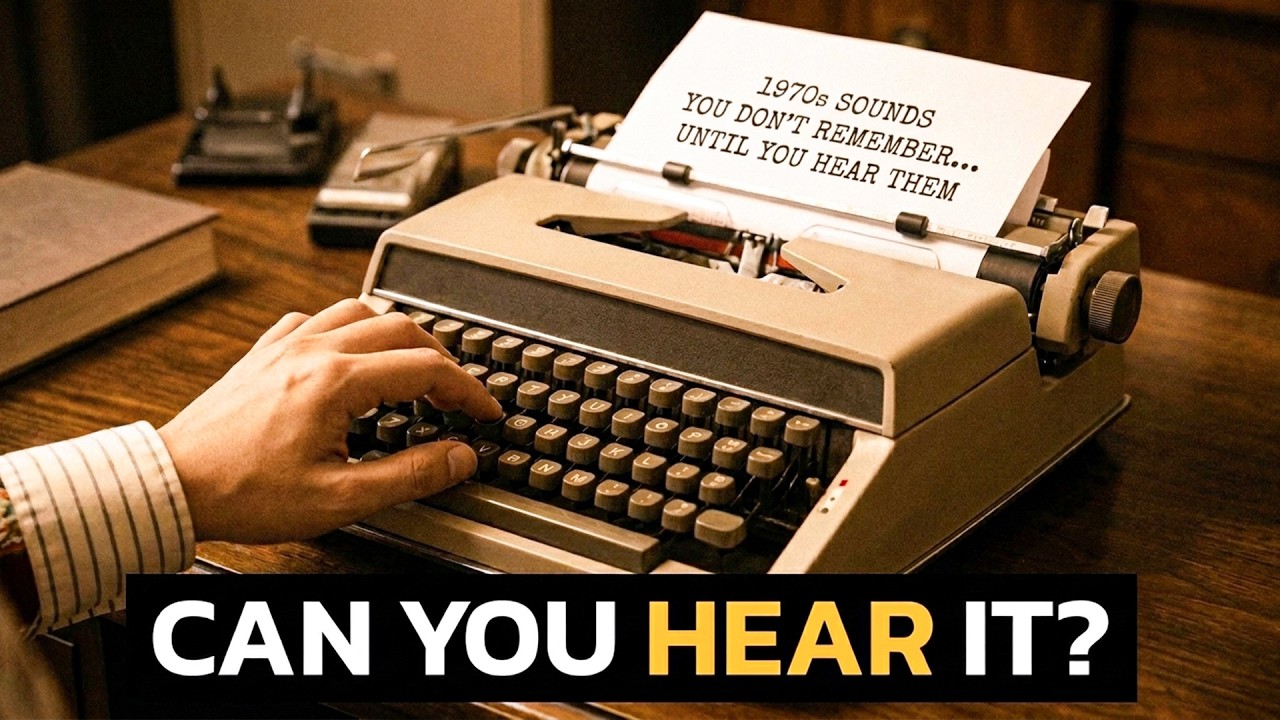
That was not typing; it was a weapon going off. A metal ball the size of a golf ball spun and slapped paper faster than the eye could follow. A good secretary could hit 120 words per minute. There were no keys hitting the page; one ball rotated and tilted for every single letter.
The machine-gun rattle it produced was the sound of business getting done in America, echoing through every office building, insurance agency, and school front desk from sunup to quitting time. In 1978, toys started to talk. Texas Instruments released a bright orange box with a little screen and a robot voice, and every kid in America wanted one. Stores could not keep them on the shelves.
It cost about fifty dollars at Sears, which was real money then. Most kids eventually stopped spelling words and started typing in things the box was never meant to say, just to hear the robot voice try to pronounce them. For most of a generation, that was the first time a computer spoke. It sounded cold and wrong, and we loved it.
Before you had a clock on your microwave or a clock in your pocket, you had a phone number. Every town had one. In many places, you simply dialed the word “popcorn,” and a woman’s voice picked up: calm, clear, a little bit sweet. At the tone, the time will be.
Her name was Jane, and she was heard 40 million times a day. She was the most heard voice in America, and almost nobody knew her name. You called her before school to set your watch, before church to make sure you were not late, and during snowstorms when the power flickered and the wall clock went dark. She never changed.
She never got tired. She was always there. The whole country’s clocks ran on her, until the cell phone came along and Jane went quiet forever. You heard those three tones from across the room.
Nothing else in 1972 sounded like that. A quarter got you a game: a white dot bounced between two white lines, and that was the whole thing. The entire country lost its mind over it. The man who built Pong had no memory to work with and no instructions, but he needed a sound.
He grabbed whatever beep he could find inside the television already in the machine. Three tones, a total accident. Every kid who ever dropped a quarter into an arcade machine after that heard the grandchildren of those three beeps. And if you beat your older brother at Pong in 1974, for one brief, glorious summer, you were the champion of the world.
You heard the pop of the pull tab at every cookout, every Little League game, every fishing trip. Then you had the sharp little metal ring in your hand and had to do something with it. Some folks dropped it back into the can and drank around it. Some wore them on chains.
Kids strung them together into belts. A whole lot of people threw them on the ground. Beaches, parking lots, and campgrounds became littered with them; you could not take a step without one stabbing your foot. The problem grew so bad that in 1975, a man patented a new design, the kind still used today, where the tab stays on the can.
The pop you hear now is completely different: cleaner, safer. But something left with those old sharp rings. The sound of summer changed, and most of us never noticed. Most of these sounds have disappeared from the world, but not from memory.
The brain held on to every single one, whether you wanted it to or not. The ker-chunk between songs, the buzzer that nearly drove your father into a ditch, the static that meant a stranger was saying hello from a hundred miles away, the machine-gun rattle of business getting done, the robot voice that sounded cold and wrong and wonderful, and Jane telling you the time one more time. You forgot you remembered them.
Your brain didn’t.
