December 1778. After more than eight years of marriage, the Queen of France was finally giving birth to her first child. The royal doctor announced it aloud, and a crowd flooded her bedroom. The rush nearly crushed her.
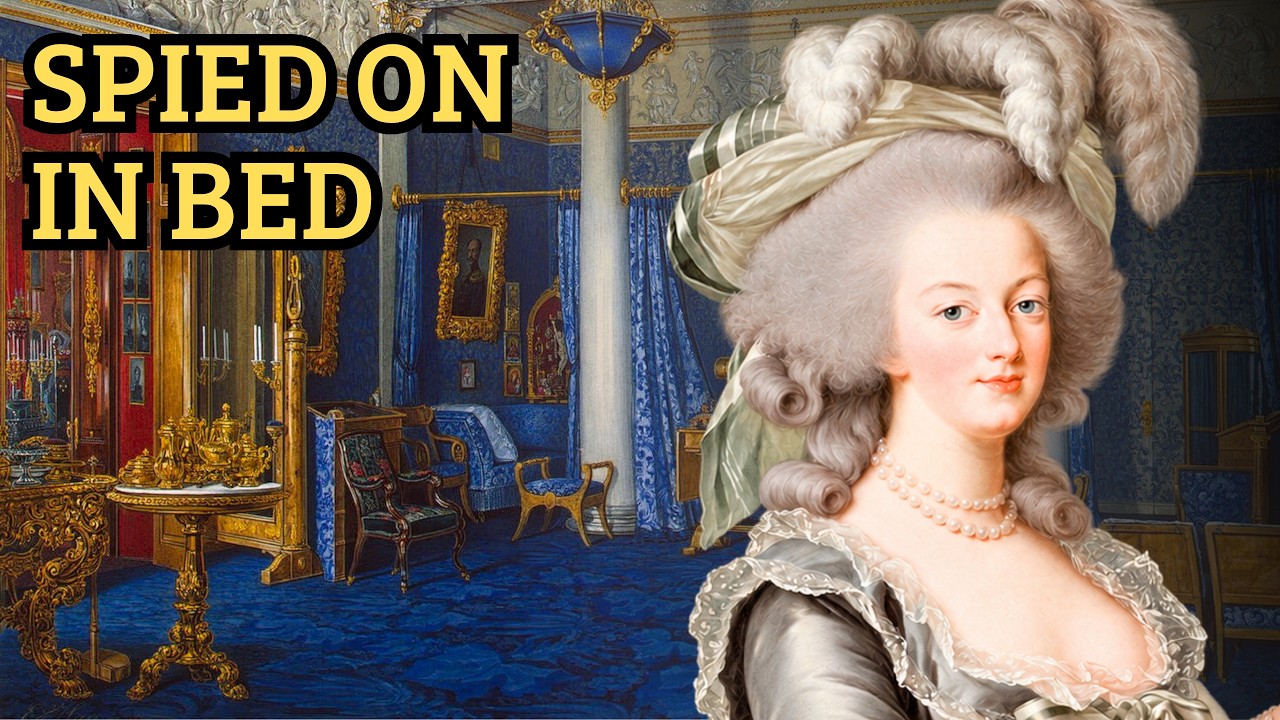
Two men climbed onto the furniture for a better look. She went into convulsions. The tall windows had been sealed with strips of paper, so the King forced them open himself. A surgeon cut into her foot to bleed her.
She was Marie Antoinette, twenty-three years old, and her own servants were watching. Some of them had been secretly reporting on her for years. She survived that day, but the scene says a great deal about the life she was living, and about who was standing close enough to see it. Marie Antoinette lived in France for twenty-three years, and for nearly all of that time she was surrounded by servants.
They dressed her, bathed her, served her meals, and handed her linen. Some of them later wrote down what they had seen. Others never published a word, yet their observations still survive because they were quietly passing them to someone else. The most famous member of the first group was a woman named Henriette Campan.
Born Henriette Genet in 1752, she was the daughter of a clerk in the French Foreign Office. Her memoirs open with a simple line: “I was 15 years of age when I was appointed reader to Mesdames. ” The Mesdames were the old King’s unmarried daughters, and the job meant reading aloud to royal women who had very little else to do. Soon after the young Austrian bride arrived, Campan moved into her service as one of her chambermaids.
That sounds humble, but it was not. A chambermaid to a royal princess handled her clothes, her linen, her private rooms, and her daily rituals. She stayed for over twenty years, close enough on many mornings to be holding the Queen’s clothes in her hands. Her memoirs came out only after her own death in 1822, nearly thirty years after the Queen’s.
She loved the Queen. That matters, and it is worth keeping in mind. Around her, over the years, there would be others. A milliner who was not allowed into the bedroom.
A hairdresser who traveled just hours ahead of the royal family during their desperate attempt to escape. A valet in a prison tower. And finally, a young serving girl in a damp cell who helped her hide something on the last morning of her life. The second group is harder to see.
Their names mostly are not famous, but they were paid, and their reports traveled more than six hundred miles. To understand why anyone would bother spying on a teenage girl’s daily routine, you have to go back to the spring of 1770. Marie Antoinette was the youngest daughter of Maria Theresa, the formidable empress who ruled the Habsburg lands from Vienna. On the 16th of May, 1770, at the age of fourteen, she married Louis, the fifteen-year-old grandson and heir of King Louis XV of France.
France and Austria had spent generations as enemies. This wedding was supposed to seal a new alliance, and the bride’s real task was easy to describe and impossible to accomplish on her own. She had to give France a son. At Versailles, that task came with an audience.
The French court ran on an old idea that the royal body was not entirely private. Waking, dressing, eating, washing, much of it happened in front of people who had the right to be there, and that right was jealously guarded. Being allowed to watch was a privilege. Being watched was the price of the crown.
That is how two strangers would one day end up standing on her furniture while she gave birth. A few weeks after the wedding, on the 12th of July, 1770, the new Dauphine wrote to her mother and walked her through an ordinary day. In the middle of that letter sits one plain sentence. Translated from her French, it reads: “I put on my rouge and wash my hands in front of everybody.
” She does not complain about it in that line. She simply reports it the way you might mention what time breakfast was served. That is what makes it so striking. A fourteen-year-old girl was putting on makeup and rinsing her hands while a room full of adults looked on, and she described it as routine.
It was routine, and it was only the beginning. Her mother, back in Vienna, read letters like this one very closely, and she had firm opinions about her daughter’s riding, her habits, and how she spent her hours. Because there was also the bed. The wedding night produced nothing, nor did the following month or the following year.
The marriage that two empires had celebrated remained, in the careful language of the court, unconsummated. It would stay that way for more than seven years. For an ordinary young couple, that would have been a private difficulty. For these two, it was an international problem.
Without a child, the alliance looked fragile. And in a palace where servants changed the sheets and laundered the shirts, a secret like that was never going to stay private. Everyone with an interest in that alliance wanted to know exactly what was happening behind the bedroom door. So people started counting.
Courtiers counted. Her mother counted from her palace in Vienna. Even the Spanish ambassador sent home reports on the subject. And to count properly, they needed eyes and ears inside the royal apartments, among the women who handled the linen and the men who served in the chambers.
The young Dauphine was writing letters home about her days, but she was not the only one. Within six months of the wedding, someone else at the French court was also writing to Vienna about her in secret. His letters were far more detailed than hers, and they named exactly where his information was coming from. His name was the Count of Mercy-Argenteau, and officially he was Austria’s ambassador to France.
Unofficially, he was the Empress’s eyes inside her daughter’s household. On the 16th of November, 1770, writing from the royal palace at Fontainebleau, he explained to Maria Theresa exactly how he was managing it. He had, he wrote, secured three people from the Dauphine’s lower service: one of her women and two valets of the chamber. These three gave him, in his words, an exact account.
On top of that, he was told day by day what the girl said in private to her reader and confidant, a priest called the Abbé de Vermond, a man to whom, Mercy noted, she hid nothing. And a court lady, the Marquise de Durfort, kept him informed about what was said in the apartments of the King’s daughters. Then comes the line that should make anyone’s skin crawl. Thanks to all this, Mercy assured the Empress, there was not an hour of the day he could not account for.
Think about who those three people were. Not ministers, not courtiers. One of the women who served her in private, the men who came in and out of her rooms. The kind of people a fifteen-year-old would naturally stop noticing because they were always there.
And there is no sign in these letters that she knew which of her own servants were reporting on her. Mercy does not name them in that letter. He only gives their jobs. And their reports, folded into his, went straight to her mother.
Maria Theresa made full use of them. Her letters to her daughter are loving, but they are also relentless. On the 2nd of December, 1770, she warned her about horseback riding, which the young Dauphine had started to enjoy. “Riding,” the Empress wrote, “spoils the complexion, and in the long run your figure will suffer for it.
” Later, she complained that she had found out about her daughter’s hunting from the newspapers. You can feel the irritation. A mother who had planted informers in her child’s bedroom was annoyed that the gazettes got there first. But the surveillance went further than riding habits.
It reached her body. Inside the family, there was a private code word for the girl’s monthly period. They called it “the general,” a joking reference to a real lady at court. Where the nickname came from is still unclear.
According to the biographer Antonia Fraser, working from the family’s letters, the young Dauphine wrote home in the summer of 1773 that the general had arrived as usual, a few days early. Her mother wanted that information. Every month it came meant, once again, no pregnancy. Years later, the joke was still running.
Fraser reports that in a New Year’s letter of 1780, the Empress noted that the real lady had died and hoped this meant the monthly general would stop visiting too. In plain language, she was hoping her daughter was pregnant again. So the Dauphine’s body was watched, timed, and reported. But what about her husband’s?
The young Louis was not as easy to read as his wife, and his own servants were not, as far as we know, on anyone’s payroll. They did, however, talk. And someone was listening. The Count of Aranda, the ambassador of Spain, a kingdom bound to France by a family alliance between the two royal houses, passed what he heard back to Madrid.
His dispatches are astonishing to read today. In November 1773, he reported stains that some claimed proved the marriage had finally been consummated, though others gave them a less useful explanation. By August 1774, Louis had become king, and Aranda described two theories circulating about why there was still no child. One was that a small band of tissue was restricting the King’s foreskin.
The other was that the foreskin itself was too tight, and might need, as Aranda put it, a kind of circumcision. The following month, he went further. In September 1774, he reported that the King’s personal servants swore they had observed what he called a perfect erection, together with recognizable stains on the King’s shirt. Read that again slowly.
The men who dressed the King of France were apparently inspecting his shirt, and a foreign ambassador was writing it up for his government. Nobody in this story had a private body, not the Queen, and not the King either. And as long as nobody knew where the problem really lay, a foreign bride without a child was the easiest target for gossip. That rumor about surgery had a long life.
It was being discussed openly by the mid-1770s. Satirical pamphlets mocked it. And in December 1775, Marie Antoinette herself wrote that she very much doubted the King would decide to undergo the operation. It is still one of the most repeated stories about this marriage: the shy king, the painful problem, the small cut that fixed everything.
But it falls apart under the evidence. In January 1776, a surgeon from the great Paris hospital, the Hôtel Dieu, was consulted and judged an operation unnecessary. Fraser, after going through the record, is blunt about it. There never was an operation, she concludes, and the problem was not in fact a physical deformity of that kind.
Which leaves a much more awkward question. If no operation was needed, and no operation ever happened, then why, year after year, was there still no child? For more than a year after that, the court whispered, the pamphlets sneered, and the informers kept reporting. The answer, when it finally came, would arrive from an unexpected direction.
Not from a doctor, and not from a spy, but from the Queen’s own brother. Before he arrived, though, she had already become Queen, and the rituals of Versailles had become hers in full. Some of those rituals were so absurd that her loyal chambermaid recorded the Queen’s own muttered complaint, word for word. Old King Louis XV died on the 10th of May, 1774.
His grandson became Louis XVI, and Marie Antoinette, at eighteen, became Queen of France. On paper, that sounds like real power. In practice, it meant that every ritual surrounding the Queen’s body now belonged to her, and she belonged to them. Campan describes her ordinary mornings without drama.
The Queen usually woke at eight and had breakfast at nine, often in bed, coffee or hot chocolate. Then came the dressing, and the dressing was where the rules of the court could turn a simple act into something close to farce. The central rule was this. The Queen’s shift, the long linen undergarment worn against the skin, had to be handed to her by the highest-ranking lady present.
Not by the maid who was holding it, not by whoever happened to be closest by rank. And if a lady of higher rank walked into the room, the honor passed to her. For the women involved, this was not silly at all. Status at Versailles was measured in exactly these tiny privileges, and handing over the Queen’s linen was a visible sign of where you stood.
Campan remembered one winter’s day when this rule played out in full. The Queen, in Campan’s words, was entirely undressed and about to put on her shift. Campan herself was holding it, unfolded and ready. The lady of honor came in and, following etiquette, took over the task.
Then the Duchess of Orleans came in. She outranked the lady of honor, so the shift had to change hands. Then another arrival: the Countess of Provence, the wife of the King’s brother. She outranked everyone, so the shift was passed along yet again.
All this time, the Queen of France was standing there with nothing on. Campan noticed that she kept her arms crossed over her chest and appeared to feel cold. When the Countess finally put the shift over her head, she knocked the Queen’s cap off in the process. And the Queen’s reaction?
“She laughed,” Campan says, “to hide her impatience, but not before muttering several times under her breath. ” In the original French, Campan gives her words as “C’est eau de quelle importunité. ” The old English translation softens them to “How disagreeable, how tiresome. ” A more honest rendering might be, “This is hateful.
What a nuisance. ”
It is a rare moment where we hear her reacting in the moment to the system around her. Notice what she did. She did not shout.
She did not stop the ceremony. She laughed, kept her arms crossed, and complained quietly. A young woman who was technically one of the most powerful people in Europe could not get dressed without permission from the guest list. Meals were no better.
In Campan’s words, “One of the customs most disagreeable to the queen was that of dining every day in public. ” Outsiders came to the palace simply to watch the royal family eat. Campan describes visitors who, after watching the young Dauphine take her soup, hurried off to see the princes eat their boiled beef. The royal family was, quite literally, a tour.
As Queen, she did manage to change some of it. In the very first year of the reign, Campan says, “She abolished the custom of the lady of honor waiting on her at table. ” In later years, the public dinners were reduced to Sundays, eaten with the King alone in a room known as the cabinet of the nobles. It was a small victory, but it was a real one.
And what did all those spectators actually see her eat? Not much, according to Campan. At dinner, she took only white meat, usually poultry, and she drank water only. In the evening, she had broth, the wing of a chicken, and small biscuits that she dipped in a glass of water.
Remember that small detail about the water. It will come back. Then there was the bath, and here Campan becomes noticeably fierce. She writes that the Queen bathed wearing a long flannel gown buttoned all the way up to the collar.
When her two bathing women helped her climb out of the tub, she insisted that a sheet be held up high in front of her so that none of her attendants could see her body. And she is not just describing a habit; she is arguing with someone. As she puts it herself: “These minute details are given here only to do justice to the Queen’s scrupulous modesty. ” The someone was a writer named Soulavie, who had claimed in print that the Queen bathed naked and even received a respectable churchman while in that state.
Campan included her flannel gown story specifically to destroy that claim. And Soulavie’s version was mild compared with what the pamphlet printers would later sell. That battle between what the servants saw and what the presses invented runs through the rest of this story. This is where we have to take that earlier warning seriously.
Campan loved the Queen, and she wrote decades later, after the Revolution had turned her mistress into a symbol of everything foul about the old regime. She was a witness, but she was also a defender. Even in the 1820s, some readers attacked her. One critic called her indiscreet and vain.
Another said she was poorly informed about the substance of things. So when Campan tells us something flattering, it deserves a raised eyebrow. When she tells us something embarrassing, like the Queen undressed and cold while noblewomen passed her underwear along, it is much harder to dismiss. Because the shocking thing about the chemise ceremony is not anything the Queen did; it is what was done around her in the name of good manners.
And the manners stopped at the doors of her private rooms. Beyond them, in the corridors and stairwells of the most famous palace in Europe, Versailles itself was a very different place from the one in the paintings, and a great deal dirtier. Versailles was not just a palace; it was a small city crammed under one roof, with courtiers, officials, and servants all living, working, and waiting inside it. And a city needs plumbing that eighteenth-century Versailles simply did not have enough of.
The historian William Ritchie Newton went through the palace’s own administrative records to reconstruct what daily life there was actually like. The picture he describes is not the one on the postcards. Valets relieving themselves in the corridors. Latrines so badly blocked that the smell carried for dozens of yards.
Chamber pots emptied straight out of the windows. Rats living under the floors. This was the building where the chemise ceremony took place, where great ladies competed for the honor of handing the Queen her linen. And it was servants, the same kind of people whose memories and reports fill this story, who emptied those pots and cleaned those corridors.
You may have heard the popular claim that Versailles had no toilets at all. That part is a myth. There were latrines and there were close stools, which were essentially padded chairs with a pot hidden inside. The problem was not that nothing existed; it was that far too many people were sharing far too little in a building never designed for the crowd it held.
The Queen, of course, lived differently. Campan describes how, when she bathed, a large slipper-shaped tub was wheeled into her room. And in 1781, her private apartments were fitted with a proper bathroom and a flushing toilet in the English style, a real luxury at the time. So the Queen of France could escape the stink of her own palace, at least behind her own doors.
Many of the people who served her could not. But there was another kind of escape she wanted much more, and it arrived in the shape of a milliner. Her name was Rose Bertin, and she was a fashion merchant from Paris. Campan says she was brought into the Queen’s household by the Duchess of Chartres, a fashionable princess of the royal family.
And Campan, loyal as she was, does not pretend the result was minor. Up to this point, she writes, “The queen had shown very plain taste in dress. ” Now she began to make it a principal occupation. Here is a detail that shows exactly how rigid Versailles still was.
Rose Bertin was famous across Paris, and the Queen relied on her more and more. Yet Bertin was not allowed into the royal bedchamber. She was not of the right rank. So she waited in a small private room nearby, and the Queen went to her.
The woman who dressed the Queen stood on one side of a door, and etiquette stood on the other. The clothes were only half of it. The hair rose higher and higher, padded and decorated into towering arrangements, sometimes called poufs. Campan describes the Queen’s headdresses growing so tall that it became necessary to put on her shift from below, rather than over the top of her head.
Think back to that winter morning chemise ceremony, with the Countess of Provence knocking the royal cap off. Now the hairstyle itself had rewritten the ritual. It was a striking reversal, and a slightly ridiculous one. Campan says, “The queen wanted the most fashionable hairdresser in Paris.
” The man who did her hair became known simply as Léonard. Remember that name, because he turns up again at one of the most dramatic moments of her life. But treat the memoirs published under his name with real suspicion. Historians generally believe they were written by someone else, long after the fact, and much of what they say about the Queen cannot be trusted.
Not everyone enjoyed the new look. In a note to her memoirs, Campan records that the King was unhappy to see the Queen adopt these elaborate hairstyles. And Mercy, still filing his reports, watched the bills grow. On the 11th of January, 1777, Mercy reported to the Empress that the Queen’s debts had reached 487,000 livres.
The livre was the main French unit of money, and that figure did not come from dresses alone. It included diamonds and other purchases. But the total was large enough to need a rescue. According to Mercy, the King paid it from his own purse.
Think about the position that put her in. Nearly seven years into a marriage that still had not been consummated, with her mother’s ambassador tracking her moods, her body, and now her spending. She was financially dependent on the husband whose marriage bed was the gossip of every court in Europe. Freedom through fashion had created one more dependency, and every detail of it was being written down by someone.
The fashion itself was carefully organized. Campan describes how each morning the Queen was brought a book of fabric samples and chose the clothes for the day by sticking pins into the patterns she wanted. One of these wardrobe books for the year 1782 survives in the French National Archives with small swatches of fabric still attached. It was kept by the Countess of Ossun, the lady in charge of the royal wardrobe, who complained, according to the biographer Antonia Fraser, that Bertin never sent proper detailed accounts.
So by early 1777, here was the situation. A young Queen still with no child. A debt her husband had just quietly paid. Hair so tall it changed how she got dressed.
And a household full of people who reported on her to Vienna. That spring, Vienna decided that letters were no longer enough. The Empress’s eldest son, Joseph II, the Holy Roman Emperor and the Queen’s own brother, was coming to France in person. He wanted to see France for himself.
But among the things he meant to examine closely was his sister’s marriage, and before his visit was over, the King would end up confiding in him in astonishing detail. Joseph arrived in the spring of 1777, and he did not behave like a polite guest. He was nearly fifteen years older than his sister, and he had strong opinions about almost everything. He also had a sharp tongue, and Campan preserved one example of it.
Watching the Queen being made up one day, he teased her about it. Campan quotes him, comparing her to a lady who was present, and telling his sister to add a little more under the eyes, and to lay on the rouge like a fury, as that lady does. Remember that letter from 1770, the fourteen-year-old who put on her rouge in front of everybody. Seven years later, her brother was standing in the audience, making jokes about it.
But Joseph had not traveled across Europe to discuss cosmetics. He talked to the King, and the King talked back. On the 15th of June, Mercy wrote to the Empress that the King had gone into the most detailed account of his physical state with the Emperor, and had asked him for advice. A twenty-two-year-old King of France confiding in his wife’s brother about the most private part of his life.
Mercy reported that, too. Then Joseph wrote his own account to his younger brother Leopold. It was never meant for anyone else’s eyes. It is one of the most extraordinary letters any monarch ever wrote about another, and here it is in the English translation used by the biographer Antonia Fraser.
The King, Joseph explained, “introduces the member, stays there without moving for about 2 minutes, withdraws without ejaculating, but still erect, and bids good night. ”
So that was the great mystery. Not a deformity, not a surgical problem. Going by Joseph’s description, it was simply two young people who, after years of public pressure, did not know what they were doing, and a husband who did not seem to understand that he was stopping halfway.
Joseph’s verdict on the couple was brutal and in its way almost affectionate. They were, he wrote, “two complete blunderers. ” Seven years of ambassadors, informers, pamphlets, and rumors about surgery, and the answer, if Joseph’s letter is any guide, was that nobody had ever properly explained the facts of life to the King of France. Whatever Joseph said or did, it seems to have worked.
In August 1777, after more than seven years of marriage, the couple finally consummated it. The exact day is uncertain, and the sources differ by about a week, but by the 12th of September, Mercy was writing to Vienna that the change was confirmed and certain. He added that the King had demanded secrecy about the state of his marriage. After seven years in which his bedroom had been discussed by half of Europe, Louis finally wanted a little privacy.
Mercy, of course, reported that request as well. The Queen wrote to her mother that September with careful hope. She had had, she said, a moment of hope of being pregnant, but it had vanished. The monthly general, it seemed, was still arriving on schedule.
Not for much longer, as it turned out. By the following year, she was expecting her first child, and the whole of France was waiting with her. Which brings us back to Versailles and to that December day in 1778. The birth of a royal child was public by tradition.
The custom was meant to ensure that witnesses could confirm the baby was genuinely the Queen’s own and that no substitution had taken place. So the people with the right to enter, and plenty who simply pushed their way in, were ready. On the 19th of December, the royal doctor announced aloud that the Queen was about to give birth. According to Campan, the people who poured into the chamber were so numerous that the rush nearly killed the Queen.
Campan noticed two Savoyards, men from the Alpine region of Savoy, who had climbed up onto the furniture to get a better view of the Queen, whose bed had been placed opposite the fireplace. The King had taken one precaution. The large tapestry screens around the bed had been secured with cords, so the crowd could not topple them. The baby was born.
It was a girl, and she would be named Marie Thérèse, after her grandmother the Empress. Hold on to her. Almost fifteen years later, men in Paris would ask this child questions about her mother that no daughter should ever have to answer. Then the Queen went into convulsions.
In the French version of her memoirs, Campan adds that the blood rushed to her head and her mouth twisted. One of her closest friends, the Princesse de Lamballe, fainted and had to be carried out through the crowd. Someone called out for air, for warm water, and for the Queen to be bled from the foot, but the windows had been sealed. “They were enormously tall,” Campan says, “and pasted shut with strips of paper all the way around.
” The King forced them open himself. Then, without waiting for the warm water, the doctor told the chief surgeon to go ahead with his lancet. He cut into the Queen’s foot. The blood streamed out freely, and she opened her eyes.
She had no idea what had happened. When she was settled back into her bed, she asked why there was a linen bandage on her foot. Out in the next room, crowded with nobles waiting for news, it was Campan who was the first to announce that the Queen had come back to life. The Austrian ambassador had been in that room because protocol required it.
When Mercy reported to Vienna five days later, his diagnosis was simple. “The main cause of her convulsion,” he wrote, “was the commotion of far too many people being present. ”
She had survived. And within a few weeks, Mercy would be passing something new to Vienna: what the Queen herself now thought about going through all of that again.
On the 25th of January, 1779, about five weeks after the birth, Mercy wrote that the Queen was, in his French, un peu dégoûtée de ses couches: a little disgusted with her lying-in, or at least thoroughly put off by it. “At first,” he reported, “she wanted to avoid becoming pregnant again for several months. ”
So there is our first truly disgusting thing at Versailles. And notice whose disgust it was.
Not the public’s disgust with the Queen. The Queen’s disgust with what had been done to her in front of a crowd. Even that feeling was not allowed to stay private. Mercy sent it to Vienna.
Something did change, though. Mercy, who had watched the birth with his own eyes, now pushed for the room to be closed. Future births, he reported, would be attended only by the royal family, a few ladies, the doctors, and the Abbé de Vermond. Campan put it more dramatically: “The cruel etiquette,” she wrote, “was abolished forever.
” It is worth noticing that the sources give the credit to Mercy and the King, not to the Queen herself. Even the reform of her own childbirth was decided around her. And it held. When the Queen gave birth to the long-awaited heir, a son named Louis Joseph, in October 1781, the King’s own journal listed only a small group of family and ladies in the room, with fresh air guaranteed this time.
When a second son, Louis Charles, arrived in 1785, there were again no crowds. That scene, with strangers on the furniture, was not repeated. Keep Louis Charles in mind as well. His name will return at the very worst moment of his mother’s life.
In between those births, however, the reporting on her body never stopped. In September 1779, Mercy noted that it had been more than three weeks since the Queen was, in his delicate phrase, in a position to become pregnant. A few weeks later, he mentioned a very slight suspicion that she might be expecting, but explained that it rested only on a delay of two days. Two days.
That was the level of detail traveling between Versailles and Vienna. By the summer of 1780, Mercy was reporting a shift in her mood, noting that the Queen was worrying less about not becoming pregnant. Even her anxiety, and its easing, went into the diplomatic mail. Her body changed, too.
According to later accounts, including the memoirs of a noblewoman who knew her, the Queen’s hair began to thin after the birth of her son. The towering poufs gave way to a shorter, simpler style, sometimes called the coiffure à l’enfant, the child’s hairstyle. The evidence here is thinner than for the rest of this story, and some of it comes from the unreliable memoirs credited to Léonard. But it fits a pattern.
Her hair, like everything else about her, had become public information. And by now, other people had started writing about her body. Not servants, not ambassadors. Pamphleteers.
In 1779, less than a year after that public birth, a pamphlet appeared called The Loves of Charlotte and Toinette. Toinette was the Queen. Charlotte was the King’s younger brother, the Count of Artois. The pamphlet presented the Queen as frustrated by her husband and turning to his brother instead.
There was no evidence for any of it, but the timing was cruel. For seven years, the court had gossiped about a royal marriage without children. Now that a child had finally arrived, the gossip simply found a nastier target. It got worse.
Over the following years, pamphlets accused the Queen of sexual relationships with her female friends, including the Duchess of Polignac, her favorite companion, and the Princesse de Lamballe, the same friend who had fainted at the birth. One notorious work, the Historical Essay on the Private Life of Marie Antoinette, printed in 1789 under a false London address, claimed that all the women of the court were either tribades, gamblers, or swindlers. Tribade was an old word for a woman who had sex with other women, and in these pamphlets, it was meant as the filthiest insult available. These were allegations, and the people writing them were not witnesses.
They were propagandists, often anonymous, sometimes paid, and the scenes they described had no source except their imaginations. That is the key difference from everything we have heard so far. Campan was biased, but she was in the room. Mercy was intrusive, but his informers were in the room.
The pamphleteers were nowhere near it. None of this makes the Queen a saint. She spent heavily. She had favorites, and she enjoyed enormous privilege.
But extravagance is not the same thing as the sexual scenes the pamphlets invented. So how did these pamphlets spread? Partly because of the very attempt to stop them. According to the historian Simon Burrows, blackmailers working out of London would produce scandalous texts about the Queen and then offer to destroy them for a price.
The French crown often paid. Royal agents bought up the printed copies, and some were locked away in the Bastille, the old royal fortress and prison in Paris. Then, in 1789, the Bastille fell. And copies stored there were reprinted for a public that was now eager to believe the worst.
The effort to protect the Queen’s reputation had preserved the very lies it was meant to bury. Campan says the Queen deliberately refused to buy up one libel later in her life because she found such attacks too atrocious and incredible to be worth stopping. It was a dignified position. It was also, as it turned out, a costly one.
Because by then, much of the public no longer needed any proof. The clearest demonstration of that came in 1785, in a scandal involving a diamond necklace the Queen had never ordered, never received, and never worn. And this time, one of the people standing closest to the truth was Campan herself. The necklace affair is famous, yet the servant who first heard the jeweler’s claim is rarely mentioned.
What had Boehmer come to collect? The necklace was a monster of a jewel, an enormous diamond piece made by the court jewelers Boehmer and Bassenge. They had first offered it to the royal family in 1782, and the Queen turned it down. By early 1785, the price had come down to 1.
6 million livres. Remember those debts of nearly half a million that the King paid off in 1777? This was more than three times that, for one piece of jewelry. Here is what was actually going on, as the court later discovered it.
A con woman named Jeanne de la Motte, who claimed royal ancestry, had persuaded a powerful churchman, the Cardinal de Rohan, that the Queen secretly wanted the necklace and would repay him in installments spread over two years. Rohan was desperate to win the Queen’s favor. He believed forged letters, arranged the purchase, and received the necklace on the 1st of February, 1785. It never reached the Queen.
It was broken up and sold. The Queen knew nothing about it. In July, the jeweler sent her a confusing note thanking her for the purchase, and according to the palace’s own history, she destroyed it without understanding what it meant. That summer, Boehmer went looking for answers, and he went to Campan.
She was at her country house when the jeweler appeared, talking about money he was owed. Campan had no idea what he meant. When she pressed him on what exactly the Queen owed him for, Boehmer answered, as she recorded it, quite coolly: “For my necklace, madam. ”
Campan told him the Queen had never had his necklace.
Boehmer insisted she had. As he explained, Campan realized something was very badly wrong. Her reaction, in her own words, was, “What a detestable plot. ”
This is a rare case where Campan is not just remembering.
Her account is backed up by the Cardinal’s own legal memorandum, which says Boehmer went to Madame Campan’s country house, and that she told him the Queen had never had the necklace. A servant’s memory and a defendant’s legal paperwork telling the same story from opposite sides. The rest moved fast. On the 15th of August, 1785, as Cardinal de Rohan was about to celebrate mass in the Royal Chapel at Versailles, he was summoned to the King.
He was arrested in the Hall of Mirrors in front of the court. The Queen was not passive here. According to the palace’s own history, she wanted the Cardinal brought down. The case went to the Parliament of Paris, the high court, and in May 1786, against most expectations, the Cardinal was acquitted.
Jeanne de la Motte was convicted and branded with a V for voleuse, the French word for thief. But the public verdict went the other way. The Queen had done nothing in this affair, yet many people now assumed she had. The judges had cleared the Cardinal, and to many people that seemed to suggest he really had believed the Queen was involved.
To a public raised on years of pamphlets, the logic was simple. If the lie fit, it was probably true. And there is a bitter footnote. Jeanne de la Motte later escaped to London, and scandalous memoirs attacking the Queen appeared under her name.
In 1792, Campan says she herself acted as go-between when someone offered to sell the Queen the printed copies of one of these libels, and the Queen refused to buy them. The con woman who had stolen in her name ended up writing about her, too. Four years after the necklace scandal, the pamphlets and the gossip came walking up the road to Versailles. On the 5th of October, 1789, a huge crowd from Paris, many of them women angry about the price and shortage of bread, marched to the palace.
That night, it was not Campan on duty in the Queen’s apartments, but her sister, Madame Auguié. Campan was not there. Everything she tells us about the night came from her sister the next day. So this is second-hand, but it comes from one of the two women on duty in the Queen’s rooms that night.
In the early hours of the 6th, attackers broke into the palace. A member of the royal bodyguard shouted a warning to the Queen’s women: “Save the queen, madam. They have come to assassinate her. ” Madame Auguié turned to the Queen.
“Get up, madam,” she told her. “Don’t stay to dress yourself. Fly to the king’s apartment. ” The women threw a petticoat around the Queen without even tying it, and hurried her toward the passage that connected her rooms to the King’s.
The door was locked from the other side. For a moment, the Queen of France was trapped in a corridor in a half-fastened petticoat, with a mob inside her palace. The King, it turned out, had gone to her rooms by a different passage to find her. Eventually, the family was reunited unharmed.
For two centuries, people have repeated a more dramatic version of this night. The attackers, it is said, burst into the Queen’s bedroom moments after she fled and slashed her empty bed with their swords. It is a perfect image. And Campan, who might easily have been tempted to make that night sound as terrible as possible, flatly denies it.
“It is not true,” she writes, “that the assassins reached the Queen’s chamber and pierced the bed with their swords. The only people who entered,” she says, “were royal guards running for their lives. ” Even her defender refused to let the Queen’s story be made more lurid than it was. The reality was bad enough.
Later that same day, the royal family was taken from Versailles to Paris, escorted by the crowd, and installed in the old Tuileries Palace. The Queen never lived at Versailles again. Campan soon followed her there. The rituals, the crowds, the watching eyes, all of it now moved to Paris, and the watchers were no longer courtiers.
For almost two years, the royal family lived in the Tuileries as something between rulers and prisoners. Then, in June 1791, they tried to escape. In the middle of the night, disguised, they slipped out of Paris in a large carriage and headed east toward the frontier, where loyal troops were waiting. They got as far as the small town of Varennes.
There, they were recognized, stopped, and sent back to Paris under guard. The escape had failed, and now everyone in France knew the King had tried to run. And here a familiar name reappears. Campan notes that Léonard, the Queen’s hairdresser, passed through Varennes a few hours before the royal family.
He had gone on ahead of them. The man who had built her towering hairstyles at Versailles was now riding ahead of her through the French countryside while she followed in a carriage that would never reach safety. When the Queen returned to Paris, Campan saw her. And what she saw was not a hairstyle at all.
Campan writes that the Queen’s hair had turned in one single night as white as that of a woman of seventy. The Queen was thirty-five years old. It is worth being careful with this. Hair almost certainly does not turn white in a single night, and Campan may be compressing what she noticed after days of unbearable strain.
But she was an eyewitness, and the change she describes was dramatic enough that the Queen herself acknowledged it. She had a ring made for her friend, the Princesse de Lamballe, and had it inscribed with three words: “Blanched by sorrow. ”
Think about the journey that hair had taken. The towering poufs that forced her to put on her shift from below.
The thinning that later accounts describe after childbirth. And now this. There was another person deeply involved in the escape attempt: a Swedish nobleman named Count Axel von Fersen. He had helped organize it, and for years people have asked whether he was also the Queen’s lover.
The pamphlets certainly said so, but the pamphlets said a great many things. Here, for once, there is new evidence. The Queen and Fersen wrote to each other in secret, often in code, between June 1791 and August 1792. Some lines in those letters were heavily blacked out.
Of twenty-five surviving letters from the Queen in that collection, seven had been censored, and so had eight of Fersen’s. For more than two centuries, nobody could read them. Then, in a study published in 2021, French scientists analyzed the inks. They were able to recover the hidden words in several of the censored letters.
And in a letter from the Queen dated the 4th of January 1792, the words that had been scratched out read: Mon bien, cher et tendre ami, que je vous aime à la folie. My very dear and tender friend, how madly I love you. They also discovered something else. The ink used to censor the letters matched the ink Fersen used for his own writing.
In other words, the person who hid those words was very likely Fersen himself, perhaps to protect her reputation or his own. So was there an affair? The scientists themselves said their findings were not earth-shattering revelations. The honest answer is that the letters prove deep romantic feeling.
They do not prove a physical relationship. They also pointed out that the language was not entirely unlike what she wrote to her female friend Lamballe, whom she called “my very dear heart. ” The question honestly remains open. What we can say is that the Queen had at least one private feeling, and somebody tried very hard to keep it private.
Back in Paris, even her most loyal servant was under suspicion. Campan’s brother, Edmond Genêt, was a diplomat with revolutionary sympathies who would later represent the new French Republic in the United States. That was enough for a royalist newspaper to denounce Campan herself as a constitutionalist, someone who supported limits on royal power, and to claim she was more dangerous to the Queen than a Jacobin, one of the radical revolutionaries. According to Campan, when the Queen heard the accusation, she replied, “I know it.
Madame Campan has told me so. ” And she says the King remarked that it was better both for her and for them that she be thought a constitutionalist. Of course, this is Campan defending her own loyalty in her own book. But it shows how thin the ground had become.
Even the servants were now choosing sides, or being suspected of choosing them. Then came the 10th of August, 1792. That morning, an armed crowd attacked the Tuileries. The King, the Queen, and their children left the palace and took refuge with the National Assembly, the new legislature.
Their servants and defenders were left behind. Hundreds of the Swiss Guards defending the palace were killed. Campan was among those still inside. She describes the attackers forcing their way into the apartments.
In the chaos, she felt, in her words, “a horrid hand thrust into my back. ” By her own account, she was moments from death. And then she heard the words that spared her life. “Get up, you jade.
The nation pardons you. ” A jade, in the old translation, was an insult for a worthless or disreputable woman. That was the price of survival: to be called worthless and let go. The monarchy was suspended.
The royal family was imprisoned in an old fortress in Paris called the Temple. Campan asked to join her mistress there. The answer came from Pétion, the mayor of Paris. He refused.
After more than twenty years at her side, Campan’s eyewitness account of the Queen ends here. From this point on, the record passes to other servants, people the revolutionary authorities allowed inside the walls of the Temple. The most important of them was a valet named Jean-Baptiste Cléry, and what he saw there was worse than anything Campan had described. Cléry was the King’s valet, and in the Temple he became the family’s servant in almost everything.
He published his journal in 1798, five years after the events, and much of it reads like a careful record of a family trying to keep its days normal. “In the mornings,” he writes, “the queen was occupied with her daughter’s education. The hour before noon was spent on needlework, knitting, or tapestry. ” A former Queen of France, mending and teaching in a tower.
François Hue, another servant, had been allowed to stay when most of the household was arrested. Cléry recalls the Queen telling him that he would look after her son and coordinate with Hue for everyone else. A court of hundreds had shrunk to a handful of men. And then came the 3rd of September, 1792.
That week, crowds in Paris broke into the prisons and killed well over a thousand inmates. Among them was the Princesse de Lamballe, the friend who had fainted at the Queen’s first childbirth and received the ring inscribed “Blanched by sorrow. ” Her head was cut off and carried on a pike to the Temple. Cléry saw it himself.
He describes her fine light hair, in his words, still curling around the pike. Inside, a man in the uniform of the National Guard told the royal family that people wanted to hide something from them. According to Cléry, he said they were trying to keep the Queen from seeing Lamballe’s head, which had been brought there so that she might know, as Cléry recorded it, how the people avenge themselves upon their tyrants. “At this threat,” Cléry writes, “the queen fainted away.
I flew to support her. The king told the man they were prepared for everything, but he might have spared the queen this horrible news. ”
So the servants’ accounts contain two moments of collapse years apart. The young Queen convulsing after childbirth, surrounded by strangers.
And the older one fainting in a prison tower when she was told her closest friend’s head was outside. Even in the Temple, servants found ways to communicate. A man named Turgy, who had worked in the royal kitchens, managed to keep a job serving the prisoners’ meals. He and Cléry worked out a system of silent signals to pass on news from outside.
One that survives from their notes: if the English had put to sea, Turgy would place his right thumb on his right eye. The King’s sister, Madame Elisabeth, wrote messages by pricking holes in paper with a pin, and replies came back hidden inside a ball of cotton thrown under Cléry’s bed. Remember that pin. None of it saved the King.
He was tried and condemned to death. On the evening of the 20th of January, 1793, his family was allowed to see him one last time. Cléry says the meeting lasted an hour and three quarters. At the end, the King promised to see them again at eight the next morning.
The Queen asked, “Why not at seven? ” He agreed. Their daughter, Marie Thérèse, fainted at her father’s feet. After they left, Cléry says the screams and lamentations of the women could be heard for some time on the stairs.
The King was executed the next day. The Queen was now a widow. The revolutionary authorities had given the royal family the surname of their distant ancestor, Capet. Officially, she was the widow Capet.
Her son had already been taken away from her that July and handed to a guardian, a cobbler named Simon. In the early days of August 1793, she was separated from her daughter too, and moved to the Conciergerie, an old prison attached to the law courts where people waited for trial before the Revolutionary Tribunal. And here we meet the last servant in this story. Her name was Rosalie Lamorlière, a woman from Breteuil in Picardy who worked for the couple running the prison.
Her account was published in 1824, about thirty years later, by a royalist writer who admitted he had combined her memories into a single narrative. So the words are partly his. But in 1864, a historian who checked her story against the archives concluded that its main points were accurate, while noting several errors. What Rosalie describes is the opposite of Versailles.
She calls it the damp room. The bricks were so wet that rust had to be scraped off the Queen’s shoes. Two gendarmes stayed in the room with her at all times, always the same men, named Dufresne and Gilbert. Gilbert, Rosalie thought, was the rougher of the two.
The Queen had a screen about four feet high, like half a curtain, to separate her from the guards when she needed to relieve herself. That was all the privacy left to her. Think back to the shift passed from one noblewoman to the next. The audience had changed.
The watching had not. She was refused needles, so she pulled threads from the old cloth hanging on the wall and braided them on her knee, using pins in place of needles. She cut her portion of chicken in half to make it last two days, and she drank only water. Exactly what Campan said she drank at Versailles.
Then, at the end of the summer, someone tried to rescue her. The gendarme Gilbert wrote an official report about it on the 3rd of September. A police official had brought a visitor into the cell, a man whose appearance, Gilbert said, made the widow Capet start. The Queen later told Gilbert that this man had slipped her a carnation with a note hidden inside.
She tried to answer by pricking a message with a pin. The pin, once again, a note of hope written in holes. Gilbert passed the note on. The rescue collapsed, and the people who had looked after her paid for it.
According to Rosalie, the couple running the prison were themselves arrested and jailed. Rosalie also noticed something the Queen was trying very hard to hide. In her words, the Queen suffered great hemorrhages. She secretly asked Rosalie for linen, and Rosalie cut up her own shifts and hid the cloths under the Queen’s bolster.
Rosalie put the bleeding down to grief, bad air, and lack of exercise. Modern writers have suggested other explanations, from fibroids to cancer to the early stages of menopause. But no doctor’s examination survives, and heavy bleeding in a thirty-seven-year-old woman under extreme stress could have many causes. We simply do not know.
What we do know is that in a cell with two men in it at all times, she was bleeding and trying to keep it secret. Then the Revolution came for her reputation one last time. On the 6th of October, 1793, her eight-year-old son, Louis Charles, living in the custody of the cobbler Simon, put his name to a statement accusing his mother and his aunt of sexually abusing him. Simon and his wife declared they had heard it from the boy.
The document was signed by the child and by several revolutionary officials, among them the radical journalist Jacques Hébert. Remember Louis Charles, the second son born without the crowds? This was the worst moment of his mother’s life, and his name was on it. The next day, the officials questioned his sister.
Marie Thérèse was fourteen now, the baby born in that crowded bedroom at Versailles. Asked whether her mother and aunt had made the boy sleep between them, she answered, “No. ” When her brother repeated the accusation in front of her, she said she had not seen any such thing. Years later, she wrote that she had been questioned about a thousand vile things and had answered truthfully that they were not so.
The trial began on the 14th of October. Hébert repeated the charge in court. When a juror pressed the Queen to respond, she gave the answer that the official trial bulletin recorded: “Nature refuses to answer such a charge made against a mother. I appeal,” she said, “to all those who may be here.
” It was the pamphlet’s filth, now read out in a courtroom. One juror later claimed that even Robespierre, the most powerful man in the Revolution, was furious, calling Hébert an imbecile for raising it. That story comes from a single witness writing after Robespierre’s fall, so treat it carefully. Either way, the verdict was never in doubt.
In the early hours of the 16th of October, she was condemned to death. That morning, Rosalie came to her with some broth. The Queen, in tears, told her, “My child, I need nothing more. All is over for me.
” She managed only a few spoonfuls. Rosalie wrote that she became convinced the Queen was losing all her blood. Then the Queen needed to change her shift. She went into the narrow gap between her camp bed and the wall, and Rosalie stood in front of the bed to block the view.
But an officer of the gendarmerie came up to the head of the bed and watched. The Queen spoke to him. “In the name of decency, monsieur,” she said, “allow me to change my linen without a witness. ” He refused.
His orders, he said, were to keep his eye on all her movements. So she changed in front of him, and then she did one last thing. She carefully rolled up her blood-stained shift, pushed it into a sleeve, and tucked it into a gap between the old cloth wall hanging and the wall. Think about where this story began.
A teenage princess putting on her rouge in front of everybody. A cold young Queen with her arms crossed while noblewomen passed her shift from hand to hand. A crowd standing on her furniture while she gave birth. Now, on the last morning of her life, a man watched her undress, and the only privacy left to her was a gap behind a wall hanging.
She dressed in a white morning gown with a plain cap. Her hands were tied. The accounts disagree about her hair. One says the executioner cut it off roughly in the prison, while another says she had already cut it herself.
The King had been driven to his death in a carriage. She was taken through Paris in an open cart, sitting on a plank. A hostile writer at the time noted that her face was pale and drawn because of a loss of blood she had suffered in prison. Even her enemies, it turns out, recorded the bleeding.
You may have heard that on the scaffold she stepped on the executioner’s foot and apologized. That story was first printed about sixty-five years later, in a letter from a man who claimed he had heard it from the executioner. The hostile writer from the time said she spoke neither to the crowd nor to the executioners. She was executed on the 16th of October, 1793.
She was thirty-seven. The servants scattered. Campan’s sister, Madame Auguié, the woman who had warned the Queen on the night the mob came, killed herself in 1794 at the very moment she was being arrested. Campan survived.
She opened a school for girls with almost nothing, a single revolutionary banknote worth five hundred francs, and later ran a school for Napoleon. She died in 1822. Cléry published his journal in exile. Rosalie’s account appeared in 1824.
And Marie Thérèse, the baby from that crowded room, was the only one of the Queen’s children to survive the Revolution. For two centuries, the pamphlets told the world that Marie Antoinette’s life was disgusting. Her servants told a different story: of a body that was never her own, watched by courtiers, reported to Vienna, slandered by pamphleteers, and guarded by gendarmes. Somewhere in the Conciergerie, behind an old cloth on a damp wall, she hid her blood-stained shift.
It was the last thing she ever managed to keep to herself.
