He walked toward her on a movie set in Portofino, Italy, during the summer of 1960—a singer of twenty-four coming up to an actress who was still just eight years old. He declared that someday he would wed her. She was Sandra Dee; he was Bobby Darin. Years afterward, she would admit that her very first impression of him was anything but flattering.
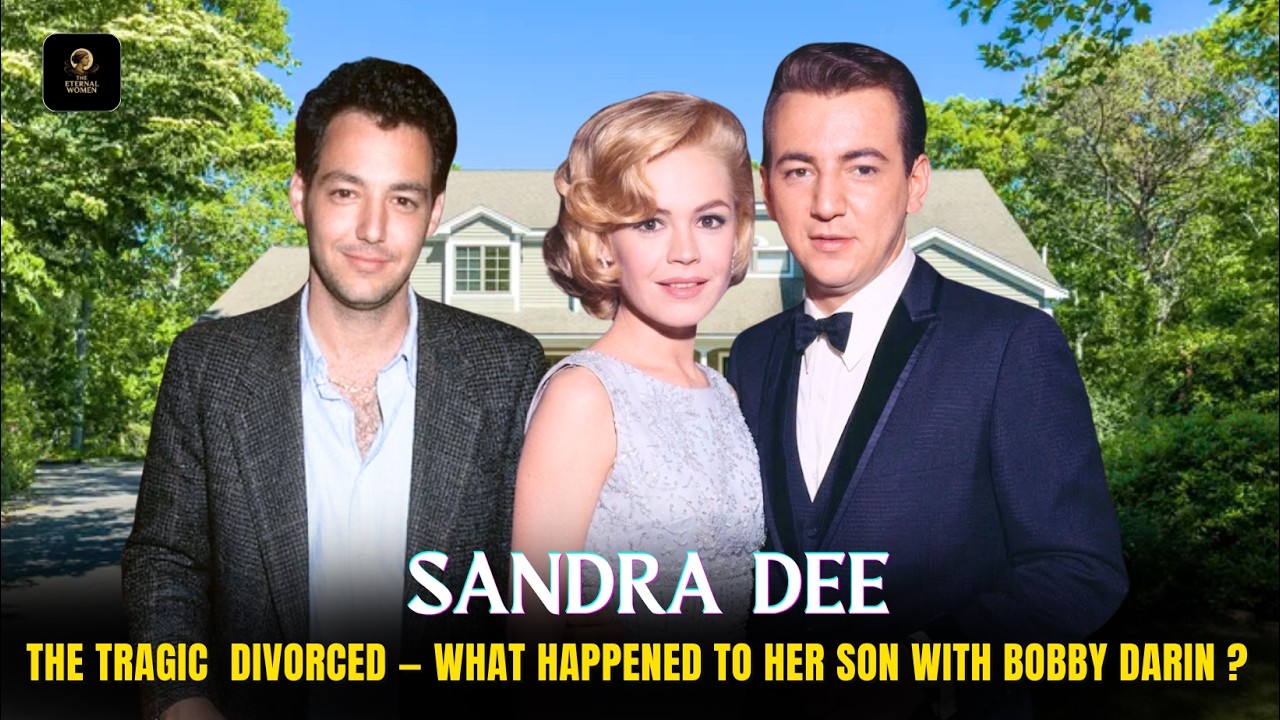
Apart from the fact that he was brash, wild, and forever pushing buttons to get a rise out of people, she simply couldn’t stand him. Yet by December of that very year, they were husband and wife. To anyone watching from outside, it resembled the most glittering romance Hollywood had turned out in ages. America promptly crowned them the ideal couple.
Their son, Dodd, would later state it bluntly: their story appeared glamorous. From the outside it seemed flawless, but the reality was nowhere close. What the public never glimpsed was a secret Sandra had borne since childhood—one her husband only discovered after their divorce, one that made him break down in tears when she finally revealed it. What outsiders never saw was the boy who grew up to become the most truthful witness to a story Hollywood always chose to keep polished.
This is the story of Sandra Dee. She entered the world as Alexandra Zuck on April 23, 1942, in Bayonne, New Jersey, the only daughter of John Zuck and Mary Douvan Zuck. Her parents split when she was tiny—still a baby, really—and her mother, Mary, brought her up under the harsh realities of single motherhood in 1940s New Jersey. Mary carved her way through life after a broken marriage with a daughter who was strikingly beautiful from a very early age.
She wasn’t a stage mother in the predatory sense of the term. But she was a mother who spotted something in her child and made choices built on that recognition—choices Sandra had no way of fully evaluating at the age they were made. Sandra started modeling at twelve, not out of any personal ambition, but because her mother set it up. Mary grasped that beauty in mid-century America was an asset convertible into money and chances, and that the window for cashing in was limited.
Mary had remarried as well. Her second husband was Eugene Douvan, the man whose name Sandra used professionally as Sandra Dee, since the “Dee” was a softened, Americanized rendering of “Douvan.” The name she rose to fame under belonged to the man who abused her. Sandra Dee’s son, Dodd, made this public after his mother passed away.
Sandra never discussed it openly with complete candor while she was alive. She had dropped hints. She spoke of psychological harm in ways that gestured toward it, but she never identified Eugene Douvan the way Dodd did once she was gone. The sexual abuse started when Sandra was roughly eight years old and went on for years.
She was a child model. She was being abused by her stepfather. She was being managed by her mother, and she was growing in reaction to the particular conditions of her life: coping mechanisms, both mental and physical, that would shape her adult existence. Eating disorders that took hold in adolescence and that she battled for the remainder of her life.
The trouble with closeness that made her marriage to Bobby Darin far more difficult than it appeared from outside. The emotional distance and numbness that rank among the most documented reactions of children abused by adults in positions of trust. She carried every bit of this before she ever walked onto a Hollywood soundstage, before she turned sixteen, before she played Gidget, before Bobby Darin strode toward her on a set in Italy and told her she would become his wife. The public Sandra Dee—the girl next door, the flawless sweetheart, the untouchable good girl of 1950s Hollywood—was constructed atop a private truth that was the precise opposite of that image.
That flawless good girl was a child abused by the man whose name she bore. That untouchable image was a reaction to having been touched in ways she had neither the strength to stop nor the words to describe. When Grease enshrined her as an overblown emblem of purity—“Look at me, I’m Sandra Dee, lousy with virginity”—the joke struck hardest against the person least capable of finding it amusing. By the late 1950s, Sandra Dee stood among the most famous young actresses in Hollywood.
She shifted from modeling into acting with the efficiency of someone guided toward a set destination rather than guiding herself toward one. And that destination, by 1957 and 1958, was real stardom at a major studio. Four films in 1959 sealed her position at the center of a specific American cultural moment. The Wild and the Innocent in 1959.
A Summer Place in 1959, a drama helmed by Delmer Daves that was a huge commercial hit and introduced her to audiences as a romantic lead rather than just a pretty face in a supporting part. Imitation of Life in 1959, directed by Douglas Sirk, in which she appeared opposite Lana Turner, now considered one of the most significant melodramas of its period. And Gidget in 1959, Columbia Pictures’ adaptation of Frederick Kohner’s novel about a teenage girl learning to surf, which transformed Sandra Dee into a cultural phenomenon of a very particular and singular sort. Gidget was not, judged against the other films she made that year, the most artistically weighty of her 1959 credits.
But it was the one that endured. It forged a public identity for Sandra Dee that was at once her greatest triumph and the thing that restricted the rest of her career and public image more than anything else. Gidget was lively, sweet, innocent, and uncomplicated. Gidget was precisely the girl-next-door archetype that mid-century America was eager to celebrate.
And Sandra Dee, who was seventeen while filming, who bore inside her the particular and painful burden of what her stepfather had done to her, performed the role so persuasively that audiences took it as the whole truth about her. She was seventeen. She was a major Hollywood star. She was managed by her mother and by Universal Pictures.
She had never finished a normal education. She had never experienced a normal adolescence. She had been working professionally since age twelve, and she had been carrying her stepfather’s secret since she was about eight. And now she was the face of innocent American teenage optimism.
The divide between public Sandra Dee and private Alexandra Zuck was not a narrow one. It was the gulf between what the industry wanted her to be and what she truly was. And that gulf, maintained across years of public performance and private anguish, takes a toll that eventually grows visible to everyone—usually after it has slipped beyond the control of the person paying it. To grasp why the marriage between Sandra Dee and Bobby Darin was always bound to be hard, you first have to grasp who Bobby Darin really was.
He wasn’t just a charming singer who wound up married to the wrong woman. He was a particular, complicated man carrying his own secrets, his own wounds, and his own strange relationship with time that molded everything he did. He came into the world as Walden Robert Cassotto on May 14, 1936, in the Bronx, New York. He was raised in a home where the women drove his life: his mother, Nina, whom he worshiped, and his grandmother, Vivian, who for years stood as the steady anchor of the family.
His biological father was absent from his life. He grew up convinced that Nina was his mother and Vivian his grandmother. Only later did the truth surface: Vivian was in fact his birth mother, Nina was his older sister, and the father he never met was not Nina’s husband but a man who had vanished before Bobby was born. The discovery hit him hard.
His whole sense of where he came from rested on a invented story the women of his family had kept alive for years. As a child he caught rheumatic fever, a grave illness that left his heart damaged and planted in him, from a very young age, a deep certainty that his heart could not be trusted and that his life might run shorter than most. He later told people he expected to be dead before he turned thirty. He did not die before thirty.
He died at thirty-seven, on December 20, 1973, after open-heart surgery at Cedars-Sinai Medical Center in Los Angeles. The rheumatic fever that scarred his heart in childhood delivered its final consequence twenty-nine years after that first infection. That awareness of limited time, the feeling that his years were finite and that everything he wanted to achieve had to fit inside whatever window was left, shaped his whole career. He was impulsive, relentless, and his impatience was the kind that belongs to a man who believes he is racing a deadline no one else can see.
He took home the Grammy for Record of the Year in 1960 for “Mack the Knife. ” He earned an Academy Award nomination for Best Supporting Actor for Captain Newman, M. D. in 1964.
He was inducted into the Rock and Roll Hall of Fame in 1990 and the Songwriters Hall of Fame in 1999. By any fair standard, he ranked among the most gifted and versatile artists of his generation. He was also, by the account of those who knew him, a genuinely hard man to be married to. His focus on his career was obsessive in a way that set him apart as someone who treated professional success as a matter of existence rather than just a job.
He was pathologically jealous, suspicious of Sandra’s relationships with her co-stars in ways that sparked confrontations and separations throughout their marriage. He could be warm and truly affectionate, with the particular intensity of a man who loved deeply and showed it in ways that were both sincere and stifling. And he was fundamentally unequipped to handle what Sandra was carrying. Not because he was a bad man, but because the burdens she bore—abuse, eating disorders, addiction—demanded a particular kind of sustained therapeutic care that Bobby Darin, racing against time and consumed by his own ambition, could not give.
When they met on the set of Come September in Portofino in the summer of 1960, he sent her eighteen yellow roses every day throughout their courtship. He proposed with a flawless seven-carat diamond ring. On the very day they first met, he told her he would marry her one day. He was confident, charming, and completely himself, while she was nineteen years old and had never felt entirely safe.
She would say later that on the first morning she woke up as his wife, she felt safer than she had ever felt in her life. That safety, that particular feeling, was what marriage was meant to give, and it was ultimately what the marriage could not hold onto. They wed in the early hours of December 1, 1960. Sandra was nineteen.
Bobby was twenty-four. They entered the marriage with what looked like an almost even blend of real love and real incompatibility. It took seven years to settle the question of which would win out. Their son, Dodd Mitchell Darin, arrived on December 16, 1961, exactly one year and fifteen days after the wedding.
He was their only child. His arrival, by both parents’ accounts in later years, brought genuine joy. Bobby doted on him, Sandra loved him, and for a while the child gave them a shared focus that held the marriage together in ways the two adults could not manage for each other. But a child was never going to fix the structural problems in the marriage.
In some ways, the child made things worse. After Dodd’s birth, Sandra’s doctor prescribed amphetamines, a common practice in early 1960s Hollywood, where weight control was a professional requirement for actresses and where the medical profession had not yet recognized the addictive and destructive properties of amphetamine use as clearly as it would later. Sandra had already been suffering from anorexia nervosa since adolescence, a response to the abuse and control exercised over her body since childhood. The amphetamines layered a pharmaceutical dependency on top of an already deeply rooted troubled relationship with food and her body.
Bobby’s response to Sandra’s difficulties was not empathy. It was impatience, and in the end, suspicion. He was a man who knew what he wanted and chased it with a particular intensity, as someone convinced time was short. He did not know the full story of what Sandra was suffering and coping with.
She never told him about her stepfather, about the abuse, about the specific origins of the damage he watched her trying to manage with alcohol and pills. He saw the symptoms without knowing the causes: symptoms like drinking, erratic behavior, difficulty with emotional closeness. He read them through the lens of his own insecurity and jealousy rather than through what she was actually experiencing. In 1963, Bobby left.
He accused Sandra of having an affair with Peter Fonda, her co-star in Tammy and the Doctor. Sandra’s version of events was that the accusation had no basis, that Peter Fonda was simply a friend and colleague, nothing more. They reconciled. The marriage went on, but the reconciliation rested on the same foundation as before: Sandra’s untreated trauma, Bobby’s impatience and jealousy, and the fundamental incompatibility between two people who genuinely loved each other but could not give each other what the other needed.
The final separation came in 1966, after Bobby saw Sandra talking with Warren Beatty at a party. She described the incident later with precise and rather heartbreaking clarity. She said it meant nothing at all. But it was the first time Bobby had seen her with a handsome man with a Hollywood reputation, and that was enough.
Bobby filed for divorce in 1967. Throughout the marriage, Sandra had tried to be Bobby Darin’s wife: she went to his Las Vegas shows, arranged her life around his timetable, and put her own career second to whatever his demanded. In an interview later discussed by her son Dodd, she said: “I didn’t have a life, and we didn’t have a life together.” That line indicts the particular arrangement of the marriage, but it also describes something deeper: a woman who was never given room to build an identity of her own.
First her mother managed her, then the industry molded her image, then her marriage required her to serve as little more than a support beam for someone else. She would find that once the marriage was over, she was unsure who she was without it. Here is the detail in Sandra Dee’s story that is seldom talked about and most essential to understanding it. After the divorce, after the marriage had ended, after Bobby Darin and Sandra Dee were no longer husband and wife, Sandra finally told Bobby what her stepfather had done to her.
She told him once the divorce was final, after seven years of marriage, after the jealousy and the accusations and the amphetamines and the drinking and the last fight over the party with Warren Beatty, after all of it had brought their union to its legal end. She told him. Bobby cried. This detail, recorded in multiple accounts including their son Dodd’s, is the pivot on which the whole story turns.
It accounts for things the public version of their marriage never accounted for. It accounts for why Sandra was the way she was: the trouble with intimacy, the eating disorder, the drinking, the emotional capacity that was never quite what it should have been. It accounts for why a woman who said she felt safer with Bobby than she had ever felt in her life could not give him the marriage that safety might have made possible. It accounts for why the symptoms Bobby read as infidelity and dysfunction were in fact the expressions of a child abused by an adult, who had never been given the support to work through that abuse and move on.
This raises the most painful question in the story: what would have become of the marriage had she told him while it was still going on? The honest answer is that we do not know. Bobby’s jealousy and his fixation on his career were not simply products of his failure to understand Sandra’s trauma. They were also products of his own wounds, his sense of limited time, his own personality.
It is not certain that knowing Sandra’s history would have resolved the marriage’s other structural problems. But it is at least possible, and perhaps likely, that Bobby would have responded very differently to Sandra’s behavior had he known what he was dealing with: that the woman he accused of affairs and of being unreasonably erratic was managing the long-term aftermath of childhood sexual abuse with no support or acknowledgment from the man she had married. That the drinking and the pills were not moral failures but survival mechanisms of a person who had never received the therapeutic help to get through it any other way. He cried when she told him.
That means the jealous, impatient, career-obsessed man who filed for divorce carried, deep down, the capacity for that particular grief that comes when you realize, too late, what someone you loved had been carrying and you never knew. The divorce became, paradoxically, the start of the closest stretch of their relationship. Freed from the structure of marriage and the specific expectations it created, Bobby and Sandra built a friendship that, by her account and by Dodd’s, was more honest and genuinely supportive than most of what the marriage had been. When Bobby’s health began to fail in the early 1970s, as the problems with his damaged heart worsened and the countdown he had always known about neared its end, he sought Sandra out.
He wanted her close to him. The woman he had divorced was the person he wanted once he understood that the time he had always known was short had grown shorter still. Bobby Darin died on December 20, 1973, at Cedars-Sinai Medical Center in Los Angeles, following open-heart surgery. He was thirty-seven.
Dodd was twelve. Sandra Dee was thirty-one when Bobby Darin died. She had been divorced from him for six years. She had spent those six years grappling with the same struggles that had marked her marriage: anorexia, amphetamine dependence, alcohol, all of it without the structure of marriage and without the career that had once given her life some external support.
The Hollywood that had made her a star had moved on without her. Sandra Dee found herself divorced in 1967 just as the Hollywood film landscape was shifting. Audiences were no longer lining up for the sugary romances that had made her a star in the early 1960s. The move from the sweetness of Gidget to the harsher, more realistic American cinema of the late 1960s and early 1970s was one her particular image could not keep pace with.
She had been packaged as something the culture was in the process of rejecting. The perfect, innocent, untouchable girl next door belonged to an earlier America, one that the social upheavals of the mid-1960s had largely torn down. She appeared in the horror film Dunwich in 1970. She made guest appearances on television shows like Night Gallery, Love, American Style, and Fantasy Island.
She appeared in the film Lost in 1983, her final screen credit. The work that had come steadily through the late 1950s and early 1960s slowed until it faded and then stopped. She became reclusive in the 1980s after her retirement. Her depression deepened after her mother’s death in 1987, a relationship that had been troubled over the years.
Mary Douvan had been the central adult figure in Sandra’s whole life: she had managed her career, she had married the man who abused her, she had pushed and protected and exploited and loved her in the complicated, contradictory way of a mother who never fully grasped the dimensions of what was happening to the child in her care. Her death left Sandra without the complicated anchor Mary had always been. Whatever price Sandra paid in that relationship, Mary’s presence had been constant since birth. After 1987, it was not.
Sandra never remarried. She never entered another serious public relationship. She lived largely alone in Los Angeles, managing her health, her dependencies, and the ongoing consequences of decades of anorexia on her body. She was a person who achieved fame before she was old enough to vote, and she spent the last decades of her life largely invisible to the industry and the public that had consumed her image entirely.
The anorexia that started in her teenage years had never gotten the ongoing professional care the illness demands. Anorexia carries the highest death rate of any psychiatric disorder, and over the years it steadily damages the body’s systems in ways that eventually cannot be undone. Decades of the eating disorder brought on the kidney disease that would ultimately take her life. In her last years, her son Dodd was the steadiest and most dependable support she had.
He helped her along the road to recovery. He was there in ways that the distance and difficulties of earlier years had not always permitted. In those final years, he became more than her son—he became her champion: the one person who fully grasped the truth of her life and who was already considering how to make sure that understanding became part of the legacy she left behind. On February 20, 2005, Sandra Dee died at Los Robles Hospital and Medical Center in Thousand Oaks, California.
She was sixty-two. The cause of death was kidney disease complicated by decades of anorexia. She was buried at Pierce Brothers Westwood Village Memorial Park in Los Angeles, the cemetery where Marilyn Monroe, Natalie Wood, and Dean Martin are also buried. A neighborhood of Hollywood’s most significant figures.
A fitting spot for a woman who was, for a specific and important stretch of American cultural history, one of the most famous faces in the country. She died without telling her full story to the public. Her son told it for her. Dodd Mitchell Darin was born December 16, 1961, the only son of Sandra Dee and Bobby Darin.
Born into one of the most visible marriages in American entertainment history, he grew up beneath the shadow of the private reality of what that marriage actually was. He was twelve when his father died on December 20, 1973. He was forty-three when his mother died on February 20, 2005. Between those two losses, he built a career as a music producer and entertainment industry professional, kept his personal life private, and wrote the most complete public account of his parents’ lives.
In 1994, Dodd Darin published Dream Lovers: The Magnificent Shattered Lives of Bobby Darin and Sandra Dee. The title is accurate and honest. The word “magnificent” was earned by both of them, and the word “shattered” was earned by both of them equally. The book drew on Dodd’s first-hand knowledge of his parents’ private lives, on interviews with people who knew them, and on Sandra’s own accounts of the marriage and what followed.
At the time of its publication, the book was the most complete public account of what the marriage had actually been. Not the glamorous story the photographs suggested, but the complex, painful, and sometimes beautiful reality the photographs had always concealed. The book made clear, as Sandra had never publicly done herself, the dimensions of what her stepfather, Eugene Douvan, had done to her and the impact that abuse had left. Dodd named Douvan directly by name.
He described the sexual abuse in terms that made clear its severity and duration. He traced the anorexia, the addictions, and the difficulties with intimacy that marked his mother’s adult life to the specific context of what was done to her in her childhood. This was an act of great courage and great love. It was the act of a son who understood that his mother’s story had been told incompletely, that the public version of Sandra Dee had always lacked the information that would make her choices and struggles comprehensible rather than merely puzzling or disappointing.
He gave her the context she herself was never able to provide publicly, and he did it in a way that honored her rather than exploited her. He also told his own story honestly, in the book and in later interviews. He described growing up with a father who loved him and whom he lost at twelve. He described growing up with a mother whose struggles were evident to him, whose roots he only gradually came to understand.
He described the specific experience of being the child of two famous people whose public images were so manufactured that the gap between image and reality was something he always had to navigate, knowing the truth about his parents while the world fell in love with who they appeared to be. After the book, he helped support his mother on her road to recovery from addiction, a commitment that reflected his love for her and the particular role children sometimes play in the recovery of parents who have suffered from addiction for decades. He was by her side in the years before her death in ways that public records do not fully document, but his statements about her make clear. Bobby Darin has been celebrated and memorialized.
The Rock and Roll Hall of Fame in 1990, the Songwriters Hall of Fame in 1999, and the 2004 film Beyond the Sea in which Kevin Spacey played him. Bobby Darin’s story has been told, celebrated, and given the full Hollywood treatment. Sandra Dee was reduced—famously—to a joke in a song in the film Grease. “Lousy with virginity.
” The joke targets a woman whose private truth was the exact opposite of the image the song was mocking: a woman whose virginity was taken from her by her stepfather before she even understood what was being taken. A woman who carried that secret for decades and died at sixty-two from the physical consequences of never receiving adequate support for what had been done to her. Dodd Darin has been the most steadfast and honest advocate for his mother. In an entertainment industry that always preferred the beautiful version of the story to the true one, he has quietly and insistently insisted on the truth.
He is now sixty-three. He is the only surviving member of the family his parents created. He is the son of two people whose public images were magnificent but whose private lives were shattered, and he has spent three decades insisting that both things must be understood simultaneously: that the magnificence was real, and the shattering was real, and that any story that acknowledges only one of them is not the complete story. His mother deserved better than a joke in a film like Grease.
His father deserved better than the shortened life his damaged heart imposed. And Dodd Darin, the son who carried them both, has spent his adult life making sure that their truth—with all its complexity, talent, brokenness, and capacity for genuine love, limited by the damage their histories left behind—was at least partially visible to the world they left behind.
