The order was issued quietly, as orders of this kind usually were. A document that had already been printed, already bound, already shipped to public libraries across France, was gathered back up and removed from the shelves. Three hundred and forty pages, with photographic plates, geological sections, and measurements drawn by hand in the field. Only two hundred copies had ever existed.
The official reason given was that the survey contained errors in measurement, and that a corrected edition would follow. It never did. The men who compiled that report had entered the southern Algerian Sahara in the spring of 1903, sent by the French colonial administration on what was supposed to be a routine six-week mapping expedition. They returned after eleven weeks.
Two of them never came back at all. A third entered a sanatorium in Marseille within a year. And the thing they went to map, the thing that stretched across an expanse of desert roughly the size of Belgium, was not a mountain range, not a mineral vein, not a disputed border. It was trees.
Now, petrified wood in the Sahara is not exceptional. It has been spotted, collected, and catalogued for centuries, and any geologist working in the region expects to find it. That is not what stopped those men. What stopped them was the size.
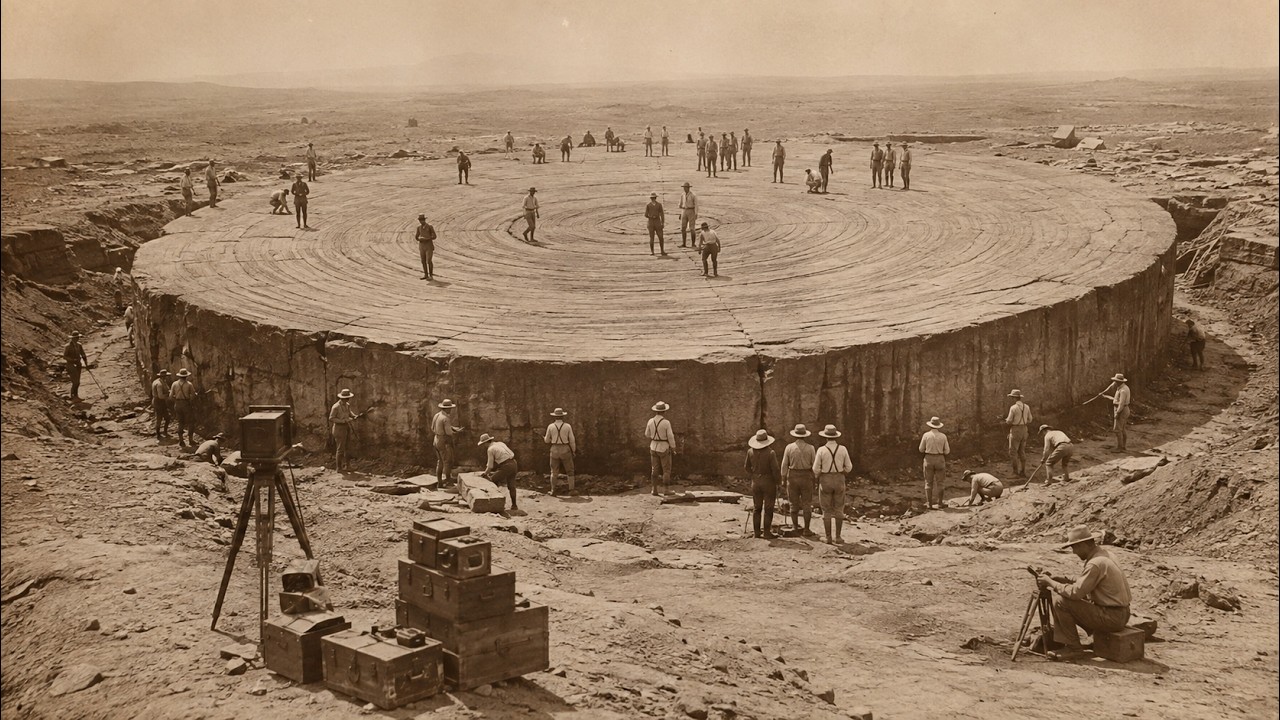
The largest specimen recorded by the surveyors measured forty-two meters across, a hundred and thirty-eight feet. A single trunk wider than most apartment blocks in Paris. Wider than the full span of the Arc de Triomphe. And it was no isolated anomaly.
They counted, measured, and catalogued forty-seven of them. Today, outside a small circle of researchers, almost no one has heard of this survey. Three original copies are believed to still exist in private hands. The photographic plates are gone, lost in a fire at the library of the Geographical Institute in 1962, a fire that damaged the colonial-era archive room and left every other section of the building completely intact.
If you find that detail hard to believe, hold onto it. It will not be the last coincidence in this story. To understand why a report about trees might frighten anyone, you have to abandon the picture most of us carry of the Sahara. Endless dunes, a dead place that was always dead.
That picture is simply wrong. The Sahara was green, not in some remote geological abstraction, but green within human history. Between six and ten thousand years ago, the region was savanna, lakes, rivers, and dense forest. Hippopotamuses lived in what is now central Algeria.
Cattle herders left paintings on cave walls showing a scene closer to the Serengeti than to the dust-covered plains there now. Science calls this the African humid period. It is taught and accepted as uncontroversial fact, but the textbook-approved version carries a silent problem. That problem is arithmetic.
The forests that died when the Sahara dried up consisted of acacia, relatives of the baobab, and various species of drought-resistant hardwoods. None of those types come anywhere near the dimensions recorded in 1903. Consider the largest living tree on Earth today, General Sherman in California, whose base diameter is about eleven meters. The average diameter of the trunks documented in the Algerian Sahara was three to four times that, larger than anything alive on the planet by a margin that is not merely a matter of estimation.
So what were they? When were they standing? And why, according to the surveyors’ own drawings, were they lying flat in patterns suggesting they had been deliberately felled? The man responsible for those drawings was named Étienne Marchand.
He was thirty-eight years old, a graduate of the École Polytechnique, with ten years of field experience surveying French colonial lands. He was not an eccentric or a seeker of mysteries. He was a precise, factual technician who had built his reputation on accuracy. Traveling alongside him was the geologist Paul Renaud, the photographer Henri Vasseur, and twelve local guides from Tuareg communities.
They set out in the last days of March. For three weeks, nothing happened. Marchand’s notes from that period were so routine as to be almost dull. Then, on the morning of April 19, 1903, one of the Tuareg guides took Marchand and Renaud to a place his people called, in their language, “the place of the fallen giants.
” Marchand dismissed it as folklore. The guide corrected him. He said he had been there himself as a boy, and that no European had ever seen it because none of them had ever thought to ask the right question. What Marchand wrote that evening still exists, and it is one of the few passages from the entire journey that later researchers have been able to quote directly.
He described walking toward what he assumed was a rock formation, a series of long parallel ridges stretching across the desert floor. The closer he got, the stranger it seemed. The ridges were too uniform, too straight, and the surface had a texture unlike stone. Bark.
Petrified bark, visible in cross-section where the formation had split open. He was standing next to a tree. It lay on its side, half buried in the sand, but exposed enough to measure. He measured the diameter at the thickest point, then asked Renaud to take the measurement independently without consultation.
The two figures agreed within one meter: thirty-one meters across at the base. And that was just the first tree. Renaud later recalled that Marchand went pale, and that when he finally straightened up, he said a short sentence in French. Translated, it means: “We have found something that should not exist.
”
Over the next four days, the guide led them to thirteen more trees. Some were smaller, some were much larger, and the largest of all, the one forty-two meters in diameter, lay half submerged in a shallow depression the guide identified as the bed of an extinct lake. Then the guide told Marchand something the surveyor recorded without comment because he did not know what to do with it. The tree had not fallen there.
It had been transported. The guide said the legend was older than his tribe, older than any tribe in that land, older than Islam itself. He had inherited it from his grandfather in the usual way. Giants who once walked the earth had used these trees for some purpose, and the people who came after them no longer knew what that purpose was.
Now, the logical objection comes at this point, and it deserves a fair hearing. Perhaps Marchand was deceived. Perhaps he was making it up. Perhaps heat, isolation, and the strangeness of the terrain drove a tired man to mistake an unusual rock formation for something organic.
Perhaps his measurements were simply wrong. Here that objection runs into a wall. Renaud, the geologist, filed his separate report through his own channel, and Renaud’s figures matched Marchand’s report. Vasseur photographed the formations directly, and at least three of his plates were reproduced inside the original 1903 publication before it was withdrawn from circulation.
Two of those copies still exist today, and they were scanned in the late 1980s by a researcher named Jean-Claude Baumol. What the images show is petrified trunks of extraordinary size, and in two of the shots, a human figure has been placed at the base for scale. You have to look for him. He is very small.
Standing at the base of the trunk, he reaches about one-fifteenth of its diameter. That is not a rock formation. That is not a transcription error in a field notebook. That is a tree that has no business existing at all.
So what does mainstream science say about these things? Nothing. There is no recorded counter-explanation, because there is nothing officially recognized to explain. The report was withdrawn, the plates burned, and the site itself swallowed by shifting sands, or, in the more contested account, deliberately buried.
There are persistent claims, unconfirmed but repeated with insistence, that French colonial authorities sent a second expedition in 1907, and that this expedition carried explosives, and destroyed the largest specimens before burying what remained. Why would anyone go to such trouble? The answer offered by researchers working in the “Tartaria” field over the past two decades is unsettling, but coherent. What Marchand found did not fit the accepted story of human history, and by 1903 that story had already been written, taught in universities, institutionalized, and defended with full force against anything that threatened it.
Which means we must now talk about Tartary. “Great Tartary” appears on dozens of European maps across the sixteenth, seventeenth, and eighteenth centuries, as vast lands covering most of what is now Russia, Central Asia, Mongolia, and parts of China. It was not obscure. The first edition of the Encyclopædia Britannica, published in 1771, clearly described it as the largest empire on Earth by area.
Follow that entry through subsequent editions and watch what happens to it. In the second edition, the description became noticeably shorter. By the third, it had been removed. By the fourth, Tartary no longer existed in the encyclopedia at all.
Then it disappeared from maps as well, somewhere between the late eighteenth and early nineteenth centuries. Note the manner of its disappearance. It was not conquered. It did not fracture into client states with new names and flags, as empires usually end.
It simply stopped being drawn. Researchers in this field point to the consistency of the term across multiple centuries and independent cartographic traditions. Mapmakers in different countries, working from different sources, all recorded the same vast thing. They also point to the architectural anomalies scattered across those former lands.
Structures that appear older than the civilizations officially credited with building them. Structures built in styles incompatible with the technological capacities of the populations assumed responsible. And here is precisely where the collection of buried trunks in the Algerian Sahara becomes more than a curiosity. If a worldwide civilization preceded our own, and if it was deliberately erased from the records, then the question was never whether its remnants still remained.
The question was where those remnants had been hidden, suppressed, or destroyed. The 1903 survey fits this pattern with almost uncomfortable precision. The trees Marchand classified were not desert species. Their dimensions alone rule that out.
No plant lineage in the African fossil record is capable of producing timber of this size. So either an unknown species grew in exactly one place on Earth and left no other trace in the fossil record whatsoever, or the trees never grew there at all. They were brought there, transported across land that could not have supported their growth, and placed for some reason, then left where they settled. That is the proposition now defended by a number of Tartaria researchers: that the trunks Marchand catalogued were not a forest at all, but the remains of an industrial operation, a mined resource, a building material collected on a scale we have no framework to understand.
What is strange is how many separate details align to support this idea without strain. The Tuareg legend says the trees were transported. The trunks lie parallel to one another at regular intervals across open desert, and that is not how forests die. The largest specimen of all was found resting in the bed of a lake that no longer exists, exactly where you would expect to find a cargo transported by water and then abandoned when the water dried up.
If this unsettles you, that is normal. No civilization in the accepted historical record possessed the means to cut, transport, and arrange objects forty meters in diameter. To take this proposition seriously is to concede that everything taught about pre-Roman engineering is wrong, not slightly wrong, but fundamentally wrong, which is precisely what the Tartaria framework has been arguing all along. Marchand remained in the field for another three months.
He documented additional sites. He mapped the distribution of trunks across an area he estimated at about thirty thousand square kilometers. He recorded another detail never satisfactorily addressed: the largest specimens were consistently found next to what appeared to be artificial earthworks, mounds, canals, and geometric depressions carved into the desert floor, matching no natural erosion pattern he knew. Two of his men died on the return journey.
The cause was officially recorded as exposure and exhaustion. In a private letter written in 1908, discovered in a French regional archive in 1979, Renaud recorded a different belief. He thought they had been poisoned. Vasseur, the photographer, reached France and was admitted to a sanatorium in Marseille within eight months.
He died there in 1911. After his death, his family destroyed his personal papers on instructions, according to Renaud’s letter, from an authority the letter did not name. Marchand himself lived until 1934 and never spoke of the expedition publicly again. Privately he wrote of his regret at the report being buried, and of his certainty that what they found was real.
In a letter dated 1919, he recorded that he had received a warning from parties he declined to name in writing, that returning to the subject would bring consequences for his family. At least three expeditions are reported to have gone looking for the site since then, in 1932, 1958, and 1987. The last was led by an independent French geologist named Lucien Petit, who claimed to have found one of the smaller trunks. He photographed it.
He filed a preliminary report. Within twelve months, he lost his university position. In 1989, his home was burglarized and the photographs stolen. He died in 1994 of a recorded heart attack at the age of fifty-one, despite having no prior cardiac history.
The honest position is that we do not know. The evidence is too fragmentary, too damaged, too fiercely disputed. What remains is the residue of Marchand’s report, Renaud’s testimony, two reproduced photographs, and a pattern of suppression that deserves examination in its own right, even if it proves nothing about the trees themselves. But if those trees existed, they impose one of three conclusions, each of which costs the prevailing narrative something it cannot afford.
Either a species of giant tree grew in the Sahara and left no other fossil trace anywhere on Earth, meaning our ancient botanical record has gaps we have not acknowledged. Or the trees were transported from somewhere else, requiring a civilization capable of moving objects weighing hundreds of thousands of tons. Or the timeline itself is wrong, and forests stood in that region during a geological period current science does not recognize. There is no comfortable option on that list.
And that may, in the end, be the whole explanation for what happened in 1903. The report was not withdrawn because the trees did not exist. It was withdrawn because they did, and because their existence raised questions that the scientific institutions of the early twentieth century had no means to answer. For more than a hundred years, silence has served as the answer.
So let us return for a moment to that document. Three hundred and forty pages, two hundred copies, cross-sections drawn by a man whose entire professional reputation rested on the accuracy of measurements, standing in the sand next to something thirty-one meters wide and saying only that they had found something that should not exist. His work was gathered, corrected, and quietly removed from every library that held it. But the trees, if they are real, were never removed.
They still lie there beneath the sands of southern Algeria, forty-two meters across at the widest point, waiting for someone with the funding and the political permits to dig. That leaves us with the question this matter always returns to, the question that has no end. Were we the first, or did someone stand here before us, build something we do not recognize as building, leave behind evidence our tools lack the capacity to read, and then fade from the records so completely that the mere fact of their existence is now disputed? Perhaps the desert already knows the answer.
The survey of 1903 came very close to telling us.






