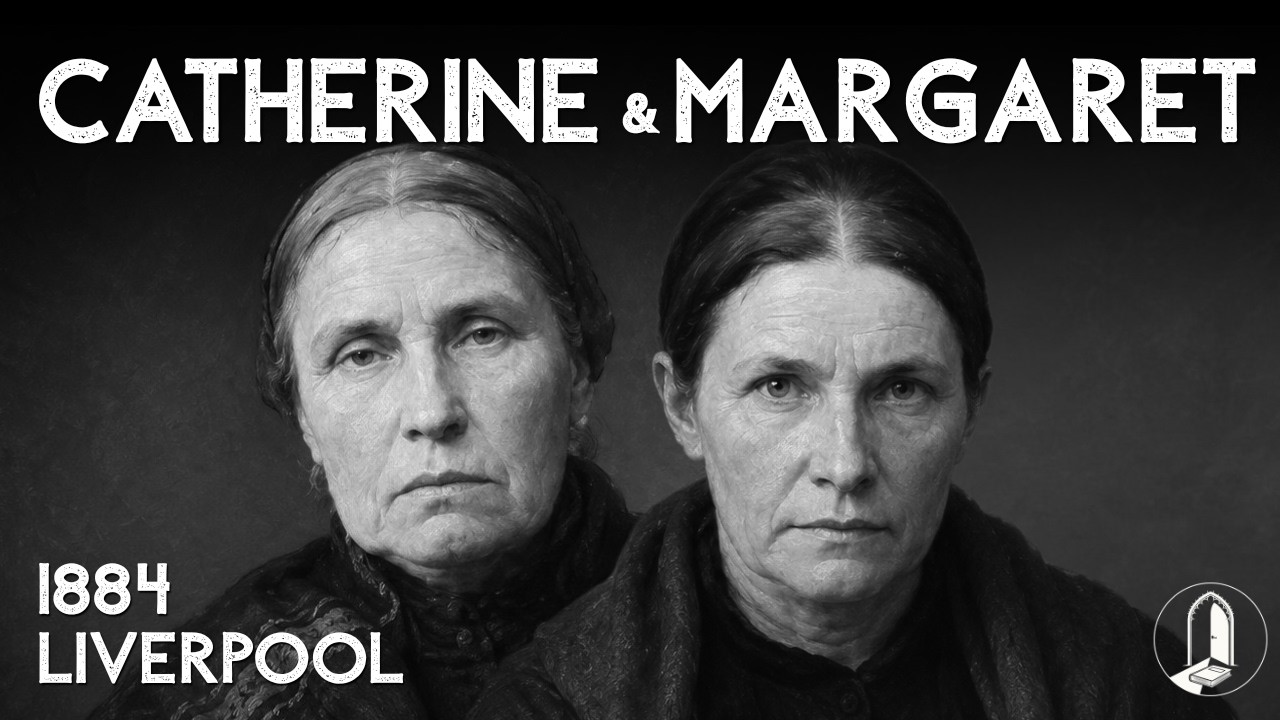
On the morning of October 4, 1883, the funeral of Thomas Higgins was already underway at 27 Ascott Street in Liverpool. Mourners filled the front parlor. His widow, Margaret Higgins, dressed in black, received condolences while her sister, Catherine Flanagan, stood nearby. A horse-drawn hearse waited at the curb.
At precisely 11:44 a. m. , the city coroner arrived with two policemen, carrying a warrant. He announced that there would be no burial that day.
The body would be returned upstairs, and an autopsy would be performed on the kitchen table within the hour. Catherine Flanagan slipped out the back, through the yard, and into the alley behind Ascott Street, still in her mourning clothes. She did not collect her belongings. She stayed one step ahead of the Liverpool police for nearly a week until her arrest in the suburb of Wavertree, when a woman who had sheltered her recognized her from the morning paper.
Margaret Higgins was taken at the front door that same day. The two sisters, both born in Ireland and raised in Liverpool’s poorest Irish quarter, had managed a lodging house together for years. By the spring of 1880, the house at 5 Skirving Street was crowded. Catherine, then around fifty-one, lived there with her adult son, John Flanagan, a twenty-two-year-old dockworker.
Margaret, then thirty-seven, shared the house with a widowed builder named Thomas Higgins and his eight-year-old daughter, Mary. Two other lodgers, Patrick Jennings and his teenage daughter Margaret, filled out the seven residents. Within four years, four of those seven people would be dead. In early December 1880, Catherine began telling neighbors her son was unwell.
She described exhaustion, loss of appetite, and weakness. By all other accounts on the street, John was a strong, healthy young man working at the docks. He died on December 7, 1880, after a short, sudden illness. The parish doctor signed the death certificate without an autopsy.
Days after the burial, Catherine collected 71 pounds from the burial insurance society where John had been insured, money she had taken out on his life. She covered the funeral costs and kept the rest. In the autumn of 1882, Margaret married Thomas Higgins, the lodger who had rented a room from her sister for nearly two years. He was in his mid-forties; she was thirty-nine.
The household continued as before. In late November of that year, Thomas’s eight-year-old daughter, Mary, fell ill. The sickness was short. Margaret, now the stepmother, cared for the girl.
The parish doctor signed the death certificate. The child was buried. Margaret collected 22 pounds from the burial society. Neighbors later recalled that she collected the money with indecent haste and was seen in the pub at the end of the street the same day.
In January 1883, a third resident fell ill: nineteen-year-old Margaret Jennings, daughter of the lodger Patrick Jennings. She had been healthy and, by all accounts, a promising young woman. Her illness was brief. The doctor signed the certificate.
She was buried in the last week of January. This time, Catherine Flanagan collected the insurance money, having taken out a policy on the young woman months earlier without her knowledge or her father’s. Three deaths in one house in twenty-five months. A young man, a child, a young woman.
None of them had been sick before they died within days. The parish doctor signed all three certificates without ordering a single autopsy. Neighbors began to talk, then to cross the street when they saw the sisters. The family moved in late spring 1883 to a larger house at 105 Latimer Street, then again in September to 27 Ascott Street.
New parish, new neighbors, new start. That autumn, Thomas Higgins began to feel suddenly and severely unwell. For months, the sisters had been buying Maxwell’s fly paper from chemists across north Liverpool. It cost a halfpenny a sheet and was saturated with arsenic.
When asked, they explained the house was plagued by flies. The chemists thought nothing of it; Maxwell’s fly paper sold by the thousands across the city. But the sisters had been steeping the paper in cold water since at least 1880, then pouring off the cloudy liquid through cloth, extracting nearly all the arsenic into solution without any chemical expertise. In the last days of September 1883, Thomas Higgins came home from work with severe stomach pain.
He took to his bed and never rose again. Margaret tended him devotedly, according to what she later said. The local doctor, a man named Whitford, examined the patient, asked about his diet, and concluded stomach disease from cheap alcohol and bad meat, a common diagnosis for working-class men of forty-five. He prescribed a small dose of opium for the pain and a bottle of castor oil to cleanse the system.
Thomas Higgins died on October 2, 1883. Doctor Whitford signed the death certificate without an autopsy. The cause of death was listed as stomach disease. The next morning, Margaret Higgins set out in her dark mourning dress to visit the five burial insurance companies where she had taken out policies on her husband in the months before his illness, without his knowledge.
She collected a total of 181 pounds, 19 shillings, nearly a full year’s wages for a Liverpool laborer. What she did not know was that Thomas Higgins had a brother. Patrick Higgins was a dock laborer like his brother, but with a sharp memory. When he heard the news, he refused to accept it.
Thomas was a strong man, a hard worker who carried bricks ten hours a day in all weather, not a man who lay in bed. Two days before the funeral, Patrick started quietly investigating. He visited the doctor, who repeated his diagnosis and dismissed the brother’s concerns. Then Patrick walked to the burial insurance offices in north Liverpool, asking at each one whether his brother had been insured.
At the first, he was told Margaret Higgins had bought a 20-pound policy. At the second, a 22-pound policy. At the third, another. At the fourth, another.
At the fifth, another. He stood on the pavement in the cold October air and added the numbers in his head: 181 pounds, 19 shillings. His brother had been worth more dead than he had ever earned alive. Patrick Higgins went to the police station that afternoon.
The autopsy on Thomas Higgins, performed on the kitchen table at 27 Ascott Street, confirmed arsenic in his organs in quantities consistent with slow ingestion over several days. A small bottle of cloudy liquid was found in a kitchen drawer. Liverpool’s toxicologist, Doctor Campbell Brown, found it contained an arsenic solution adulterated with chemicals that did not match common rat poison. Arsenic dust was found in the seams of Margaret’s dress pockets.
Within a week, Doctor Brown identified the source: the residue of Maxwell’s fly paper. Exhumation orders were issued for John Flanagan, Mary Higgins, and Margaret Jennings. All three bodies contained arsenic. The trial of Catherine Flanagan and Margaret Higgins opened on February 14, 1884, at the Liverpool Assizes in the great colonnaded building of St.
George’s Hall. Crowds overflowed from the building along Lime Street to the railway station. The sisters were charged with the murder of Thomas Higgins. The three earlier deaths were not part of the formal indictment, but they were presented to the jury as evidence of a pattern: residents who fell suddenly ill, died within days, and left the two women with burial insurance payouts.
Doctor Campbell Brown explained how he had steeped Maxwell’s fly paper in cold water in his own laboratory and produced a solution chemically identical, down to the mysterious adulteration, to the cloudy liquid in the kitchen drawer. Doctor Whitford admitted under questioning that he had never considered poisoning. Patrick Higgins described walking from one burial society to another that afternoon. Insurance clerks confirmed the policies.
The lodger Patrick Jennings testified he had no idea his daughter had been insured. The jury withdrew on the evening of February 16 and returned within fifty minutes. Guilty of the murder of Thomas Higgins. The judge donned his black cap and pronounced the death sentence.
Catherine Flanagan stood motionless in the dock, her expression unchanged. Margaret Higgins collapsed and had to be carried from the courtroom. In the days after sentencing, Catherine Flanagan asked to speak to her lawyer from her cell at Kirkdale Prison. During lengthy interviews in the weeks before her execution, she told him the murders she had been convicted of were not the only ones.
She and her sister had not worked alone. In the poor neighborhoods of Liverpool, a wider network of women had been responsible for other deaths the police had not investigated. She named six women: Margaret Evans, Bridget Beasley, Margaret Potter, Mrs. Fallon, Bridget Stanton, and Catherine Ryan.
She provided details and addresses. She offered to testify against them in exchange for a commutation of her sentence. The Liverpool prosecuting solicitor, a man named William Markes, took the file. In February 1884, he wrote to the Director of Public Prosecutions in London.
In the letter, still preserved in the archives, he stated his belief that at least six victims in Liverpool’s poor districts had probably been killed for burial insurance payouts by the women Catherine named. But he also noted, with the honesty of a Victorian prosecutor who knew his law, that the evidence against any of the other women rested almost entirely on the word of Catherine Flanagan herself, a convicted murderer with every reason to spread the blame. He did not believe a jury would convict on that basis. He recommended rejecting the offer.
The offer was rejected. Whether the broader network of Liverpool poisoners was real, the city’s prosecuting solicitor, who had seen the evidence, believed at least part of it. But those women were never tried. On the morning of March 3, 1884, at eight o’clock, during a snowstorm that had blanketed Liverpool since before dawn, Catherine Flanagan and Margaret Higgins, dressed in their final morning clothes, climbed the twenty-two stone steps to the gallows inside Kirkdale Prison.
The prison’s Catholic chaplain walked behind them, murmuring prayers. They were hanged together. A crowd of about a thousand people stood outside the prison walls in the snow at the moment of execution. Within weeks, wax figures of the sisters were placed in the Chamber of Horrors at Madame Tussaud’s in London, where they remained for nearly fifty years.
Doctor Whitford, who had signed three death certificates for that house without requesting a single autopsy, returned to his practice and later became a recurring reference in Victorian medical journals on what doctors began calling the duty of suspicion. That same year, Doctor Campbell Brown published research on the chemical fingerprint of arsenic solutions extracted from fly paper, and the Liverpool police continued to summon him throughout the following decade whenever an unexplained sudden death produced a bottle of cloudy liquid in a kitchen drawer. On the last day of July 1889, five years, four months, and twenty-eight days after the verdict against Catherine and Margaret, a new Liverpool jury entered a different courtroom inside the same colonnaded building of St. George’s Hall.
They heard the case of another woman accused of poisoning her husband with the same chemical, extracted by the same method from arsenic-saturated fly paper. Her name was Florence Maybrick. The jurors did not need anyone to tell them what steeping fly paper in water could produce.
The poisoners of Liverpool had already shown them, five years earlier.
