At 2:45 in the afternoon of July 12, 1979, three men in ski masks burst through the front of Joe and Mary’s Italian-American restaurant at 205 Knickerbocker Avenue in Bushwick, Brooklyn. They did not stop at the counter. They moved straight through the dining room and out into the garden patio in back, where Carmine Galante was finishing lunch with his cousin, Giuseppe Turano, and an associate named Leonard Coppola. The first intruder called out as they ran.
A witness inside heard the words: “In the back, Sally! ”
Then the shooting started. Shotgun blasts and automatic pistol fire tore through the enclosed garden. Galante, the 69-year-old boss of the Bonanno crime family, took a shotgun blast to the chest that threw him backward out of his chair.
More bullets hit him in the left eye and riddled his torso. He crashed into a small tomato patch behind the patio. Turano and Coppola died beside him. Galante’s two bodyguards, Cesare Bonventre and Baldo Amato, stood nearby throughout the attack and did nothing.
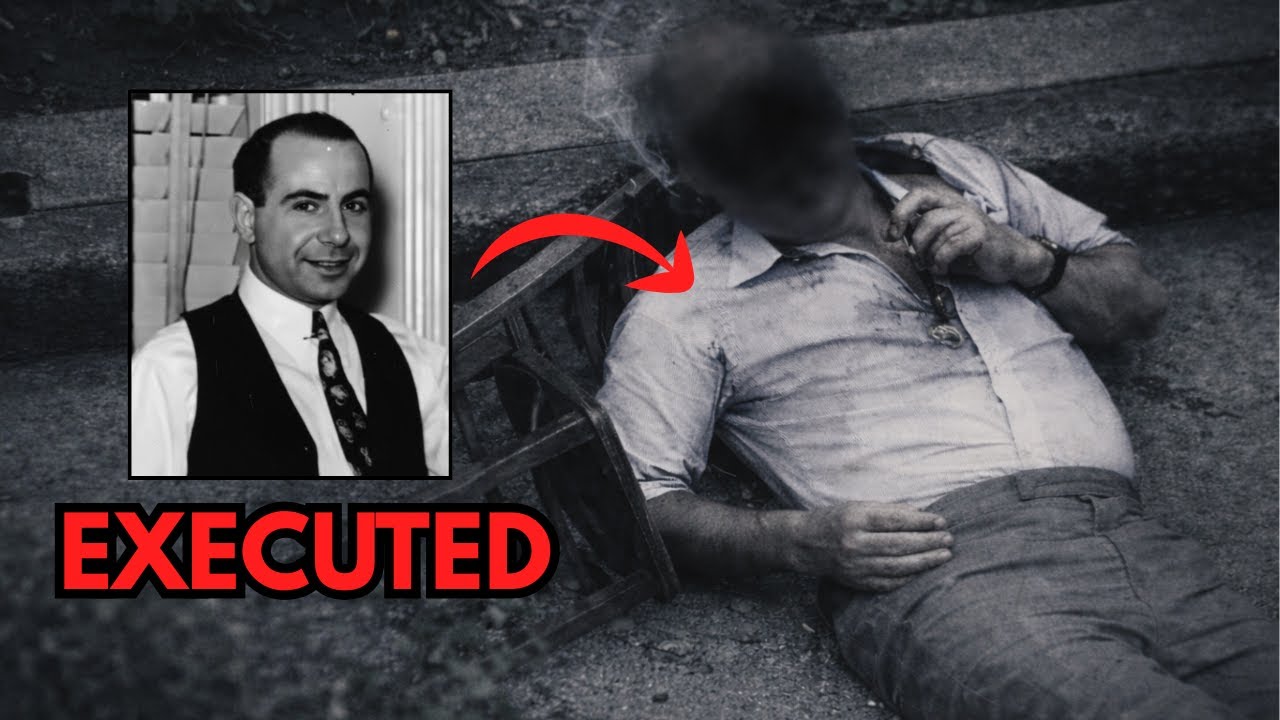
They were left completely unharmed. The gunmen fled. When police arrived, they found Carmine Galante lying on his back in the tomato patch, blood pooling beneath him. His cigar was still clenched between his teeth.
The crime scene photograph, the dead boss with the cigar still in his mouth, appeared on front pages across the country. The most feared mobster in America had been executed in broad daylight at his cousin’s restaurant, and the identity of the men who ordered it made the story even darker. Galante had not been killed by rival gangsters. He had been killed by his own family, his own commission, and his own bodyguards.
Camillo Carmine Galante was born February 21, 1910, in a tenement building in East Harlem, Manhattan. His parents, Vincenzo James Galante and Vincenza Russo, had emigrated from Castellammare del Golfo, Sicily, to New York City in 1906. Vincenzo worked as a fisherman. They settled in East Harlem, one of the toughest Italian immigrant neighborhoods in the city.
Carmine had two brothers, Samuel and Peter, and two sisters, Josephine and Angelina. By age ten, he was already in serious trouble, sent to reform school for his criminal activities. He soon formed a juvenile street gang on the Lower East Side. By fifteen, Galante had dropped out of school after the seventh grade.
On December 12, 1925, he pleaded guilty to assault charges. On December 22, 1926, at barely sixteen years old, he was sentenced to at least two and a half years in state prison. He was still a teenager when he killed his first man. In August 1930, Galante was arrested for the murder of police officer Walter DeCastia during a payroll robbery.
He was never indicted. That same year, NYPD officer Joseph Minahan caught Galante and other gang members attempting to hijack a truck in Williamsburg, Brooklyn. In the gun battle that followed, Galante wounded Minahan and a six-year-old bystander. Both survived.
On February 8, 1931, after pleading guilty to attempted robbery, Galante was sentenced to twelve and a half years in state prison. He was twenty years old. While imprisoned that year, doctors evaluated him and diagnosed a psychopathic personality. They determined he had a mental age of fourteen and an IQ of ninety.
The psychological reports described him as dangerous, impulsive, and incapable of feeling remorse. On May 1, 1939, Galante was released on parole. By 1940, he was carrying out murders for Vito Genovese, the underboss of the Luciano crime family. Galante built an underworld reputation for viciousness that followed him for the rest of his life.
The NYPD would eventually suspect him of involvement in more than eighty murders. In 1943, Galante allegedly murdered Carlo Tresca, the publisher of an anti-fascist newspaper in New York. Vito Genovese, then living in exile in Italy, had offered to kill Tresca as a favor to Italian Prime Minister Benito Mussolini. Galante was arrested but never convicted.
On February 10, 1945, Galante married Helen Marulli. They had three children: James, Camille, and Angela. They later separated but never divorced. Galante said he never divorced her because he was a good Catholic.
Despite that claim, he lived for twenty years with a mistress, Ann Acquavella, who bore two of his five children. By 1953, Galante had risen to become the Bonanno family’s underboss under Joseph Bonanno. It was during this period that he earned his nickname, “The Cigar,” or in Sicilian slang, “Lilo. ” He was rarely seen without one clenched between his teeth.
Galante’s real value to the Bonanno operation was drug trafficking, particularly heroin. He spoke several Italian dialects and was fluent in Spanish and French, linguistic skill that made him invaluable for international narcotics operations. Joseph Bonanno sent him to Montreal, Canada, to oversee the family’s heroin business, smuggling so-called French Connection heroin from France through Canada into the United States. Galante ran the Montreal operation for years, generating massive profits.
But in 1957, Canadian authorities had enough and deported him back to the United States. On October 14, 1957, Galante attended the infamous Apalachin meeting in upstate New York, where more than sixty mob bosses from across the country gathered. Police raided the gathering, exposing organized crime’s national structure and triggering massive federal scrutiny. In 1958 and 1960, Galante was indicted for drug trafficking.
In 1962, he was sentenced to twenty years in federal prison and sent to the penitentiary in Lewisburg, Pennsylvania. While Galante sat in prison, the Bonanno family descended into chaos. Joseph Bonanno attempted to consolidate power across all five New York families, triggering what became known as the Bonanno War. Without Galante as his top enforcer, Bonanno’s plans collapsed.
The commission forced Bonanno into retirement in 1968, installing Philip “Rusty” Rastelli as the new official boss. Galante was paroled in 1974 after serving twelve years. The day he walked free from federal lockup in Lewisburg, he sent a message: he ordered the tombstone of former New York mafia chief Frank Costello blown to pieces with dynamite. It was a declaration.
Carmine Galante was back, and he was taking over. The commission had appointed Rastelli as boss of the Bonanno family, but Galante ignored that appointment and named himself the new don. When Rastelli went to prison on extortion charges, Galante seized complete control. He surrounded himself with a crew of young, imported Sicilian drug pushers called “Zips” for protection.
These were tough, ruthless enforcers from Sicily who owed loyalty only to Galante. He rebuilt the family’s heroin empire, using his Sicilian connections to import massive quantities of heroin through Montreal and distribute it across the United States. The profits were staggering. But Galante was not satisfied with controlling just the Bonanno family’s drug business.
He wanted it all. During the late 1970s, Galante allegedly organized the murders of at least eight members of the Gambino family, with whom he had an intense rivalry, as he tried to take over their narcotics operations. He began muscling in on other families’ drug territories, demanding tribute, eliminating anyone who refused to cooperate. Then he declared himself capo di tutti capi, boss of bosses, an arrogant claim that had not been made since the days of Lucky Luciano.
The other families were alarmed and furious. The commission existed precisely to prevent any one boss from becoming too powerful. Galante was violating every rule. On March 3, 1978, the United States Parole Commission revoked Galante’s parole, citing his association with other Bonanno mobsters, and sent him back to prison.
But on February 27, 1979, a judge ruled the government had illegally revoked the parole and ordered his immediate release. Galante walked free again and immediately resumed his power grab. He continued expanding his drug empire, eliminating rivals, acting like he owned New York. The other crime families had had enough.
Genovese family boss Frank Tieri began contacting Cosa Nostra leaders to build a consensus for Galante’s murder. Even Joseph Bonanno, the retired former boss who had mentored Galante, gave his approval. When your own mentor agrees you need to die, you have crossed every possible line. In 1979, Philip Rastelli, the official boss still in prison, sought commission approval to kill Galante.
The commission granted it. The contract was issued. Rastelli had his two top capos, Alphonse “Sonny Red” Indelicato and Dominick “Sonny Black” Napolitano, coordinate the details of the hit. First, they made a back-channel deal with Galante’s inner circle, the Sicilian Zips from Knickerbocker Avenue.
Cesare Bonventre and Baldo Amato, Galante’s personal bodyguards, were offered promotion and a bigger share of the family’s drug rackets if they cooperated. They did not hesitate. They sold out their boss and agreed to set him up. About 1:00 p.
m. on July 12, 1979, Bonventre and Amato accompanied Galante to lunch at Joe and Mary’s Italian-American restaurant on Knickerbocker Avenue in Bushwick. The restaurant was owned by Galante’s cousin, Giuseppe Turano, a soldier in the Bonanno family. Earlier that day, someone had called the restaurant.
According to later testimony from John Turano, Giuseppe’s son, the caller identified himself as Jimmy Galante, Carmine’s nephew and driver, and asked if his uncle was there. Giuseppe Turano went out to the garden patio to join Galante and Leonard Coppola, a frequent companion. The men sat at a table in the outdoor garden behind the restaurant. It was a hot summer day, eighty-seven degrees.
They ate a meal of fish, salad, and wine. Galante lit his cigar. Around 2:45 p. m.
, the three masked gunmen stormed in. John Turano heard one of them say, “In the back, Sally. ” The gunmen entered the garden and opened fire. Galante was hit in the chest by a shotgun blast that threw him backward.
Bullets pierced his left eye and riddled his chest. Turano and Coppola were killed where they sat. Bonventre and Amato stood by and watched. They did not move, did not draw their weapons, did nothing.
When the gunmen fled, they were still standing. The scene police found was surreal. Galante lay on his back in the tomato patch, cigar still clenched between his teeth. Turano and Coppola lay dead beside him.
Their bodies were covered with the floral oilcloth from the table. Chalk marks indicated where slugs, casings, and impact points were found. It was a professional hit, executed with precision. When morgue attendants carried Galante’s body out of Joe and Mary’s, it passed beneath a sign reading, “We give special attention to outgoing orders.
” Photographers captured that irony too. The Catholic Archdiocese of New York refused to give Galante a burial mass, invoking a rarely used bit of ecclesiastical law. The church apologized but stated, “We are not able to grant a liturgical service in the church because of the scandal that would ensue. ” For practicing Catholics, even those who made their living killing on the black market, this was a serious matter.
The associates slain alongside Galante, Turano and Coppola, were granted proper Catholic burials. The investigation moved quickly, but only one person was ever charged for the crime. Anthony “Bruno” Indelicato, a member of Galante’s own Bonanno family and son of capo Sonny Red Indelicato, was convicted at the Mafia Commission trial in 1986. He served nineteen years in prison.
But everyone in law enforcement knew the truth. You do not hit a boss without approval. One federal source told reporters, “We feel quite strongly that the decision was made here in New York. ” The commission had authorized the hit.
Multiple families had cooperated. Galante’s own bodyguards had sold him out. The murder had a domino effect. “The Galante murder really opened and accelerated federal efforts to go after this heroin smuggling ring,” explained Jeff Schumacher, senior director of content at the Mob Museum.
“Ultimately, a couple of years later, it led to a mass of arrests of individuals involved in the heroin ring. ” The hit also destabilized the Bonanno family for years. Without Galante’s iron grip, factions emerged, power struggles erupted, and the family descended into violence. Dominick “Sonny Black” Napolitano, one of the capos who had coordinated Galante’s murder, was himself killed in 1981 after the Donnie Brasco FBI infiltration was exposed.
Cesare Bonventre and Baldo Amato, the bodyguards who had betrayed Galante, did not live long to enjoy their rewards. Bonventre was murdered in 1984, his body found stuffed in two oil drums. Amato was killed in 1982. Betraying your boss might save you temporarily, but in the mafia, betrayal is never truly forgiven.
Galante’s famous arrogance contributed to his downfall. He had been quoted saying, “No one will ever kill me. They wouldn’t dare. ” That statement encapsulated his fatal flaw.
He believed his reputation for violence made him untouchable. He thought his control of the heroin trade made him indispensable. He assumed nobody would dare challenge him. He was catastrophically wrong.
The commission dared, and they succeeded. Today, Joe and Mary’s Italian-American restaurant is gone. The building at 205 Knickerbocker Avenue has been shuttered for over fifteen years, an empty retail unit. The neighborhood has changed.
Boutique pet shops and trendy bars have replaced old mob hangouts. Bushwick gentrified, and the mafia’s grip on the area weakened. But locals still remember. Bartenders at places like Three Diamond Door, just a few doors down from where Joe and Mary’s stood, still hear the stories.
“That’s wild,” one bartender told Fox 5 News when reminded of the history. The bloody demise of Carmine “The Cigar” Galante is part of the neighborhood’s dark folklore. His legacy is one of violence, greed, and overreach. He was a psychopathic killer who murdered over eighty people.
He built a heroin empire that destroyed countless lives. He tried to become boss of bosses and paid for it with his life. The photograph of him lying dead with his cigar still in his mouth became iconic. It symbolizes the end of an era when mob bosses thought they were untouchable.
Galante proved they were not. The commission was stronger than any individual. And when you take too much, when you become too arrogant, when you threaten the entire system, the system eliminates you.
