The sound was impossible to mistake for anything else. Hooves on flesh, wet and heavy, the kind of impact that you feel in your own bones even when you are thirty feet away. A horse weighs close to a thousand pounds, and when it comes down on a man with all of its strength driving it, there is nothing soft about what follows. The screaming was worse, though.
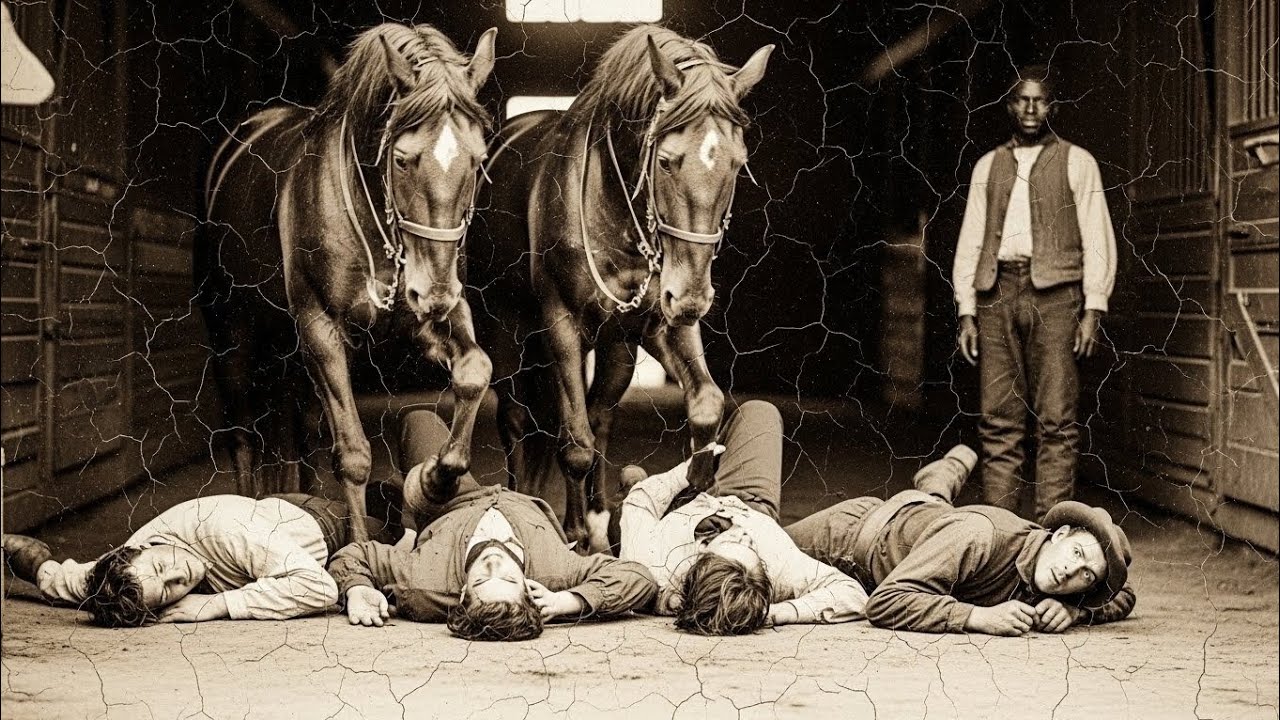
The screaming always was. By morning, four men lay dead in the paddock behind Riverside Estate in southern Virginia. The county coroner would later call it a tragic accident, a once-in-a-generation catastrophe of stampeding horses. Accidents, however, rarely kill four men at once.
They do not happen to men who spent their entire lives around horses. And they do not leave a stable master vanishing into the night, never to be seen again. The estate itself still stands, though the paddock has long since been paved over. Descendants of those four men still live in the area, their family names carved into the headstones at the local cemetery.
But ask them about that night, about what happened when their great-great-grandfathers died screaming in the dirt, and they will tell you they do not know. Or, more honestly, they will say they do not want to know. Some stories are better left buried. Riverside Estate sat on three hundred acres of prime Virginia tobacco land, about twelve miles south of Richmond.
The main house was a monument to antebellum wealth: white columns, wraparound porches, windows that caught the morning sun just right. Behind it, a network of barns, stables, and outbuildings spread across the property like a small village. At its heart stood the stable, where some of the finest horses in Virginia were kept. The estate belonged to the Harrington family.
By 1864, however, ownership had become complicated. The Civil War had raged for three years, and the Confederate cause was crumbling. Richmond itself would fall to Union forces within seven months. But in September of that year, the men of Riverside still clung to their dying way of life with desperate determination.
The estate had once employed more than a hundred enslaved people. By 1864, that number had dropped to 43. Some had been sold to raise money. Others had escaped to Union lines.
A few had died from disease or overwork. The remaining slaves lived in a state of constant anxiety, knowing their world was ending but uncertain what would replace it. Four men mattered that night. Four men whose names would be etched into local history, though not in the way they would have wanted.
Edmund Harrington was the eldest son and nominal owner of the estate. At 42, he had never worked a day in his life but considered himself an expert on everything from politics to agriculture. He had avoided military service through wealth and medical exemptions, claiming a weak heart that never seemed to affect his ability to drink whiskey or beat his slaves. A widow since 1859, when his wife Margaret died giving birth to their fourth child, Edmund had mourned for exactly three months before taking up with a woman in Richmond he visited every Thursday.
His brother Charles was three years younger and twice as cruel. A brief stint with the Confederate cavalry had ended in a riding accident that left him with a permanent limp and a burning resentment toward anyone he perceived as beneath him, which was nearly everyone. He had blamed the horse for his humiliation, a spirited young mare named Tempest, and had wanted her shot. Edmund refused, arguing the horse was too valuable, so Charles kept her instead, riding her hard and punishing her for perceived disobedience.
Marcus Whitfield was Edmund’s brother-in-law and business partner. A calculating man of fifty, he kept detailed ledgers of every penny spent and every slave purchased. He saw human beings as numbers on a balance sheet, assets to be managed and exploited for maximum profit. He visited the estate three times a week to review the books, and he had been the one who suggested purchasing Thomas Garrett fifteen years earlier, recognizing that a skilled stable master would increase the value of their equine investments.
Daniel Cross was the overseer. Unlike the others, he had come from modest means, born to a poor farming family in North Carolina, the youngest of seven children. He had left home at fifteen and worked his way up through brutality and efficiency. He understood the psychology of control, how to break people down, how to maintain order through a combination of violence and unpredictability.
He carried a whip at all times and was not afraid to use it. These four men met every Wednesday evening in the estate study to discuss business, drink imported brandy, and congratulate themselves on their superiority. They called themselves the Riverside Council. By the summer of 1864, however, those meetings had become increasingly desperate.
Tobacco prices were falling. The Union blockade made exporting impossible. Slaves were becoming harder to control and more likely to escape. And the war news grew worse by the day.
And then there was Thomas Garrett. Thomas had been at Riverside for fifteen years. He had arrived in 1849 as a young man of twenty, purchased at auction in Richmond for the specific purpose of managing the estate’s horses. His previous owner had trained him well.
Thomas could calm a spooked stallion with a whisper, diagnose lameness from a horse’s gait, and deliver a foal with the skill of any veterinarian. He was, by all accounts, the finest stable master in three counties. But Thomas was property. He slept in a small room above the stable, ate whatever scraps were brought to him, and wore the same clothes until they fell apart.
He had never been allowed to marry, though he had loved a woman named Ruth, who worked in the main house. He watched her die of fever in 1857, denied even the dignity of sitting with her in her final hours because Edmund Harrington needed a horse saddled for an afternoon ride. Thomas saddled Sovereign with shaking hands, helped Edmund mount, and watched him ride away. While Edmund enjoyed his leisurely ride, Ruth died alone in the slave quarters, calling for Thomas with her last breaths.
He was not allowed to attend her burial. There was work to be done. The horses needed feeding. After Ruth’s death, something in Thomas changed.
The hope he carried died with her. What remained was a cold, hard core of survival. He would endure, but he would never again allow himself to hope. Thomas cared for seventeen horses at Riverside.
He knew each one by name, by temperament, by the particular way they liked to be brushed. There was Sovereign, Edmund’s magnificent bay stallion, sixteen hands high, with a coat that gleamed like polished mahogany. Tempest, Charles’s gray mare, nervous and high-strung, prone to spooking at shadows. Midnight, Marcus’s black gelding, steady and dependable.
And Brutus, Daniel’s young chestnut stallion, only three years old, intelligent and energetic, full of potential. These horses were Thomas’s world. They were the only beings on the estate who treated him with genuine affection. They did not see him as property.
They saw him as the person who fed them, cared for them, understood them. And Thomas loved them for it. But he also watched, day after day, as the four men who owned them treated them with casual cruelty. Edmund used spurs that drew blood.
Charles whipped Tempest across the face when she balked at a jump. Marcus rode Midnight until the gelding was lathered and trembling. Daniel beat Brutus with a riding crop for the simple crime of being young and spirited. Thomas said nothing.
He could not. Speaking out meant punishment, possibly death. So he kept his head down, did his work, and tried not to think about the injustice of it all. But in early August, he overheard something that shattered what little remained of his carefully controlled detachment.
The four men were discussing business in the study, their voices carrying through the stable wall. They were talking about liquidating assets. “The horses are our most viable remaining assets,” Marcus said. “If we’re forced to evacuate, we’ll need them.
But we can’t take Garrett with us. ”
“Why not? ” Edmund asked. “He’s the best stable master in Virginia.
”
“Exactly. Which means he’s valuable. We sell him in Richmond before we leave. Get whatever price we can.
Use the money to establish ourselves elsewhere. ”
Thomas froze, the brush still in his hand, Sovereign’s warm flank pressed against his side. Fifteen years of perfect service, and he was still just property to be liquidated when convenient. “I say we do it next week,” Daniel added.
“Get it done before the market gets any worse. ”
They discussed him for another hour, debating his value like he was livestock. Thomas listened to every word, and something inside him finally cracked. He did not sleep that night.
He sat in his small room above the stable, listening to the horses moving in their stalls below. He thought about Ruth. He thought about the scars on his back. He thought about every indignity, every cruelty, every moment of powerlessness.
And he thought about the horses. The horses trusted him. The horses loved him. The horses would do anything he asked.
An idea began to form. It was terrible. It was unthinkable. It was also perfectly, beautifully simple.
He could kill them. All four of them. And he could make it look like an accident. Thomas spent the next three days wrestling with the moral weight of what he was considering.
He had been raised Christian, had been taught that murder was a sin. But he had also been taught that slavery was God’s will, and he had stopped believing that a long time ago. What was justice in a world where the law said you were property? What was morality in a system built on the suffering of millions?
If the legal system offered no recourse, what options remained? He could accept being sold, sent away to suffer under new masters until he died. Or he could take control of his own fate, even if it meant becoming something he had never wanted to be. In the end, it was not really a choice at all.
Thomas knew horses better than anyone at Riverside. He knew their temperaments, their triggers, their fears. He knew that Sovereign, for all his magnificence, was deeply territorial and would attack anything he perceived as a threat to his space. He knew that Tempest was prone to panic and that once she started running, she would not stop.
He knew that Midnight was a follower who would do whatever the other horses did. And he knew that Brutus, young and spirited, was easily agitated and would lash out when frightened. He also knew that horses could be trained to respond to specific signals, and that horses, when properly motivated, could kill. It was not common.
Horses were generally gentle creatures despite their size. But Thomas had seen it happen twice in his fifteen years at Riverside, once when a stallion attacked a handler who had beaten him, once when a mare trampled a man who got between her and her foal. Both times, the horses acted on instinct, protecting themselves or their young. But what if that instinct could be directed?
What if those protective impulses could be aimed at specific targets? The training had to be subtle. Thomas incorporated new signals into his regular routine, making them seem like natural extensions of his normal work. With Sovereign, he used a specific whistle when the stallion was eating, then introduced a dummy into the stall, a sack of hay roughly the size and shape of a man.
Over a week, he made the dummy move, more threatening each time, and Sovereign learned to charge, strike, bite. Thomas rewarded him every time. With Tempest, he chose a gesture, a particular way of raising his hand in a circular motion, and paired it with sudden noises that startled her. She learned to associate the gesture with danger, with the need to run.
With Midnight, he reinforced the gelding’s natural tendency to follow, exercising him with Sovereign so he learned to mimic the stallion’s aggressive behavior. And with Brutus, he taught the young stallion a single word. “Strike. ” He would say it, tap the horse’s hindquarters, and Brutus would kick out reflexively.
Over time, the kick became more powerful, more aggressive. The stallion thought it was a game. The other thirteen horses did not need specific training. Thomas simply kept them slightly on edge, primed for chaos.
On September 10th, he overheard Marcus tell Edmund that he had found a buyer for Thomas. A plantation owner in South Carolina was willing to pay eight hundred dollars. The sale would take place on September 20th. Thomas had ten days.
On September 12th, Edmund announced that he had invited a potential buyer to visit the estate on Wednesday, September 14th. A wealthy merchant from North Carolina was interested in purchasing several horses. They would bring them all out to the paddock at eight o’clock. Thomas felt his heart begin to race.
This was the opportunity he had been waiting for. But there was a problem: the buyer. An innocent man who had nothing to do with Thomas’s grievances would be present. So Thomas sabotaged the bridge on the main road, three miles from the estate, cutting halfway through three key support beams in the dark of night.
A man on foot or a single horse could cross safely. A heavy carriage would collapse it. On the night of September 13th, with everyone asleep, Thomas walked the three miles to the bridge. It took him two hours to complete the sabotage.
When he was finished, the bridge looked intact, but it was structurally unsound. The buyer would be delayed, forced to take a longer route. He would arrive too late to witness what Thomas had planned. Wednesday, September 14th, 1864 dawned hot and clear.
Thomas woke before sunrise, knowing this would be his last morning at Riverside Estate. By nightfall, either his plan would succeed and he would be gone, or it would fail and he would be dead. He went through his morning routine with meticulous care, feeding the horses, checking their water, grooming them. He spent extra time with Sovereign, Tempest, Midnight, and Brutus.
“I’m sorry,” he whispered to Sovereign as he brushed the stallion’s gleaming coat. “I’m sorry for what I’m going to ask you to do. But I promise you, after tonight, you’ll never be hurt again. ”
Sovereign turned his head and nuzzled Thomas’s shoulder.
That afternoon, word arrived that the bridge had collapsed. The buyer’s carriage had gone through, the man was unhurt, but the carriage was damaged. He could not make it tonight. He would come next week instead.
Edmund was furious. Charles was drinking. And then Charles said, “I want to see those horses run. Been looking forward to it all week.
”
“We can still do it,” Marcus said. “Don’t need a buyer to appreciate good horse flesh. Let’s have Garrett bring them out. See them move in the evening light.
”
Daniel nodded. “Agreed. I want to see how Brutus performs. Been working with him all month.
”
Edmund hesitated, then shrugged. “Why not. Garrett, bring the horses to the paddock. All of them.
We’ll have our own private show. ”
Thomas returned to the stable, his hands shaking. He thought about Ruth, about the life they had never had. He thought about the forty-three slaves still living in fear on this estate.
He thought about the fifteen years he had spent in bondage, and the fact that he had only ten days left before being sold. And he thought about justice. Or revenge. Or whatever you wanted to call it.
He began leading the horses out one by one. Sovereign first, stepping proudly. Then Tempest, tossing her head nervously. Midnight, calm and steady.
Brutus, young and eager. Then the other thirteen horses. The four men stood at the fence, already drinking. Thomas could smell the whiskey from twenty feet away.
They were relaxed, jovial. This was entertainment for them. He led the last horse into the paddock and closed the gate behind him. The horses milled around, calm and trusting.
They knew this place. “Show us Sovereign’s paces,” Edmund called out. “Let’s see him run. ”
Thomas raised his hand and made the specific gesture he had taught Tempest.
The signal for panic. Run. Don’t stop. The gray mare’s eyes went wide.
Her ears pinned back. And then she reared up, screaming, a sound of pure terror that echoed across the paddock. “Wh—” Charles started to say, but he did not finish. Tempest came down and bolted, not away from the men, but toward them, directly toward the fence where they stood.
She crashed into the wooden fence with devastating force. The boards splintered. Charles tried to jump back, but his bad leg betrayed him. He stumbled, and Tempest’s flailing hooves caught him in the chest.
The sound of ribs breaking was audible even over the chaos. “Garrett, control that horse! ” Edmund shouted. Thomas gave the whistle he had taught Sovereign.
The signal for attack. Eliminate the threat. Protect your territory. The bay stallion’s entire demeanor changed in an instant.
His ears went flat, his eyes rolled white, and he screamed, a sound of pure aggression Thomas had never heard before. Sovereign charged. Edmund tried to run, but Sovereign was faster. The stallion reared up, front hooves striking out.
One caught Edmund’s shoulder, spinning him around. The other came down on his head. Marcus Whitfield was screaming, trying to climb the fence. He got one leg over the top rail when Midnight slammed into the fence from the other side, reared up, and came down on the top rail right where Marcus was trying to climb.
Marcus lost his grip and fell backward. Midnight’s hooves came down again and again. Daniel Cross pulled a pistol from his belt. His hands were steady, his face cold.
He aimed at Sovereign. Thomas shouted the word he had taught Brutus. “Strike. ”
The young chestnut stallion wheeled with incredible speed.
His hind legs lashed out in a devastating kick that caught Daniel in the stomach. The pistol fired, but the shot went wild, burying itself in the dirt. Daniel flew backward, landing ten feet away. He tried to get up, but he could not.
Something inside him was broken. And then all seventeen horses were moving. The other thirteen, primed for chaos, had finally panicked. They were running in circles, screaming, eyes rolling white.
The paddock became a maelstrom of hooves and dust and terror. But even in their frenzy, the horses avoided Thomas. He stood in the center of the chaos, untouched. Fifteen years of trust, even in their panic, the horses would not harm him.
The four men had no such protection. Charles Harrington was trying to crawl toward the gate, dragging himself with his arms. Tempest came around again, hooves coming down on his back once, twice, three times. He stopped moving.
Edmund Harrington was on the ground, blood pooling around his head, but still alive, still conscious. He looked up at Thomas, eyes wide with shock and something that might have been understanding. “You,” he gasped. “You did this.
”
Sovereign came around again. The stallion reared up and came down on Edmund’s chest. Again and again. Marcus Whitfield had made it to his feet somehow.
He was staggering toward the fence, one arm hanging useless, blood streaming from his mouth. He was crying, begging. Midnight and three other horses converged on him. He went down under a storm of hooves.
Daniel Cross was the last one alive. He had managed to get to his knees, one hand pressed against his stomach, blood seeping between his fingers. He was looking at Thomas with pure hatred. “You’re dead,” he gasped.
“You’re a dead man, Garrett. They’ll hunt you down. They’ll hang you. They’ll—”
Brutus charged from behind.
The stallion’s shoulder slammed into Daniel, knocking him flat. And then the young horse struck again and again, hooves coming down with terrible precision. When it was over, when all four men lay still in the dirt, Thomas gave a different whistle. The signal for safe.
Calm. Rest. The horses slowed. They stood in the paddock, sides heaving, frightened animals pushed beyond their limits.
The silence that followed was deafening. Thomas walked to each man, checking for signs of life. He found none. Edmund’s skull was crushed.
Charles’s back was broken. Marcus’s chest was caved in. Daniel’s neck was bent at an impossible angle. Thomas felt nothing.
No satisfaction, no remorse, just a vast, empty numbness. The estate was chaos within minutes. The screams, the gunshot, the sounds of destruction had drawn people from the main house, the slave quarters, the fields. They came running and found a scene from a nightmare.
Four men dead in the paddock. Seventeen horses standing calm and quiet. And Thomas Garrett, standing in the center of it all, blood on his clothes, an expression of perfect calm on his face. Someone shouted, “What happened?
” Thomas did not answer. He walked through the crowd and headed for the stable. In his small room above it, he gathered his few possessions: a spare shirt, a blanket, a small knife. That was all he owned in the world.
He walked through the stable one last time. The horses knickered softly as he passed. He stopped at each stall, running his hand along each horse’s neck, saying goodbye. “I’m sorry,” he whispered.
“I’m sorry I used you like that. I’m sorry I made you do something that goes against your nature. But I had no choice. ”
He left through the back door, the one that opened onto the fields.
The sun had set completely, darkness covering the land. Thomas walked into the tobacco fields, into the night, and he did not look back. Behind him, Riverside Estate burned with light and noise and confusion. Ahead of him lay nothing but darkness and uncertainty.
But for the first time in fifteen years, Thomas Garrett was free. The official investigation concluded it was a tragic accident. The coroner’s report, filed on September 18th, 1864, stated that the horses had been spooked by something, perhaps a snake or a loud noise, and had panicked. The four men had been in the wrong place at the wrong time.
The report made no mention of the precision with which the horses had attacked. It did not note that all four men had been targeted specifically while the horses carefully avoided everyone else. It did not question why seventeen horses had all panicked simultaneously or why they had all attacked the same four people. Perhaps the coroner had noticed these things and chosen not to include them.
Acknowledging them would mean acknowledging something far more disturbing: that a slave had orchestrated the murder of four white men using animals as weapons. That was a truth the authorities could not afford to acknowledge in 1864 Virginia. No one mentioned Thomas Garrett’s disappearance, except as a footnote. A slave had run away in the confusion.
It happens sometimes. The sheriff made a half-hearted attempt to track him. With Union forces advancing and the Confederacy collapsing, there were bigger concerns than one missing slave. The truth was, no one wanted to look too closely at what had happened.
The horses were sold off within a month. Sovereign went to a plantation in North Carolina. Tempest was bought by a cavalry officer. Midnight and Brutus went to different buyers.
The other thirteen horses were scattered across Virginia and the Carolinas. None of them ever attacked another human being. The estate itself was seized by Union forces in April 1865 when Richmond fell. The Harrington family lost everything.
Edmund’s three children went to live with relatives in Georgia. Marcus’s wife, Catherine, moved back to Richmond and lived on charity. Daniel Cross’s small house was burned by Union soldiers, and no one mourned. Riverside was eventually sold to a northern businessman who tried to turn it into a profitable farm using paid labor.
The venture failed. The land changed hands multiple times over the decades. The main house still stands, converted into a museum now, though they do not talk much about what happened there in 1864. The slaves at Riverside knew the truth, or at least they suspected it.
They had seen Thomas’s face that night, seen the calm certainty in his eyes. They had watched him walk away into the darkness. When the sheriff questioned them, they claimed ignorance. It was a lie, but a lie they all agreed to tell.
Thomas had done what none of them could do. He had struck back. They were not about to betray him. Thomas Garrett was never seen again.
There were rumors, of course. Someone claimed to have seen him in Philadelphia in 1866, working at a stable under a different name. Another report placed him in Canada in 1868, living in a community of escaped slaves. A third insisted he died trying to cross into Union territory, buried in an unmarked grave somewhere in Maryland.
But no one knows what happened to him. He vanished into history, leaving behind only questions. Did he make it to freedom? Did he live out his days in peace, finally free from the chains that had bound him for thirty-five years?
Or did he die in the attempt, his body lost to time and memory? Thomas took his secrets with him. What we do know is this. Four men died screaming in a paddock in Virginia on September 14th, 1864.
Four men who had built their lives on the suffering of others, who believed their wealth and status made them untouchable. They were killed by the horses they owned, the horses they abused, the horses they considered beneath them. Was it justice, or was it murder? Thomas Garrett was a slave.
He had no legal recourse. The men who owned him had absolute power over his life. He used the only tools available to him: his knowledge, his skill, and the trust of animals who had never betrayed him. He had spent fifteen years in bondage, been beaten and humiliated, watched the woman he loved die alone while his master went for a ride, and been told he was about to be sold.
And he planned. He prepared. He executed his revenge with cold calculation. The descendants of those four men still live in the area.
Ask them about the stable master who disappeared and the horses that killed their great-great-grandfathers. They will tell you they do not like to talk about it. Some stories, they say, are better left alone. But this story still gets told, because it is about what happens when human beings are pushed beyond their limits.
Those four men did not die in isolation from their past. They beat and humiliated and dehumanized the people they claimed to own. They treated human beings as property and animals as tools. And in the end, those same animals became the instruments of their destruction.
The men of Riverside Estate believed their wealth and status made them untouchable. They believed the system would always protect them. They were wrong.






