In 2019, a collector sorting through a box of uncatalogued photographs at an estate sale in Providence, Rhode Island, came across a formal sepia portrait from the early 1900s. It showed a woman in a dark Victorian dress seated in an ornate wooden chair, holding what appeared to be an infant wrapped in white christening clothes. The collector, Margaret Chen, almost passed over it. But something about the positioning of the mother’s hands made her look again.
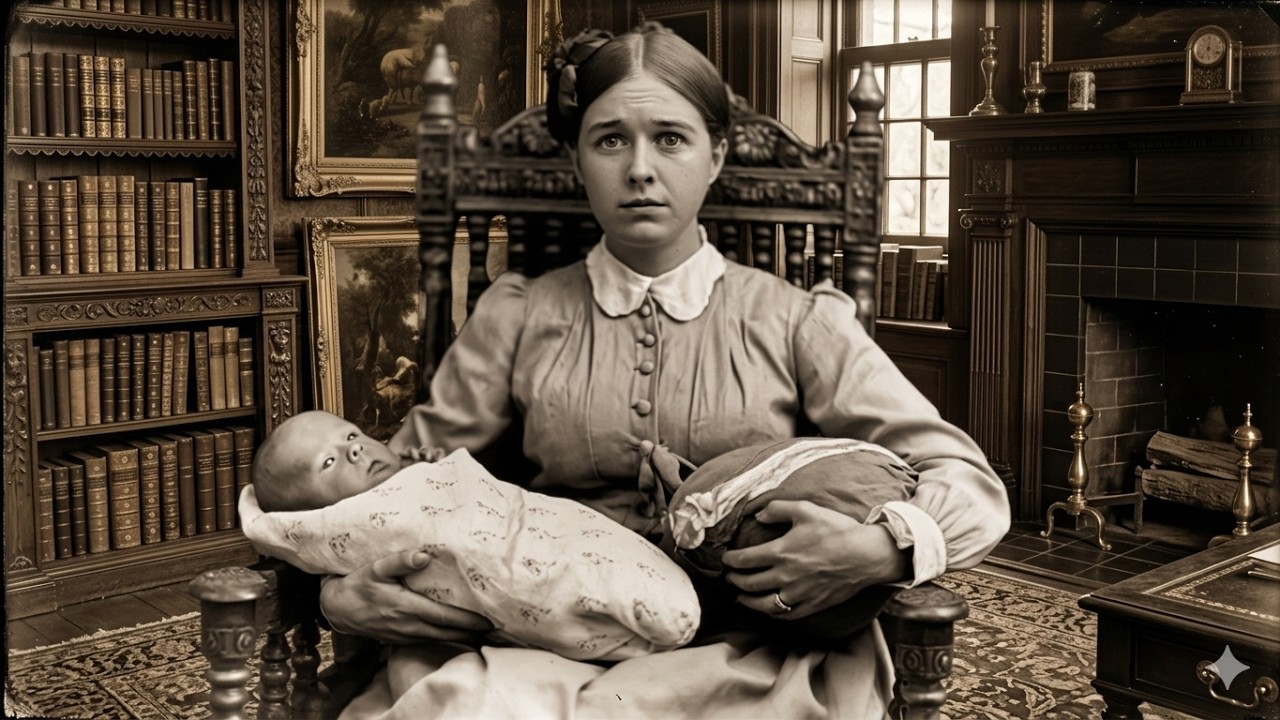
When she held the photograph up to the sunlight, she saw that the woman was not holding one child. She was holding two bundles, and the second one, partially hidden beneath the folds of the christening gown, was shaped like an infant but was distinctly wrong. Written on the back, in faded brown ink, were the words: “Mrs. Catherine Hartwell and children, Providence Studio, March 1906.
” Children, plural. Margaret bought the photograph for five dollars. That evening she scanned it and began researching Catherine Hartwell. The trail led her to the Providence Historical Society, where city records revealed a disturbing timeline.
Catherine, born Catherine Morrison in 1878, had married Thomas Hartwell in 1902. The 1905 census listed the couple and a daughter named Mary, born in 1903. But a brief notice in the Providence Journal from February 1906 reported the death of an infant son after a brief illness, with private services. The photograph had been taken just one month later.
An archivist at the Historical Society noted that postmortem photography of deceased children was common in that era, with families commissioning portraits as their only visual memory of a lost child. Those photographs, however, were usually posed with clear signs of mourning. This image had been catalogued as a standard family portrait. Something else troubled the archivist.
Beside the infant in Catherine’s right arm, the object in her left arm was roughly the same size and wrapped in similar white fabric, but its proportions were distorted. It did not resemble an infant. Margaret contacted Dr. Sarah Chen, a photography historian at Brown University, who examined the original photograph under magnification.
Dr. Chen concluded that the photographer had deliberately arranged the fabric to make both objects visible, while also attempting to conceal something. Her assessment was that the mother had wanted to document something but could not be explicit about it. A private message from an online user directed Margaret to the registry of the Providence Studio, which had operated on Westminster Street under the ownership of Albert Fletcher.
The entry for March 14, 1906 recorded that Mrs. Hartwell had requested a private session after hours, insisted on a specific arrangement, refused multiple attempts to repose the subjects, and paid triple the standard rate. The notation also noted that the negative had been retained at the customer’s request for potential future prints. Margaret eventually located the original glass negative in the collection of a retired photographer in Cranston.
When a fresh print was developed from the negative, the sharper resolution revealed details that had been lost in the paper copy. The object in Catherine’s left arm became clearly visible, and its shape defied explanation. The fabric was arranged to mimic an infant’s form, but the proportions were impossible. Catherine’s face, now legible in high resolution, did not show peace.
It showed the blank stare of someone who had witnessed something that had shattered their understanding of the world. Scratched into the back of the glass negative was a note in Albert Fletcher’s handwriting: “May God have mercy on this family. I should not have taken this photograph, but she begged me, and what was I to do? She said it was the only way to show the truth.
”
The subsequent records painted a grim picture. In April 1906, one month after the sitting, Catherine Hartwell was admitted to Butler Hospital, Providence’s psychiatric institution. Her admission record stated that she exhibited severe melancholia and claimed to have witnessed an impossible event. The report noted that her husband believed she had been inconsolable since the death of their infant son and that she insisted on caring for both children despite being told that only her daughter remained living.
Catherine remained institutionalized for three years. Medical notes from her stay described a woman who maintained a consistent story across multiple interviews, showing no other signs of delusion or instability, yet unable to recant whatever claim she was making. The full medical records were later destroyed in a fire in 1954. While Catherine remained hospitalized, Thomas Hartwell remarried in 1909 and moved to Boston with his new wife and daughter Mary.
Catherine was released that same year and disappeared from all public records. Margaret eventually found a letter written by Albert Fletcher in May 1906, donated to the Historical Society by a descendant. In it, Fletcher wrote to his brother that he was leaving Providence and could not continue his work after what he had photographed. He described how Mrs.
Hartwell had come to his studio with two bundles, one containing her deceased infant son, for which he agreed to create a memorial portrait. But the other bundle, which she insisted he photograph alongside the dead child, contained something he could not describe. He wrote that when he uncovered the bundle to arrange it properly, he saw something that was not of natural origin. He stated that Mrs.
Hartwell was not mad, that she was trying to document evidence of something that should not exist. Fletcher moved to Portland, Maine in June 1906 and never returned to Providence. He died in 1934. The full account of what Catherine claimed to have witnessed was preserved only by her family.
An elderly distant cousin, Eleanor Pritchard, contacted Margaret with a leather journal kept by her grandmother, who had sheltered Catherine in Vermont after her release from the hospital. Catherine had changed her name back to her maiden name, worked as a seamstress, and died in 1947. In her final years, she told her story to Eleanor’s grandmother, who wrote it down. According to that journal, in February 1906 Catherine’s infant son James had fallen ill with a high fever.
On the third night, Catherine dozed in a chair beside his crib and woke to silence. When she looked into the crib, she knew immediately that the child was not her son. It had the same size, the same dark hair, but its eyes moved differently and its sounds were not quite right. It was as if something had tried to imitate a human infant without fully understanding one.
She searched the house that night and in the cellar found a small, still bundle wrapped in a blanket, shaped to look like a child but clearly not one. She brought it upstairs to show her husband, but Thomas refused to look closely. He told her she was hysterical, took the bundle, and burned it in the fireplace. The next day he called the doctor, who declared the replacement child healthy.
No one believed Catherine. She retrieved pieces of the burned bundle from the fireplace and took them to Albert Fletcher. She paid him triple his rate and begged him to photograph both the living child and the evidence she had collected. When Fletcher unwrapped the bundle, he saw that it was not organic matter.
It appeared to be a constructed form, assembled from materials he could not identify, designed to imitate but not perfectly replicate infant anatomy. Catherine’s life collapsed after that sitting. Her husband had her committed. The child everyone believed was James grew up as Mary’s brother, but died in 1911 at age five from a sudden illness very similar to the one James had experienced in 1906.
According to Catherine, Thomas finally looked closely at the boy’s body before burial and saw what she had been trying to show him for five years. He never spoke to her again. Mary, the daughter, lived until 1976 and reportedly told her own daughter that she remembered having a little brother who was not quite right, who never interacted normally, and who would stare at people with an expression that made her uncomfortable. Scientific analyses of the photograph in 2023 were inconclusive.
A forensic imaging specialist found no evidence of manipulation or double exposure. However, the specialist noted that the object in Catherine’s left arm reflected light differently than the cotton fabric in the rest of the image, as if the material had optical properties inconsistent with ordinary cloth. A reconstruction artist attempted to model the shape required to produce the visible wrapping pattern and concluded that the three-dimensional form implied by the folds could not physically exist. People who studied the photograph for extended periods reported recurring unease and vivid dreams, though no explanation was ever established.
Margaret published her findings in a paper titled The Hartwell Photograph, sparking debate between those who viewed it as a case study in grief-induced delusion and those who considered it evidence of something unexplained. The photograph remains in Margaret’s possession, stored in a climate-controlled archive. She has preserved Catherine’s story, Fletcher’s letter, the medical records, and the scientific analyses in a digital archive, ensuring the evidence survives. Whatever Catherine Hartwell held in her left arm in March 1906 was never conclusively identified.
The only certain facts are these: an infant died, a mother insisted on a private photograph of two bundles, the photographer fled the city unable to describe what he had seen, and the woman was committed to an asylum for insisting that the truth be documented. The image itself remains, frozen in sepia, a mother staring out from 1906 with an expression that was never peace.
