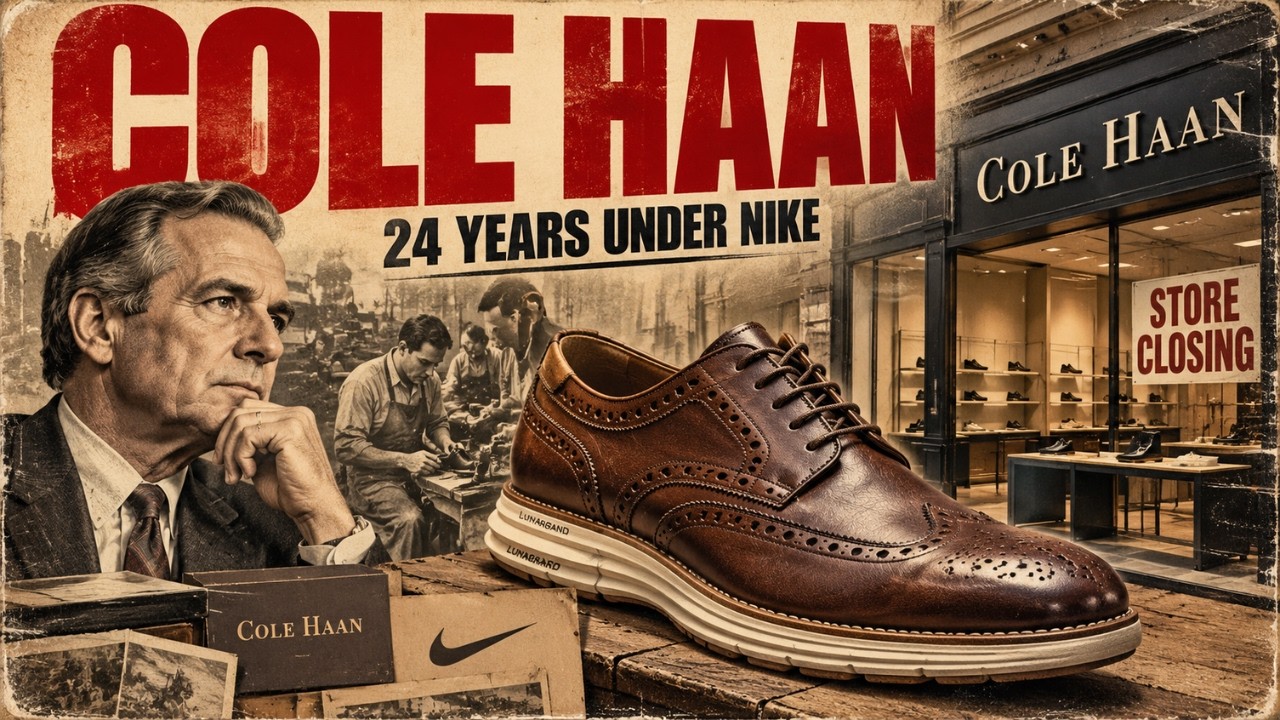
On November 16, 2012, Nike headquarters in Beaverton, Oregon issued a short statement. The world’s largest athletic shoe company was selling Cole Haan, the dress shoe brand it had owned for twenty-four years. The name was more than three decades older than Nike itself. It had been built on men’s dress shoes, shoes once cut and stitched by hand in the mill towns of Maine.
By the day of the announcement, the last hand-shoemaking floor in Maine had been silent for thirteen years. The name survived the move. The work that built it did not. The story begins in Chicago in 1928.
The city was a place that made things, packing meat, rolling steel, and cutting leather by the ton. Out of that world came Trafton Cole and Eddie Han. According to one account, the company grew out of the collapse of an older Chicago manufacturer, Cels Schwab and Company, a shoemaker with roots in the nineteenth century. When that firm was liquidated around 1930, its largest Chicago factory went to five former executives, including Cole and Han, who organized a new company to keep making men’s footwear in the same building.
Another account places the takeover in 1928. The sources do not agree on the year or the exact shape of the deal, but they agree on the essential picture. Cole and Han were insiders stepping into the wreckage of a business they had helped run, deciding it was worth saving. Cole watched over manufacturing.
Han went out to sell. One man made sure the shoe was right. The other made sure someone bought it. For the next two decades, the firm made men’s dress shoes for department stores.
By 1947, it was operating as Cole, RDE, and Han, and the business came under the control of the J. P. Smith Shoe Company. The trail then turned east.
In 1957, the company was bought by E. E. Taylor, a Maine shoe firm, and manufacturing moved to Maine. Maine in the 1950s was one of the great shoemaking regions of America.
Its river towns had grown up around mills, and families had passed down the work of cutting, lasting, and stitching leather for generations. A Chicago dress shoe found a home among people who knew exactly how one should be made. In 1975, the brand found its next owner standing at a cutting table in a shoe factory. The cutter was George Denny, and he led a group of partners who took the brand private and brought its headquarters to Yarmouth, a small coastal town north of Portland.
The company started in an old mill on Bridge Street, then moved along Main Street, then to Elm Street, and finally to a site off Route One. In 1979, the brand formally took the short name it carries today, Cole Haan, in honor of the two men who had rescued it in Chicago half a century earlier. The partners then did something that set the company apart. In 1982, Cole Haan launched its own retail division, building its own stores and speaking directly to customers.
The line widened from men’s dress shoes to include shoes for women and children, then leather goods and accessories. By 1988, Cole Haan was bringing in roughly $62 million a year, a substantial business for a privately held shoemaker run out of a small town in Maine. In April 1988, the attention arrived from Beaverton, Oregon. Nike announced it would acquire Cole Haan for $80 million plus $15 million in assumed debt.
Phil Knight, Nike’s co-founder, framed the deal as a marriage of the best in athletic footwear with the leading name in dress and casual shoes. When Nike bought Cole Haan, it bought two things at once. A name, and the hands in Maine that gave that name its meaning. Only one of them would make it into the next century.
Nike had never been in the business of owning the hands that made its shoes. The company began in 1964 as Blue Ribbon Sports, importing running shoes made in Japan. From the start, its founders sold shoes that someone else manufactured. As Nike grew, it designed shoes in Oregon, marketed them with enormous force, and paid independent factories overseas to build them.
When costs rose in one country, the contracts moved to the next. During the 1980s, Nike closed its last American footwear factory in Saco, Maine, less than an hour’s drive south of Yarmouth. So when Nike bought Cole Haan in the spring of 1988, it was buying something it had already chosen not to be. For the first years, the answer seemed reassuring.
Cole Haan kept its international headquarters in Yarmouth and its design office in New York City. It ran largely on its own, an affiliate brand, a separate house on the same street. George Denny stayed in charge, and he kept running the company until 2002. He had built up its manufacturing in Maine with his own hands, developing three separate factories.
To him, the shoe and the place that made it were not two separate things. The years that followed were good ones. In Lewiston and the small mill town of Livermore Falls, workers stitched the moccasins and loafers that carried the Cole Haan name into department stores across the country. In 1994, Cole Haan employed 785 people in Maine, the high point of a workforce built up over nearly twenty years.
Then, quietly, the numbers began to fall. On May 10, 1996, an official of the United States Department of Labor signed a notice in Washington. Two weeks later, it appeared in the Federal Register. It concerned workers of the Cole Haan Manufacturing Division in Lewiston, Maine, and a second location in Livermore Falls, who had lost their jobs fully or partly on or after March 11, 1995.
They were eligible for federal adjustment assistance, a program created by the Trade Act of 1974 for the American worker whose job had been lost to foreign competition. In plain terms, the notice was an official acknowledgment that moccasins once sewn by hand in Maine were now being made somewhere else. The company also moved its customer service operation across the state line to Greenland, New Hampshire. Cole Haan was not alone.
By the spring of 1998, Maine’s shoe industry had fallen from about 17,000 jobs fifteen years earlier to roughly 5,000. Maine’s governor described shoes and textiles as sunset industries. At some point in 1998, a new petition was opened with the Department of Labor on behalf of the workers at Cole Haan Manufacturing in Livermore Falls. The finding was published in the Federal Register on June 30, 1999.
The verdict was yes. Imports had played their part. That same year, the plant closed. The Livermore Falls plant was the last shoemaking operation Cole Haan had in Maine.
When it went dark, the company’s long run of making its own shoes in the state was over. After the plant closed, Cole Haan still had about 200 people in Maine, but they worked in offices, warehouses, and behind retail counters. None of them was making shoes. On July 2, 1999, the White House issued a release from the office of Vice President Al Gore announcing a federal grant of $1.
78 million to help workers in Maine who had lost jobs in the pulp, paper, textile, and shoe industries. The release named five employers whose closures and cutbacks had made the grant necessary. There was Cole Haan in Livermore. The list read like a roll call of old Maine.
Years later, George Denny offered his own explanation. The retired leather cutter said the company had brought in a new president who did not understand the quality he had worked so hard to protect, and the company eventually began making its products in China. It is one man’s account, but it matches the paper trail. The shoes kept coming.
The hands that made them were no longer in Maine. Inside the company, a new chapter was already being written. In February 1999, Matthew Rubel became chairman and chief executive of Cole Haan. His career had been built in fashion and retail marketing.
The company no longer had its own factories in Maine to manage. What it had was a name, and Rubel’s world was the world of names. In the late 1990s, the company repositioned itself around a theme it called the modern artisan. Starting in 2000, Cole Haan redesigned its stores, opening prototype shops in Chicago and Boston.
The new Chicago store sat next door to Niketown, the parent company’s flagship. The same year, Nike approached its subsidiary with an idea that would define the next decade. Cole Haan would take the Nike Air cushioning system and build it into dress shoes. From then on, Nike’s cushioning found its way into Cole Haan loafers, brogues, boat shoes, and boots.
The technology had finally crossed from Oregon into the shoe itself. The strategy worked. Rubel was credited with leading a multi-year turnaround. Back in Maine, the story was one of quiet retreat.
In the summer of 2011, after about thirty-five years in Yarmouth, Cole Haan moved its headquarters to Scarborough, into a modern office park with no cutting tables and no stitching rooms. The biggest moment of the Nike era was still to come. In early 2012, Cole Haan released the Lunar Grand, a classic full brogue wingtip in suede set on top of a thick, bright, visible Lunarlon sole. On February 10, 2012, it went on sale exclusively at the Cole Haan store in SoHo, New York, priced at $248 in five suede colors.
Crowds lined up, and within days the first run was nearly gone. Young men who had never owned a pair of wingtips were suddenly lining up for one. The dress shoe had learned to run, and the world had noticed. Sixteen weeks later, Nike made an announcement of its own.
On May 31, 2012, Nike said it intended to sell two of the brands it owned. One was Umbro, the English soccer label. The other was Cole Haan. Mark Parker, Nike’s president and chief executive, said selling the two brands would let Nike put its resources behind the opportunities with the highest potential for sustainable, profitable growth.
Nothing in the statement criticized Cole Haan. It did not need to. The message was clear enough. Nike believed its money would work harder somewhere else.
Nike hired Goldman Sachs to run the sale. Umbro went first. On November 16, 2012, Nike announced a definitive agreement to sell Cole Haan to the private equity firm Apax Partners for $570 million in cash. At the time, Cole Haan was bringing in about $535 million a year in sales.
Nike had bought the brand for a fraction of that price a quarter of a century earlier. The deal closed on February 1, 2013. The same day, Jack Boys was named chief executive. He had spent ten years as CEO of Converse, helping grow its sales from about $150 million to more than a billion.
The new owners moved quickly. On October 11, 2013, Cole Haan announced it would move its headquarters out of Scarborough, Maine, and across the state line to Greenland, New Hampshire, combining with the customer service and distribution center that had operated there for years. About 110 people worked at the Scarborough headquarters. After nearly six decades, the long connection between the brand and the state that had made its shoes was coming to an end.
The first thing the new Cole Haan had to do was learn to walk without Nike’s feet. In July 2014, it answered with a shoe of its own, the Zero Grand, a wingtip weighing less than 290 grams per shoe. Underneath was a new in-house platform the company called Grand OS. The heavy steel shank that had given dress shoes their stiffness for generations was replaced by an engineered cushioning compound.
It worked. The Zero Grand topped the company’s bestseller lists. Then in September 2016, Cole Haan launched a limited edition collection called Made in Maine USA. Six styles, priced between $325 and $400, were made by hand in Lewiston, Maine, the same city where Cole Haan’s own moccasin workers had once sat at their benches.
According to the company, each shoe passed through the hands of at least five different artisans, and a single pair could take as long as thirty hours to make. The company called the collection a homecoming. Seventeen years after its last Maine plant closed, Cole Haan was selling Maine craftsmanship as a premium limited edition product. Behind the marketing, the business was under strain.
In 2017, Moody’s downgraded the company citing its debt and weaker prospects. The brand recovered, and by 2019 Apax was ready to cash in. In October 2019, Cole Haan confidentially filed to go public, planning to list on the NASDAQ under the ticker symbol CLHN. In the fiscal year ending June 2019, revenue had risen 14.
1 percent to $686. 6 million. The filing described Cole Haan as a ninety-year-old startup. The timing could not have been worse.
The coronavirus was already spreading. Within weeks, offices across America emptied, and with them went the daily need for a dress shoe. On January 22, 2021, Cole Haan formally withdrew its plans to go public. Today, Cole Haan describes itself as a global American lifestyle brand sold in more than 100 countries.
Its headquarters sit in Greenland, New Hampshire, with offices in New York City. As far as public records show, it remains in the hands of Apax Partners. In every press release, the company still reaches back for its past, speaking of a nearly 100-year heritage of time-honored craftsmanship, of a legacy rooted in the shoemaker’s bench. In 2028, the brand will mark 100 years since the date it claims as its beginning in Chicago.
A brand can survive long after the thing that made it meaningful has gone. The name printed inside the shoe outlasted Chicago. It outlasted Yarmouth. It outlasted the moccasin sewers of Lewiston and the plant at Livermore Falls.
It outlasted Nike itself. Each time the brand lost something, it found a way to keep going. The federal notices from the Federal Register still exist. They record in dry and exact language that workers in Lewiston and Livermore Falls lost their jobs making shoes for Cole Haan, and that the government agreed imports had played a part.
They do not list names. They do not describe the last shift. But they prove the work was there. The Androscoggin River still runs past Livermore Falls the way it did when the cutters and stitchers walked to work.
The shoes that carry the Cole Haan name now fit a golfer’s stride and a commuter’s rush. They are lighter than any wingtip those workers ever made.
